Manufacturing Associate Resume Examples: free ATS score
Write a Manufacturing Associate Resume That Clears the Plant Screen
By Mustafa Tarabya, founder of CVBooster · Published · Updated
Manufacturing associate resume example, keyword list and writing guide covering line rates, GMP documentation, changeovers and scrap control.
Sample resumes for a manufacturing associate
The same manufacturing associate content laid out in three CVBooster templates, so you can see what the finished document looks like before you write a word.
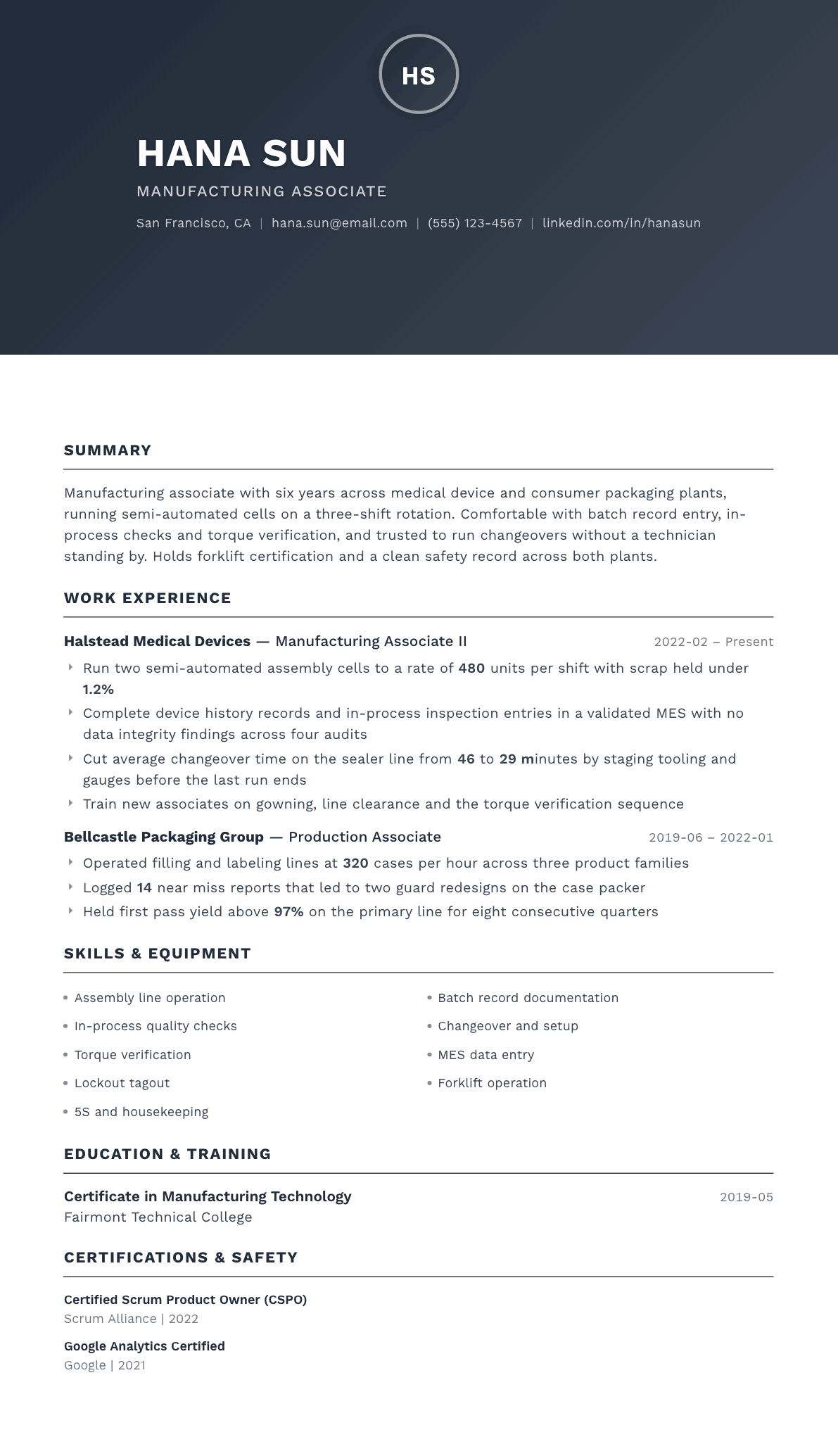
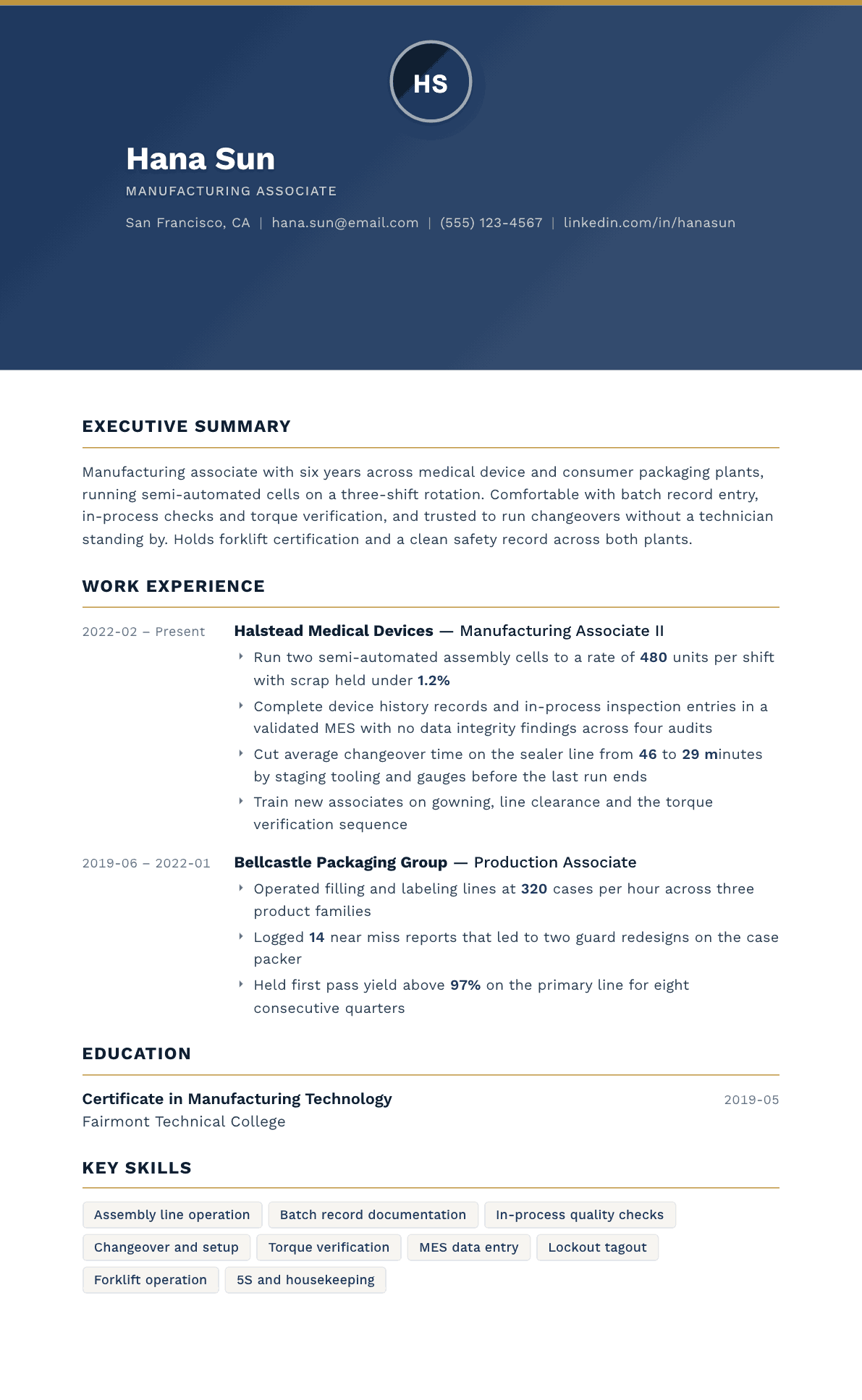
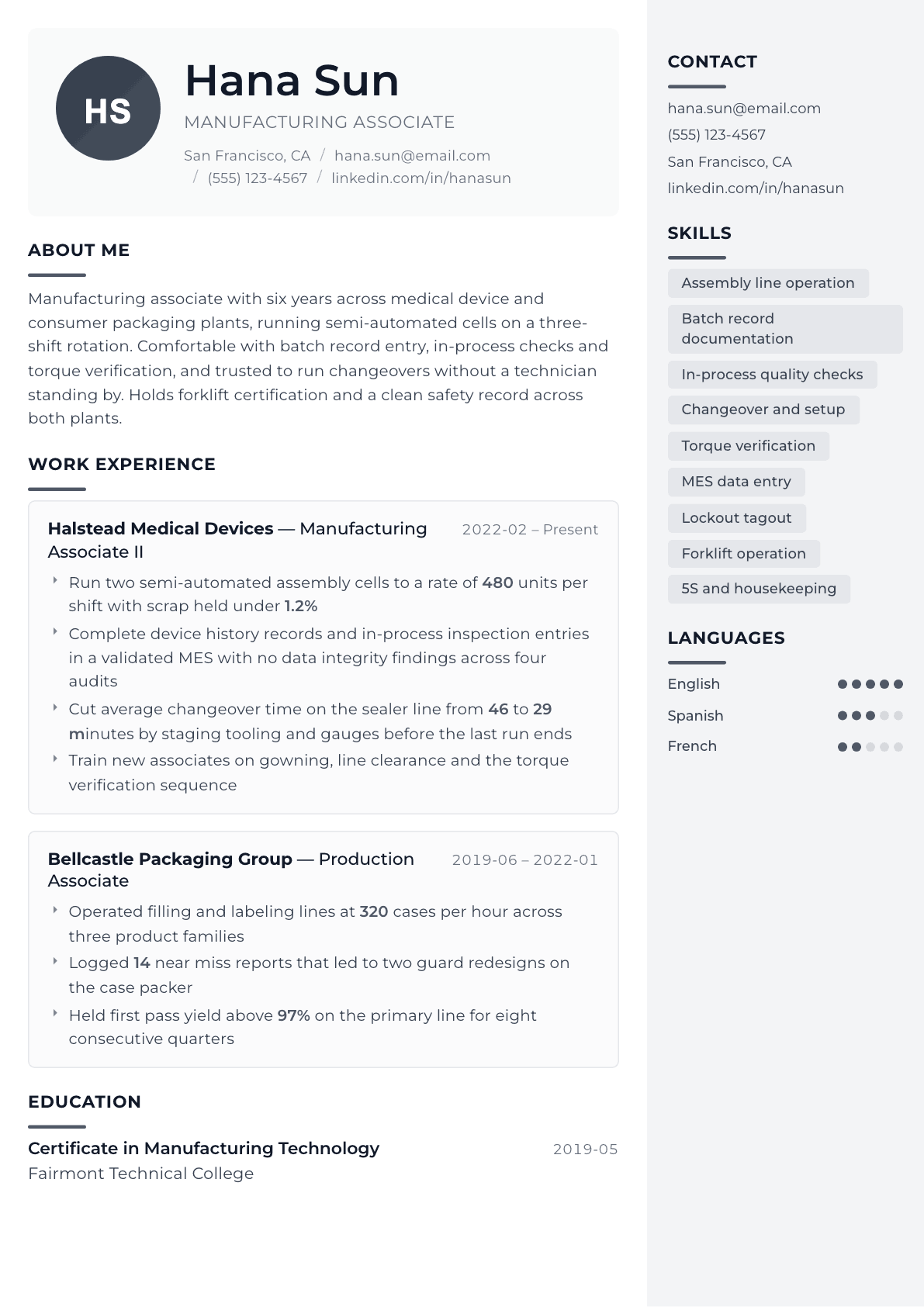
Example Manufacturing Associate summary
Manufacturing associate with six years on medical device and packaging lines, running semi-automated cells to rate on a rotating three-shift schedule. Enters batch records in a validated system, performs in-process checks with calipers and torque tools, and holds scrap under target on both cells. Reduced sealer changeover time by staging tooling ahead of the last run. Forklift certified with a clean safety record.
Skills to list on a Manufacturing Associate resume
- Assembly and subassembly work
- Machine tending and operation
- Changeover and tooling setup
- Batch record and traveler entry
- In-process inspection
- Calipers and micrometers
- Torque tools and verification
- Blueprint and work instruction reading
- MES and ERP terminal entry
- Lockout tagout
- Good manufacturing practice
- Cleanroom gowning
- 5S and lean housekeeping
- Scrap and yield tracking
- Forklift and pallet jack operation
What actually gets this resume read
- Name the products you build and the regulated environment you build them in, because GMP work and general assembly are screened differently.
- Give your line rate, your scrap figure and your first pass yield so a supervisor can compare you against the person leaving.
- List the machines by manufacturer and model, since a plant hiring for a specific press will search for that name.
- Say which shift pattern you have worked and whether you rotate, because staffing the night shift is the hardest part of the job.
- Show your documentation record: batch records, travelers, in-process forms and any audit you were part of.
- Put safety on the page as a number, whether that is near miss reports filed or years without a recordable injury.
- Add every equipment certification you hold, including forklift, overhead crane and powered industrial truck.
How to write a manufacturing associate resume
The person screening manufacturing associate resumes is usually a production supervisor with an open seat on a shift he already cannot cover. He is not reading for career narrative. He is reading for whether you can walk into a cell, hit the posted rate by the end of week two, fill out the paperwork correctly, and not become the reason the line stops.
That means three things decide your resume: the equipment you have actually run, the documentation environment you have worked inside, and the numbers your last plant used to judge you. A resume that says "responsible for various production duties in a manufacturing environment" gives him none of the three, so it goes in the maybe pile and stays there.
This guide covers the sections a plant reads, in the order it reads them, with summaries for a first factory job, a settled associate and someone ready for a lead badge, before and after bullets pulled from real line work, and the questions associates ask when they move between a general assembly shop and a regulated one.
Format: one page, equipment and certifications where a supervisor finds them fast
One page, reverse chronological, with an equipment block near the top. Plant hiring runs on matching: the supervisor has a list of machines and a list of documents, and he is checking your page against both. Burying the machine names in the third bullet of your second job makes him work, and he will not.
Put your certifications and licenses in their own short section rather than sprinkling them through the jobs. Forklift, powered industrial truck, overhead crane and any hazardous material training are all things a plant has to fund if you do not already hold them, so grouping them turns them into a reason to call you.
- Equipment block right under the summary: presses, sealers, fillers, cells and hand tools, named by manufacturer where you know it.
- A documentation line naming what you complete: device history records, batch records, travelers, in-process forms or scrap tickets.
- Each job header carries the product built and the plant type: medical device, food, automotive tier supplier, consumer packaging.
- A shift line stating the pattern you have worked, whether that is straight days, rotating twelve hour, or four on four off.
- Certification section holding forklift, crane, respirator fit test and any lean or safety training with the awarding body.
Summary: product, plant type, rate, documentation
Four lines at most. Name what you build, the kind of plant you built it in, the rate you hold, and the paperwork you complete without supervision. Those four facts let a supervisor decide within seconds whether to keep reading, and they cost you nothing to state honestly.
If you have worked in a regulated plant, put that fact in the first sentence. Associates who already understand gowning, line clearance and why a corrected entry needs an initial and a date are cheaper to onboard than associates who have to learn it, and a hiring supervisor in a device or pharmaceutical plant knows exactly what that is worth.
Experience: the rate, the scrap and the changeover
Each job needs the cell or line you ran, the product family, the rate you held and the shift you held it on. Then the technical detail: what you set up, what you inspected, what you documented and what you fixed before calling a technician. Associates who can clear a jam, reset a sensor or swap a change part without escalating are the ones a supervisor fights to keep.
Give the numbers your plant tracked. Units per shift or cases per hour, scrap or reject rate, first pass yield, and changeover time are the standard four. If you improved one of them, say what you changed rather than only what happened, because "reduced scrap" reads as luck while "reduced scrap by staging preheated tooling" reads as a person who understood the process.
Delete the lines every associate writes: worked in a team environment, followed all safety procedures, maintained a clean work area. They are the baseline expectation, so they carry no information. Replace them with the specific version: what the 5S audit score was, what near miss you reported, what guard got redesigned because you flagged it.
Documentation, quality and safety
In a regulated plant, your documentation record matters as much as your output. Say which system you enter data into, whether that is a validated manufacturing execution system, a paper batch record or an electronic traveler, and say whether you have been through audits. An associate who has stood next to an auditor and answered questions about his own entries is a different candidate from one who has not.
On quality, name the checks you personally perform and the tools you perform them with: calipers, micrometers, go and no go gauges, torque wrenches, leak testers, checkweighers. Then say what you do with a failing part, because the escalation path is where a supervisor learns whether you understand your own authority.
Safety belongs on the page as behavior, not as a claim. Lockout tagout, machine guarding, near miss reporting and the specific hazards of your equipment are all worth a line. A plant with a bad recordable rate is looking for someone who will report rather than absorb, and you can show that with one honest example.
Keywords a plant applicant system filters on
Manufacturing job postings recycle a narrow vocabulary. Assembly, machine operation, changeover, setup, first pass yield, scrap, in-process inspection, work instructions, good manufacturing practice, cleanroom, lockout tagout, forklift, 5S and kaizen cover most of them. Use the exact word the posting uses, once in your skills block and once inside a bullet where the work is visible.
Do not stuff the tail of the resume with a keyword wall. A supervisor reading a list of forty tools with no job attached to any of them assumes you touched all of them once. Ten skills tied to jobs beat forty skills floating alone every time.
- Match the posting word for word on process names: subassembly, kitting, packaging, palletizing, torque, crimp, press fit.
- Name regulated standards only if you worked under them: current good manufacturing practice, ISO 13485, IATF 16949, HACCP.
- Include the enterprise system by name, since plants search for their own screens.
- Spell out lean tools you have used on the floor, not ones you read about: 5S, standard work, kanban, kaizen event.
Manufacturing Associate resume summary examples
First factory job
Manufacturing technology certificate graduate with warehouse and hand tool experience, trained on calipers, micrometers and work instruction reading. Forklift certified in 2023. Seeking a first assembly seat on a rotating shift, comfortable with repetitive rate work and documentation.
Four years in
Manufacturing associate running two semi-automated assembly cells to 480 units per shift with scrap held under 1.2%. Completes device history records in a validated system with no data integrity findings across four audits, and performs changeovers independently on the sealer line.
Senior associate and trainer
Senior manufacturing associate across medical device and packaging plants, qualified on six cells and the plant trainer for gowning, line clearance and torque verification. Cut sealer changeover from 46 to 29 minutes and holds first pass yield above 97% on the primary line.
Work experience bullets: before and after
Before: Operated machines on the production line.
After: Ran two semi-automated assembly cells to a posted rate of 480 units per shift on a rotating three-shift pattern, with scrap held under 1.2% for six consecutive months.
The cell count, the rate, the shift pattern and the scrap figure turn a job title into a staffing decision.
Before: Completed required production paperwork.
After: Completed device history records and in-process inspection entries in a validated manufacturing execution system with no data integrity findings across four internal and customer audits.
Naming the record type and the audit outcome proves the documentation habit rather than claiming it.
Before: Helped reduce changeover time.
After: Cut average sealer line changeover from 46 to 29 minutes by staging tooling, gauges and change parts at the machine before the final run of the previous order finished.
The before and after numbers plus the actual method show a repeatable improvement, not a good week.
Before: Followed all safety rules and kept the area clean.
After: Filed 14 near miss reports over two years, two of which led to guard redesigns on the case packer infeed, and held the cell 5S audit score at the top of the shift.
Reported hazards and a resulting design change are evidence; following rules is the minimum everyone claims.
Before: Trained new employees.
After: Trained nine new associates on gowning sequence, line clearance sign off and torque verification, and signed their qualification records once they ran the cell unsupervised for a full shift.
A training count with the specific topics and a qualification standard shows what the training was worth.
Hard skills
- Assembly and subassembly build
- Machine tending and cell operation
- Changeover and change part swapping
- Batch record and traveler completion
- In-process quality inspection
- Calipers, micrometers and go no go gauges
- Torque tool operation and verification
- Work instruction and blueprint reading
- Manufacturing execution system entry
- Lockout tagout and machine guarding
- Cleanroom gowning and line clearance
- Scrap, yield and downtime recording
- Forklift and pallet jack operation
- 5S, standard work and kanban
Soft skills
- Holding a steady rate through a full shift
- Escalating a quality problem before the pallet ships out
- Coaching a new associate without slowing the cell
- Handing over a cell cleanly at shift change
- Staying accurate on paperwork at the end of a long night
Certifications worth listing
- Powered Industrial Truck Operator Training (OSHA compliant employer training program)
- OSHA 10-Hour General Industry (OSHA Outreach Training Program)
- Certified Production Technician (CPT) (Manufacturing Skill Standards Council)
- Certified Six Sigma Yellow Belt (CSSYB) (American Society for Quality)
Mistakes that cost manufacturing associate candidates the interview
- Writing "operated production equipment" instead of naming the cells, presses or fillers a supervisor can match to his floor.
- Leaving out the rate you held, which is the single number that tells a plant whether you can cover an open seat.
- Claiming attention to detail while giving no scrap, yield or inspection figure that would demonstrate it.
- Hiding forklift and crane certifications inside a job bullet where a screener filtering on the word will never see them.
- Using the same resume for a device plant and a metal shop when one wants documentation discipline and the other wants throughput.
- Listing every lean tool you have heard of rather than the two you actually used on a kaizen event you can describe.
Manufacturing Associate resume questions
How do I write a manufacturing associate resume with no factory experience?
Lead with anything that proves you can hold a rate and follow written steps: warehouse picking, kitchen line work, military maintenance, retail stocking. Add your measurement tool training, any forklift card, and state plainly that you are available for rotating shifts, which solves a real staffing problem.
Should I list the machine models I have run?
Yes, when you know them. A plant running the same brand of filler, press or sealer will pull your resume out of the pile because retraining time drops to nothing. When you do not know the model, describe the machine type and control system instead of leaving the line blank.
How do I move from general assembly into a regulated plant?
Emphasize documentation discipline over speed. Show that you have completed travelers or inspection forms, corrected entries properly, and worked to written instructions without improvising. Then take a good manufacturing practice course and put it on the page, because that removes the objection a device plant would otherwise have.
Do temp agency assignments belong on the resume?
Put them on, with the client plant named and the agency in parentheses. Long gaps look worse than short assignments, and a supervisor knows that agency work is how most people enter the industry. Group several short assignments under one agency heading so the page does not look scattered.
What numbers should a manufacturing associate track for the next resume?
Keep a note of your rate per shift, your scrap or reject rate, first pass yield on your cell, changeover times before and after any improvement you made, and how many people you trained. Write them down monthly, because none of it is recoverable once you leave the plant.
Related resume examples
- Production Supervisor Resume example
- CNC Machinist Resume example
- Manufacturing Technician Resume example
- Assembler Resume example
- Clean Room Technician Resume example
- Electronics Assembler Resume example