Emergency Medicine Physician Resume Examples: free score
Build an Emergency Medicine Physician Resume Around Volume and Acuity
By Mustafa Tarabya, founder of CVBooster · Published · Updated
An emergency medicine physician resume guide with department volume examples, procedure lists, trauma level keywords and bullets that show throughput leadership.
Sample resumes for a emergency medicine physician
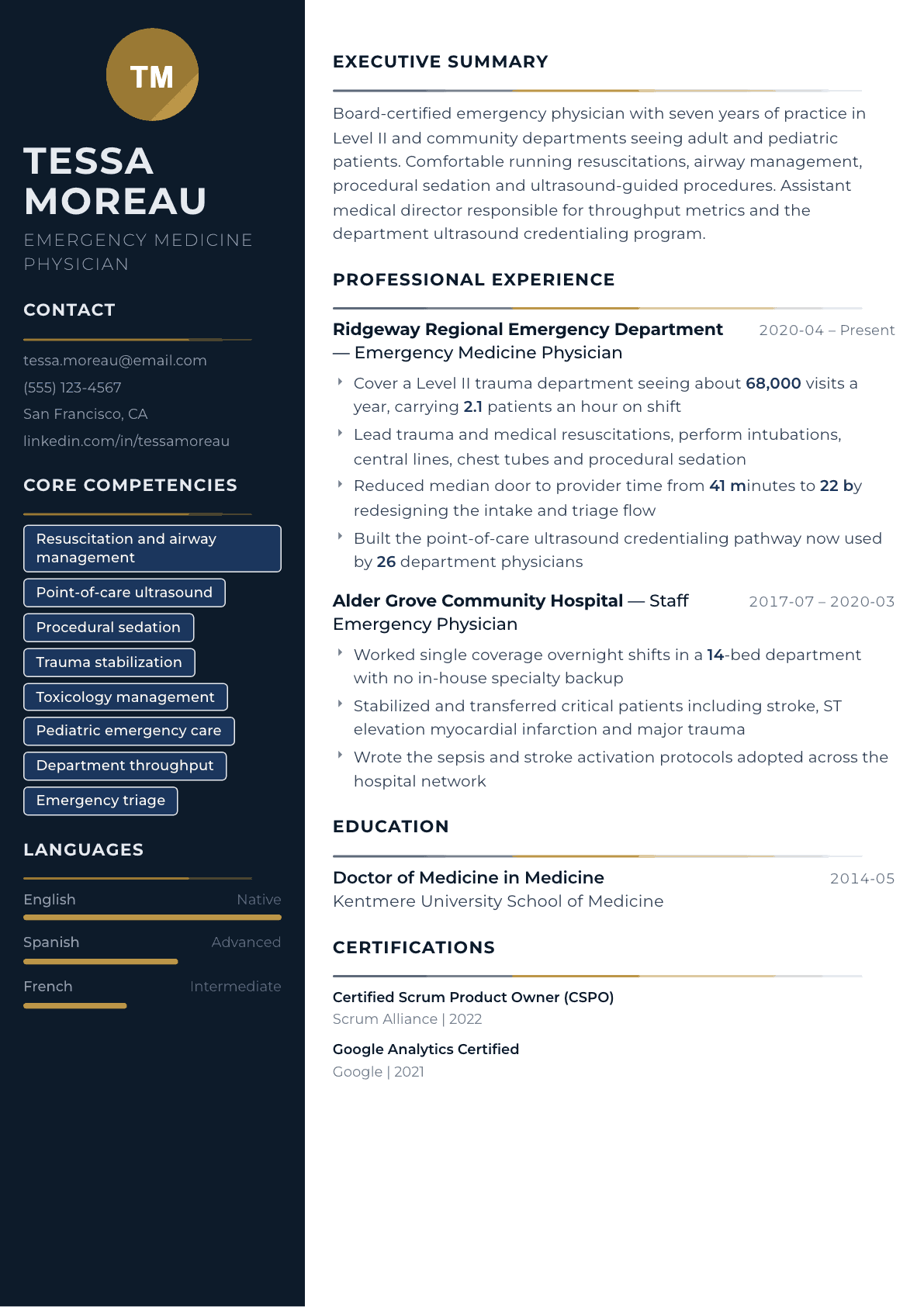
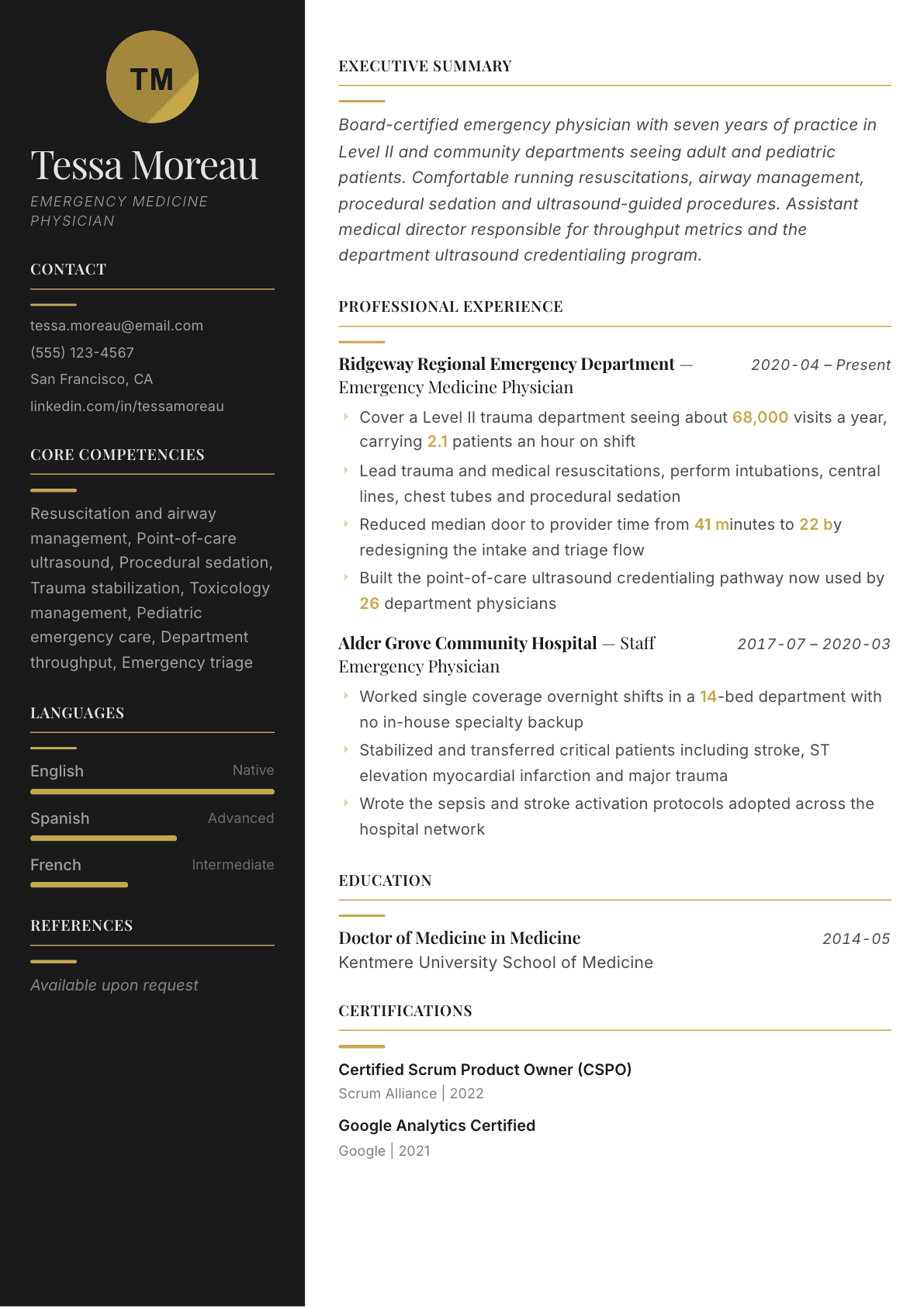
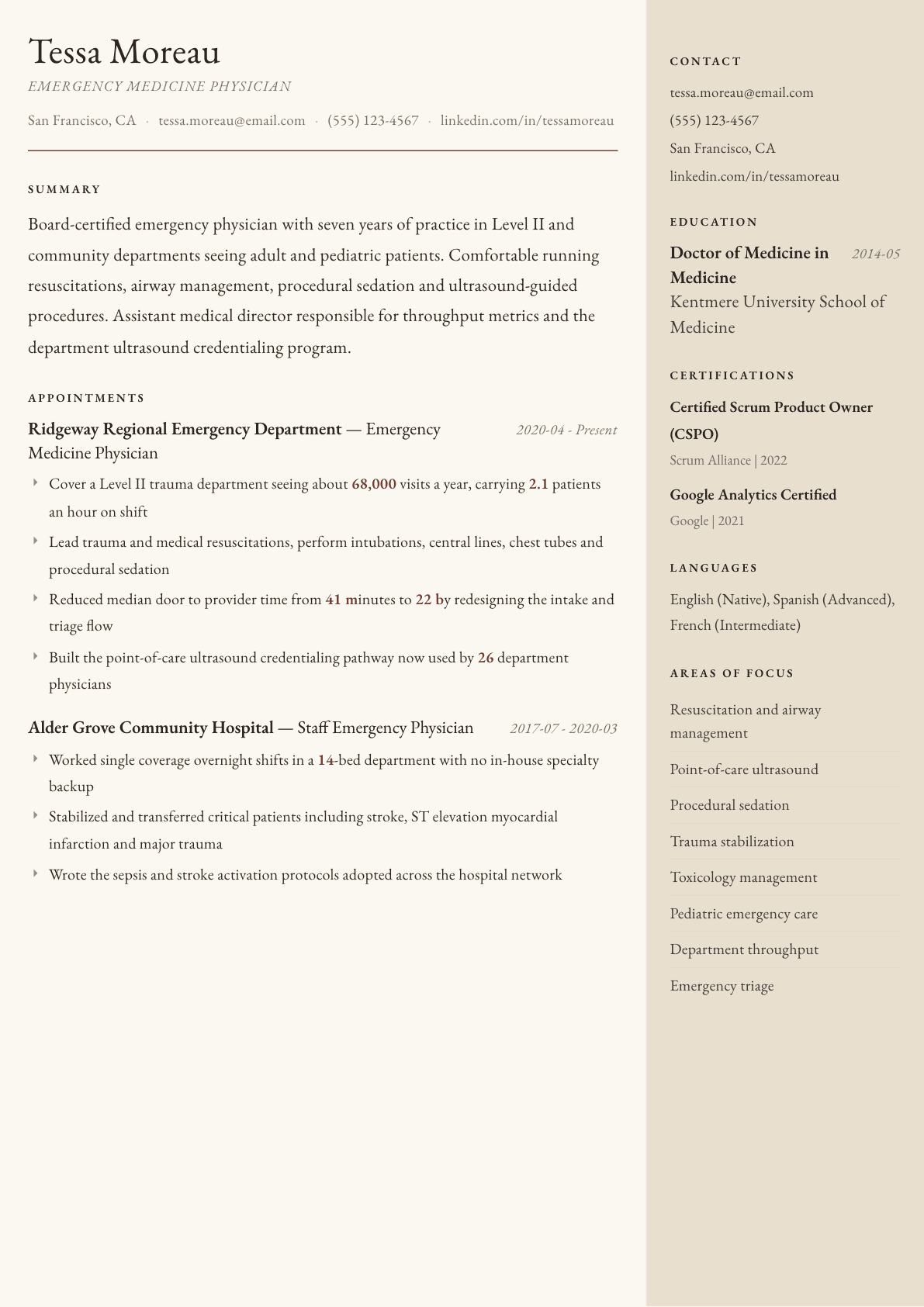
The same emergency medicine physician content laid out in three CVBooster templates, so you can see what the finished document looks like before you write a word.
Example Emergency Medicine Physician summary
Board-certified emergency physician with seven years across Level II and small community departments, carrying about 2.1 patients an hour in a site seeing 68,000 visits a year. Leads resuscitations, manages airways and performs ultrasound-guided procedures. Cut median door to provider time from 41 minutes to 22 and built a department ultrasound credentialing pathway. Seeking an assistant medical director role in a high-volume department.
Skills to list on a Emergency Medicine Physician resume
- Emergency medicine
- Advanced airway management
- Trauma resuscitation
- Point-of-care ultrasound
- Central venous access
- Procedural sedation
- Fracture reduction and splinting
- Toxicology and overdose management
- Pediatric emergency care
- Stroke and myocardial infarction activation
- Sepsis protocols
- Emergency triage
- Department throughput improvement
- Emergency medical services direction
What actually gets this resume read
- Give annual department visit volume, trauma level and your patients-per-hour rate for every emergency department you staffed.
- List procedures you perform independently, from intubation and central access to chest tubes and reductions.
- Say whether the site had single coverage, in-house specialists or transfer-only capability, because that defines your autonomy.
- Include throughput metrics you moved: door to provider, length of stay, left without being seen or boarding time.
- Keep certifications current and visible, since credentialing offices verify them before an interview is scheduled.
- Mention emergency medical services direction, ultrasound credentialing or protocol authorship as evidence of leadership.
How to write a emergency medicine physician resume
An emergency medicine resume is read by a group medical director filling shifts. The questions are blunt: can this physician hold a busy board alone, will they move patients, and does their file clear credentialing without a fight. Everything else is secondary.
What answers those questions is site detail. Annual department volume, trauma designation, patients seen per hour, whether specialists were in-house or a phone call away, and whether you worked single coverage overnight. Two emergency physicians with identical training can have completely different levels of autonomy depending on where they worked, and only these facts reveal it.
This guide covers site and volume reporting, the procedure list a credentialing committee expects, throughput metrics that matter to a director, administrative and prehospital roles, and the questions emergency physicians ask when moving between community groups, academic departments and locum work.
Format: credentials block, then site facts, then everything else
Two pages, reverse chronological, plain layout. Emergency medicine groups credential in bulk and move fast, so put the credentials block directly under the header: board certification and status, state licenses with expiration, controlled substance registration, and current advanced life support cards for adults, children and trauma.
If you hold licenses in more than one state, list them all. Groups covering several sites and locum agencies both screen on license breadth, and it is one of the few things on a resume that immediately widens the roles you can be offered.
- Header: name and degree, city and state, phone, email.
- Credentials: board certification, all licenses, registrations, life support cards.
- Then summary, department history with site facts, residency, education, procedures, administrative roles.
Summary: department type, volume, acuity and your rate
Name the kind of departments you have staffed, their trauma level and annual volume, your patients-per-hour rate, and whether you cover pediatrics. Four facts. A director staffing a busy urban board and a director staffing a rural critical access site want opposite things, and this sentence tells them which you are.
If you want an administrative role, say it here and name the administrative work you have already done. Assistant medical director positions are usually filled from candidates who arrive already describing throughput work.
Experience: the site facts that define your autonomy
Open each position with the department: annual visits, trauma designation, bed count, whether it is a receiving or transferring facility, whether residents or advanced practice clinicians work alongside you, and what specialty backup exists in-house overnight.
That last item is the one candidates skip and directors care about most. Working single coverage overnight in a fourteen-bed department with no in-house surgery, no interventional cardiology and a two-hour transfer time is a different job from a shift with three attendings and a trauma team in the building.
Then your own rate: patients an hour, shift length, the share of night shifts, and the acuity mix. Add the critical work you own, such as resuscitation leadership, airway management, procedural sedation and critical transfers, before any bullets about administrative duties.
- Annual visits, trauma level, bed count, receiving or transferring status.
- Staffing model: single coverage, double coverage, residents, advanced practice support.
- Specialty backup available in-house overnight.
- Your patients-per-hour rate, shift length, and night shift share.
Procedures and resuscitation: write the list explicitly
Credentialing committees want a procedure list and most emergency medicine resumes do not have one. Write it: endotracheal intubation including video laryngoscopy and surgical airway, central venous and intraosseous access, arterial lines, chest tube and needle decompression, procedural sedation, lumbar puncture, thoracentesis and paracentesis, fracture reduction and splinting, joint reduction, laceration and wound care, pericardiocentesis and resuscitative procedures.
Point-of-care ultrasound deserves its own line. Say which applications you perform, whether you are credentialed, and whether you have taught or run a credentialing pathway for other physicians. Ultrasound is a common gap in community groups and a reliable differentiator.
Throughput, protocols and prehospital work
Directors are accountable for the clock. Door to provider, length of stay for discharged and admitted patients, left without being seen, boarding hours, and door to electrocardiogram or door to needle for time-critical conditions. If you have moved any of these, write the number before and after and describe the change you made.
Protocol authorship, stroke and sepsis activation pathways, ultrasound credentialing programs, emergency medical services medical direction and disaster preparedness work all sit here. These are the roles that separate a physician who works shifts from one a group can build a department around.
Emergency Medicine Physician resume summary examples
New from residency
Emergency medicine board eligible, completing residency at a Level I center seeing about ninety thousand visits a year, with logged experience covering 120 intubations, 60 central lines and resuscitation leadership on trauma and medical codes. Ultrasound credentialed. Seeking a community department position with adult and pediatric coverage.
Seven years on shift
Board-certified emergency physician working Level II and small community departments, carrying about 2.1 patients an hour at a site seeing roughly sixty-eight thousand visits a year. Leads resuscitations, manages difficult airways and performs ultrasound-guided procedures. Cut median door to provider time from 41 minutes to 22.
Assistant medical director
Emergency physician and assistant medical director with fourteen years on shift, responsible for scheduling, throughput metrics and clinical protocols for a department of 26 physicians. Built the ultrasound credentialing pathway, serves as an emergency medical services medical director, and maintains a full clinical shift load.
Work experience bullets: before and after
Before: Worked shifts in a busy emergency department.
After: Covered a Level II trauma department seeing about sixty-eight thousand visits a year, carrying 2.1 patients an hour across nine-hour shifts with roughly a third of shifts overnight.
Volume, trauma level, patients per hour and night share describe the actual workload a director is trying to fill.
Before: Performed emergency procedures.
After: Performed intubations including video laryngoscopy and one surgical airway, central and intraosseous access, chest tubes, procedural sedation and joint reductions as the sole physician on overnight shifts.
The named procedures and the single coverage context tell a credentialing committee exactly what to grant.
Before: Helped reduce wait times.
After: Redesigned intake and triage flow with nursing, moving median door to provider time from 41 minutes to 22 and cutting the share of patients leaving before evaluation.
A before and after clock figure plus the change you made turns a claim into a repeatable intervention.
Before: Used ultrasound in the department.
After: Built the point-of-care ultrasound credentialing pathway, wrote the image review standard and brought 26 department physicians through to independent credentialing.
Program building with a physician count shows leadership rather than personal skill with a probe.
Before: Stabilized and transferred critical patients.
After: Stabilized and transferred stroke, ST elevation myocardial infarction and major trauma patients from a 14-bed department with no in-house specialty backup and a two-hour ground transfer time.
Naming the conditions and the transfer constraint proves autonomy that a busy urban shift never demonstrates.
Hard skills
- Emergency resuscitation leadership
- Advanced and difficult airway management
- Point-of-care ultrasound
- Central venous and intraosseous access
- Chest tube placement and needle decompression
- Procedural sedation and analgesia
- Fracture and joint reduction, splinting
- Laceration repair and wound management
- Toxicology and overdose management
- Pediatric emergency care
- Sepsis, stroke and myocardial infarction activation pathways
- Critical care transfer coordination
- Emergency medical services medical direction
- Department throughput and flow design
Soft skills
- Decision making with incomplete information
- Simultaneous task management on a full board
- Team leadership during resuscitation
- De-escalation with agitated patients
- Difficult conversations at short notice
- Handoff discipline at shift change
Certifications worth listing
- Emergency Medicine Certification (American Board of Emergency Medicine)
- Emergency Medical Services Subspecialty Certification (American Board of Emergency Medicine)
- Advanced Trauma Life Support (ATLS) (American College of Surgeons)
- Advanced Cardiovascular Life Support (ACLS) (American Heart Association)
- Pediatric Advanced Life Support (PALS) (American Heart Association)
Mistakes that cost emergency medicine physician candidates the interview
- Omitting annual department volume and trauma level, which leaves the reader guessing at the job you actually held.
- Skipping the staffing model, so single coverage overnight looks identical to a shift with three attendings.
- Leaving out the procedure list that a credentialing committee will request within days anyway.
- Describing throughput improvement with no clock figure before and after the change.
- Listing only one state license when locum and multi-site groups screen directly on license breadth.
- Letting life support certifications lapse on the document, which stalls the file at the medical staff office.
Emergency Medicine Physician resume questions
What department details belong on an emergency medicine resume?
Annual visit volume, trauma designation, bed count, receiving or transferring status, the staffing model, and what specialty backup was in the building overnight. These six facts define your autonomy better than any description of your clinical style.
Should I list my patients-per-hour rate?
Yes, when you know it and it holds up. Directors staff boards from that number, and a candidate who reports it accurately signals awareness of the operational side of the job. Give the shift length alongside it so the rate can be read properly.
How do I present locum tenens work?
Group it under one heading with the agency or your own entity, then list the sites with dates, volumes and trauma levels underneath. Presented that way, locum work reads as breadth across many departments rather than a series of short unexplained jobs.
Does administrative experience help if I only want clinical shifts?
It still helps, because it shows you understand the metrics your director is judged on. Keep it to two or three bullets so the resume does not read as an application for a job you are not asking for.
How do I write this resume as a new emergency medicine graduate?
Lead with your training site volume and trauma level, then your logged procedure numbers for intubation, central access and resuscitation leadership, then ultrasound credentialing. Groups hiring new graduates want evidence of high-acuity exposure and procedural repetition more than anything else.