Flight Nurse Resume Examples: free ATS score and gap list
Write a Flight Nurse Resume That Shows Autonomy Under Altitude
By Mustafa Tarabya, founder of CVBooster · Published · Updated
Flight nurse resume examples with critical care transport keywords, sample mission bullets, and a guide to certifications, weight limits and scope.
Sample resumes for a flight nurse
The same flight nurse content laid out in three CVBooster templates, so you can see what the finished document looks like before you write a word.
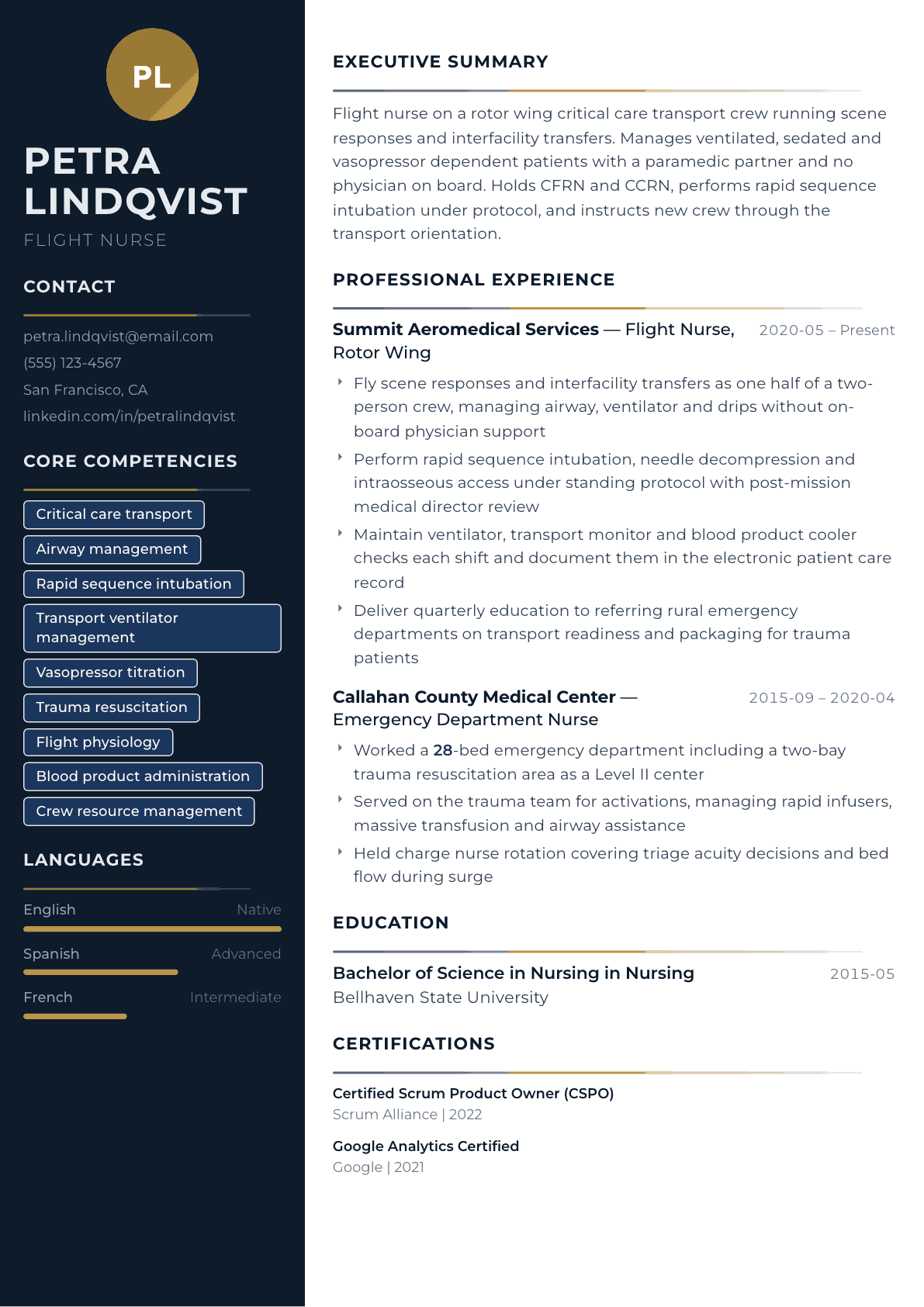
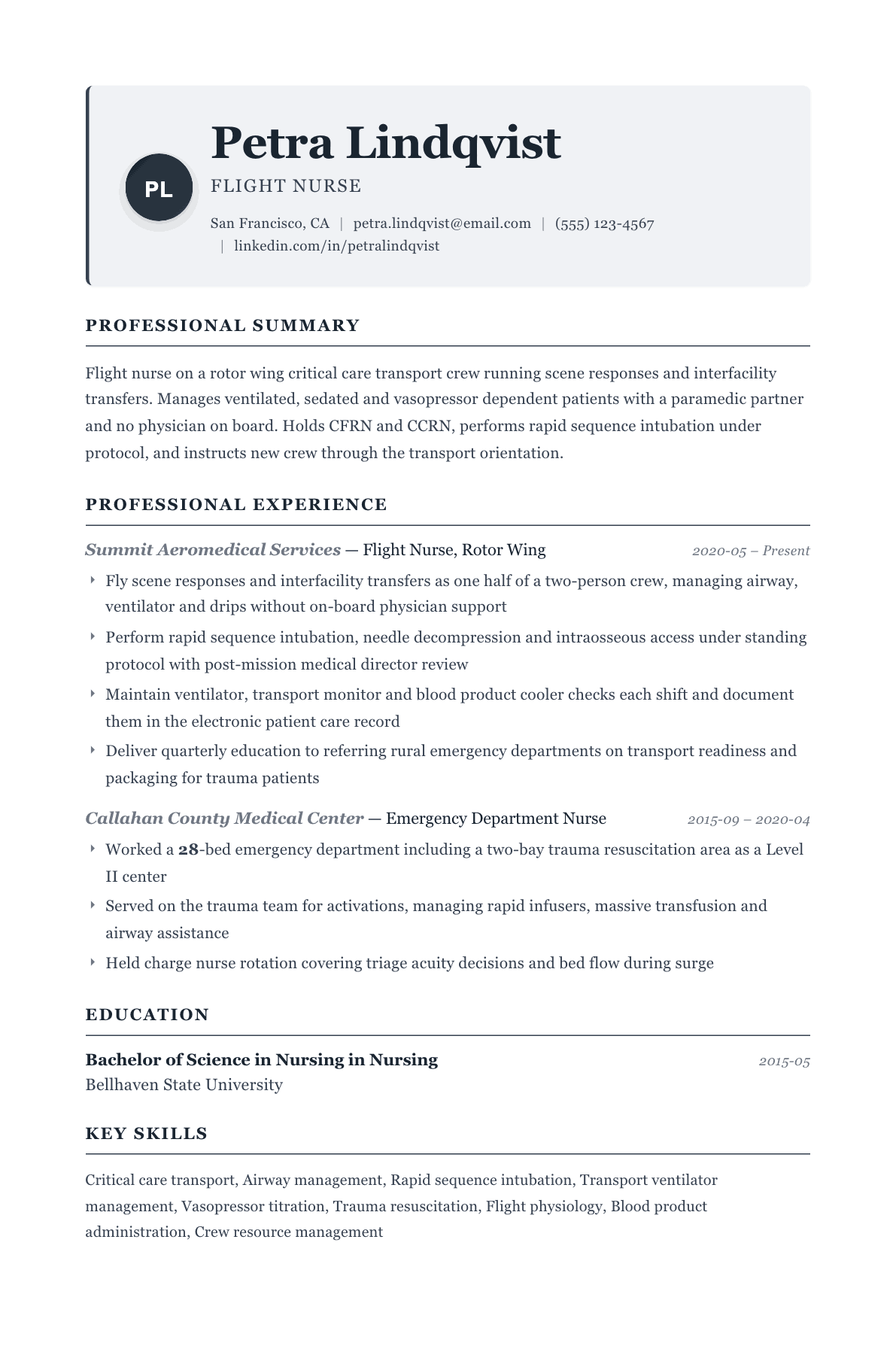
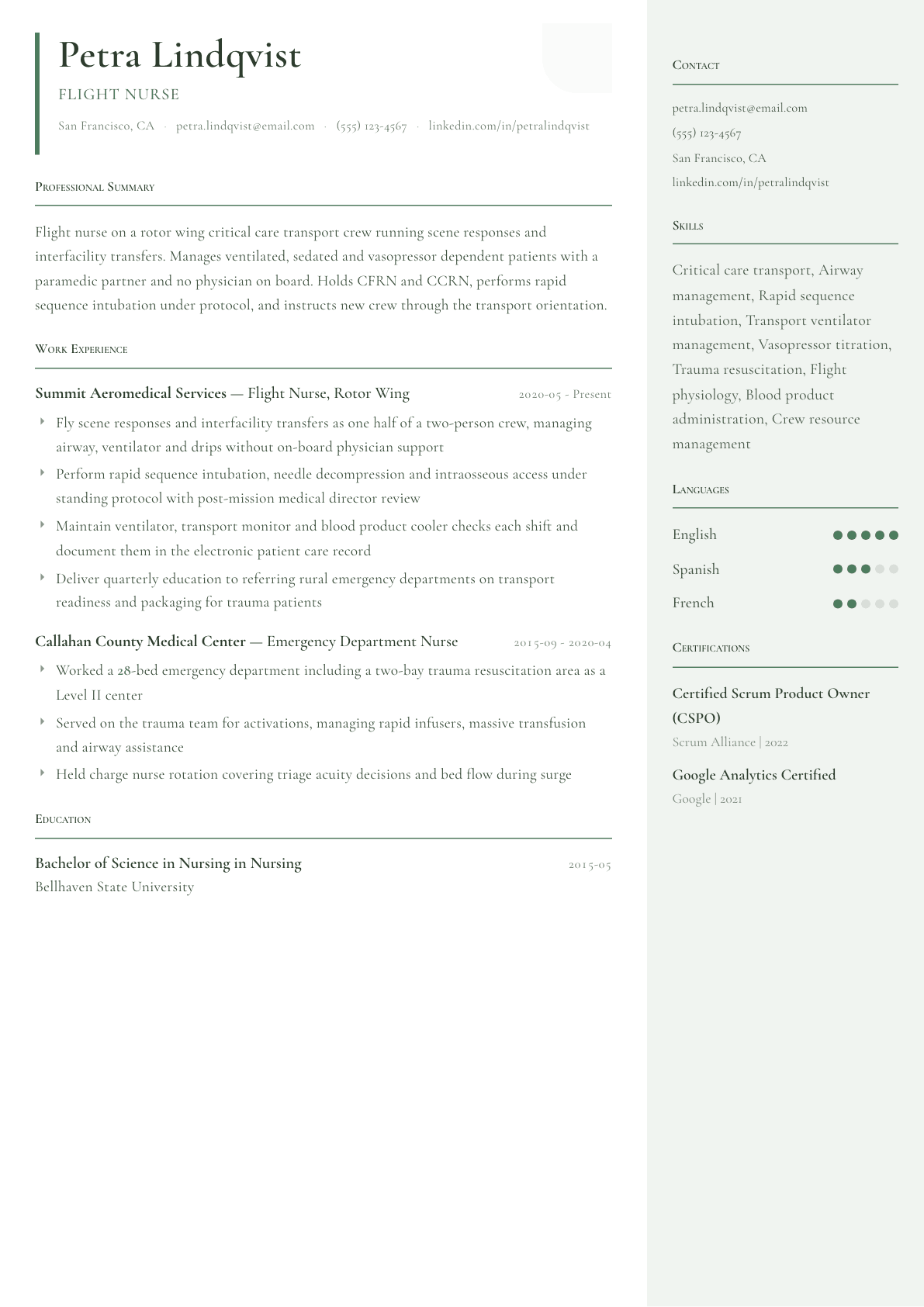
Example Flight Nurse summary
Flight nurse with ten years of emergency and critical care practice and five years on a rotor wing transport crew. Manages ventilated and vasopressor dependent patients with a paramedic partner and no physician on board, performing rapid sequence intubation under standing protocol. CFRN and CCRN certified, and an instructor for new crew orientation. Seeking a lead flight nurse role with a hospital based program.
Skills to list on a Flight Nurse resume
- Critical care transport
- Advanced airway management
- Rapid sequence intubation
- Transport ventilator management
- Vasopressor and sedation titration
- Trauma resuscitation
- Massive transfusion protocol
- Intraosseous access
- Needle decompression
- Flight physiology
- Crew resource management
- Scene safety and landing zone coordination
- Neonatal and pediatric transport
- Electronic patient care reporting
What actually gets this resume read
- Open with the aircraft type and mission mix: rotor wing or fixed wing, scene response, interfacility, neonatal or specialty team.
- List CFRN, CCRN, ACLS, PALS and any trauma course in a certifications block near the top, because postings gate on them.
- Make your autonomy explicit: two-person crew, standing protocols, no physician on board, medical director review process.
- Name the transport equipment you own on shift, including ventilator, monitor, infusion pumps and blood product handling.
- Give the acuity of your ground experience with the unit, the level of the trauma center, and the years before you flew.
- Mention that you meet the weight requirement and hold current flight physiology training if the posting asks for it.
How to write a flight nurse resume
Air medical programs receive far more applications than they have seats, and the chief flight nurse reading yours is filtering for a narrow thing: proof that you can manage a crashing patient in a confined, loud, moving space with one partner and no physician to defer to. Everything on the resume either supports that or gets in the way.
The first pass is mechanical. Programs gate on certifications, on minimum years of high acuity experience, and often on a weight limit for the aircraft. If the certifications block is missing or vague, no one reads your bullets. The second pass is clinical judgment: airway decisions, ventilator management outside a hospital, blood product administration in the back of an aircraft, and what you did when the plan failed at altitude.
This guide covers how a flight nurse resume should be built, three summaries covering the ground nurse applying in, the working crew member and the program lead, before and after bullets from transport work, and the questions candidates ask before they apply to a program.
Format: certifications block above the fold
Reverse-chronological, two pages, and the certifications block sits directly under the summary rather than at the end. Programs screen against a required list, and a recruiter who cannot confirm the list in five seconds moves to the next file.
List each credential with the issuing body and current status. Include the trauma and pediatric courses even when they feel routine, because they appear as line items on the program checklist and an absent line reads as a missing credential.
- Header: name, credentials, city and state, license states, current certifications summarized in one line.
- Order: summary, certifications, transport experience, ground critical care experience, education, additional training.
- Ground applicants add a section for tactical, wilderness, disaster or prehospital experience when they have it.
Summary: aircraft, crew configuration, mission mix
Name the aircraft type, rotor wing or fixed wing, the crew configuration, and the mission mix. A two-person nurse and paramedic crew running scene calls is a different job from a nurse and respiratory therapist team moving intensive care patients between hospitals, and programs hire for their own model.
If you have not flown yet, say what you are applying from and make the acuity explicit: the level of the trauma center, the intensive care unit type, the years, and the procedures you perform independently under protocol. Do not describe yourself as adaptable. Describe the resuscitation you ran.
Experience: autonomy is the whole argument
Every transport bullet should make clear how much you decided alone. Standing protocols, medical director review, no physician on board, scene command interaction and the fact that you and your partner are the entire team are the details that separate transport from bedside work.
Name the equipment you own on shift. Transport ventilator, monitor and defibrillator, infusion pumps, point of care testing, blood product cooler and the electronic patient care record are all things you check, troubleshoot and document. Managers read equipment ownership as evidence you will not freeze when a pump alarms in flight.
For ground experience, write the unit and its acuity, then choose bullets closest to transport: trauma activations, massive transfusion, rapid infusers, airway assistance, post-arrest care, balloon pump or extracorporeal support, and charge shifts where you ran the room. Skip routine floor tasks entirely.
Safety, flight physiology and crew resource management
Air medical programs run on safety culture and they screen for it. Say that you participate in preflight risk assessment, that you know when and how a crew member calls a mission off, and that you complete flight physiology and survival training. A candidate who never mentions safety reads as someone who thinks the job is only clinical.
Crew resource management is worth its own line. Closed-loop communication, sterile cockpit discipline, briefing and debriefing, and how you work through a disagreement with a pilot or partner are the behaviors that keep a two-person crew functional at three in the morning.
Teaching, outreach and the keywords programs search
Outreach is part of the job. Programs teach referring rural emergency departments about packaging patients for transport, run base station education, and precept new crew through a long orientation. Any of that belongs on the resume, because it shows you represent the program well outside the aircraft.
Mirror the language postings use: critical care transport, interfacility, scene response, rapid sequence intubation, transport ventilator, vasoactive infusions, blood administration, flight physiology, crew resource management and the certification abbreviations. Use the terms once high on the page and once inside a bullet where they carry real content.
Flight Nurse resume summary examples
Ground nurse applying in
Emergency department RN with six years at a Level II center, including trauma team response, massive transfusion and airway assistance, plus charge rotation for a 28-bed department. Holds CEN, ACLS, PALS and a trauma course. Seeking a first rotor wing flight nurse position with a full orientation.
Three seasons flying
Flight nurse on a rotor wing critical care crew running scene responses and interfacility transfers with a paramedic partner and no physician on board. Manages transport ventilators, vasoactive infusions and blood products, and performs rapid sequence intubation under standing protocol. CFRN and CCRN certified.
Base clinical lead
Base clinical lead for a rotor wing program with nine years of transport experience, responsible for crew orientation, quarterly skills validation and post-mission clinical review with the medical director. Flies a full clinical schedule and teaches referring emergency departments on packaging and transport readiness.
Work experience bullets: before and after
Before: Transported critically ill patients by helicopter.
After: Flew scene responses and interfacility transfers as one half of a two-person crew, managing airway, transport ventilator and vasoactive infusions without on-board physician support.
Crew configuration and independent scope are what a chief flight nurse is actually reading for.
Before: Performed advanced procedures during transport.
After: Performed rapid sequence intubation, needle decompression and intraosseous access under standing protocol, with every procedure reviewed by the medical director after the mission.
Naming the procedures and the review loop shows both capability and accountability.
Before: Checked equipment before shifts.
After: Completed shift checks on the transport ventilator, monitor, infusion pumps and blood product cooler, and documented each in the electronic patient care record before the aircraft was released.
Specific equipment and a documented process demonstrate the readiness discipline programs require.
Before: Taught classes for local hospitals.
After: Delivered quarterly education to rural referring emergency departments on packaging trauma patients for transport, covering airway securement, line placement and handoff structure.
The audience and the content prove genuine outreach teaching rather than an attended in-service.
Before: Worked well with the flight crew.
After: Practiced closed-loop communication and sterile cockpit discipline with pilot and paramedic partners, contributed to preflight risk assessments, and led post-mission debriefs after difficult calls.
It converts a claim about teamwork into the named safety behaviors an air medical program screens for.
Hard skills
- Critical care transport
- Advanced airway management
- Rapid sequence intubation
- Transport ventilator management
- Vasoactive and sedation infusion titration
- Trauma resuscitation
- Massive transfusion and blood administration
- Intraosseous access
- Needle decompression and chest tube assistance
- Point of care testing
- Flight physiology
- Electronic patient care reporting
Soft skills
- Independent decision making
- Crew resource management
- Closed-loop communication
- Composure in confined spaces
- Referral relationship building
- Debriefing after difficult calls
Certifications worth listing
- CFRN (Certified Flight Registered Nurse) (Board of Certification for Emergency Nursing)
- CTRN (Certified Transport Registered Nurse) (Board of Certification for Emergency Nursing)
- CCRN (Acute/Critical Care Nursing) (American Association of Critical-Care Nurses)
- Certified Emergency Nurse (CEN) (Board of Certification for Emergency Nursing)
- Advanced Cardiovascular Life Support (ACLS) (American Heart Association)
- Pediatric Advanced Life Support (PALS) (American Heart Association)
- Trauma Nursing Core Course (TNCC) (Emergency Nurses Association)
Mistakes that cost flight nurse candidates the interview
- Burying certifications at the end when programs screen against a required list before reading anything else.
- Describing transport work without stating the crew configuration, which is how a chief judges your autonomy.
- Listing ground experience as routine floor duties instead of the resuscitations and procedures that transfer.
- Never mentioning safety culture, preflight risk assessment or the authority any crew member has to decline a mission.
- Ignoring the program weight requirement when the posting states one, which wastes everyone a screening call.
- Claiming procedures you performed once in a simulation lab rather than under protocol on real patients.
Flight Nurse resume questions
How many years of experience do I need before applying to a flight program?
Most programs set a minimum in high acuity emergency or intensive care nursing and state it in the posting. Read that requirement literally, and if you are close, strengthen the application with certifications, procedural volume and any prehospital or transport exposure you already have.
Which certifications should a flight nurse resume list first?
Lead with the flight or transport certification if you hold one, then critical care or emergency certification, then the resuscitation and trauma courses. Write each with the issuing body and current status, because programs verify them line by line during credentialing.
How do I show autonomy if I have never flown before?
Use ground bullets that describe decisions you made without waiting: recognizing deterioration and escalating, running the airway cart during a resuscitation, holding charge and directing a trauma bay, or performing procedures under protocol. Autonomy is a behavior you can evidence anywhere.
Should I mention the weight requirement on my resume?
Only if the posting names one, and then only as a short line confirming you meet the stated requirement. Programs list it because aircraft performance depends on it, and confirming it early avoids losing a slot after the clinical interview goes well.
Does neonatal or pediatric transport experience belong on a general flight nurse resume?
Yes, in its own block. Specialty team work expands what a program can assign you to, so name the population, the equipment such as transport isolettes, and the team configuration rather than folding it into adult transport bullets.