Emergency Medical Technician Resume Examples: free score
Build an EMT Resume That Shows Call Volume and Skill
By Mustafa Tarabya, founder of CVBooster · Published · Updated
EMT resume sample and emergency medical technician resume example with call volume, certification wording, protocol keywords and a guide to every section a service reads.
Sample resumes for a emergency medical technician
The same emergency medical technician content laid out in three CVBooster templates, so you can see what the finished document looks like before you write a word.
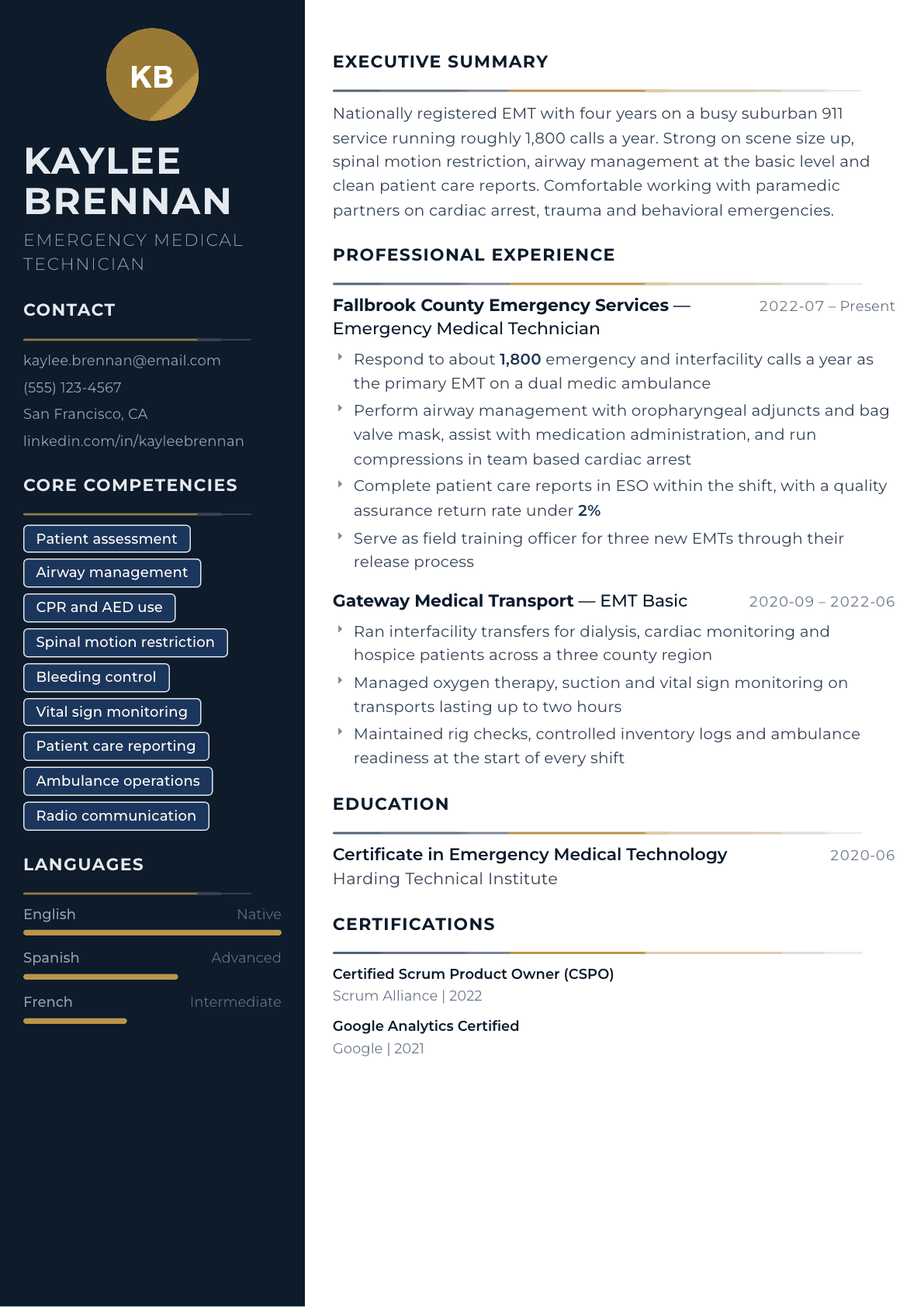
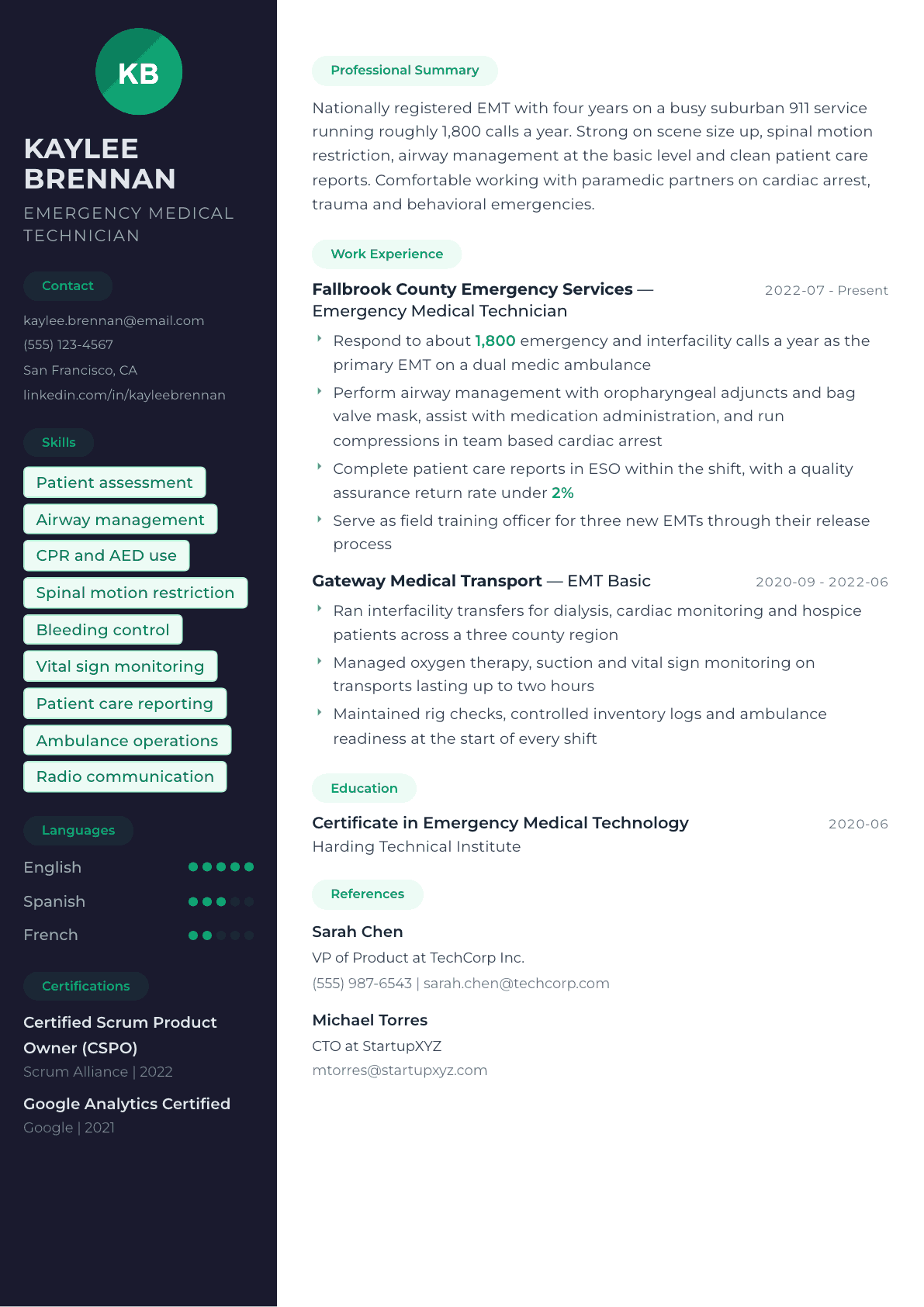
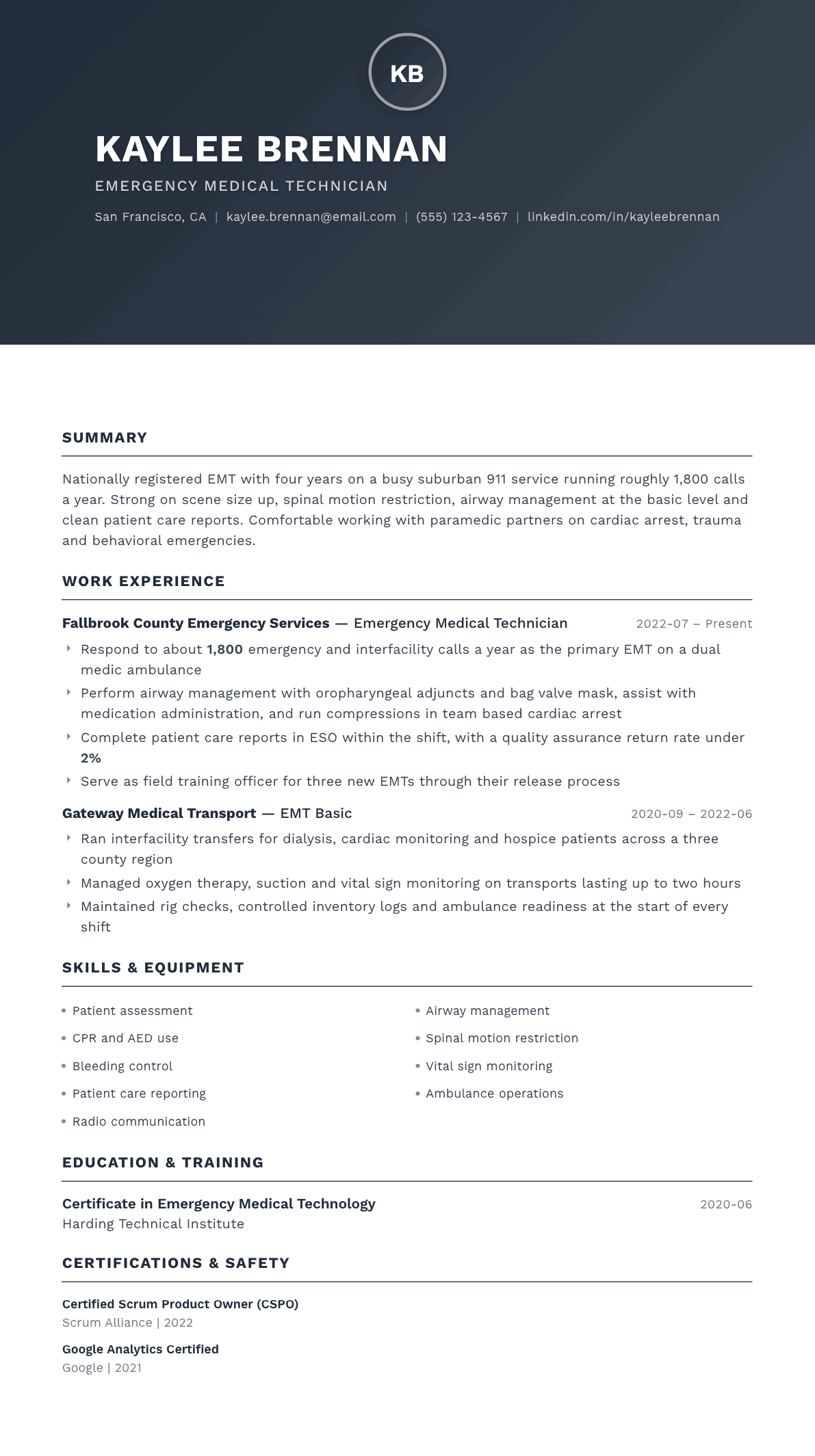
Example Emergency Medical Technician summary
Nationally registered emergency medical technician with four years on a high volume 911 ambulance and a background in interfacility transport. Assesses quickly, manages airways and bleeding under protocol, and writes patient care reports that hold up in quality review. Field training officer for new hires, current in CPR instruction, and steady on cardiac arrest, trauma and psychiatric calls.
Skills to list on a Emergency Medical Technician resume
- Basic life support
- Patient assessment
- Airway management and suction
- Bag valve mask ventilation
- CPR and automated defibrillation
- Spinal motion restriction
- Splinting and bleeding control
- Oxygen therapy
- Vital sign monitoring
- Patient care report writing
- Emergency vehicle operations
- Radio and dispatch communication
- Triage under mass casualty protocol
- Scene safety and extrication support
What actually gets this resume read
- Put your National Registry number status, state certification and driver license class in a credentials block up top.
- Give annual call volume and the service type, because a rural volunteer service and an urban 911 system read differently.
- Name the skills your scope actually allows, since claiming intubation as a basic EMT ends the interview early.
- Mention the electronic patient care report platform you use, as services measure report quality and timeliness closely.
- Include field training, preceptor or CPR instructor work, because supervisors look for EMTs who can teach the next shift.
- List the specialty work you have covered such as standby events, tactical support, wildland or interfacility critical care.
How to write a emergency medical technician resume
An emergency medical technician (EMT) resume is read by an operations supervisor who has run the same calls you have. He can tell within a few lines whether you have worked a real 911 system or spent your time on scheduled transports, and he will not be persuaded by adjectives. Call volume, system type, scope of practice and report quality are the four things he is checking.
Certification is the gate before any of that. National Registry status, state certification, driver license class and current cards decide whether your file even reaches him, which is why they belong in a block at the top rather than a line at the bottom under education.
This guide lays out the format services expect, three example summaries from a new certification through field training officer, before and after bullets written the way a chart review reads, and the questions that come up constantly when EMTs update their resumes for a new service or for paramedic school.
EMT resume sample: a complete 911 entry, top to bottom
Here is a complete EMT resume sample for a basic EMT with three years on a 911 service, laid out the way a field supervisor reads it: certification line, then the system, then the calls. Copy the structure, not the numbers. Every figure on your own EMT resume has to be one you can explain in the interview.
Header and certification line: Jordan Ellis, EMT. NREMT certified, state EMT license, BLS for Healthcare Providers, EVOC. Phone, email and city on one line underneath.
Summary: EMT with three years on a county 911 service running about 1,500 calls a year on a BLS unit with ALS intercept. Strong on patient assessment, spinal motion restriction, airway adjuncts and patient care reports finished before the end of the shift.
Second sample, for someone one step earlier. A newly certified EMT has nothing to count yet, so the resume counts the training instead: ride time, clinical hours, skills signed off and the job you did before. That is honest, and it is exactly what a hiring supervisor checks first.
Summary: Newly certified EMT, NREMT, with ambulance ride time and emergency department clinical hours completed during the course. Four years in a busy pharmacy, used to calming people on the worst day of their week.
Its strongest lines. Clinical rotation: completed ride time on a 911 unit, assisting with assessments, vital signs, splinting and patient moves under a preceptor. Skills signed off: patient assessment, bleeding control, splinting, spinal motion restriction, CPR and AED, oxygen delivery. Certifications: NREMT EMT, state EMT license, BLS for Healthcare Providers.
The experience entry for the first sample, EMT, Harlan Valley Ambulance District, reads as the bullets below.
- Respond to about 1,500 emergency calls a year on a BLS unit, requesting ALS intercept under county protocol on cardiac, stroke and breathing calls.
- Perform patient assessment, vital signs, glucose checks, oxygen therapy and airway management with OPA, NPA and bag valve mask within the EMT scope.
- Complete every patient care report in the electronic PCR system before the end of the shift, with no reports returned by quality review in the last year.
- Run the daily rig check and controlled supply inventory, and restock after every call so the unit goes back in service ready.
- Education: EMT certificate program, Harlan Valley Community College.
Format: certifications first, then the operational picture
One page until you have around eight years in the field. Reverse chronological, plain headings, no columns, because many services still run resumes through parsers that mangle a two column layout. Put a certifications block directly under your contact details: National Registry status, state certification level and number, driver license class with any ambulance endorsement, and current cards with issuing bodies and expiry dates.
Follow that with a one line operational summary for your current role: system type, annual call volume, unit configuration and shift length. A supervisor reading forty two applications can place you immediately, and the rest of the page then has context.
- Header: name with certification level, city and state, phone, email.
- Sections: certifications, summary, response experience, specialty assignments, education, skills, continuing education.
- Newly certified EMTs add clinical and field internship hours with the site and the preceptor sign-off status.
Summary: system, volume, partner configuration, strengths
Three lines. Name your certification level and years, the type of system you run in, the annual call volume, and whether you work a basic life support unit, a dual medic truck or a mixed configuration. A busy urban 911 service and a rural volunteer district produce very different EMTs, and the reader needs to know which one you are.
Close with a strength that the posting names. If the service runs a lot of interfacility critical care transfers, say what monitoring you have supported. If the posting mentions community paramedicine or standby event coverage, name your experience with it instead of hoping the reader infers it.
Experience: calls, skills within scope, and the report
Each position needs the service name, the type of system, the annual call volume you personally ran, and your unit assignment. Then bullets grouped around assessment, intervention, teamwork and documentation.
Assessment bullets should show scene work: size up, triage under a mass casualty protocol, hazard recognition, and the judgment calls that decide transport priority. Intervention bullets should stay strictly inside your scope: airway adjuncts and bag valve mask ventilation, oxygen therapy, suction, bleeding control including tourniquets and hemostatic dressing, splinting, spinal motion restriction, glucometry where allowed, and assisting a paramedic with medication administration or advanced airway placement. Do not claim skills above your level, since the interview panel will ask you to describe them.
Documentation deserves its own bullet. Services measure report completeness, narrative quality and time to submission, and every quality assurance officer has a stack of reports returned for correction. If yours are rarely returned, that is a real credential and worth writing down.
Specialty assignments and the parts of the job outside the truck
Field training officer, preceptor, CPR instructor, honor guard, community risk reduction, standby coverage at stadiums and races, wildland or tactical support, and disaster deployment all belong in their own short section. These are the assignments that turn an EMT into someone a service wants to keep, and they read very differently from another year of calls.
Add fleet and readiness duties if you have owned them: narcotics and controlled inventory checks, rig readiness, equipment ordering, station supply, or vehicle checkout audits. Supervisors know how much of the operation rests on these tasks even though they never appear in a job posting.
Skills, keywords and continuing education
Postings reuse a tight vocabulary: basic life support, patient assessment, airway management, spinal motion restriction, hemorrhage control, emergency vehicle operations, patient care report, protocol compliance, mass casualty triage. Mirror those terms once in the skills list and once inside a bullet where the work is visible.
Then list your continuing education using the recognized model with the component hours you have completed toward recertification, and name the electronic patient care report platform you have used. Both matter to an employer who has to keep a whole roster compliant.
Emergency Medical Technician resume summary examples
Newly certified
Newly certified emergency medical technician with 120 hours of classroom instruction, ten emergency department clinical shifts and a field internship of 48 ambulance hours across 40 patient contacts. Trained in assessment, airway adjuncts, hemorrhage control and spinal motion restriction. Seeking a 911 position with structured preceptorship.
Three years on a 911 truck
Emergency medical technician with three years on a suburban 911 service running around six calls per twelve hour shift alongside a paramedic partner. Strong on scene size up, airway support, trauma packaging and cardiac arrest team roles. Writes patient care reports that clear quality review without return, and holds an emergency vehicle operator certificate.
Field training officer
Senior emergency medical technician with seven years across urban 911 response and critical care interfacility transport, now serving as field training officer. Has released five new EMTs through the preceptorship process, teaches CPR for the service, and covers mass gathering standby and disaster deployment assignments.
Work experience bullets: before and after
Before: Responded to emergency calls.
After: Ran roughly six emergency and interfacility calls per twelve hour shift on a dual medic unit in a suburban 911 system, covering medical, trauma, obstetric and behavioral emergencies.
Calls per shift, unit configuration and call types let a supervisor size your experience without asking.
Before: Assisted with patient care.
After: Managed airways with oropharyngeal adjuncts and bag valve mask ventilation, applied tourniquets and hemostatic dressing on penetrating trauma, and assisted the paramedic with intravenous setup and medication draw.
Naming interventions inside your scope proves competence without claiming a level you do not hold.
Before: Worked cardiac arrests.
After: Filled the compressor and airway roles in team based cardiac arrest using a metronome pacing device and a mechanical compression device, with pit crew role assignment briefed before arrival.
The specific role and equipment show you have worked a real resuscitation choreography rather than watched one.
Before: Completed paperwork after calls.
After: Completed patient care reports in the electronic platform before the end of every shift, with narratives that consistently cleared quality assurance review without return for correction.
Report quality is measured at every service, so making yours concrete turns paperwork into a strength.
Before: Helped train new employees.
After: Served as field training officer for three new EMTs, evaluating them against the service release checklist across a six week precepting cycle and documenting each shift.
The checklist and the cycle length show a formal training role rather than informal help.
Hard skills
- Patient assessment and scene size up
- Airway adjuncts and bag valve mask ventilation
- Oxygen therapy and suction
- CPR and automated external defibrillation
- Hemorrhage control and tourniquet application
- Splinting and fracture immobilization
- Spinal motion restriction
- Emergency childbirth support
- Mass casualty triage
- Emergency vehicle operations
- Patient care report writing
- Radio and dispatch communication
Soft skills
- Composure on chaotic scenes
- Crew resource coordination
- De-escalation with agitated patients
- Concise verbal handoff
- Physical stamina across long shifts
- Bystander and family management
Certifications worth listing
- NREMT Emergency Medical Technician (National Registry of Emergency Medical Technicians)
- Basic Life Support (BLS) (American Heart Association)
- Prehospital Trauma Life Support (PHTLS) (National Association of Emergency Medical Technicians)
- Emergency Vehicle Operator Course (EVOC) (State EMS agency)
- Incident Command System IS-100 and IS-200 (Federal Emergency Management Agency)
- BLS Instructor (American Heart Association)
Mistakes that cost emergency medical technician candidates the interview
- Burying National Registry status and state certification at the bottom of the page under education.
- Claiming advanced skills outside your certification level, which the interview panel will test in the first ten minutes.
- Omitting call volume and system type, leaving a supervisor unable to tell heavy 911 work from scheduled transport.
- Writing that you provided quality patient care, a phrase that appears on every resume in the stack and means nothing.
- Leaving out specialty assignments such as field training, standby events or disaster deployment.
- Ignoring documentation entirely, when report quality is one of the few EMT metrics a service actually tracks.
Emergency Medical Technician resume questions
Should I list my National Registry number on my resume?
List your certification level and status rather than the full number, and note that it is current with the expiry date. Services verify through the registry directly, so the number itself adds nothing while the status and expiry save a step.
How do I write a resume as a newly certified EMT with no calls?
Use your clinical and field internship as experience. Give the site, the hours, the number of patient contacts and the skills you were signed off on. Add any related work with the public, since scene control is largely people handling.
Does volunteer ambulance experience count?
It counts fully, provided you present it with the same detail as paid work. Give the district, the call volume, the unit type and your role. Many services value volunteer time because it usually means rural calls with long transport times.
How should I present my resume when applying to paramedic school?
Lead with call volume and the depth of assessment experience, then highlight continuing education, instructor roles and any critical care transport exposure. Programs want evidence you can handle didactic study alongside a demanding shift schedule.
What does a good EMT resume sample include?
A certification line with NREMT and your state license, a summary with call volume and unit type, experience bullets that name skills inside your scope, and a short education section. The two EMT resume samples above show that order for a working EMT and for a new EMT with no calls yet.