Medical Resident Resume Examples: the lines they read
Write a Medical Resident Resume for Fellowship and Attending Roles
By Mustafa Tarabya, founder of CVBooster · Published · Updated
Medical resident resume examples, rotation and procedure log wording, board status, and the keywords program directors screen for.
Sample resumes for a medical resident
The same medical resident content laid out in three CVBooster templates, so you can see what the finished document looks like before you write a word.
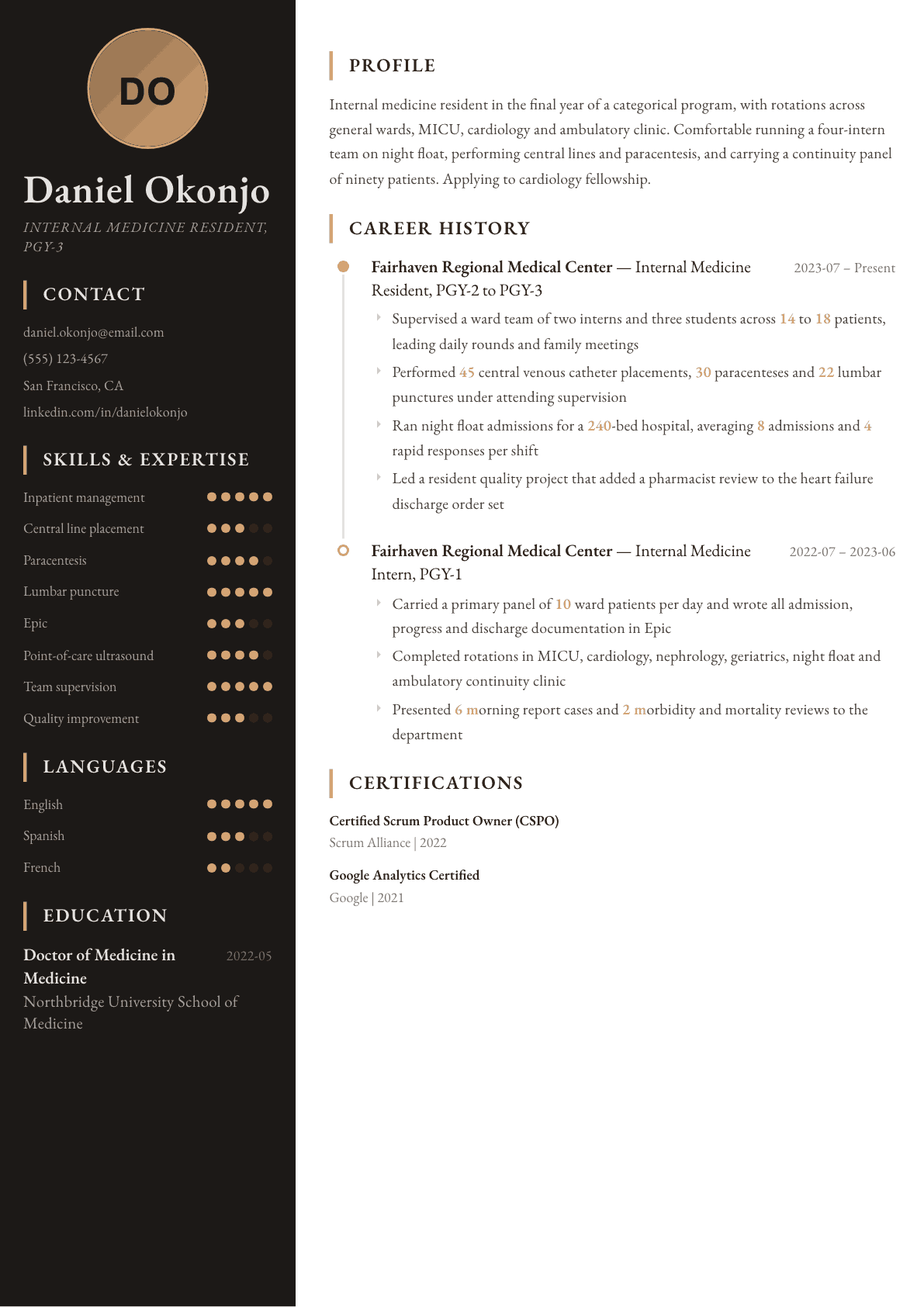
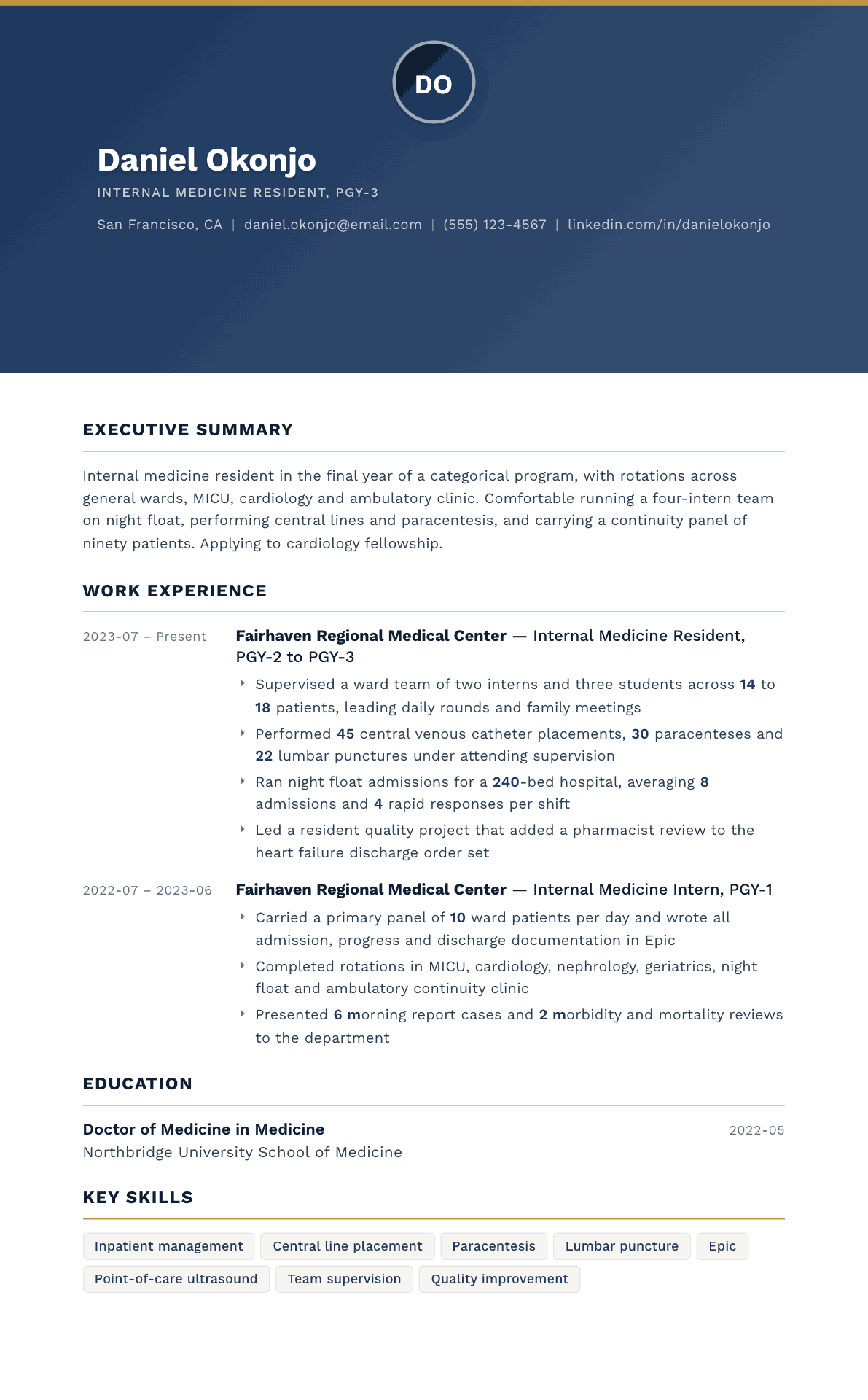
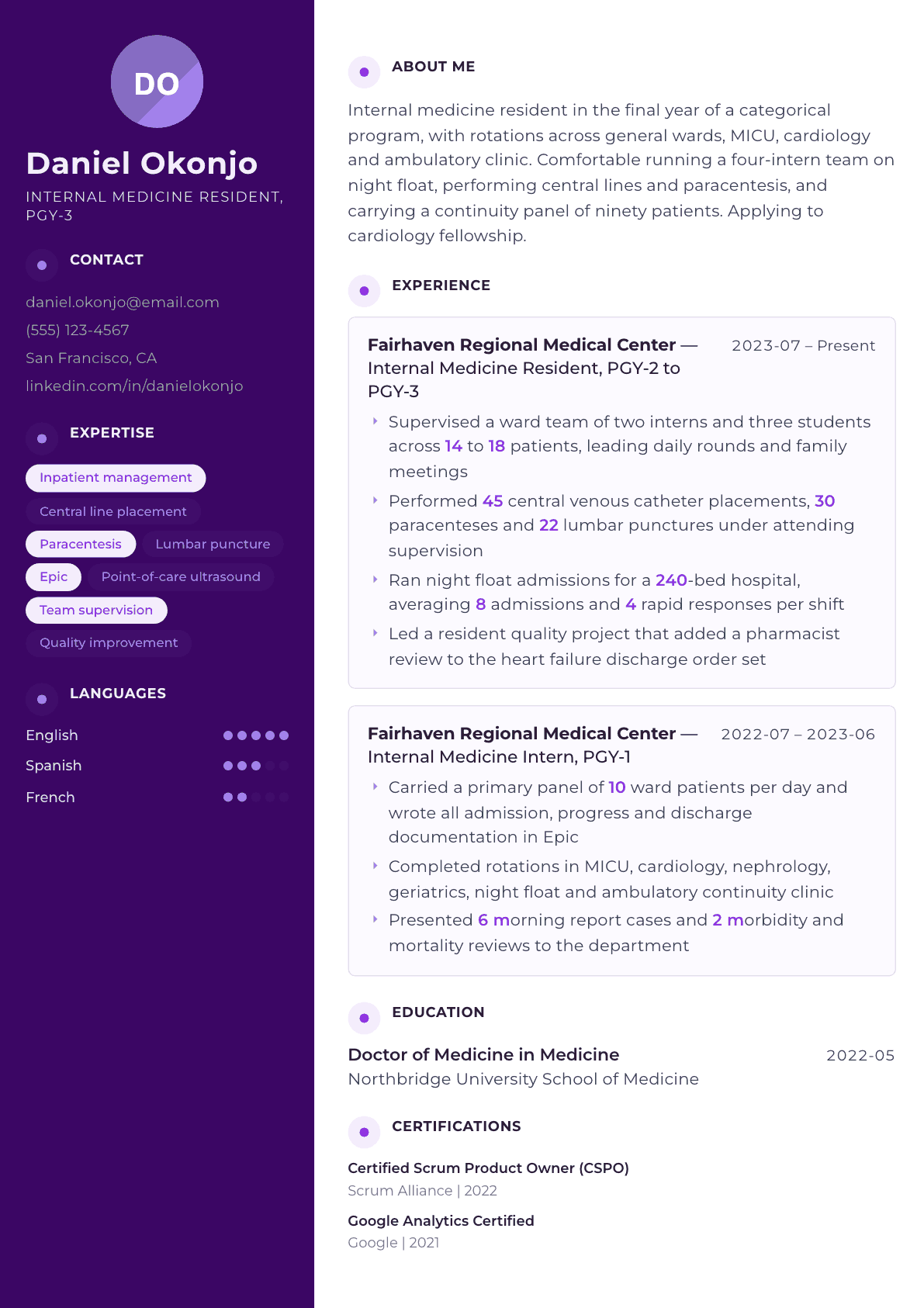
Example Medical Resident summary
Third-year internal medicine resident with ward, MICU and ambulatory experience at a 240-bed teaching hospital. Supervises intern and student teams on night float, has logged more than 90 bedside procedures, and holds an active state medical license with ABIM board eligibility next year. Presenting a first-author poster on heart failure readmissions and applying to cardiology fellowship.
Skills to list on a Medical Resident resume
- Inpatient ward management
- Critical care
- Admission and discharge documentation
- Central venous access
- Paracentesis
- Thoracentesis
- Lumbar puncture
- Point-of-care ultrasound
- Epic
- Cerner
- Morning report presentation
- Quality improvement
- Clinical research
- Medical student teaching
- Interdisciplinary rounds
What actually gets this resume read
- Put your training program, specialty, PGY level and expected completion date in the first two lines of the resume.
- Log procedures with real numbers and the level of supervision, because fellowship directors read that section closely.
- List USMLE or COMLEX step status and board eligibility plainly, along with the state medical license you hold.
- Group research, posters and publications in one section using a consistent citation order rather than scattering them.
- Name the rotations, the service census and the team you supervised so a reader can judge your clinical volume.
- Keep teaching and quality work separate from clinical rotations, since program directors score those categories on their own.
How to write a medical resident resume
A medical resident writes a resume for two audiences that overlap less than most trainees expect. Fellowship program directors want training level, specialty, procedure numbers, scholarly output and a letter-worthy narrative. Hospital employers hiring you as an attending or a nocturnist want board status, license state, service census and whether you can run a team without supervision from the first week.
Both readers start at the top of the page and stop reading fast. The header should carry your degree, your program, your specialty, your current post-graduate year and your expected completion date. If a reader has to hunt for your PGY level, the rest of the document is already losing.
This guide covers the section order training programs expect, how to log procedures without inflating them, how to present research that is still in progress, and the questions residents ask when they open a blank document in the middle of application season.
Format: the training block sits above everything else
Residency is a credential, so it belongs where a credential goes. Put a training section directly under the header with the program name, the sponsoring institution, the specialty, your start date and your expected completion. Medical school follows it. Everything else, including research and teaching, comes after.
Two pages is normal for a resident and nobody objects to it. A third page is acceptable only when publications and presentations genuinely fill it. Keep the layout single column with plain headings, because many hospital application systems mangle sidebars and drop your dates.
- Header: name, degree, program, specialty, PGY level, state license, email and phone.
- Section order: training, education, licensure and exams, clinical experience, procedures, research, teaching, quality work, service.
- Use month and year for every date so a reader can see the training timeline without arithmetic.
Summary: specialty, year, service scope, and what you are applying for
Three or four lines. Name the specialty and program type, your current training year, the service scale you have carried, and the target. A resident applying to cardiology fellowship should say so in the first sentence, because the reader is deciding within seconds whether this file belongs in their pile.
Avoid adjectives about being hardworking. Every resident in the stack survived intern year, so the trait carries no information. Replace it with something only you can claim: the census you managed, the procedures you own, the registry you built, the curriculum you wrote.
Clinical experience: census, team, and what you were responsible for
Describe each rotation block by the service, the patient population and the size of the team you led or joined. A line such as general medicine wards, 14 to 18 patients, supervising two interns and three students tells a program director exactly what your day looked like. A line that reads managed patients on the ward tells them nothing they did not already assume.
Night float, ICU months and consult service months deserve their own bullets because acuity varies enormously between them. Name the admission volume, the rapid response or code exposure and the level of attending backup, since a resident who admitted independently overnight is a different candidate from one who staffed everything in real time.
If you rotated at multiple sites, group them under the program rather than listing each hospital as a separate job. Reviewers read the program as the employer.
Procedures, exams and licensure: numbers that survive a question
A procedure log section is expected in procedural specialties and welcome in every other one. Give the procedure, the number performed and the supervision level, and pull the numbers from your program log rather than memory. Interviewers ask about the largest number on the page, so never write a figure you cannot defend.
Licensure and exam status go together in a short block: the state where you hold a training or full medical license, USMLE or COMLEX steps passed, DEA status if you carry one, and board eligibility with the certifying board named. Write board eligible only when your program confirms you are.
- One line per procedure type with a count and the supervision level, most relevant first.
- Certifications such as BLS, ACLS and PALS grouped together with the issuing body.
- Board status named against the specific board, not left as a general claim.
Research, teaching and quality: three separate sections
Fellowship applications score scholarly work, teaching and quality improvement as distinct categories, so give each its own heading rather than blending them under a single achievements block. Within research, order publications, submitted manuscripts, abstracts and posters, and use one citation format throughout with your name in the author list exactly as it is indexed.
Teaching entries should carry the audience and the frequency: a weekly intern report, a monthly student didactic, a simulation session you designed. Quality entries need the problem, the intervention and the measurement method, because a project with no measurement reads as a committee membership.
Medical Resident resume summary examples
Intern applying for a research year
First-year internal medicine resident at a 240-bed teaching hospital, carrying ten primary ward patients per day with MICU and cardiology blocks complete. Two abstracts accepted at a regional meeting and an active chart review on heart failure readmissions. Seeking a dedicated research year before fellowship application.
PGY-2 applying to fellowship
Second-year internal medicine resident supervising ward teams of two interns and three students across 14 to 18 patients. Logged 60 central lines, paracenteses and thoracenteses, ran night float admissions for the hospital, and co-authored a first-author poster on discharge medication reconciliation. Applying to nephrology fellowship.
Chief resident
Chief resident in internal medicine with three years of ward, MICU and ambulatory training and a year of scheduling, curriculum and evaluation responsibility for 42 residents. Active state medical license, ABIM board eligible this year, and lead author on two published quality improvement studies. Applying to cardiology fellowship.
Work experience bullets: before and after
Before: Rotated through internal medicine wards and the intensive care unit.
After: Led a general medicine ward team of two interns and three medical students across a census of 14 to 18 patients, and completed three MICU blocks covering ventilated and vasopressor-dependent patients.
The team size, census and acuity turn a rotation list into a description of what you actually carried.
Before: Performed various bedside procedures during residency.
After: Logged 45 central venous catheter placements, 30 paracenteses and 22 lumbar punctures, the last 20 lines placed with attending presence but no hands-on assistance.
Counts and supervision level give a program director something they can verify and ask about.
Before: Involved in a quality improvement project on the wards.
After: Designed a pharmacist-led discharge medication review for heart failure admissions, measured 30-day readmissions before and after, and presented the result to the department quality committee.
A named intervention with a measure and an audience shows real project work rather than committee attendance.
Before: Taught medical students during clinical rotations.
After: Ran a weekly bedside ultrasound teaching session for third-year students across two blocks and wrote the accompanying image interpretation checklist now used by the clerkship.
Frequency, audience and a durable artifact make teaching contribution concrete instead of incidental.
Before: Covered night shifts and admitted patients.
After: Covered night float for a 240-bed hospital, averaging eight admissions and four rapid response calls per shift with in-house attending backup by phone.
Volume and the backup arrangement tell the reader how independently you were working overnight.
Hard skills
- Inpatient ward management
- Critical care management
- Central venous access
- Paracentesis and thoracentesis
- Lumbar puncture
- Point-of-care ultrasound
- Ventilator basics
- Admission and discharge documentation
- Epic
- Cerner
- Clinical research design
- Quality improvement methodology
Soft skills
- Team supervision
- Handoff communication
- Goals of care conversations
- Teaching junior trainees
- Prioritization under census pressure
- Consultant negotiation
Certifications worth listing
- Basic Life Support (BLS) (American Heart Association)
- Advanced Cardiovascular Life Support (ACLS) (American Heart Association)
- Pediatric Advanced Life Support (PALS) (American Heart Association)
- Advanced Trauma Life Support (ATLS) (American College of Surgeons)
- Human Subjects Research Certification (CITI Program) (CITI Program)
Mistakes that cost medical resident candidates the interview
- Burying the training program and PGY level below a long objective statement, so the reader has to search for the one fact they need first.
- Listing every rotation as a separate job with the hospital as the employer, which fragments a single residency into a page of noise.
- Writing procedure numbers from memory and then failing to reproduce them when an interviewer asks.
- Describing research as involved in a study without naming your role, the method or whether anything was submitted.
- Using the word board certified while still in training, which reads as a credential error rather than an overstatement.
- Mixing publications, posters and works in progress into one undated list so the reader cannot tell what exists.
- Filling the page with duties every resident performs instead of the blocks, volumes and projects that are specific to you.
Medical Resident resume questions
How long should a medical resident resume be?
Two pages is standard and expected. Go to three only when publications, abstracts and presentations genuinely occupy the extra space. Trim service and hobby entries before you trim clinical detail, because reviewers weigh training and scholarly output far more heavily.
Should I include a procedure log on my resume?
Yes, in a short dedicated section with the procedure type, the number performed and the supervision level. Pull the counts from your program log rather than estimating, since interviewers routinely ask about the largest figure on the page and expect a precise answer.
How do I list research that has not been published yet?
Label the stage honestly: manuscript submitted, manuscript in preparation, abstract accepted, or poster presented. Give the venue where one exists. Reviewers respect an accurate pipeline and lose trust quickly when a submitted paper turns out never to have left the drive.
Do I need a separate CV for fellowship and for a hospital job?
You need the same content in a different order. Fellowship reviewers read training, procedures, research and teaching first. Hospital employers read board status, license state, service scope and independence first. Reorder the sections and rewrite the summary rather than maintaining two unrelated documents.
What should a resident put in the skills section?
Clinical procedures, the electronic record you chart in, imaging or ultrasound modalities you use at the bedside, and research or quality methods you have actually applied. Leave out generic traits, because every applicant claims them and none of them can be checked.