Environmental Engineer Resume Examples: read this first
Design an Environmental Engineer Resume That Makes an Impact
By Mustafa Tarabya, founder of CVBooster · Published · Updated
Build an environmental engineer resume highlighting remediation projects, regulatory compliance, and sustainability initiatives with ATS-optimized keywords.
Sample resumes for a environmental engineer
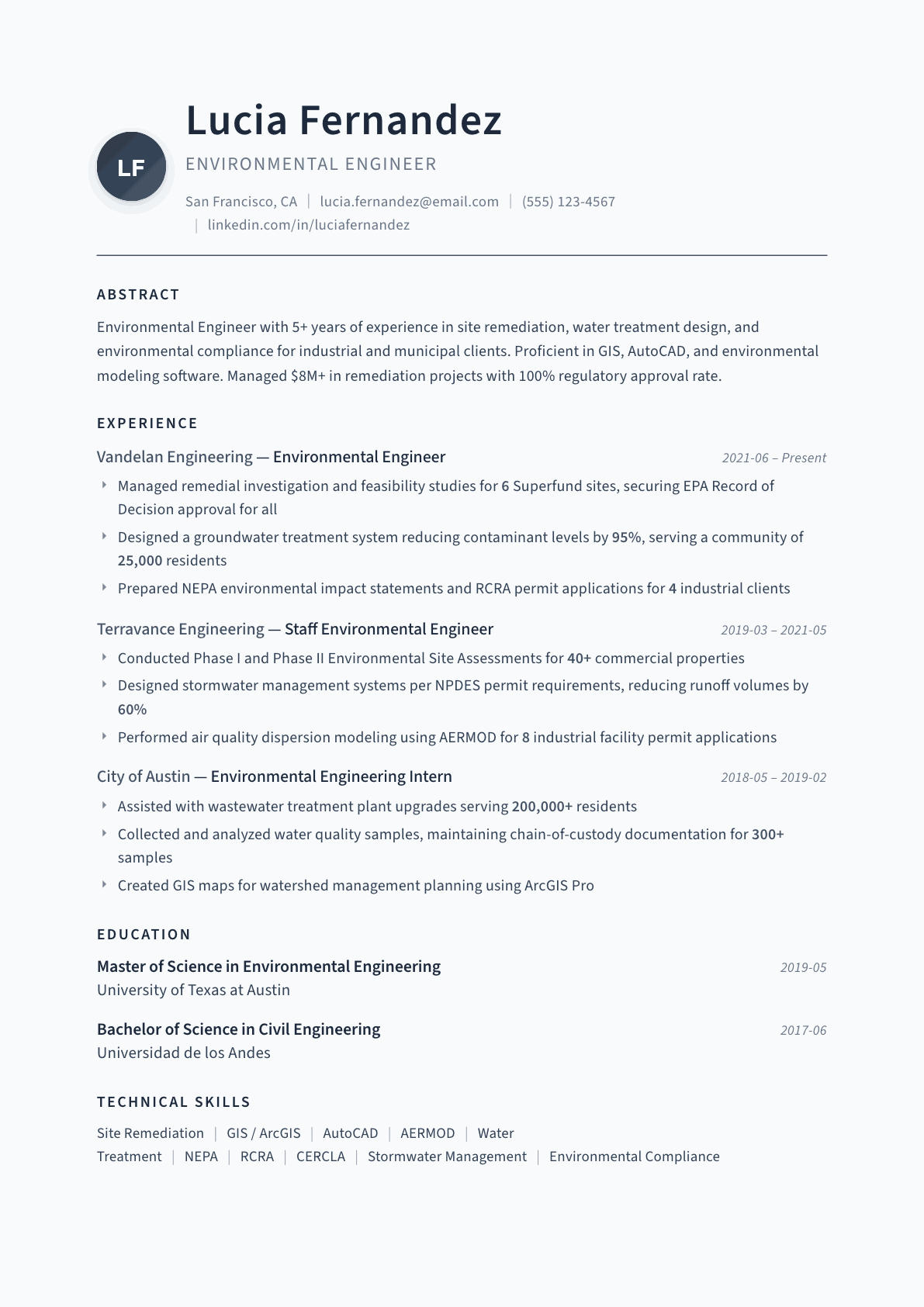
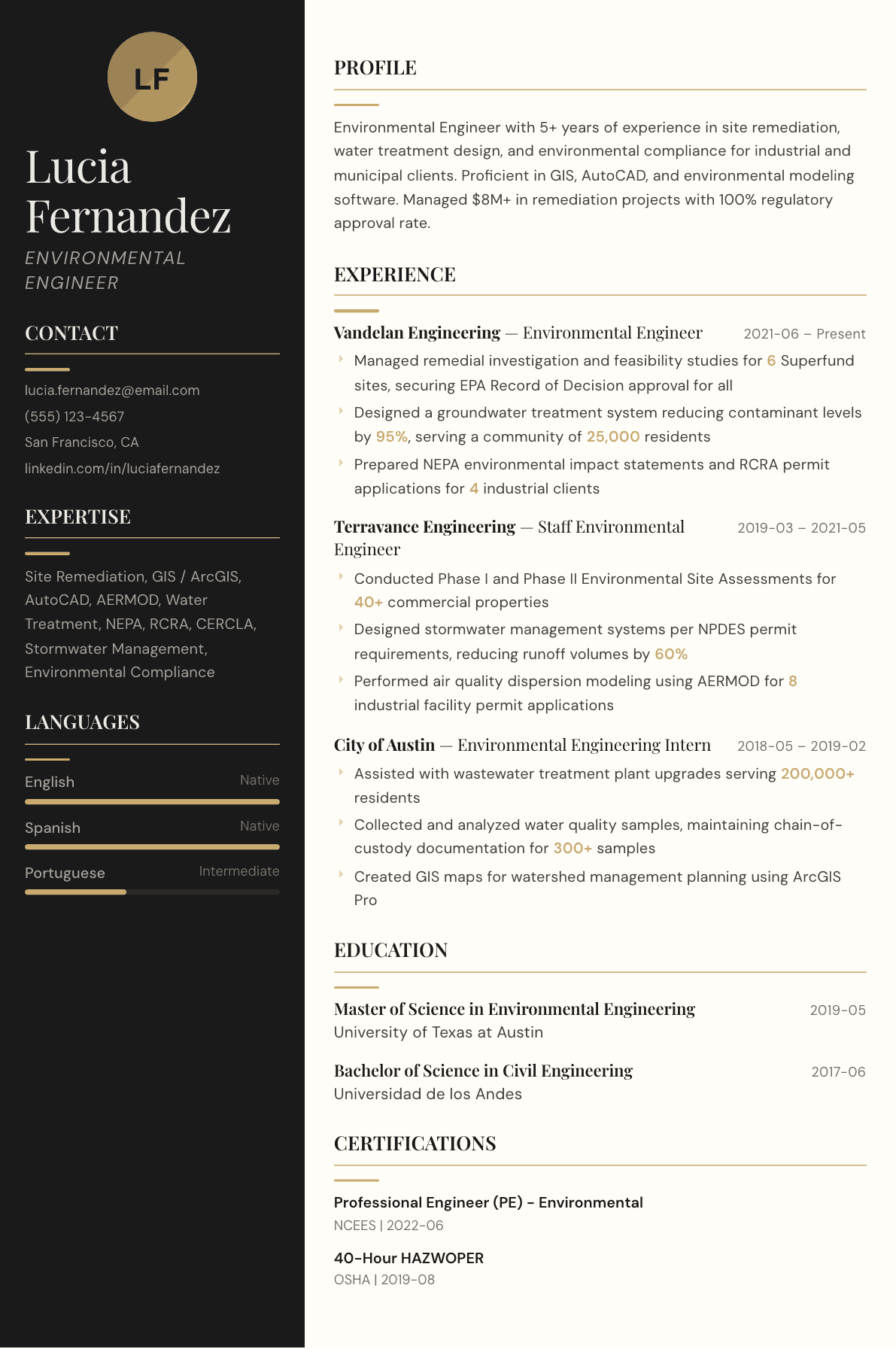
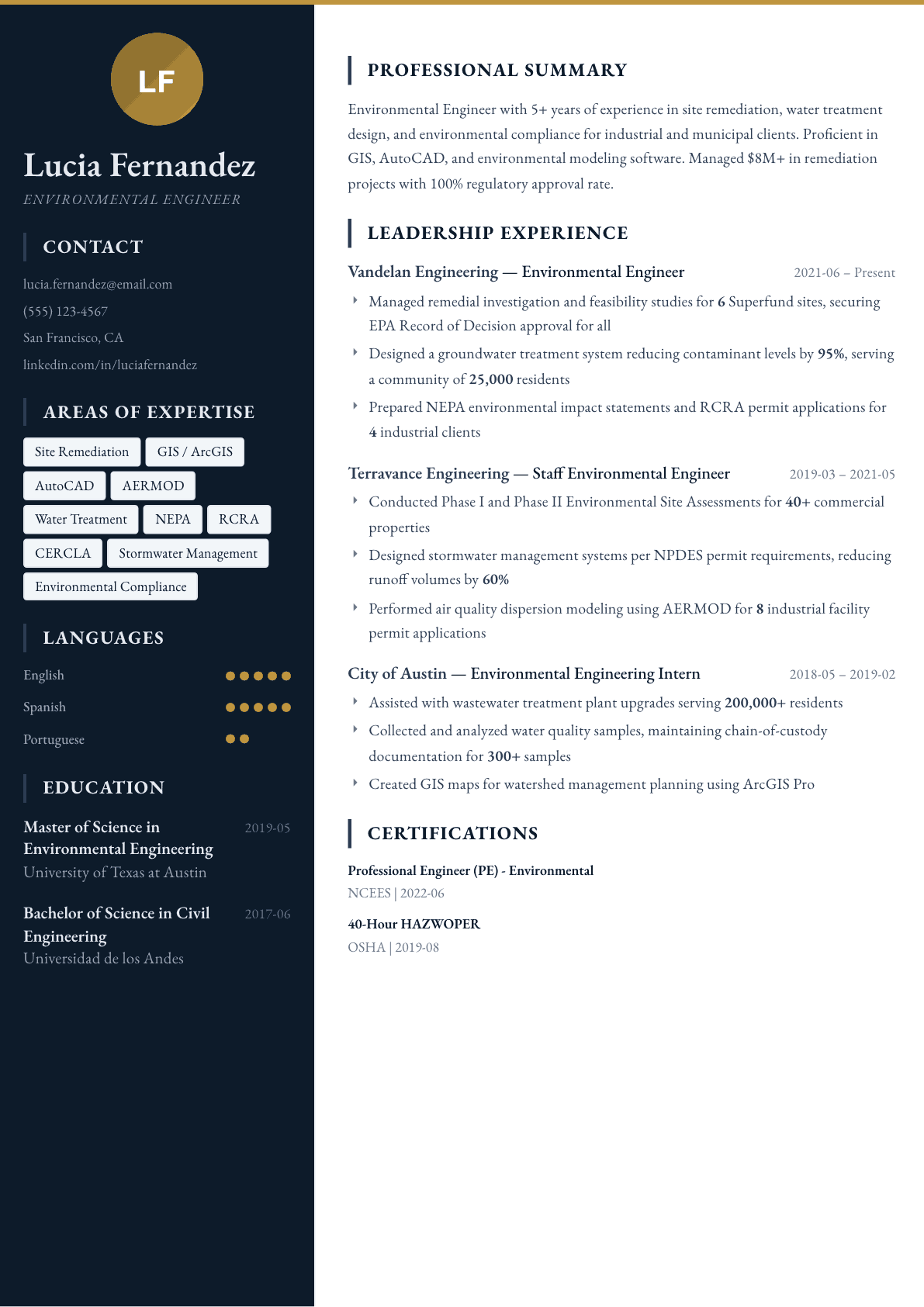
The same environmental engineer content laid out in three CVBooster templates, so you can see what the finished document looks like before you write a word.
Example Environmental Engineer summary
Licensed Environmental Engineer with 5+ years specializing in site remediation, water treatment design, and regulatory compliance. Expert in GIS, AERMOD, and MODFLOW with comprehensive knowledge of NEPA, RCRA, and CERCLA frameworks. Managed $8M+ in remediation projects with a 100% regulatory approval rate.
Skills to list on a Environmental Engineer resume
- Site Remediation
- Environmental Compliance
- NEPA
- RCRA
- CERCLA
- Clean Water Act
- ArcGIS
- AERMOD
- MODFLOW
- Water Treatment Design
- Air Quality Modeling
- Stormwater Management
- Phase I/II ESA
- HAZWOPER
- AutoCAD Civil 3D
What actually gets this resume read
- Highlight regulatory knowledge: NEPA, RCRA, CERCLA, Clean Water Act, Clean Air Act, NPDES.
- Quantify environmental outcomes: contaminant reduction percentages, populations served, sites remediated.
- Include field and laboratory skills: sampling, chain-of-custody, GIS mapping, modeling software.
- Mention your PE license, HAZWOPER certification, or state-specific environmental licenses.
- Describe project types: remediation, compliance, permitting, sustainability, or impact assessments.
- Reference software tools: ArcGIS, AERMOD, MODFLOW, AutoCAD Civil 3D, or Visual MODFLOW.
How to write a environmental engineer resume
An environmental engineer is hired to design something or to keep something legal, and usually both. Consulting firms want remediation systems and treatment designs that get built. Industrial owners want a person who can hold a discharge permit, keep an air permit current and survive an agency inspection without a notice of violation. Municipalities want treatment capacity delivered on a capital schedule.
The screening reader is checking two things: whether you are licensed or on track to be, and which regulatory programs you have worked inside. A resume that describes environmental work in general terms, without naming a permit, a cleanup program or a treatment process, cannot be matched to any of those employers.
This guide lays out the section order environmental consulting and industry expect, three summaries covering a staff engineer through a project manager, before and after bullets from remediation and treatment work, and the questions engineers ask when they move between compliance and design.
Format: licensure, program, and process in the top third
Reverse chronological, single column, PE and states in the header along with the field credentials that get you onto a site. The 40 hour hazardous waste operations training and its annual refresher are worth naming because a candidate without current training cannot be sent to a contaminated site on Monday.
Keep the first third of the page dense with the terms an environmental hiring manager searches for: the cleanup or permitting programs, the media you work in, and the treatment technologies you have designed. Everything soft can wait until the second page.
- Header: name, PE or EIT, states, current health and safety training, location, phone, email.
- Order: summary, licensure and training, experience, representative projects, technical skills and software, education.
- Note the media you work in: soil, groundwater, surface water, air, or solid and hazardous waste.
Summary: the media, the program, the design you produce
Three lines. Name the media and the regulatory program in the same breath, since they define the job: groundwater remediation under a state voluntary cleanup program, hazardous waste corrective action, air permitting under Title V, wastewater treatment design under a discharge permit, or stormwater compliance for industrial sites.
Then say what you design rather than what you support. Pump and treat systems, soil vapor extraction, in situ chemical oxidation, air stripping and carbon adsorption, activated sludge and nutrient removal processes, sedimentation and filtration, baghouses and scrubbers. Design content is the difference between an engineer and a compliance coordinator.
Experience: investigation, design, permit, construction
Follow the arc of an environmental project. Investigation first: site characterization, soil borings and monitoring well installation, sampling programs with chain of custody, laboratory coordination, data validation, and conceptual site model development including contaminant fate and transport.
Then modeling and design. Groundwater flow and transport modeling in MODFLOW and MT3D, air dispersion modeling in AERMOD, hydraulic and hydrologic design for stormwater, treatment process sizing with mass balances and loading rates, and the drawings and specifications that let a contractor build it. Give the design basis: flow rate, contaminant, concentration reduction target, and the cleanup standard you were designing to.
Close with the regulatory and construction end. Permit applications prepared and issued, agency comment rounds resolved, remedial action work plans approved, contractor oversight during installation, performance monitoring after startup, and site closure or no further action determinations. A closure letter is the strongest single line an environmental engineer can put on a resume.
Regulatory programs: name them exactly
Screening filters look for statutory shorthand, so use it while making clear what you did under each program. Hazardous waste generator status and corrective action, federal and state superfund cleanups, discharge permitting for process and stormwater, air permitting including construction and operating permits, spill prevention and countermeasure plans, drinking water regulations, and the state cleanup programs you have worked in by name.
Add the reporting obligations you have owned. Discharge monitoring reports, air emissions inventories, toxic release inventory filings and hazardous waste manifests and biennial reports. Owners hire environmental engineers largely to keep these filed correctly and on time.
Technical skills and software
Group modeling separately from production. Modeling: MODFLOW and Visual MODFLOW, MT3D, AERMOD and the meteorological preprocessors, SWMM and HEC-RAS for stormwater and surface water, and process spreadsheets or treatment simulation tools. Production: AutoCAD Civil 3D, ArcGIS Pro for figures and data management, EQuIS or a comparable environmental data system, and Bluebeam for review sets.
Add field competence, since consulting firms bill for it: well installation oversight, low flow purging and sampling, field instrumentation for photoionization detection and water quality, soil vapor sampling, and health and safety plan preparation.
Environmental Engineer resume summary examples
Staff engineer
Environmental engineer in training with 2 years in site investigation and remediation support. Oversaw installation of 30 monitoring wells, collected and validated 400 groundwater samples, and drafted 6 remedial investigation reports under a state cleanup program. FE passed, 40 hour hazardous waste training current.
Project engineer, six years
Licensed environmental engineer with 6 years designing groundwater remediation and industrial wastewater systems. Designed 4 pump and treat and soil vapor extraction systems, ran MODFLOW capture zone analysis, and secured 9 discharge and air construction permits with no second round of agency comments.
Project manager, twelve years
Environmental engineering project manager registered in 3 states with 12 years across remediation and manufacturing compliance. Manages a 10 person group and a portfolio of 25 active sites, has driven 7 sites to regulatory closure, and leads corrective action negotiations with state and federal agencies.
Work experience bullets: before and after
Before: Performed site investigations at contaminated properties.
After: Directed remedial investigation at a former plating facility: 42 soil borings, 18 monitoring wells, quarterly groundwater sampling for chlorinated solvents and hexavalent chromium, and a conceptual site model that redefined the plume boundary.
Counts, contaminants and a conclusion show investigation work that changed the understanding of the site.
Before: Designed a groundwater treatment system.
After: Designed a 90 gallon per minute pump and treat system with air stripping and liquid phase carbon polishing, sized to meet discharge limits for trichloroethylene, and produced the drawings, specifications and startup plan the contractor built from.
Flow rate, unit processes, the target contaminant and the deliverables define a real design rather than a concept.
Before: Handled environmental permits for the facility.
After: Held the industrial discharge and air operating permits for a 3 building manufacturing site, filed monthly discharge monitoring reports and the annual emissions inventory, and closed 2 agency inspections with no notice of violation.
Naming the permits, the reporting cadence and the inspection outcome proves compliance ownership.
Before: Used modeling software to evaluate contamination.
After: Built a MODFLOW and MT3D model of a 60 acre plume to evaluate 3 remedial alternatives, and used the capture zone results to reduce the proposed extraction well count from 6 to 4 while still containing the plume.
A model that changed a design decision is worth far more than a line saying the software was used.
Before: Oversaw remediation construction work.
After: Provided construction oversight for excavation and disposal of 4,000 tons of impacted soil: manifest tracking, confirmation sampling on the excavation faces, backfill verification and the closure report that supported a no further action determination.
Volume, waste tracking, confirmation sampling and the regulatory outcome complete the story a reviewer wants.
Hard skills
- Site investigation and conceptual site models
- Groundwater remediation design
- Soil vapor extraction and in situ treatment
- Wastewater treatment process design
- Air permitting and emissions inventories
- MODFLOW and MT3D modeling
- AERMOD dispersion modeling
- SWMM stormwater modeling
- Discharge and stormwater permitting
- Hazardous waste management and manifesting
- AutoCAD Civil 3D
- ArcGIS Pro and environmental data systems
- Construction oversight and confirmation sampling
Soft skills
- Agency negotiation and comment response
- Field crew and subcontractor supervision
- Health and safety leadership on site
- Explaining risk to non technical stakeholders
- Managing multiple active sites at once
Certifications worth listing
- Professional Engineer (PE), Environmental (State board of professional engineers, exam by NCEES)
- Engineer in Training (EIT) after the FE exam (NCEES and the state licensing board)
- Board Certified Environmental Engineer (BCEE) (American Academy of Environmental Engineers and Scientists)
- Certified Hazardous Materials Manager (CHMM) (Institute of Hazardous Materials Management)
- HAZWOPER 40-Hour Training (OSHA compliant training provider)
- Certified Professional in Erosion and Sediment Control (CPESC) (EnviroCert International)
Mistakes that cost environmental engineer candidates the interview
- Describing yourself as working on environmental projects without naming a single regulatory program, which makes the experience impossible to match to a posting.
- Leaving out current health and safety training, so a consulting firm assumes you cannot be mobilized to a site.
- Reporting investigation work with no design content, which reads as a technician role rather than an engineering one.
- Omitting the cleanup standard or permit limit you designed to, the number that defines whether the design succeeded.
- Listing modeling packages without ever showing a decision the model informed.
- Skipping closure outcomes and agency approvals, which are the results owners and consultants actually buy.
Environmental Engineer resume questions
Do environmental engineers need a PE license?
For consulting design work yes, because reports and drawings submitted to agencies are sealed. Industrial compliance roles often accept an unlicensed engineer with strong permit experience, but the license still decides who is promoted to project manager.
What is the difference between an environmental engineer and an environmental scientist resume?
The engineer resume is weighted toward design, modeling and sealed deliverables such as treatment systems and permit applications. The scientist resume is weighted toward field investigation, ecological assessment and impact documentation. Overlap exists, but lead with the half the posting is buying.
How do I show field experience without sounding like a technician?
Frame the field work as engineering oversight: you scoped the sampling program, directed the drillers, decided where the wells went and validated the data before it reached the model. Volume alone reads as labor, while the decisions read as engineering.
Should I list every site I have worked on?
No. Group them by program and give counts, then describe in detail the four or five sites that resemble the posting by contaminant, media and regulatory framework. Depth on comparable sites beats an inventory nobody reads.
How do I move from consulting into an industrial compliance role?
Rewrite the summary around permits held rather than projects delivered, and pull the reporting obligations, inspection outcomes and management system work to the top. Industrial hiring managers are buying continuity and regulatory calm, not billable throughput.
Related resume examples
- Civil Engineer Resume example
- Chemical Engineer Resume example
- Safety Engineer Resume example
- Water Resources Engineer Resume example
- Water Treatment Engineer Resume example
- Agricultural Engineer Resume example