Marine Biologist Resume Examples: the lines they read
Craft a Marine Biologist Resume That Makes Waves
By Mustafa Tarabya, founder of CVBooster · Published · Updated
Build a marine biologist resume showcasing field research, conservation expertise, and data analysis skills with templates designed for academic and environmental organizations.
Sample resumes for a marine biologist
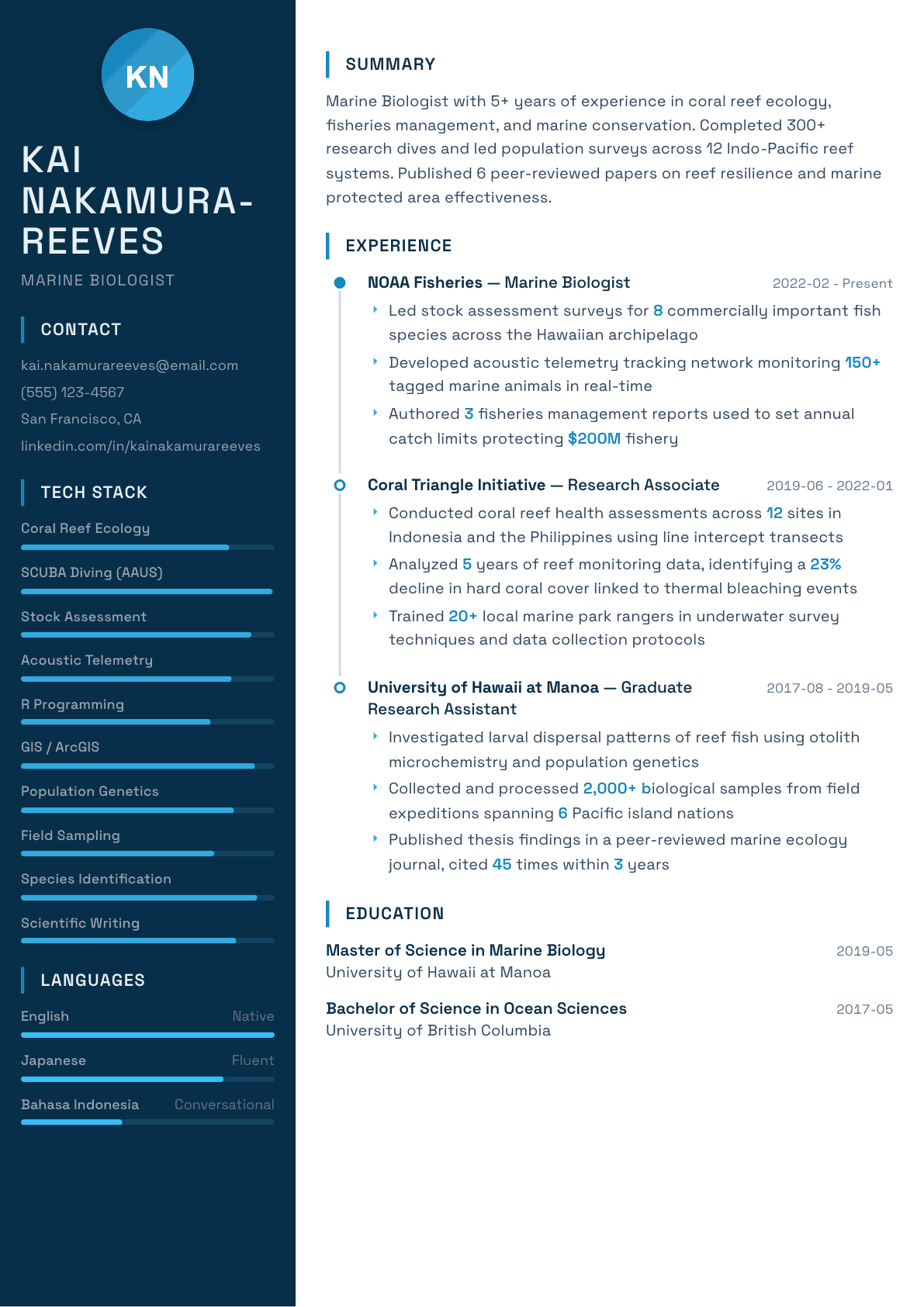
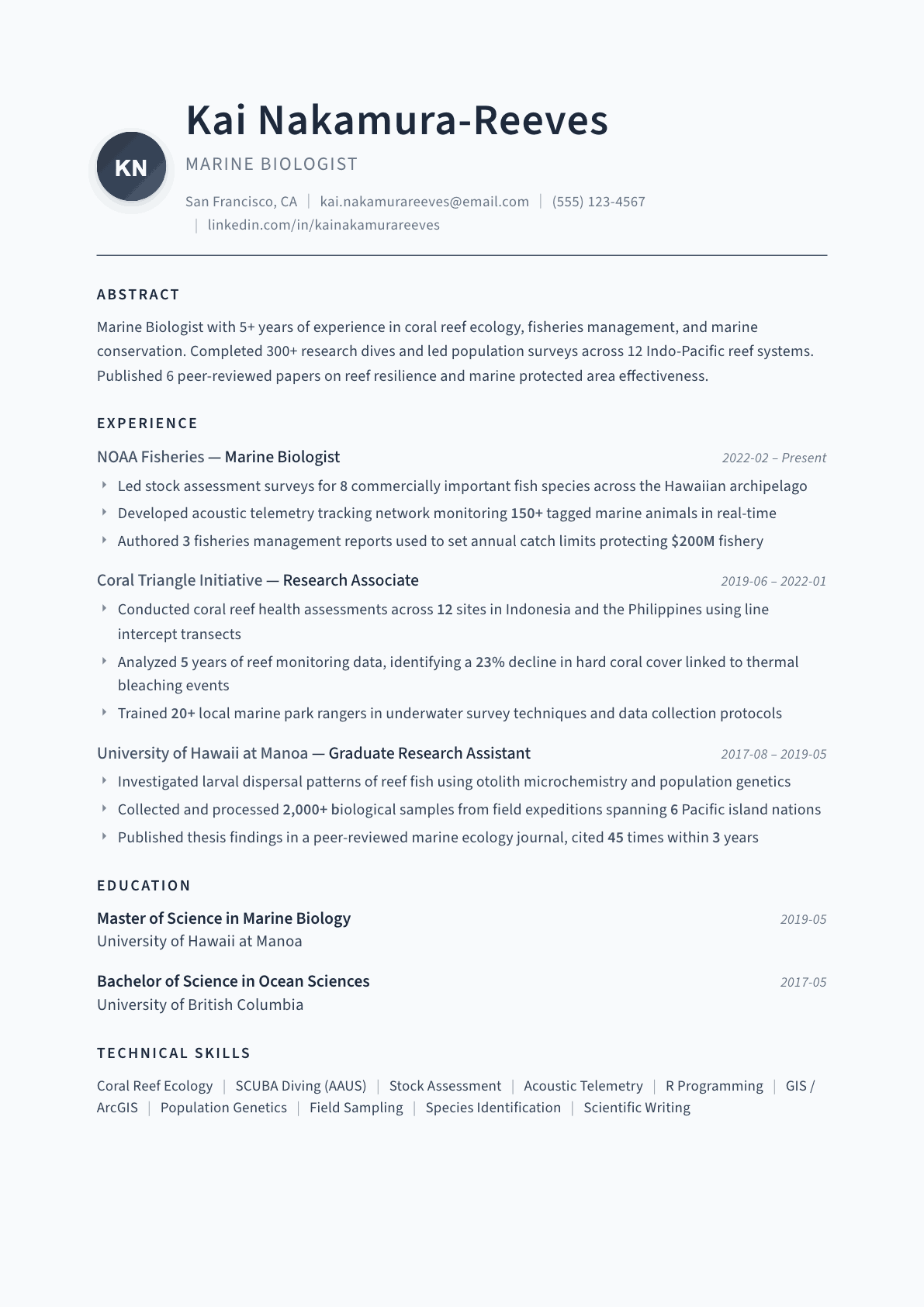
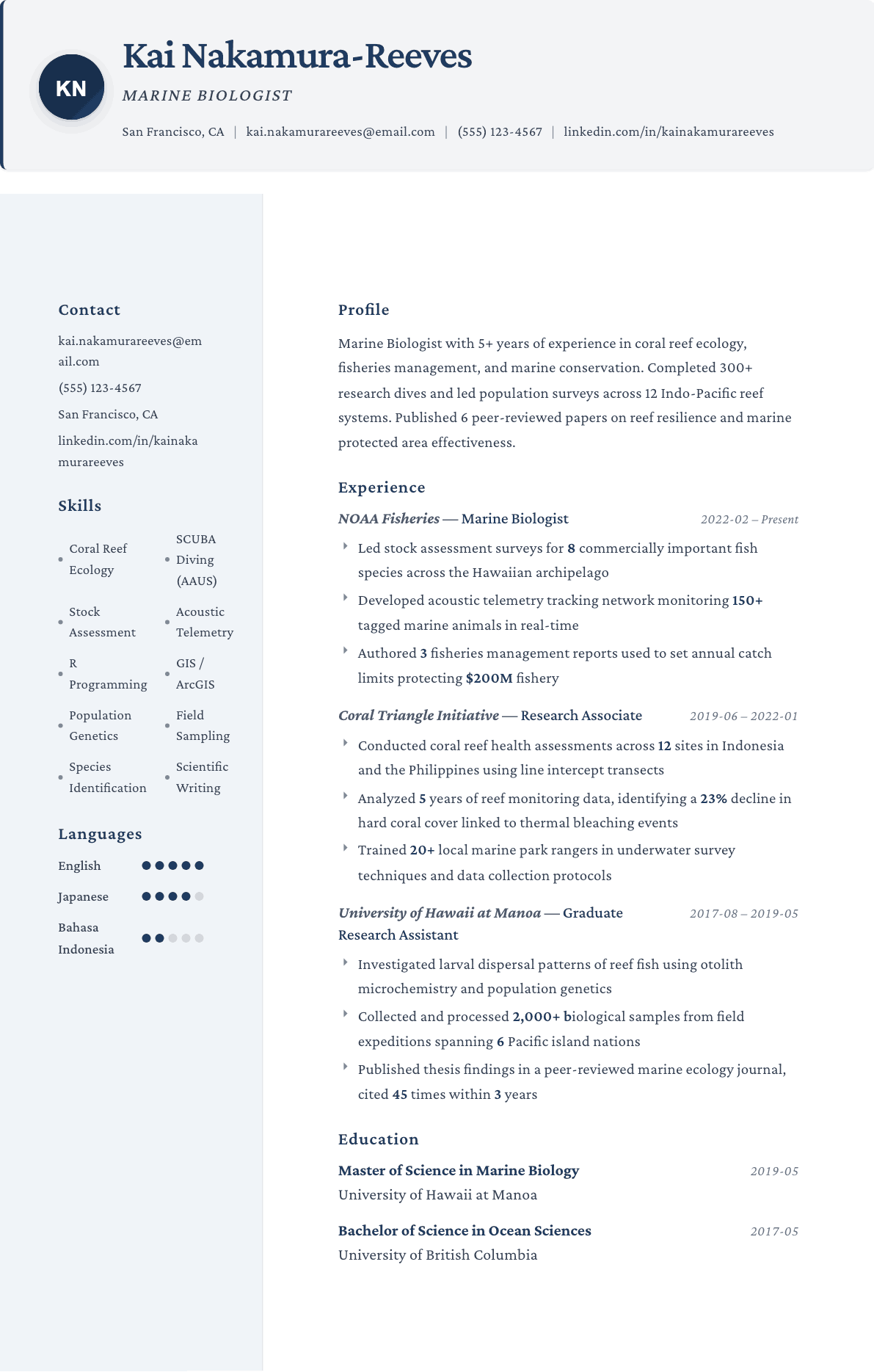
The same marine biologist content laid out in three CVBooster templates, so you can see what the finished document looks like before you write a word.
Example Marine Biologist summary
AAUS-certified Marine Biologist with 5+ years of experience in coral reef ecology and fisheries management. Completed 300+ research dives across 12 Indo-Pacific reef systems. Published 6 peer-reviewed papers on reef resilience. Skilled in acoustic telemetry, population genetics, and GIS-based spatial analysis.
Skills to list on a Marine Biologist resume
- Coral Reef Ecology
- Fisheries Science
- SCUBA / Scientific Diving
- Acoustic Telemetry
- GIS / Remote Sensing
- R Programming
- Population Genetics
- Species Identification
- Field Sampling
- Scientific Writing
- Environmental Policy
- Stock Assessment Models
What actually gets this resume read
- Highlight fieldwork experience: dive hours, research expeditions, and geographic scope of your work.
- Quantify survey data: number of sites, transects, specimens collected, or species identified.
- Include diving certifications and boating licenses prominently since they are essential qualifications.
- Mention statistical and GIS tools: R, Python, ArcGIS, PRIMER, or MATLAB.
- Reference conservation outcomes: protected area designations, policy recommendations, or fishery quotas influenced.
How to write a marine biologist resume
Marine biology hiring splits into worlds that read resumes differently. A federal fisheries science center, a state resource agency, an environmental consultancy, an aquarium or husbandry operation, a conservation organization and a university lab all use the title, and each weights a different part of your file. Federal and academic reviewers want publications, permits and quantitative method. Consultancies want field productivity, survey protocols and reporting. Aquariums want animal husbandry and public safety.
Across all of them, three things get read first: field capability, taxonomic or system expertise, and data skills. Field capability means dive qualifications, small boat handling, sampling gear and how many seasons you have survived. Data skills increasingly means statistical programming, because most marine positions are now half analysis.
This guide explains the resume against curriculum vitae decision, how to lay out field seasons and vessel time, summaries from a first technician role to a project scientist, and the questions marine biologists ask when their experience is spread across grants, contracts and volunteer work.
Resume or curriculum vitae: decide before you write a word
Academic postdoctoral positions, faculty roles and some federal research jobs expect a curriculum vitae with a full publication and presentation list and no length limit. Consulting firms, nonprofits, aquariums and most state agency positions expect a two page resume. Sending the wrong document type is the most common self inflicted rejection in this field.
Federal applications are a third case with their own rules, including detailed duties, hours per week and supervisor contact for each position. Keep a long form version you trim down, rather than trying to stretch a short one.
- Header: name, city and state, phone, email, and a professional profile or repository link if you maintain one.
- Resume order: summary, field and technical skills, research and field experience, education, publications selected, certifications.
- Dive qualifications, boat operator training and vessel days belong high on the page for any field position.
Summary: system, taxa, methods, and the analysis you can do
Name the marine system and the organisms. Coral reef ecology, temperate kelp forest, estuarine fish, deep sea benthic invertebrates, marine mammals and shellfish aquaculture are separate specialisms, and a hiring scientist places you instantly once you say which.
Then name your methods and your analysis. Underwater visual census on transects, benthic photoquadrats, acoustic telemetry, environmental DNA sampling, otolith or stable isotope work, trawl and longline sampling, or photo identification. Follow with the statistics you can run yourself, because a candidate who codes their own analysis in R saves a project scientist an entire hire.
Field experience: seasons, dives, vessels and permits
Give each position the organization, the location, the season dates and the platform. A field entry that says a research vessel, an offshore reef system and a stated number of survey days reads as professional experience. One that says assisted with fieldwork reads as a class trip.
Quantify field effort with the units the discipline uses. Research dive count and logged bottom time, vessel days at sea, transects or quadrats completed, stations sampled, animals tagged or handled, hours of video or acoustic data reviewed. These numbers are how a field lead estimates how much supervision you will need.
Say what you were trusted to do alone. Leading a dive pair, running a survey line, operating a small boat, maintaining a receiver array, calibrating a conductivity temperature depth instrument, or handling a permit condition are all indicators of independence. Mention permits and protocols by category: protected species handling, collection permits, and animal care committee approvals, since work under those constraints is a distinct skill.
Data and analysis: the half of the job people undersell
Marine biology positions read like ecology jobs on the surface and like data jobs in the day to day. Say what you analyze and in what. R is the field standard, with generalized linear and mixed models, multivariate community analysis, and mark recapture or occupancy modeling common in postings. Python appears in acoustics, imagery and remote sensing work.
Spatial ability is worth its own line. Geographic information systems for habitat mapping, bathymetry and species distribution modeling, plus any acoustic processing, image annotation or machine assisted classification you have used, are the skills that turn a seasonal technician into a permanent hire.
Publications, reports and funding
On a two page resume, list a handful of the most relevant outputs rather than everything, and include gray literature. Agency technical reports, management plans, monitoring reports and survey summaries are the products most marine employers actually generate, and demonstrating you can write one matters more to them than a citation count.
Grants, fellowships and awarded field funding belong on the page even when small. They tell a supervisor you can write a proposal, budget a field season and report against it. If you have run outreach, volunteer training or a citizen science program, give it a line, since community engagement is written into a great many marine conservation job descriptions.
Marine Biologist resume summary examples
Seasonal technician
Marine biology graduate with two field seasons on temperate rocky reef monitoring, 85 logged research dives and an American Academy of Underwater Sciences scientific diver rating. Experienced with underwater visual census, photoquadrat annotation and R for data cleaning. Seeking a seasonal fisheries or reef monitoring technician position.
Field biologist, five years
Marine biologist with five years of coral reef and reef fish monitoring across 3 island systems, 400 research dives and 90 vessel days. Runs transect surveys, maintains an acoustic receiver array, and analyzes community data in R. Lead author on 2 monitoring reports used in marine protected area review.
Project scientist
Project scientist with ten years in fisheries ecology, leading survey design, permitting and field logistics for multi-vessel campaigns. Built stock assessment inputs for 4 managed species, secured competitive research funding across 3 grant cycles, and supervises a team of 6 technicians and graduate students.
Work experience bullets: before and after
Before: Assisted with field research on coral reefs.
After: Completed 210 research dives across 14 reef sites, running line intercept transects and photoquadrats, and processed the imagery to benthic cover estimates in image annotation software.
Dive count, site count and named survey methods let a field lead judge exactly what you can be assigned to.
Before: Analyzed data collected during surveys.
After: Modeled reef fish biomass against habitat and protection status using generalized linear mixed models in R, and wrote the reproducible analysis pipeline the monitoring program now reruns each year.
Naming the model class and leaving behind reusable code shows an analyst rather than a spreadsheet user.
Before: Helped with tagging marine animals.
After: Surgically implanted acoustic transmitters in 60 juvenile fish under an approved animal care protocol, and maintained a 24-receiver array including download, biofouling removal and battery service.
The procedure, the sample size, the ethics approval and array upkeep together prove supervised-to-independent capability.
Before: Wrote reports on project findings.
After: Authored the annual reef monitoring report submitted to the state resource agency, including trend figures for 12 indicator taxa and management recommendations discussed at a public advisory meeting.
Naming the audience and what the report was used for turns writing into an outcome a manager recognizes.
Before: Trained volunteers in survey methods.
After: Designed and delivered a three-day survey training for 22 park rangers and volunteers covering species identification, transect protocol and data entry, with a post-training identification check before certification.
The structure, the size of the cohort and the competence check show program building, not a one-off talk.
Hard skills
- Underwater visual census and transect survey
- Scientific diving and dive planning
- Small boat operation and field logistics
- Benthic photoquadrat and image annotation
- Acoustic telemetry and receiver arrays
- Environmental DNA sampling
- Fish ageing and otolith preparation
- Species identification and taxonomy
- R for ecological statistics
- Geographic information systems and habitat mapping
- Mark recapture and occupancy modeling
- Water quality instrumentation and CTD casts
- Scientific and technical report writing
- Permit and animal care protocol compliance
Soft skills
- Tolerance for long field days
- Team living aboard vessels
- Careful data recording in poor conditions
- Public and stakeholder communication
- Risk assessment in the water
- Mentoring field volunteers
Certifications worth listing
- Scientific Diver (American Academy of Underwater Sciences member organization)
- Divemaster (PADI)
- Master Scuba Diver or Divemaster (NAUI)
- Diving First Aid for Professional Divers (Divers Alert Network)
- Certified Fisheries Professional (American Fisheries Society)
- Motorboat Operator Certification Course (US Department of the Interior)
Mistakes that cost marine biologist candidates the interview
- Sending a curriculum vitae to a consultancy or a two page resume to an academic search. Decide the document type from the employer, not from habit.
- Writing passion for the ocean in the summary. Every applicant has it, and it displaces a line that could have named your survey methods.
- Leaving out dive numbers, vessel days and boat qualifications, which a field lead needs before deciding whether you can be scheduled.
- Hiding the quantitative work. Many marine positions are won on statistical programming, and burying R in a skills list undersells it.
- Listing every volunteer beach cleanup as though it were research experience, which dilutes the genuine field seasons above it.
- Omitting technical reports and management documents because they are not peer reviewed, when those are exactly the products agency and consulting employers need written.
Marine Biologist resume questions
Should a marine biologist use a resume or a CV?
Use a two page resume for consulting, nonprofit, aquarium and most agency positions, and a full curriculum vitae for academic and research scientist searches. Federal applications need their own long form with hours per week and supervisor details for every position.
How do I list scuba certifications on a marine biology resume?
Put the certifying agency, the rating level, your total logged dives and your research dive count together near the top of the skills block. Add current medical clearance, oxygen provider training and any specialty ratings such as nitrox or small boat operator that the posting mentions.
How do I get a marine biology job with only volunteer field experience?
Describe the volunteer work using the same structure as paid work: organization, dates, platform, methods and effort completed. Then strengthen the analysis half of your resume, because volunteers who can clean, model and plot their own datasets get hired ahead of ones who cannot.
Do publications matter for a non-academic marine biology position?
They help but they are not the deciding factor. Consultancies and agencies care more that you can produce a defensible monitoring report on schedule, so list a few peer reviewed papers and give equal space to technical reports, management plans and survey summaries you wrote.
What software should be on a marine biologist resume?
R first, since it is the working language of the field, followed by geographic information systems software, image or video annotation tools, and any acoustic or telemetry processing packages you use. Add Python if you work with imagery, remote sensing or large acoustic datasets.