Physicist Resume Examples: free ATS score and gap list
Build a Physicist Resume with Maximum Force
By Mustafa Tarabya, founder of CVBooster · Published · Updated
Create a physicist resume showcasing theoretical modeling, experimental physics, and computational expertise with templates designed for academic, national lab, and industry roles.
Sample resumes for a physicist
The same physicist content laid out in three CVBooster templates, so you can see what the finished document looks like before you write a word.
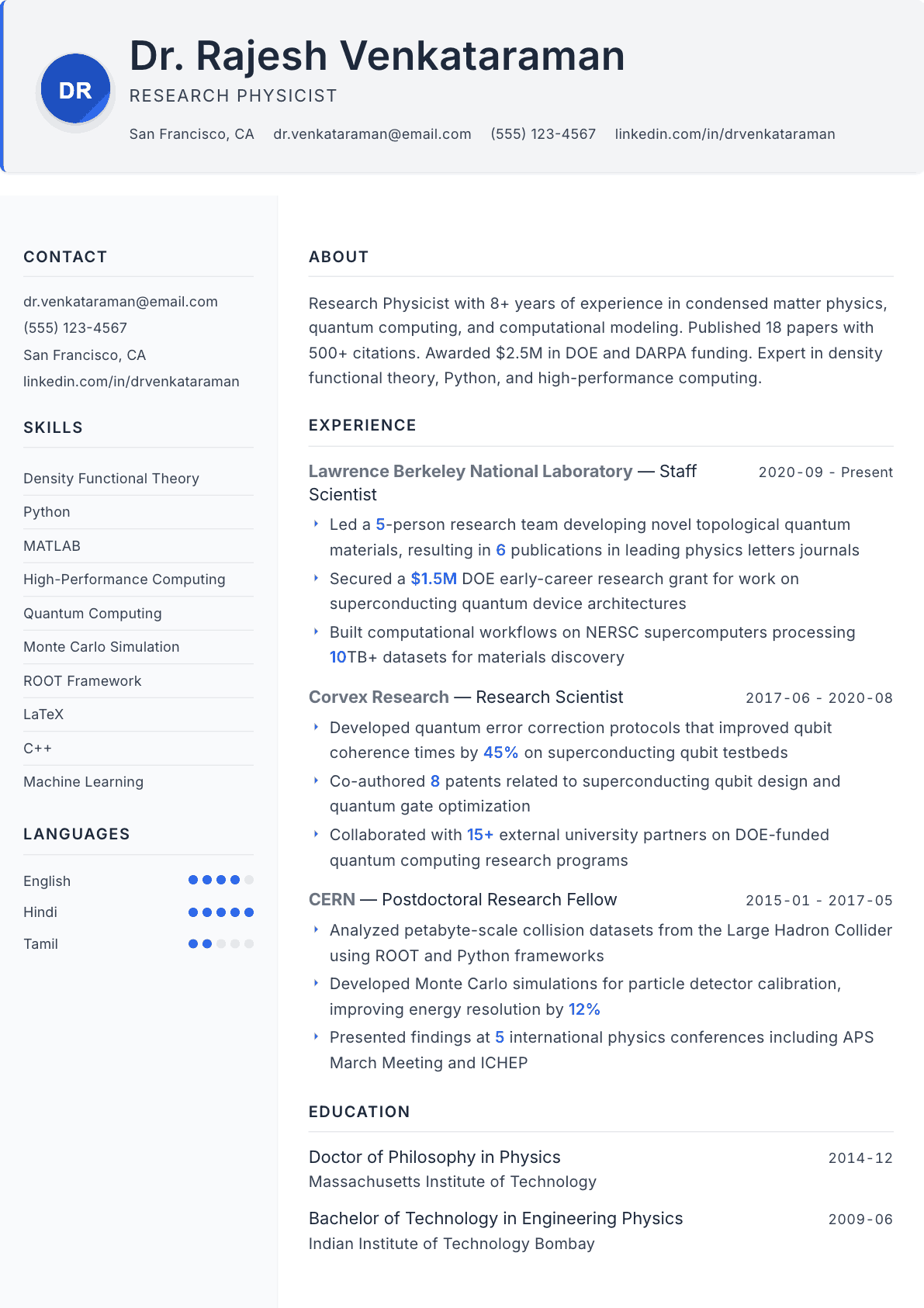
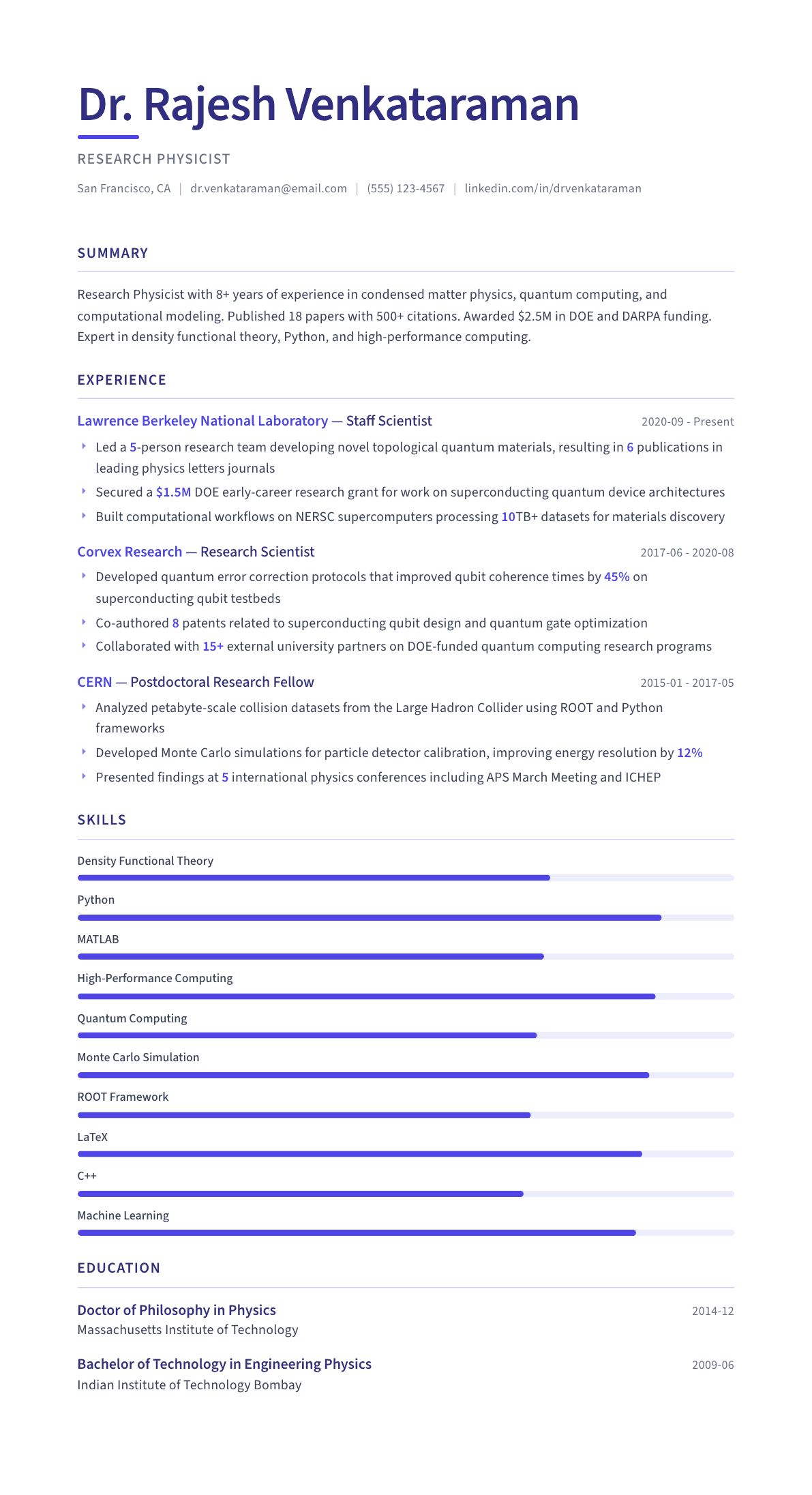
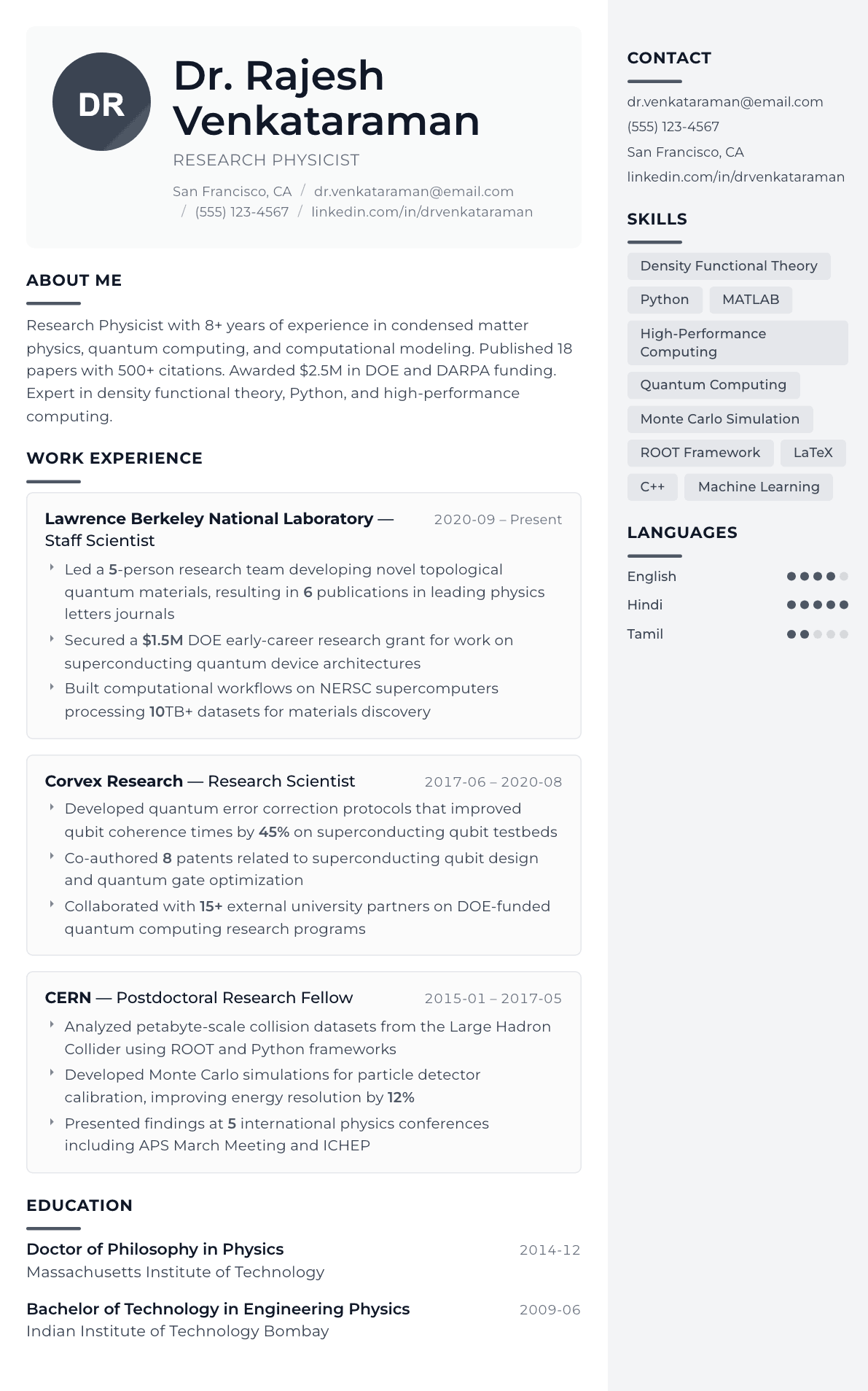
Example Physicist summary
Research Physicist with 8+ years in condensed matter physics and quantum computing, leading a 5-person team on topological quantum materials. Published 18 papers with 500+ citations and secured $2.5M in DOE and DARPA funding. Expert in density functional theory, high-performance computing, and superconducting qubit design.
Skills to list on a Physicist resume
- Theoretical Physics
- Computational Modeling
- Density Functional Theory
- Quantum Computing
- Python
- MATLAB
- C++ / Fortran
- Monte Carlo Simulation
- High-Performance Computing
- Machine Learning
- Data Analysis
- Scientific Writing
What actually gets this resume read
- Lead with publication metrics: paper count, citation count, h-index, and notable journals.
- Highlight funding secured: grant amounts, agencies (DOE, NSF, DARPA, ERC), and project titles.
- List computational tools: Python, MATLAB, C++, Fortran, ROOT, COMSOL, or VASP.
- Include patents alongside publications for industry-oriented roles.
- Mention high-performance computing experience: NERSC, XSEDE, or institutional clusters.
How to write a physicist resume
Physicists apply into three different hiring systems with the same training. A university search committee reads a long academic curriculum vitae and cares about first-author output, teaching and independent research direction. A national laboratory reads a hybrid document and cares about programs, facilities and clearance eligibility. An industry team reads a two-page resume and cares about what you can build, measure or model for their product.
The single most common failure is sending the academic document to the industry job. A twelve-page publication list tells a semiconductor or defense hiring manager nothing about whether you can run a cryostat, write production Python, or design an experiment against a schedule. The physics is not the problem, the framing is.
This guide covers how to decide which document to send, how to describe experimental and computational work so a non-specialist manager can evaluate it, summaries for a fresh doctorate, a mid-career scientist and a group leader, and the mistakes that keep strong physicists out of interviews.
Pick the document before you pick the words
Academic faculty and postdoctoral applications take the full curriculum vitae: publications, talks, teaching, funding, service, with no page limit. Laboratory staff scientist positions usually take a three to four page version with a selected publication list and a research statement attached separately. Industry takes two pages, and one page if you finished your doctorate recently.
When you cut to two pages, cut the publication list to five entries under a heading that says selected, drop conference posters entirely, and use the reclaimed space on what you actually did in the lab or on the cluster. The reader is not qualified to judge your journal, but she can judge whether you built the apparatus.
- Faculty or postdoc: full curriculum vitae, publications in reverse order, funding, teaching, service.
- National laboratory: summary, research experience, selected publications, facilities and instrumentation, clearance status.
- Industry: summary, technical skills, experience with outcomes, education, selected output.
Describe the physics as capability, not as a topic
A subfield name is not a qualification. "Condensed matter physics" describes a literature, while "built and operated a dilution refrigerator to milliKelvin base temperature with lock-in and RF readout" describes a person who can be hired. Write the second kind of line for every position you have held.
For experimentalists, name the apparatus, the measurement chain and the environment: vacuum systems, cryogenics, laser systems, cleanroom fabrication steps, detector electronics, beamline endstations, the analysis pipeline. For theorists and computational physicists, name the method and the scale: density functional theory, Monte Carlo, molecular dynamics, lattice methods, finite element modeling, the codes you used, and the machines they ran on.
Say what the result was for. A calibration that improved a detector, a model that changed a design choice, a measurement that resolved a disagreement in the group: this is the sentence that turns a physicist into a candidate.
Publications, talks and funding without padding
On an academic document, list everything in a consistent citation style, put your own name in bold if the format allows it, and mark first-author and corresponding-author work clearly. Separate refereed articles from preprints and conference proceedings rather than blending them into one inflated count.
Funding is a section of its own for anyone applying to lead research: the program, your role as principal investigator or co-investigator, and the period. On an industry resume, funding becomes a single line about writing successful proposals, because the hiring manager reads it as evidence you can win internal budget.
The skills section industry actually reads
Group your technical skills so a non-physicist can scan them: programming and analysis, instrumentation and hardware, simulation and modeling, fabrication. Python with NumPy and SciPy, C++, MATLAB, LabVIEW, ROOT, COMSOL, Geant4 and version control are all searchable terms that appear in postings for optics, semiconductor, medical device and quantum hardware teams.
Include the practical, unglamorous items that experimentalists take for granted and employers value: instrument control and automation, data acquisition, statistical analysis and uncertainty budgets, design of experiments, safety training for lasers or radiation sources, and machine shop or CAD work.
Education, clearance and the transition line
Put the doctorate with the institution, the field, the advisor when it is meaningful, and a one-line dissertation description written in plain language. A hiring manager outside your subfield should be able to read that line and understand the problem you solved.
If you are moving from academia into industry, state the move in the summary and name the transferable core: modeling, measurement, statistics, instrumentation, and the habit of finishing hard projects with ambiguous specifications. If you hold or have held a government clearance, list the level and status, because laboratory and defense roles filter on it directly.
Physicist resume summary examples
New doctorate
Experimental physicist completing a PhD in atomic and optical physics, with 5 years building laser cooling and trapping apparatus, including locking systems, ultra-high vacuum chambers and Python-based instrument control. Author of 4 refereed papers and seeking an instrumentation role in quantum hardware.
Six years post-PhD
Computational physicist with 6 years modeling semiconductor materials using density functional theory and kinetic Monte Carlo on high-performance clusters. Owns a simulation pipeline in Python and C++ used across 3 device teams, and translates modeling results into process and design recommendations.
Group leader
Staff physicist leading a team of 7 in detector development, responsible for cryogenic readout, calibration and analysis for a multi-institution collaboration. Principal investigator on 2 funded programs, author of 30 refereed papers, and holder of an active government clearance.
Work experience bullets: before and after
Before: Conducted research in condensed matter physics.
After: Measured transport in exfoliated two-dimensional heterostructures at dilution refrigerator temperatures, building the sample holder, wiring and lock-in readout chain from scratch.
The apparatus and the fact that you built it convert a field name into a demonstrable hands-on capability.
Before: Used simulations to study material properties.
After: Ran density functional theory calculations on 400 candidate compositions using a workflow I automated in Python, cutting the manual setup time per structure from hours to minutes.
Method, scale and the automation you contributed show engineering discipline, not just familiarity with a code.
Before: Published several papers in peer-reviewed journals.
After: First author on 4 refereed papers, including the group result that resolved a factor-of-2 disagreement between two published measurements of the same transition.
Authorship position plus one concrete scientific outcome is worth more than a raw publication count.
Before: Analyzed large datasets from the experiment.
After: Built the calibration and event-selection pipeline for a 40-terabyte detector dataset in C++ and ROOT, reducing the systematic uncertainty on the primary observable by a third.
Data volume, tools and the effect on uncertainty give a reviewer something quantitative to judge.
Before: Mentored graduate students in the lab.
After: Supervised 3 graduate students and 2 undergraduates on the vacuum and laser systems, writing the alignment procedure the group still uses for new members.
The people count and the surviving artifact prove mentoring produced something the lab kept.
Hard skills
- Experimental design and uncertainty analysis
- Python for scientific computing
- C++
- MATLAB
- LabVIEW instrument control
- Cryogenics and vacuum systems
- Laser and optical alignment
- Density functional theory
- Monte Carlo simulation
- Finite element modeling with COMSOL
- Data acquisition electronics
- High-performance computing workflows
- Cleanroom fabrication
- Statistical inference and curve fitting
Soft skills
- Explaining technical results to non-specialists
- Independent problem framing
- Collaboration across large teams
- Proposal and technical writing
- Mentoring students and junior staff
Mistakes that cost physicist candidates the interview
- Sending a twelve-page academic curriculum vitae to an industry posting that asked for a resume.
- Naming the subfield and the theory but never the apparatus, code or dataset you personally handled.
- Listing every conference poster and seminar, which pads the page and hides the refereed work.
- Writing bullets only another physicist in your subfield can decode, when the first reader is a recruiter.
- Leaving clearance status off a national laboratory or defense application, which forces the recruiter to guess.
- Treating teaching assistant duties as filler instead of evidence you can explain hard material to an audience.
Physicist resume questions
What is the difference between a physics CV and a physics resume?
The curriculum vitae is a complete record with no page limit, used for academic and fellowship applications. The resume is a two-page argument for one specific job, with a selected publication list and the technical capability the employer asked for moved to the front.
How do I put a physics PhD on an industry resume?
Treat it as five years of project work. Give the institution, the field and one plain-language line on the problem, then write the research like employment: what you built, which methods you used, what the result changed, and who you worked with.
Should a physicist list programming languages separately?
Yes. Group them under a technical skills heading with the libraries and environments you use, because postings in semiconductors, optics, medical devices and quantum hardware are filtered on those exact terms before a human ever reads the file.
Do I include teaching experience on a physicist resume?
On an academic document, always, with courses and enrollment. On an industry resume, keep one line only if it demonstrates communication or supervision, such as designing a laboratory course or training a group of students on instrumentation.
How many publications should a physicist list?
All of them on the academic curriculum vitae, grouped by type. Five at most on an industry resume, chosen for relevance rather than prestige, under a heading that says selected publications so nobody thinks the list is your complete record.