Botanist Resume Examples: free score, then the gap list
Grow a Botanist Resume That Flourishes
By Mustafa Tarabya, founder of CVBooster · Published · Updated
Create a botanist resume showcasing plant taxonomy, ecological research, and conservation expertise with templates tailored for academic, government, and environmental roles.
Sample resumes for a botanist
The same botanist content laid out in three CVBooster templates, so you can see what the finished document looks like before you write a word.
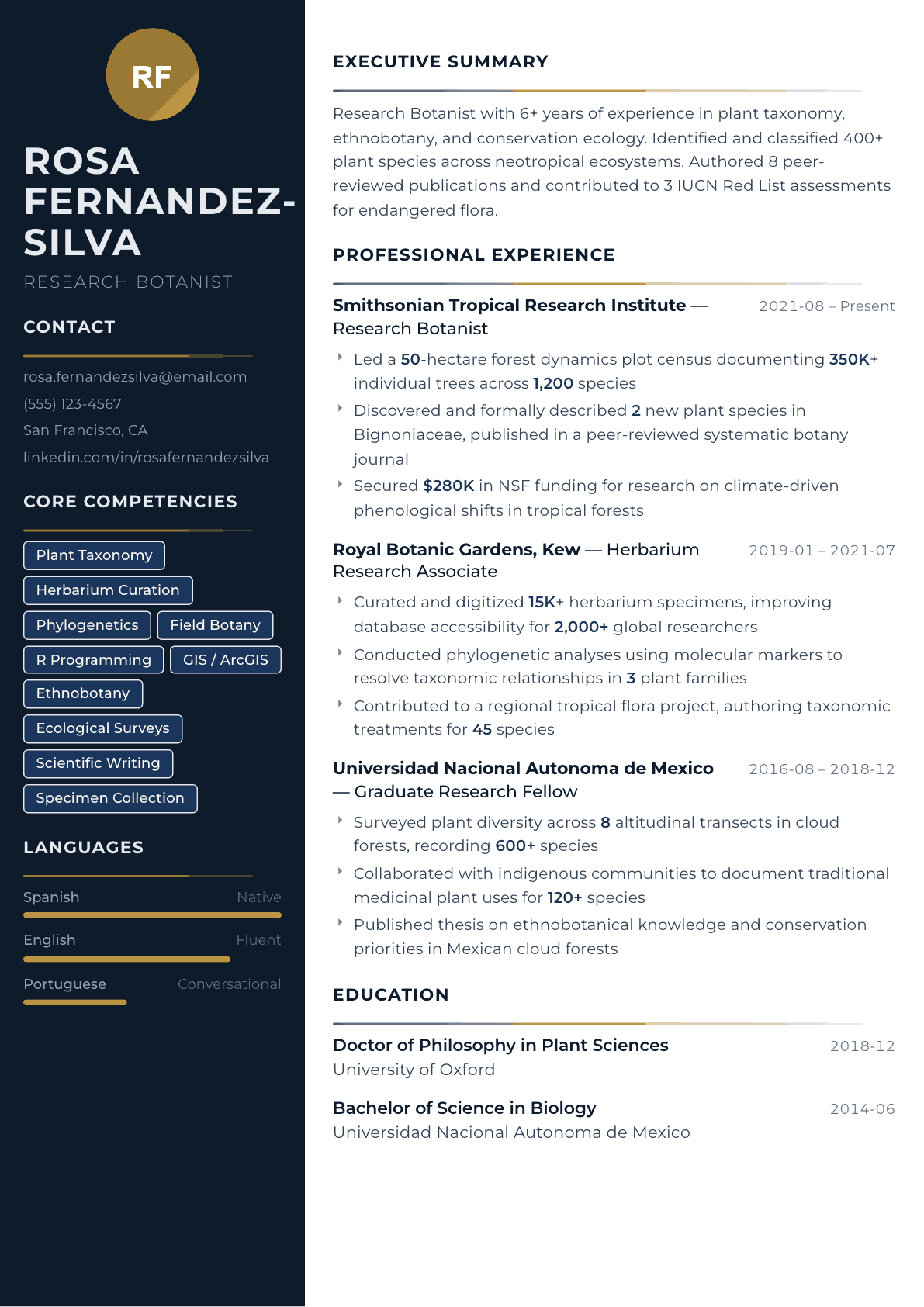
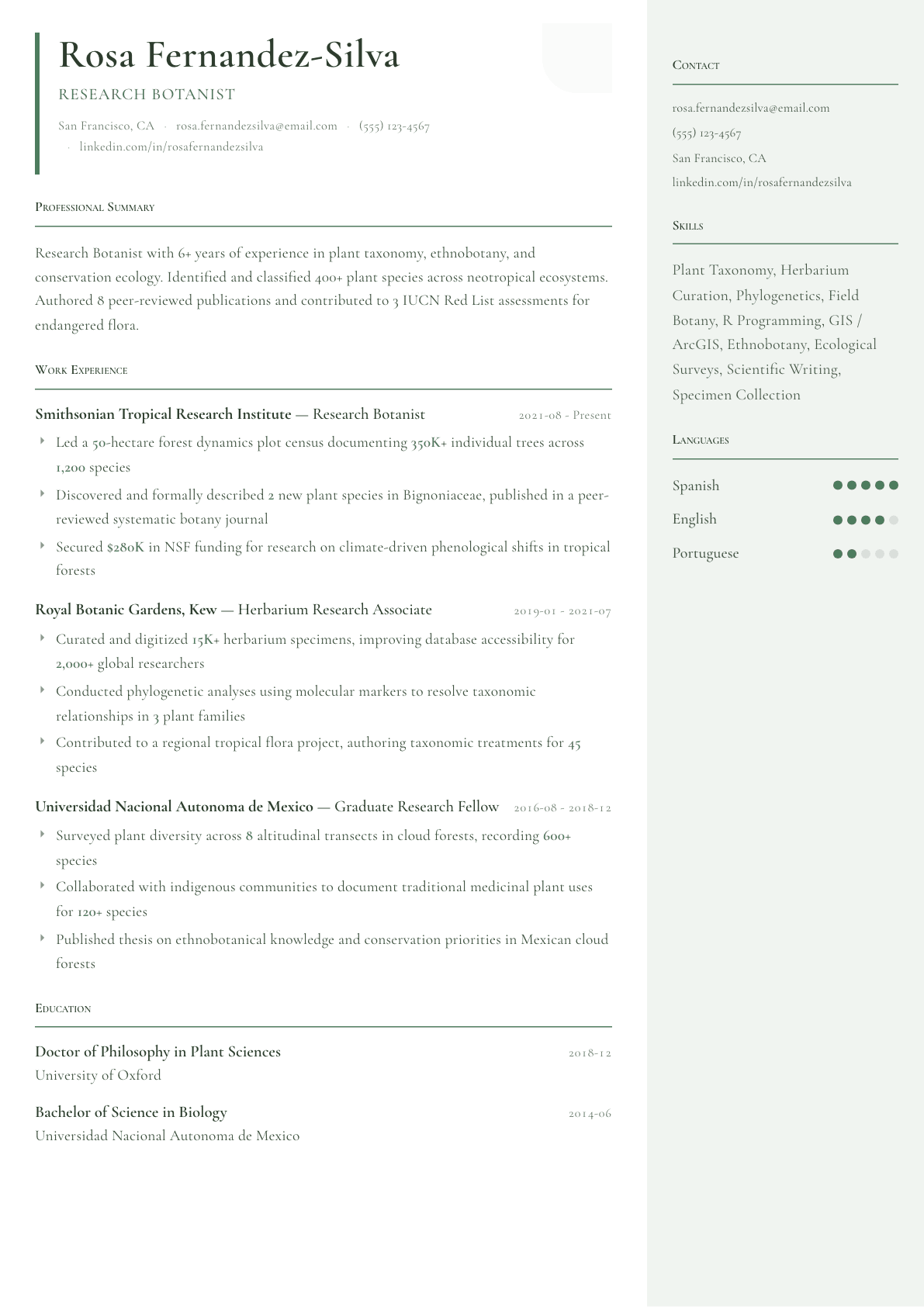
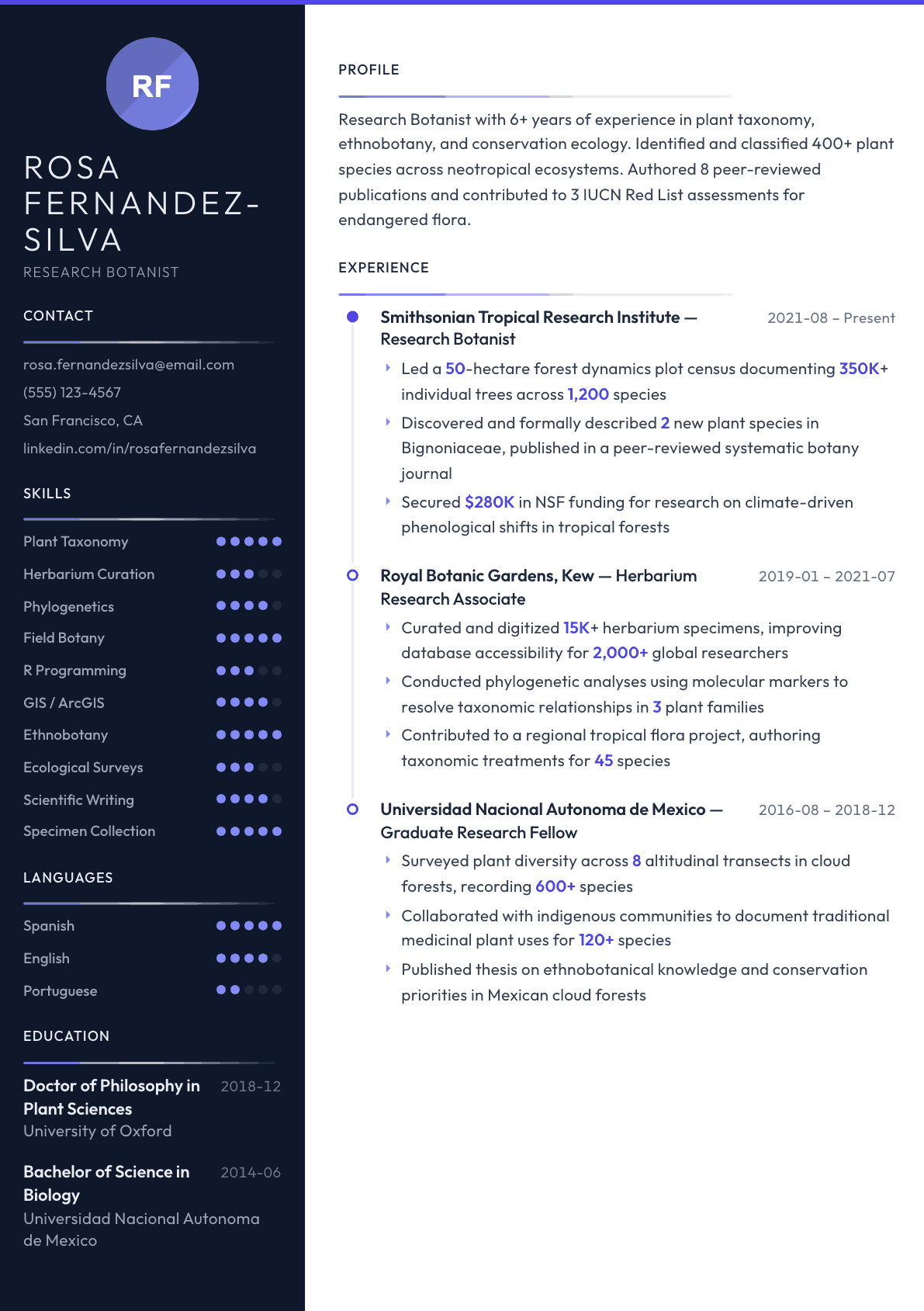
Example Botanist summary
Research Botanist with 6+ years of expertise in plant taxonomy, ethnobotany, and conservation ecology. Classified 400+ neotropical plant species and discovered 2 new species. Published 8 peer-reviewed papers and contributed to IUCN Red List assessments. Secured $280K in NSF funding for tropical forest research.
Skills to list on a Botanist resume
- Plant Taxonomy
- Herbarium Curation
- Phylogenetics
- Field Botany
- Ethnobotany
- Ecological Surveys
- R Programming
- GIS / Remote Sensing
- Scientific Writing
- Species Conservation
- Molecular Systematics
- Specimen Digitization
What actually gets this resume read
- Highlight the number of species you have identified, collected, or formally described.
- Include herbarium and specimen management experience with specific collection sizes.
- List phylogenetic and statistical tools: R, BEAST, MrBayes, MEGA, or RevBayes.
- Mention field experience in specific ecosystems and geographic regions.
- Reference IUCN assessments, conservation contributions, or endangered species work.
How to write a botanist resume
Botanist hiring splits across four employers who want four different documents. A university or research institute reads a curriculum vitae and judges publications, taxonomic treatments and funding. A federal or state agency reads against a written qualification standard and cares about coursework hours, series and grade, and field survey experience. An environmental consultancy reads for billable field skills: rare plant surveys, wetland delineation and whether you can produce a defensible report on a deadline. A garden, herbarium or seed bank reads for collections management and living collection care.
Underneath all four sits the same core question. Can you identify plants correctly in the field, without a photograph app, using keys and a hand lens, in the flora of the region the job sits in. Regional expertise is the currency of this profession, and a resume that lists plant identification without naming the flora, the region and the families you know well is the most common way qualified botanists get passed over.
This guide covers how to present field survey experience, herbarium and collections work, taxonomic and molecular research, and the permits and protocols that agencies and consultancies check before anything else.
Format: match the employer type before anything else
For research and academic positions, write a curriculum vitae with publications, presentations, funding and taxonomic contributions in full. For agency and consulting positions, write a resume of two pages or so, front-loaded with field experience, regional flora and survey protocols, because those readers are checking qualification criteria rather than judging scholarship.
Agency applications need extra care. Many botany positions carry specific coursework requirements in botany or plant science, so list the relevant courses and credit hours somewhere on the document rather than assuming a degree title covers it. Leaving that out is a frequent reason for being screened out before a human reads the file.
- Header: name, degrees, city and state, phone, email, and a researcher identifier for academic use.
- Consulting order: summary, regional flora expertise, field survey experience, permits and certifications, technical skills, education.
- Academic order: education, appointments, publications, taxonomic treatments, funding, teaching, collections and service.
Regional flora: the sentence that decides the interview
State the floristic regions and ecosystems you know and how long you have worked in them. Sagebrush steppe, southeastern coastal plain, alpine tundra, neotropical wet forest and serpentine grassland each contain a different set of hard identifications, and a project manager staffing a survey needs somebody who already carries that regional search image.
Then name the taxonomic groups you are strong in. Graminoids are the classic dividing line, because sedges, rushes and grasses in vegetative condition defeat most generalists, and a botanist who is confident in Carex is immediately more employable. Say which keys and floras you work from, and be honest about the difference between families you can key and families you can identify on sight.
Field survey experience: protocol, effort and defensibility
Consulting and agency work runs on documented survey effort. Write bullets that name the survey type, the protocol followed, the acreage or transect length, the season and the deliverable. Rare plant surveys, floristic inventories, vegetation classification and mapping, wetland delineation, invasive species mapping and monitoring plots all have accepted methods, and naming the method tells a reader your data would hold up under review.
Include the sampling design because it separates people who collect data from people who can defend it. Fixed plots, belt transects, point intercept, cover class estimation, releve plots and repeat photography each imply a different analysis afterward. Say who used your data: an agency decision, a mitigation plan, a listing assessment, a land management plan or a peer-reviewed paper.
Timing matters in botany more than in most field disciplines. Many species are only identifiable in a narrow flowering window, so mention multi-season survey experience and the ability to plan a survey calendar around phenology. Project managers lose money on badly timed surveys and hire people who understand that.
Collections, herbarium work and data
Voucher specimens are the permanent record behind every claim a botanist makes, so collections work belongs on the resume even when the job is not in a herbarium. Say how many specimens you have collected, pressed, mounted, annotated or databased, which herbarium you deposited with, and whether you have handled loans, type material or digitization projects.
Data skills now sit alongside the plant press. Geographic information systems for mapping populations and habitat, a global positioning receiver at survey accuracy, statistical work in R for community analysis and ordination, and database work in a collections management system are all routinely required. For molecular and systematic work, add sequencing, alignment and phylogenetic analysis, and say which markers and pipelines you have used.
- Specimens collected, prepared, annotated or digitized, with the receiving herbarium.
- Mapping and spatial analysis, including habitat modeling if you have done it.
- Community analysis in R, including ordination and diversity measures.
- Molecular methods, markers and phylogenetic software where relevant.
Permits, safety and the practical requirements
Field botany carries a paperwork layer that hiring managers verify. Scientific collecting permits, endangered species permits for surveying listed plants, land access agreements and any agency-specific survey qualification are all worth stating. Consultancies and agencies also want to see the safety and logistics side: wilderness first aid, defensive and off-road driving, chainsaw or all-terrain vehicle training, remote camping and backcountry experience, and the ability to work solo for long stretches.
These are not decorations. A candidate who is already permitted, trained and comfortable working alone in remote country can be sent out immediately, and that is often the deciding factor between two botanists with similar identification skills.
Botanist resume summary examples
Seasonal field botanist
Plant biology graduate with 2 field seasons on rare plant surveys in sagebrush steppe and montane meadows, covering roughly 3,000 acres of survey area. Collected and pressed 400 voucher specimens, comfortable keying graminoids to species and mapping populations with a survey-grade receiver.
Consulting botanist
Consulting botanist with 6 years running rare plant surveys, wetland delineations and vegetation mapping across 2 western states. Leads 3-person field crews through multi-season survey windows, authors technical reports for agency review, and holds a state scientific collecting permit.
Research botanist
Research botanist with 12 years in tropical plant systematics, 18 peer-reviewed publications and formal descriptions of 4 new species. Curates a working herbarium collection, has led 6 international expeditions, and contributes taxonomic treatments to a regional flora project.
Work experience bullets: before and after
Before: Conducted plant surveys in the field.
After: Ran protocol-level rare plant surveys across 3,000 acres over 2 flowering windows, documenting 6 sensitive species occurrences and submitting records to the state natural heritage database.
Acreage, survey timing and where the records went show a survey that will hold up in an agency review.
Before: Identified many plant species.
After: Keyed and verified roughly 600 vascular plant taxa in cloud forest and montane transects, including vegetative graminoids, using regional floras and confirming difficult determinations against herbarium material.
Naming the hard group and the verification method proves identification skill rather than asserting it.
Before: Worked in a herbarium.
After: Curated and digitized more than 15 thousand herbarium specimens, imaging and georeferencing each accession and resolving 300 misapplied determinations during the project.
Volume and the correction work show curatorial judgment, not data entry.
Before: Wrote reports for clients.
After: Authored 14 botanical survey reports for agency review, each with methods, species lists, mapped occurrences and impact discussion, all accepted without a request for additional survey effort.
Report counts and acceptance without rework are how consulting botanists are actually judged.
Before: Did research on plant relationships.
After: Generated sequence data for 4 markers across 120 accessions and ran phylogenetic analyses that resolved relationships in 3 genera, supporting 2 taxonomic revisions published in a systematics journal.
Markers, sample size and the published outcome turn a topic into a research contribution.
Hard skills
- Vascular plant identification and keying
- Regional flora expertise
- Graminoid identification
- Rare and sensitive species surveys
- Vegetation classification and mapping
- Wetland delineation
- Plot and transect sampling design
- Herbarium curation and voucher preparation
- Specimen digitization and georeferencing
- Geographic information systems
- Community analysis and ordination in R
- Phylogenetic analysis
- Technical report writing for agency review
- Seed collection and propagation
Soft skills
- Working alone in remote country
- Field crew leadership
- Landowner and agency communication
- Patience with tedious determinations
- Planning around narrow field windows
- Careful record keeping
Certifications worth listing
- Professional Wetland Scientist (PWS) (Society of Wetland Scientists Professional Certification Program)
- Certified Ecologist (Ecological Society of America)
- Certified Arborist (International Society of Arboriculture)
- Wilderness First Responder (National Outdoor Leadership School)
Mistakes that cost botanist candidates the interview
- Writing plant identification as a skill without naming the flora, region or taxonomic groups you actually know.
- Sending an academic curriculum vitae to a consultancy that needs to see billable field skills and report deliverables.
- Leaving out botany coursework hours when applying to agency positions that screen against a written qualification standard.
- Omitting survey acreage, protocol and season, which are the three things a project manager uses to judge field experience.
- Failing to mention voucher specimens and where they were deposited, the permanent evidence behind every determination.
- Skipping permits, safety training and remote work experience, which often decide between two similarly skilled candidates.
- Claiming confidence in difficult genera that an interviewer can test with a single specimen on the table.
Botanist resume questions
How do I show plant identification ability on a resume?
Anchor it to a place and a group. Name the floristic region, the number of taxa you routinely work with, the keys and floras you use, and the hard families you are confident in. Vague claims collapse in an interview that puts a sedge in front of you.
Do I need a graduate degree to work as a botanist?
Not for seasonal field work, consulting or many agency technician positions, where survey experience and regional knowledge matter more. Research positions, curatorial roles and senior agency botanist grades generally do expect a graduate degree.
How should seasonal work be listed?
List each season as its own entry with the employer, the region, the months and the survey type, or group repeated seasons with the same employer and give the total. Do not hide the seasonal pattern; it is normal and expected in this field.
What matters most for a consulting botanist role?
Speed and defensibility. Managers want survey protocols you already know, reports that pass agency review without rework, permits in hand, and the ability to plan around flowering windows so a crew is not sent out at the wrong time.
Should I include an academic publication list on a consulting resume?
Include a short selected list if the publications relate to the region or the taxa the firm works with. Otherwise a single line noting the number of peer-reviewed publications is enough, and the space is better spent on field survey evidence.