Building Engineer Resume Examples: the lines they read
Write a Building Engineer Resume for Class A Properties
By Mustafa Tarabya, founder of CVBooster · Published · Updated
Building engineer resume example and guide covering chillers, boilers, building automation, water treatment and tenant comfort response.
Sample resumes for a building engineer
The same building engineer content laid out in three CVBooster templates, so you can see what the finished document looks like before you write a word.
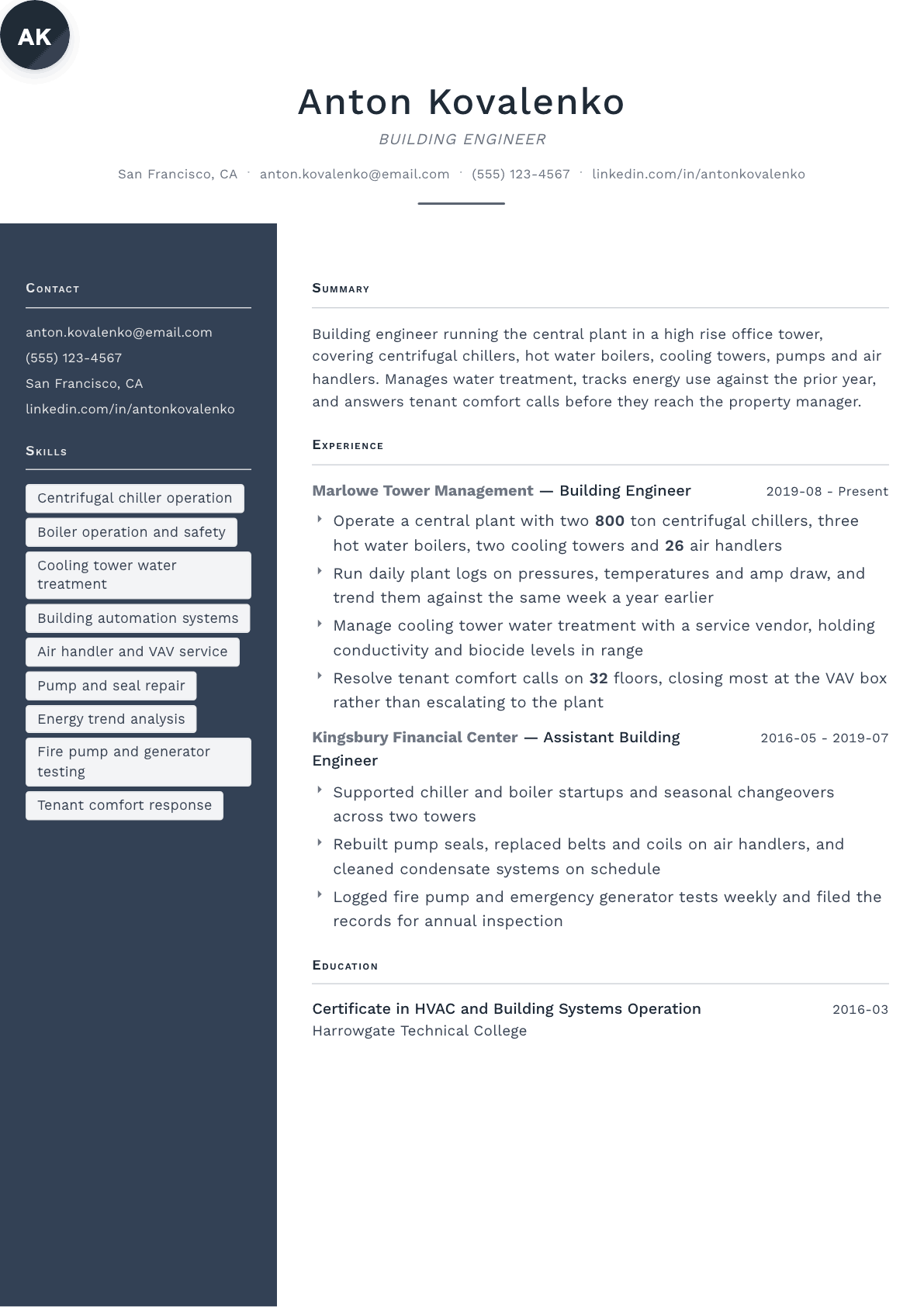
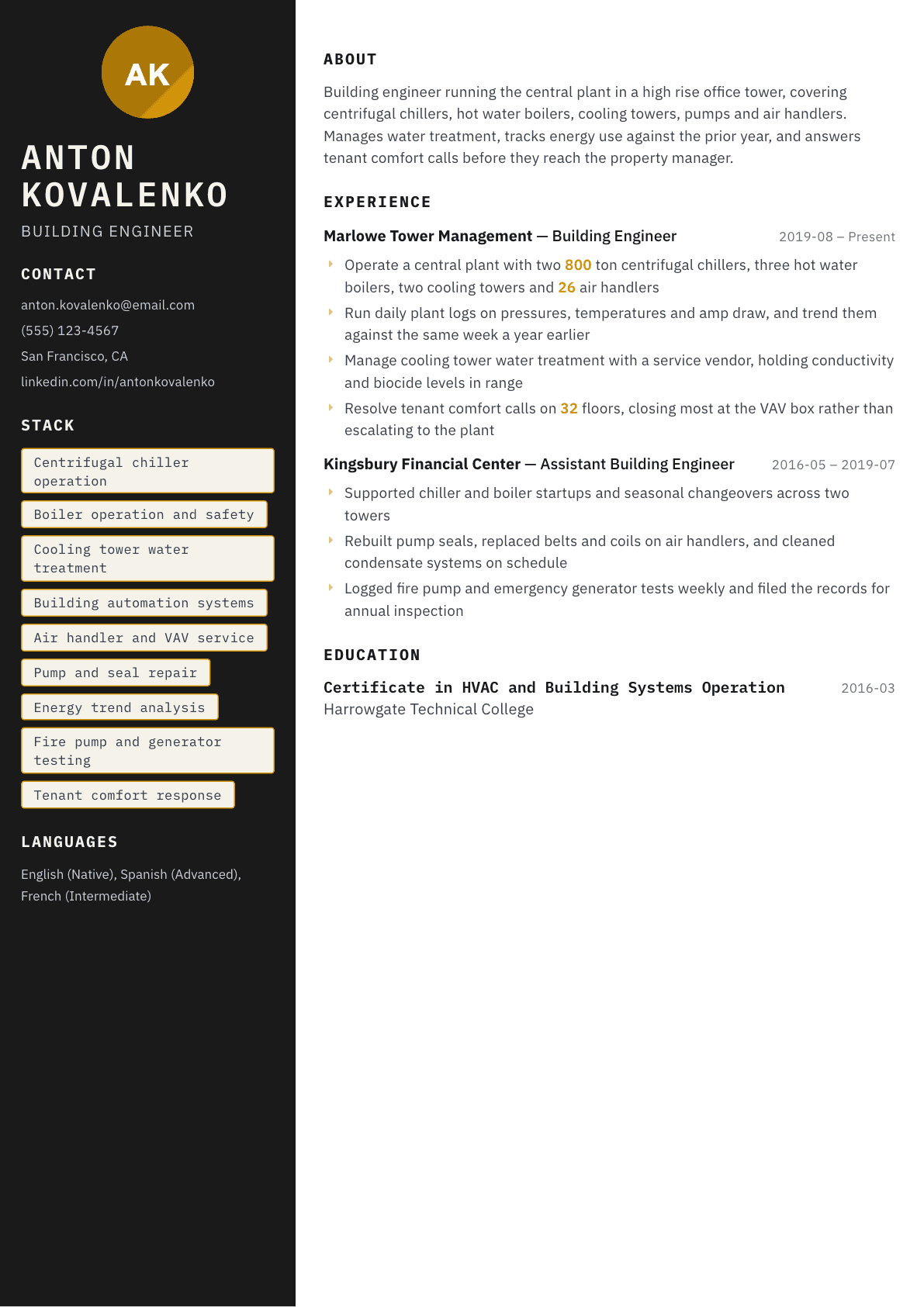
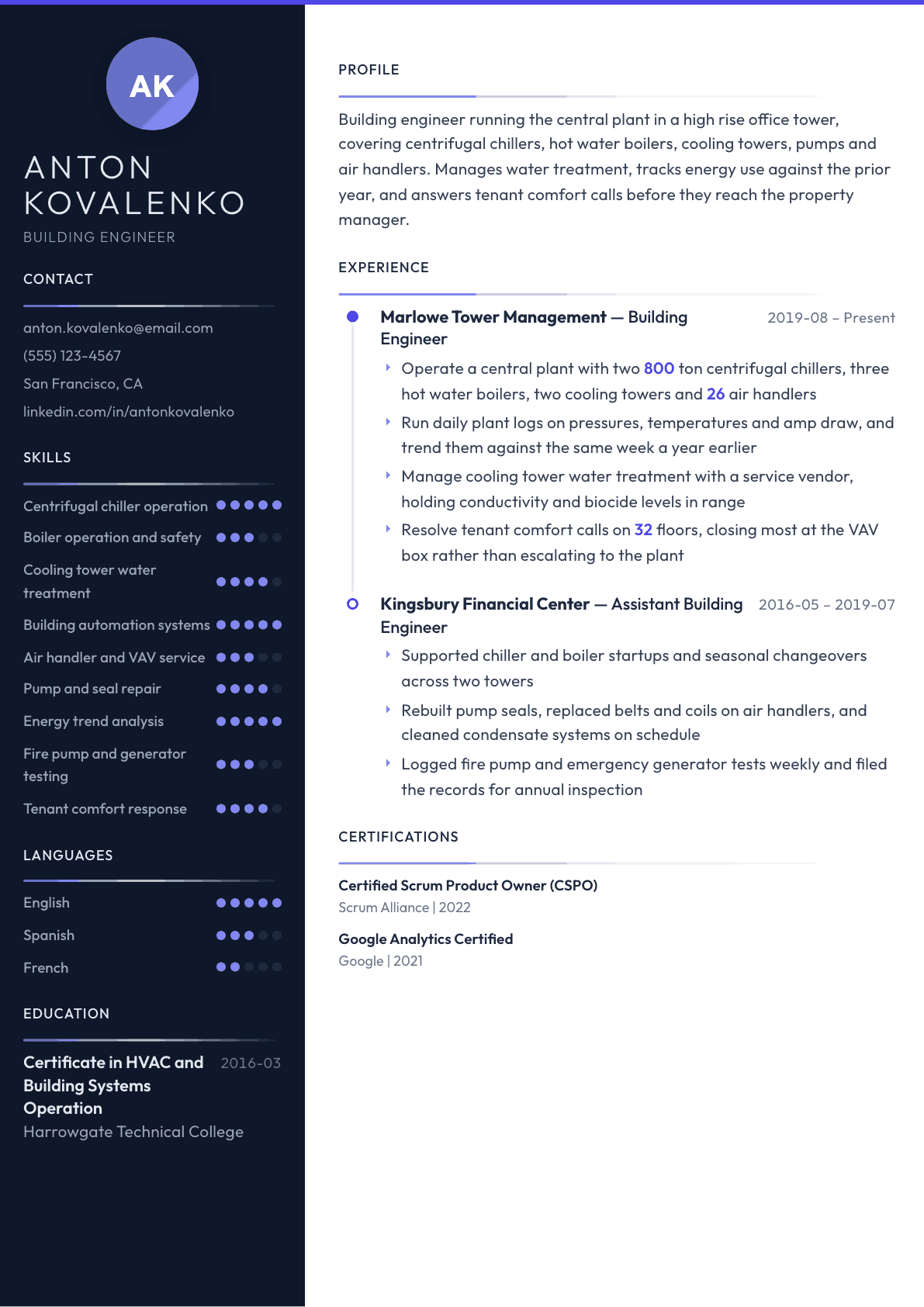
Example Building Engineer summary
Building engineer operating a high rise central plant with centrifugal chillers, hot water boilers, cooling towers, pumps and more than two dozen air handlers. Keeps daily plant logs and trends them against the prior year, manages tower water treatment with the service vendor, and tunes schedules and setpoints in the automation system. Closes most tenant comfort calls at the terminal box and runs weekly fire pump and generator tests.
Skills to list on a Building Engineer resume
- Centrifugal and screw chillers
- Hot water and steam boilers
- Cooling towers and water treatment
- Air handling units and VAV boxes
- Building automation programming
- Pumps, seals and variable speed drives
- Refrigerant handling and leak checks
- Energy trending and schedule tuning
- Fire pump and generator testing
- Electrical distribution and switchgear awareness
- Plant log documentation
- Vendor and contractor oversight
- Tenant comfort troubleshooting
- Preventive maintenance planning
What actually gets this resume read
- Describe the plant you run by equipment type and capacity, since that defines the class of building you fit.
- Say which building automation platform you operate and whether you write schedules or only read points.
- Show your log discipline: what you record daily on chillers, boilers and pumps, and how you use it.
- List boiler or refrigeration licenses with the issuing jurisdiction, because many towers require them.
- Give the tenant comfort call volume and the share you close at the terminal box rather than escalating.
- Include energy work such as schedule tuning, setpoint resets and equipment staging with the outcome.
- Name the life safety testing you perform weekly and monthly, including fire pump and generator runs.
How to write a building engineer resume
A chief engineer or property manager hiring a building engineer is handing over a central plant and the comfort of every tenant above it. The equipment is expensive, the consequences of running it badly are slow and costly, and the tenants complain to the property manager rather than to you. So the screening question is narrow: has this person actually operated a plant of this size, and does he keep logs.
That is why a building engineer resume lives or dies on plant description. Chillers by type and tonnage, boilers by type and fuel, cooling towers, pumps, air handlers and terminal units. A page that says "maintained HVAC systems in a commercial building" tells a chief engineer nothing, because a rooftop package unit and an eight hundred ton centrifugal machine are not the same job.
This guide covers how to describe a plant, how to write log and trend discipline so it reads as operating judgment, how to present licenses and refrigerant handling, the tenant comfort work that fills the rest of the day, and the questions engineers ask when moving between building classes.
Format: plant description before anything else
One page for most engineers, two once you have run several properties. Reverse chronological, and under each employer a short plant description rather than a company blurb. That description is the most important content on the page and it should read like an equipment schedule in prose.
Put licenses and refrigerant certification high, because many jurisdictions and many buildings require a stationary engineer or boiler operator license before you can hold the seat at all. If you hold one, it belongs where a screener sees it without scrolling.
- Plant description: chiller type and tonnage, boiler type and fuel, cooling towers, pumps, air handler count.
- Building description: floors, total area, occupancy type, tenant count, single or multi-tenant.
- License block: stationary engineer, boiler operator or refrigeration license with the issuing jurisdiction.
- Automation line: the platform you operate and whether you write schedules and trends or only view them.
- Life safety line: fire pump and generator testing, sprinkler, standpipe, emergency lighting.
Summary: plant, logs, comfort, coverage
Three lines. The plant you operate, the log and trend discipline you keep, how you handle tenant comfort, and whether you carry after-hours coverage or a rotating watch. A chief engineer reading that can place you in a building class immediately.
Mention seasonal changeover if you have run it. Bringing a plant from heating to cooling and back is where an operator either proves he understands his equipment or leaves a trail of nuisance alarms and unhappy floors, and it is rarely mentioned on a resume even by people who do it well.
Experience: operating, not just repairing
The difference between a building engineer and a maintenance technician is operation. Write the daily readings you take on chillers, boilers, pumps and towers, what you compare them against, and the decisions you make from them. An engineer who noticed rising approach temperature on a condenser and scheduled a tube cleaning has demonstrated the entire job in one sentence.
Water treatment deserves its own bullet. Cooling tower chemistry, conductivity, bleed control, biocide dosing and the vendor relationship behind it are safety and equipment life issues, and they are the first thing a careful chief engineer asks about in an interview.
Then cover tenant comfort with a resolution path, energy work with the schedules and setpoints you tuned, and life safety with the tests you run and log. Finish with the contractor oversight you carry, because in most towers the engineer verifies specialist work before the property manager pays for it.
- Daily plant logs: what you record, how often, and what you compare it against.
- Water treatment: parameters held, dosing method, and the vendor cadence.
- Seasonal changeover and startup or shutdown of chillers and boilers.
- Tenant comfort: call volume, and the share resolved at the terminal unit rather than the plant.
- Life safety testing: fire pump runs, generator load tests, and the records you file.
Energy, trends and the case for keeping you
Property owners measure buildings on operating cost, and the engineer is the person who moves it. Write the energy work you have done in concrete terms: occupancy schedule corrections, setpoint resets, staging changes on multiple chillers, condenser water reset, or shutting down equipment that was running through unoccupied hours because nobody looked.
Attach a comparison rather than a bare claim. Trending consumption against the same period a year earlier, with weather in mind, is how a real engineer talks about savings, and it protects you from claiming credit for a mild season. That nuance in your wording tells a chief engineer you have been doing this properly.
Skills and keywords a building engineer posting screens on
Property adverts repeat a narrow set: central plant, chillers, boilers, cooling towers, air handling units, VAV, building automation, preventive maintenance, tenant requests, life safety, water treatment. Use the words the posting uses in your plant description and blocks.
Include the property management systems you work in for work orders and tenant requests, and say what you record there. Property companies audit response times against those tickets, so an engineer who documents cleanly is worth more to a manager than one who fixes quietly and writes nothing.
Building Engineer resume summary examples
Assistant engineer
Assistant building engineer with three years supporting chiller and boiler operation, seasonal changeovers and air handler service across two office towers. Rebuilds pump seals, replaces belts and coils, and logs fire pump and generator tests weekly. Holds a refrigerant handling card and is working toward a stationary engineer license.
Building engineer
Building engineer operating a central plant with two 800 ton centrifugal chillers, three hot water boilers, two cooling towers and 26 air handlers in a 32-floor tower. Keeps daily plant logs trended against the prior year, manages tower water treatment with the service vendor, and closes most comfort calls at the terminal box.
Chief engineer
Chief engineer for a two-tower property, directing three engineers and the full vendor calendar. Owns the preventive program, the capital equipment plan and the life safety testing record, and cut plant energy use by correcting occupancy schedules and introducing condenser water reset across both buildings.
Work experience bullets: before and after
Before: Operated and maintained the building HVAC systems.
After: Operated a central plant with two 800 ton centrifugal chillers, three hot water boilers, two cooling towers and 26 air handlers serving 32 tenant floors.
Equipment type and capacity place you in a building class, which a generic HVAC claim never does.
Before: Kept logs on the plant equipment.
After: Recorded daily pressures, temperatures and amp draw on chillers, pumps and towers, and trended them against the same week a year earlier to catch drift before it became a failure.
A comparison basis turns logging from a chore into the operating judgment the role is hired for.
Before: Handled the cooling tower water treatment.
After: Managed cooling tower water treatment with the service vendor, holding conductivity and biocide levels in range and correcting a bleed valve fault that was driving chemical use up.
Named parameters and a specific correction show ownership of the chemistry rather than a vendor visit.
Before: Responded to tenant temperature complaints.
After: Resolved comfort calls across 32 floors, closing most at the VAV box by checking damper travel, reheat valve position and zone schedule before escalating anything to the plant.
The resolution path proves diagnostic depth and shows you do not chase every complaint to the chiller.
Before: Worked on reducing energy use in the building.
After: Corrected occupancy schedules on 26 air handlers and introduced condenser water reset, then trended consumption against the prior year to confirm the change held through a full season.
A named measure plus verification over a season is how an engineer proves savings rather than claims them.
Hard skills
- Centrifugal and screw chiller operation
- Hot water and steam boiler operation
- Cooling tower operation and water treatment
- Air handling units and VAV terminal units
- Building automation schedules and trends
- Pumps, seals and variable speed drives
- Refrigerant handling and leak detection
- Seasonal changeover and plant startup
- Energy trending and schedule tuning
- Fire pump and emergency generator testing
- Electrical distribution and switchgear awareness
- Preventive maintenance planning
- Contractor verification and sign-off
Soft skills
- Reading a plant by sound and gauge before opening a screen
- Staying measured with a tenant who is cold and angry
- Documenting an operating decision so the next watch understands it
- Judging when to run a machine through the day and when to stop it
- Working with a vendor without handing over your judgment
Certifications worth listing
- EPA Section 608 Universal Certification (United States Environmental Protection Agency)
- Systems Maintenance Administrator (SMA) (BOMI International)
- Building Operator Certification (Building Operator Certification Program)
Mistakes that cost building engineer candidates the interview
- Describing the plant generically instead of giving chiller type and tonnage, boiler type and air handler count.
- Leaving out logs and trends, which are the clearest proof that you operate rather than only repair.
- Skipping water treatment, the first technical subject a careful chief engineer raises in an interview.
- Burying a stationary engineer or boiler license at the bottom when it may be a legal requirement for the seat.
- Claiming energy savings with no comparison basis, which an experienced reader discounts immediately.
- Ignoring tenant comfort work, even though it fills more hours than the central plant on most days.
Building Engineer resume questions
Do I need a stationary engineer license to work as a building engineer?
It depends on the jurisdiction and the plant. Many cities require a license to operate boilers above a set pressure or capacity, and large towers often require one regardless. Check the local rule for the buildings you are targeting and put any license you hold near the top.
How do I describe a plant I operated without listing every piece of equipment?
Give the major machines with capacity, the count of air handlers, and the building size in floors. That is enough for a chief engineer to picture the plant. Save the smaller equipment for a skills block or for the conversation.
What if I have only worked rooftop package units?
Say so honestly and lead with the depth you do have: controls, comfort troubleshooting, preventive routes and refrigerant work. Then target buildings whose plant matches your experience, because a central plant tower will test the gap in the first interview.
How important is the building automation system on this resume?
Very. Modern buildings are operated through the automation front end, so name the platform and be specific about whether you view points, adjust schedules and setpoints, or build trends and graphics. Each level of access is a different value to a property.
Should I include tenant complaints on a resume?
Include how you resolve them, not that you receive them. A line showing that most comfort calls close at the terminal unit rather than at the plant tells a property manager you protect the equipment and the tenant relationship at the same time.
Related resume examples
- HVAC Technician Resume example
- Facilities Manager Resume example
- Facilities Technician Resume example
- Building Superintendent Resume example
- Lineman Resume example
- Generator Technician Resume example