Plant Engineer Resume Examples: the lines they read
Craft a Plant Engineer Resume Built on Uptime and Capital Work
By Mustafa Tarabya, founder of CVBooster · Published · Updated
Plant engineer resume example with production support bullets, reliability and capital project keywords, and a full writing guide.
Sample resumes for a plant engineer
The same plant engineer content laid out in three CVBooster templates, so you can see what the finished document looks like before you write a word.
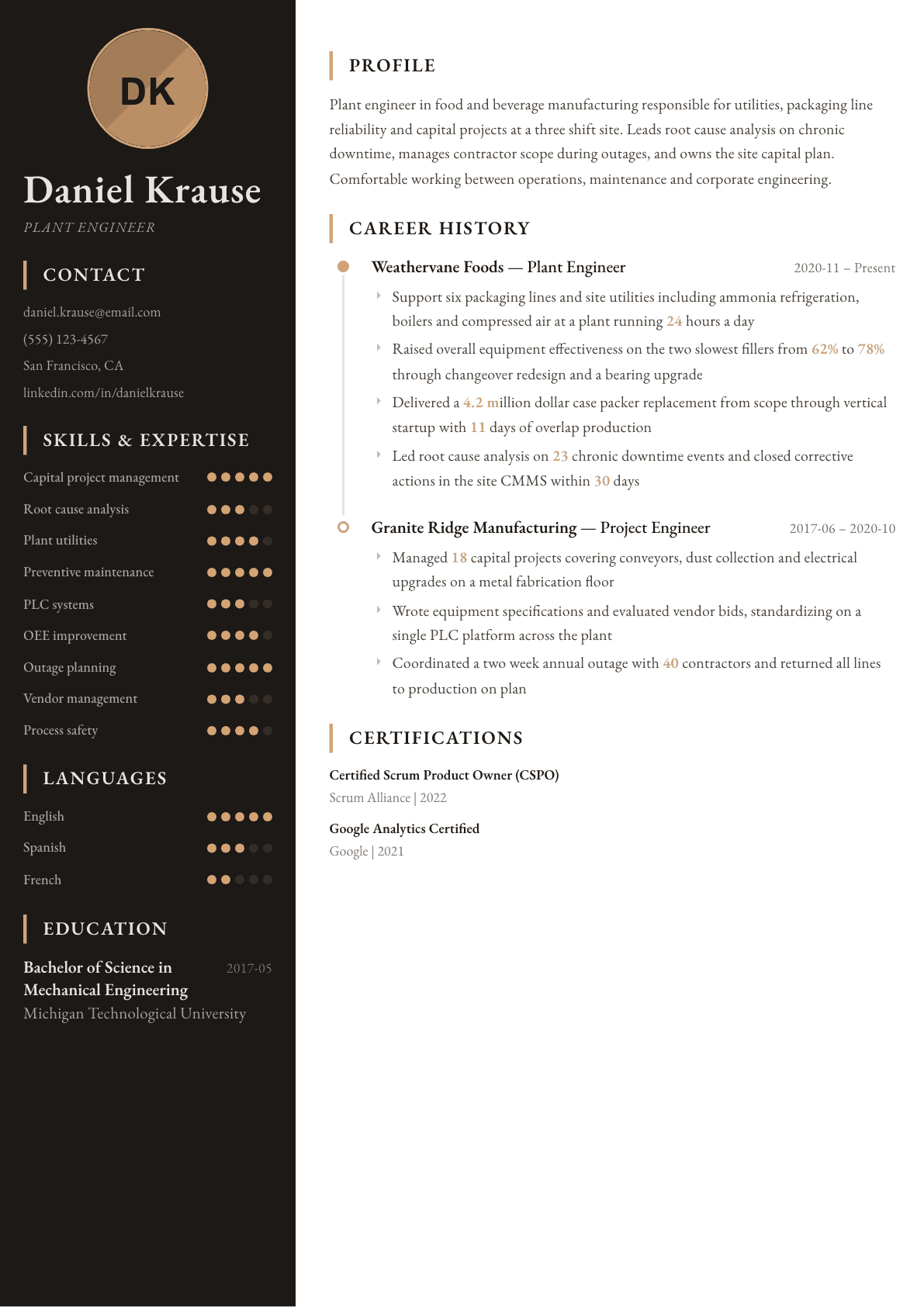
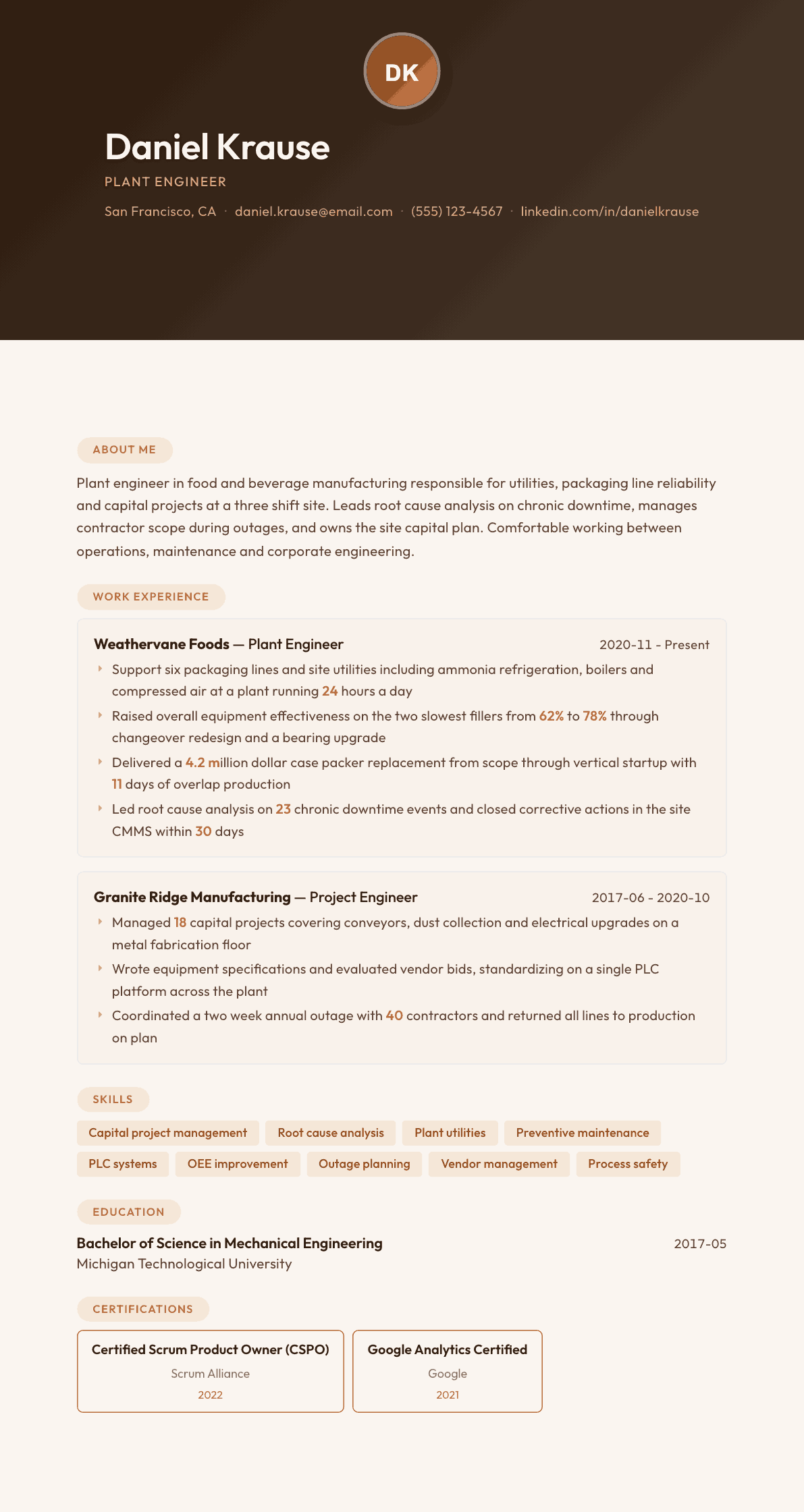
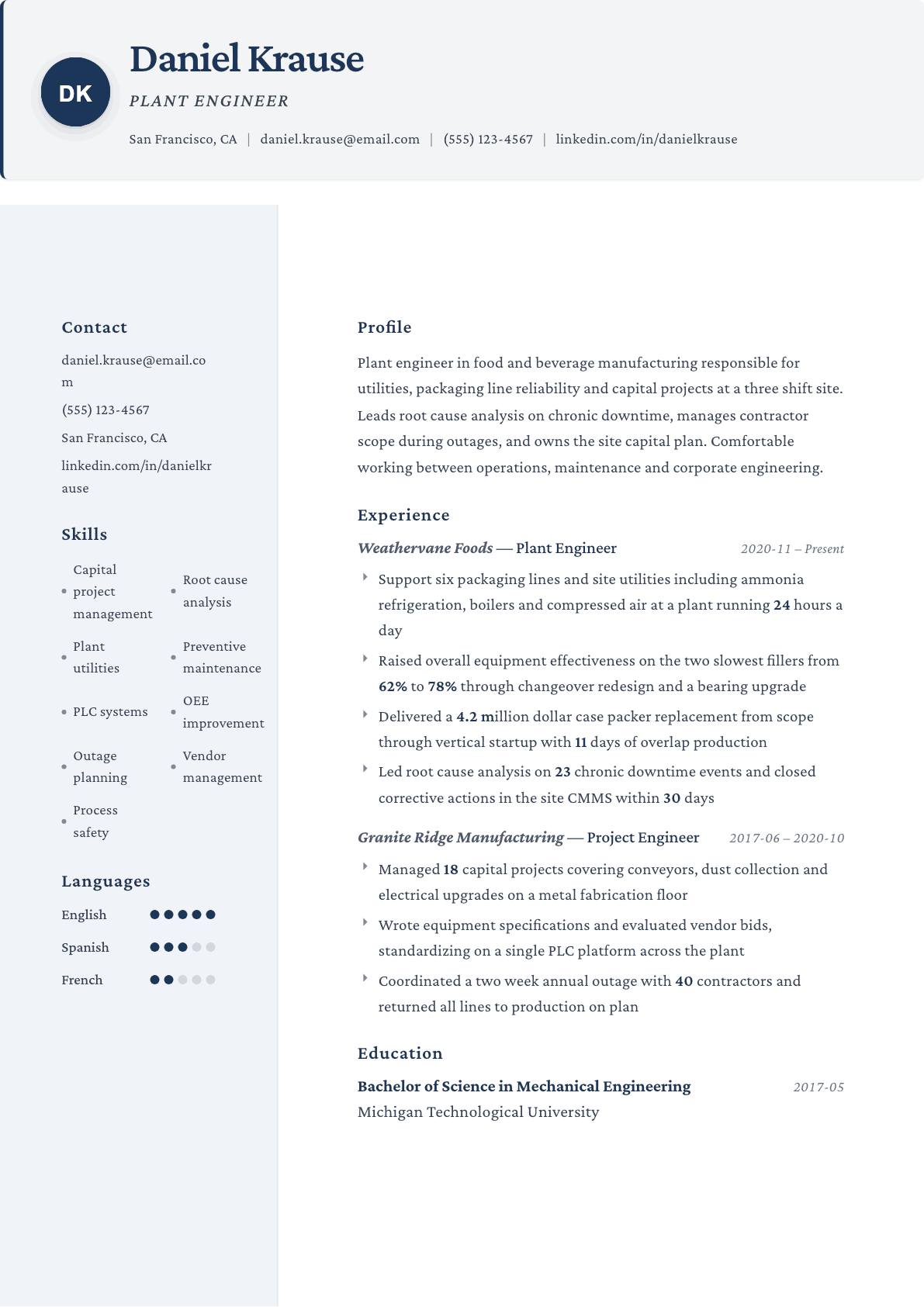
Example Plant Engineer summary
Plant engineer with seven years in food and metal fabrication manufacturing, owning utilities, line reliability and the site capital plan. Leads root cause analysis on chronic downtime, specifies equipment, and manages contractors through annual outages. Lifted filler line effectiveness from 62% to 78% and delivered a case packer replacement to a vertical startup. Looking for a plant engineering manager role at a multi line site.
Skills to list on a Plant Engineer resume
- Capital project management
- Plant utilities
- Reliability improvement
- Root cause analysis
- Overall equipment effectiveness
- Outage and shutdown planning
- Preventive maintenance systems
- Equipment specification
- PLC and controls coordination
- Contractor management
- Lean manufacturing
- Process safety management
- Budget and cost control
- Ammonia refrigeration
- Compressed air systems
What actually gets this resume read
- Describe the plant itself first: product, number of lines, shift pattern and headcount you supported.
- Use OEE, downtime hours or scrap rate as your outcome measures instead of general improvement claims.
- List capital projects with the scope and the delivery result, including startup and any production overlap.
- Name the utilities you own, such as ammonia refrigeration, boilers, compressed air or wastewater treatment.
- Show how you work with maintenance and operations, because a plant engineer succeeds through other teams.
- Include process safety or regulatory exposure by name if the site carried a covered process or permit.
How to write a plant engineer resume
A plant engineer is the technical owner of a manufacturing site. Production wants more output, maintenance wants more time on the equipment, corporate wants the capital plan delivered, and safety wants none of it done carelessly. The resume that gets a call shows a person who has stood in the middle of those four demands and moved a number that the plant manager cares about.
Screeners for this role are usually plant managers or engineering directors who have done the job. They read for the site first: what it makes, how many lines, how many shifts, how many people. Then for the numbers: overall equipment effectiveness, downtime hours, scrap, changeover time, cost per unit. Then for capital: what you specified, what you installed and whether the startup went well. A resume built on duties instead of those three layers reads as a project coordinator rather than an engineer.
This guide covers section order, what belongs in each block, three summaries across career stages, before and after bullets drawn from reliability and capital work, and answers to the questions engineers ask when they move between industries or step up toward an engineering manager title.
Format: describe the plant before you describe yourself
Reverse chronological, one column, two pages once you have a capital project history. Under each employer write a one line plant description: product, line count, shift pattern, headcount and site size. Everything after that is read against that context, and without it your numbers have no scale.
Keep safety visible. Manufacturing hiring managers screen out engineers who talk about throughput and never mention machine guarding, lockout tagout or process safety. One or two safety bullets across the resume is enough, but they need to be there.
- Header: name, city, phone, email, and any professional license or safety credential.
- Order: summary, experience with a plant description per job, capital projects, technical skills, education.
- Add a short block naming the standards your site operated under when they are relevant.
Summary: industry, site scale, and what you moved
Say the industry and the process. Food and beverage, injection molding, metal fabrication, pharmaceutical, pulp and paper, automotive and chemical processing all hire plant engineers and none of them treat the others as directly transferable. Name the utilities you own too, because ammonia refrigeration, boilers and wastewater treatment are heavy responsibilities that not every candidate has carried.
Then one result. A line effectiveness gain, a downtime reduction, a capital project delivered to a vertical startup, or a scrap rate cut. Choose the one you can talk about for ten minutes in an interview, because that is exactly what will happen.
Experience: reliability, capital, utilities and people
Reliability bullets come first because they are the daily job. Chronic downtime analysis, corrective actions closed, changeover redesign, spare parts strategy, equipment upgrades. Give the failure you attacked and the measure that moved. Overall equipment effectiveness before and after, downtime hours per week, or unplanned stops per shift.
Capital bullets need scope, budget behavior and startup. Say what the project was, whether you wrote the specification and evaluated bids, how you managed the install window, and how the equipment behaved in the first weeks of production. Vertical startups and production overlap during changeovers are the details a plant manager remembers.
Utilities and infrastructure deserve their own bullets when you own them. Boilers, compressed air, ammonia or glycol refrigeration, chilled water, dust collection, wastewater and electrical distribution each carry their own compliance and their own failure modes. Say which ones sat under your name.
Finish with the people part. Contractor crews during outages, maintenance technicians you worked through, cross functional teams for a line launch. Plant engineers deliver almost nothing alone.
Technical skills and systems
Group the list into equipment and process knowledge, systems and software, and improvement methods. Software means the maintenance management system, the historian or SCADA package, the CAD tool you draft layouts in, and the PLC platform you coordinate with even if you do not program it yourself.
Improvement methods should be named properly: root cause analysis, failure mode and effects analysis, total productive maintenance, single minute exchange of die, statistical process control, value stream mapping. Manufacturing postings are written in that language and a parser matches it literally.
Safety, compliance and posting keywords
Give one bullet to the compliance work you did: machine guarding assessments, lockout tagout procedure writing, arc flash studies, confined space entry planning, process safety management for a covered process, environmental permit conditions. Naming a covered process or a permitted discharge shows a level of responsibility that generic safety language cannot.
Common posting terms include capital project management, equipment specification, downtime reduction, preventive maintenance, plant utilities, continuous improvement, contractor management, root cause analysis and cost control. Fold them into real bullets rather than a keyword strip.
Plant Engineer resume summary examples
New plant engineer
Mechanical engineering graduate with a co-op on a packaging floor supporting conveyors and case erectors, plus a capstone on changeover time reduction. Trained in lockout tagout and root cause analysis, comfortable reading electrical schematics, and seeking a project engineer role at a manufacturing site.
Six years in
Plant engineer at a three shift food manufacturing site supporting six packaging lines plus ammonia refrigeration, boilers and compressed air. Leads chronic downtime analysis, specifies replacement equipment and manages annual outages. Raised effectiveness on two filler lines from the low sixties into the high seventies.
Senior plant engineer
Senior plant engineer with twelve years across food and metal fabrication sites, owning the site capital plan and a team of three engineers. Delivers line replacements to vertical startup, runs process safety compliance for an ammonia system, and holds annual maintenance spend flat while output grows.
Work experience bullets: before and after
Before: Improved production line performance at the plant.
After: Raised overall equipment effectiveness on the two slowest fillers from 62% to 78% through a changeover redesign and a bearing and seal upgrade on the capper.
The measure, the two starting and ending values and the physical changes make the improvement checkable.
Before: Managed capital projects for the site.
After: Delivered a case packer replacement from scope through vertical startup, holding eleven days of overlap production so no customer order shipped late.
Startup quality and protected production are what a plant manager actually judges a capital project on.
Before: Performed root cause analysis on equipment failures.
After: Led root cause analysis on 23 chronic downtime events and closed every corrective action in the CMMS within 30 days, eliminating a repeating conveyor jam at the accumulation table.
Closure discipline and one named failure eliminated prove the analysis reached the floor instead of a report.
Before: Responsible for plant utilities.
After: Owned ammonia refrigeration, two boilers and the compressed air system, including process safety documentation and the annual mechanical integrity inspections.
Listing the specific utilities and the compliance work attached shows the weight of the responsibility.
Before: Coordinated the annual shutdown with contractors.
After: Planned a two week annual outage with 40 contractors across mechanical, electrical and civil scopes, and returned every line to production on the published restart plan.
Contractor count, scope breadth and an on time restart turn coordination into a delivery record.
Hard skills
- Capital project management
- Equipment specification and bid evaluation
- Overall equipment effectiveness improvement
- Root cause analysis
- Preventive and predictive maintenance systems
- Plant utilities including boilers and refrigeration
- Compressed air and dust collection
- PLC and controls coordination
- Outage and shutdown planning
- Lean manufacturing and changeover reduction
- Process safety management
- Machine guarding and lockout tagout
- CAD layout drafting
- Maintenance budgeting and cost control
Soft skills
- Working across production and maintenance
- Contractor supervision
- Prioritizing under production pressure
- Clear technical briefing
- Capital request writing
- Coaching technicians
Certifications worth listing
- Professional Engineer (PE) (State licensing board via NCEES examination)
- Certified Maintenance and Reliability Professional (CMRP) (Society for Maintenance and Reliability Professionals)
- Certified Plant Engineer (CPE) (Association for Facilities Engineering)
- Certified Six Sigma Green Belt (CSSGB) (American Society for Quality)
- OSHA 30-Hour General Industry (OSHA Training Institute Education Centers)
Mistakes that cost plant engineer candidates the interview
- Skipping the plant description, which leaves every number on the page without a scale to be judged against.
- Writing capital projects as budgets managed rather than as equipment installed and started up successfully.
- Using continuous improvement as a phrase without a single named method or a measure that moved.
- Never mentioning safety or compliance, which reads as a blind spot to anyone who has run a manufacturing site.
- Claiming credit for maintenance results without saying how you worked through the technicians who did the work.
- Applying to a different industry without translating the process, so a reader cannot see what transfers.
Plant Engineer resume questions
What is the difference between a plant engineer and a manufacturing engineer?
A manufacturing engineer usually owns the process and the product flow. A plant engineer owns the physical site: equipment, utilities, capital and reliability. Small sites merge the two, so read the posting and mirror whichever emphasis it carries.
How do I switch industries as a plant engineer?
Translate the process into equipment terms. Conveying, filling, heat transfer, rotating equipment, compressed air and electrical distribution exist everywhere. Lead with those, then name the product specific knowledge you would need to learn and how quickly.
Do plant engineers need a PE license?
Rarely. Manufacturing sites hire on results and safety record rather than licensure. A license helps if you seal structural or pressure related work, and it can matter for a corporate engineering role, but it is not a screening gate on most site jobs.
Which metrics should a plant engineer put on a resume?
Overall equipment effectiveness, unplanned downtime hours, scrap or yield, changeover time and maintenance cost per unit produced. Pick the two your site tracked most closely and show a before and after rather than a single figure.
Should I list the capital budget I controlled?
Give the size of the projects rather than a total spend figure if your employer treats budgets as confidential. Naming the largest single project you delivered and its complexity communicates the same seniority without disclosing internal numbers.
Related resume examples
- Manufacturing Engineer Resume example
- Industrial Engineer Resume example
- Maintenance Engineer Resume example
- Plant Manager Resume example
- Reliability Engineer Resume example
- Project Engineer Resume example