Chief Engineer Resume Examples: the lines they read
Write a Chief Engineer Resume That Shows Command of the Plant
By Mustafa Tarabya, founder of CVBooster · Published · Updated
Chief engineer resume example with plant, crew and compliance bullets, licensure guidance, keywords and a full resume writing guide.
Sample resumes for a chief engineer
The same chief engineer content laid out in three CVBooster templates, so you can see what the finished document looks like before you write a word.
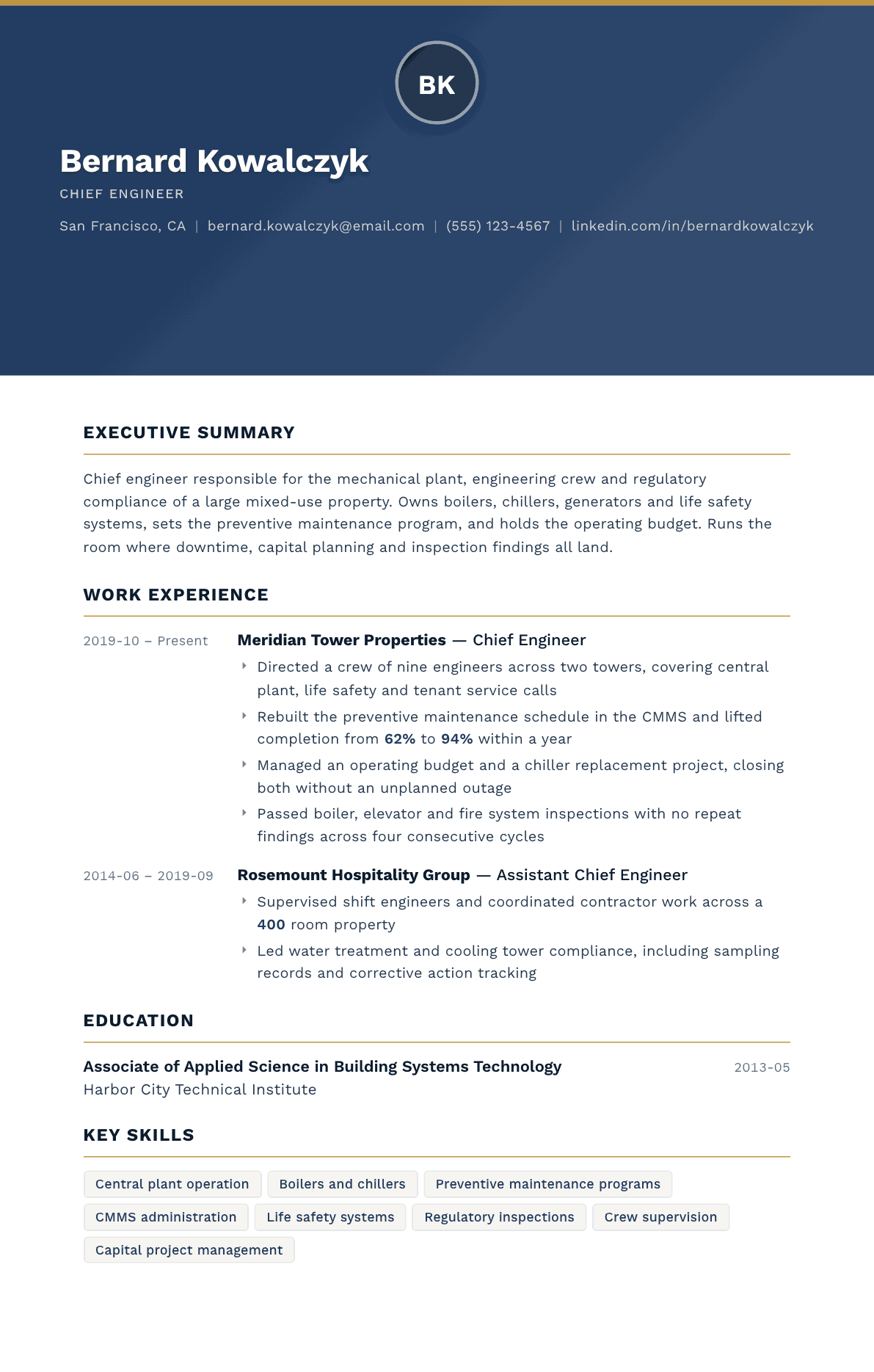
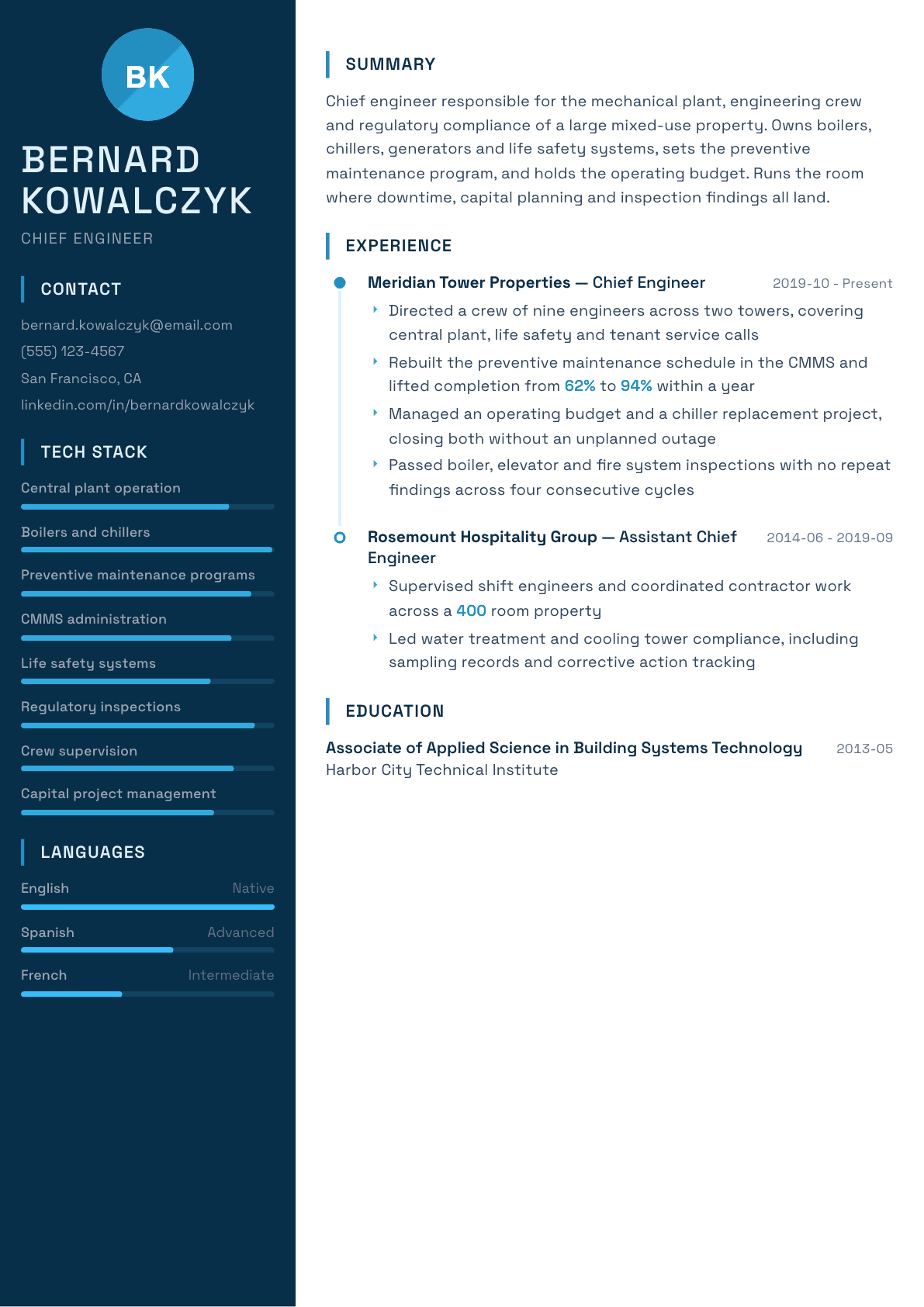
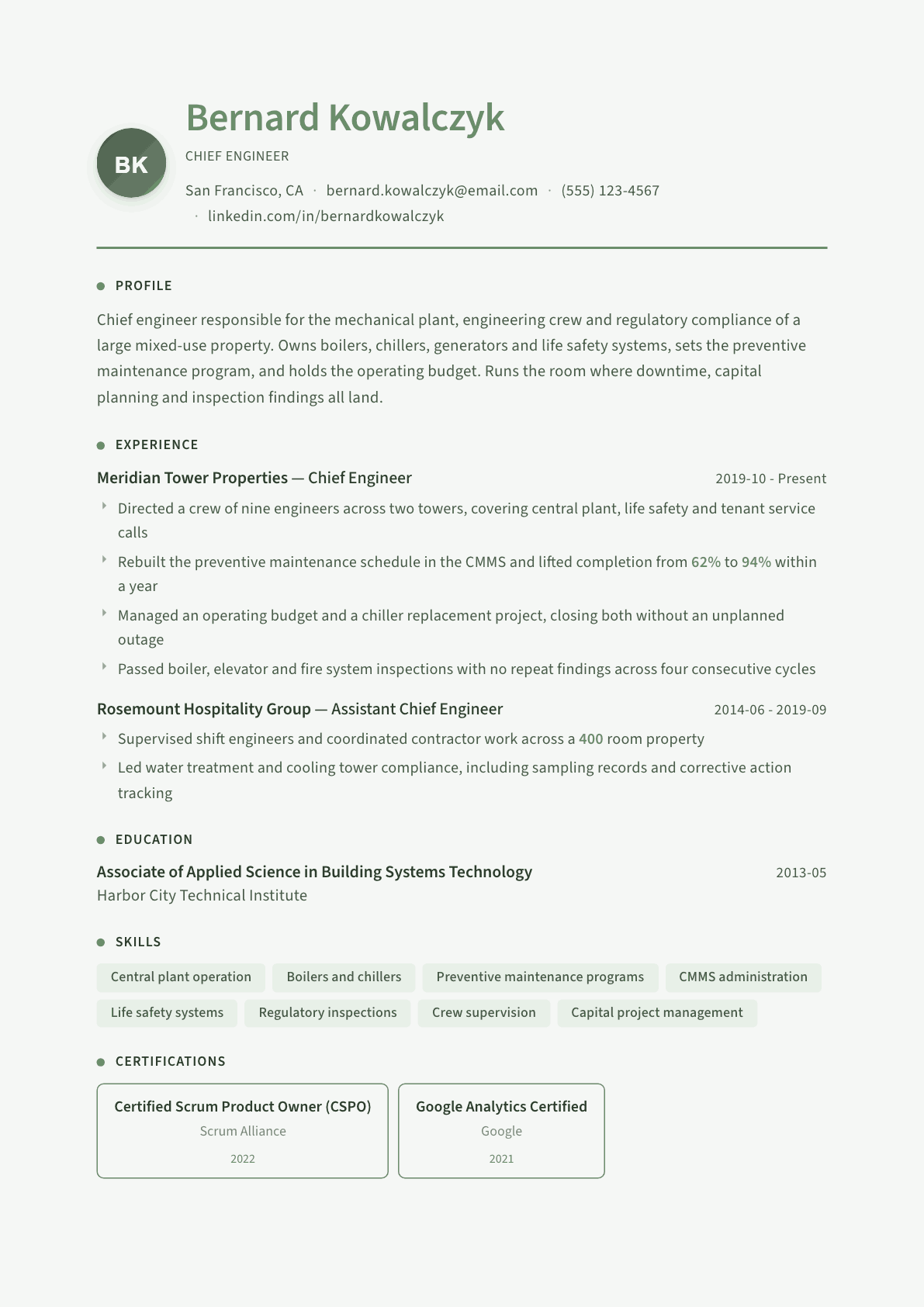
Example Chief Engineer summary
Chief engineer with more than a decade running central plant and engineering crews for commercial and hospitality properties. Owns boilers, chillers, generators and life safety systems, administers the maintenance program, and holds the operating budget. Lifted preventive maintenance completion above ninety percent and passed four inspection cycles with no repeat findings. Seeking a chief engineer role on a large campus.
Skills to list on a Chief Engineer resume
- Central plant operation
- Boiler operation
- Chiller and refrigeration systems
- HVAC controls and building automation
- Emergency generators
- Fire and life safety systems
- Preventive maintenance programs
- CMMS administration
- Water treatment compliance
- Energy management
- Contractor management
- Capital project delivery
- Budget ownership
- Crew scheduling and supervision
- Regulatory inspection readiness
What actually gets this resume read
- Open with the size of what you ran: square footage, plant capacity, crew headcount and shift coverage.
- Name every licensed system you are accountable for, such as boilers, refrigeration, elevators and fire protection.
- List your operating licenses and their jurisdiction, because chief engineer postings screen on them first.
- Show maintenance program ownership with completion rates, backlog control and the CMMS you administered.
- Include inspection and audit outcomes, since a clean record with the authority having jurisdiction is the real credential.
- Give capital project examples with scope and outcome rather than only listing routine operating duties.
How to write a chief engineer resume
A chief engineer resume is a command document for a building. The property manager or regional director reading it wants to know what plant you have run, how many engineers reported to you, which licensed systems sat under your name, and what happened the last time an inspector or an outage tested you. It is an operations job with a compliance record attached, and the resume has to show both.
The screening order is unusual. Licenses and the size of the plant come before career narrative, because a chief engineer posting is often written against a specific boiler class, a refrigeration tonnage or a jurisdictional operating license. If those facts are buried on page two, the file gets set aside before anyone reads about your maintenance program.
Below is the structure a property group expects, three summary examples from shift engineer through chief, before and after bullets built from plant and crew work, the credentials that genuinely exist in building operations, and the questions engineers ask when they step up to a chief role.
Format: two pages, with the plant described in the first ten lines
Reverse chronological, two pages is normal at this level, one column. Under the header put a licenses and certifications block, then a portfolio line describing what you have run: building type, square footage, plant equipment and capacity, crew size and shift coverage.
That portfolio line is the resume in miniature. A mixed use tower with a central chiller plant, dual fuel boilers, emergency generators and a crew of nine tells a director more than three paragraphs of duty description, and it lets him place you against his own portfolio immediately.
- Header: name, city and state, phone, email, and your operating license designation.
- Order: summary, licenses and certifications, plant experience, education, capital projects.
- Give crew headcount and shift coverage for every role where you supervised.
Summary: what you own, how big, how it performs
Name the accountability first. Mechanical plant, engineering crew and regulatory compliance for a large mixed use property is a scope statement, not a job description. Then the systems: boilers, chillers, generators, building automation and life safety.
Finish on performance. Preventive maintenance completion, inspection cycles passed without repeat findings, or a major equipment replacement delivered without an unplanned outage. Those are the outcomes a director uses to decide whether his portfolio would be safer with you in it.
Experience: plant, crew, program and outages
Each role opens with the property and the plant, then splits into four kinds of bullet. The plant itself: what you operated, at what capacity, and the systems you personally troubleshot. The crew: headcount, shifts covered, hiring, training and how you handled call outs and overtime. The program: preventive maintenance built or rebuilt in a maintenance management system, completion rates, and how you controlled the backlog. The record: inspections, audits and outages.
Maintenance program ownership is where chief engineers separate from senior technicians. Rebuilding a schedule in the maintenance system and lifting completion is a management result, and the number attached to it is one of the few metrics that transfers cleanly between properties. Give it a bullet with a before and after.
Outages and near misses deserve a line each. A chiller replacement delivered without interrupting tenant cooling, a generator failure caught during a load test rather than during a storm, a water treatment problem found in the sampling record before it became a health issue. Directors hire chiefs for the events, not the routine.
Licenses, compliance and the authority having jurisdiction
List each operating license by name and jurisdiction. Stationary engineer and boiler operating licenses are issued locally and are frequently the first filter applied to a chief engineer posting, so vagueness here costs interviews. Add refrigerant handling certification, and any fire safety director or life safety credential your jurisdiction requires.
Then the compliance record itself. Boiler, elevator, fire pump, sprinkler, backflow and emergency lighting inspections, plus water treatment sampling and cooling tower requirements. A clean record with the authority having jurisdiction across consecutive cycles is the credential that no certificate can substitute for, and it belongs on the page in plain language.
- Operating licenses with the issuing jurisdiction and class.
- Refrigerant handling and any state or city required safety credential.
- Inspection categories you were accountable for, and the outcome across cycles.
- Contractor management: scopes written, vendors held to service agreements.
Budget, capital work and the keywords in property postings
A chief engineer holds an operating budget and usually contributes to a capital plan. Say what you controlled: labor, contracts, parts, utilities, and how you forecast. Then give capital examples with scope and outcome, because a director planning equipment replacement wants a chief who has run one before rather than one who has only watched.
The recurring phrases in chief engineer postings are central plant, boiler operation, chiller, building automation, preventive maintenance, maintenance management system, life safety systems, emergency generator, water treatment, energy management, capital projects, contractor management and inspection compliance. Use them where they are true, once in skills and once inside a bullet.
Chief Engineer resume summary examples
Shift engineer moving up
Building engineer with five years on rotating shifts covering boilers, chillers, air handlers and tenant service calls in a commercial tower. Holds a boiler operating license and refrigerant handling certification, closes work orders in the maintenance system daily, and has covered the assistant chief role during vacations.
Assistant chief
Assistant chief engineer supervising shift engineers and coordinating contractors across a 400 room hospitality property. Leads water treatment and cooling tower compliance including sampling records and corrective action tracking, and runs the weekly preventive maintenance schedule with the chief.
Chief engineer
Chief engineer directing a crew of nine across two towers, accountable for central plant, life safety and tenant service. Rebuilt the preventive maintenance schedule in the maintenance system, lifted completion from 62% to 94% in a year, and passed four consecutive inspection cycles with no repeat findings.
Work experience bullets: before and after
Before: Supervised the engineering team.
After: Directed a crew of nine engineers across two towers on rotating shifts, covering central plant operation, life safety testing and tenant service calls with 24 hour coverage.
Headcount, property count and shift coverage describe the command scope a director is trying to match.
Before: Managed preventive maintenance.
After: Rebuilt the preventive maintenance schedule in the maintenance management system, retasked the crew against it, and lifted completion from 62% to 94% within a year while cutting the open backlog.
A before and after completion figure turns program ownership into a result that transfers to any property.
Before: Passed all building inspections.
After: Passed boiler, elevator and fire system inspections across four consecutive cycles with no repeat findings, closing every corrective item before the reinspection date.
Naming the systems and the consecutive clean cycles is the compliance record a regional director actually checks.
Before: Oversaw a chiller replacement project.
After: Managed a chiller replacement from scope and vendor selection through commissioning, sequencing the work around tenant cooling loads so the building never took an unplanned outage.
The scope, the constraint and the outage free outcome show capital delivery rather than project attendance.
Before: Handled water treatment for the cooling towers.
After: Led cooling tower water treatment compliance, held the sampling schedule and corrective action log, and closed every out of range result with a documented action before the next sampling round.
The sampling discipline and closure record show a compliance habit, which is what liability minded owners are buying.
Hard skills
- Central plant operation
- Boiler operation and maintenance
- Chiller and refrigeration systems
- HVAC controls and building automation
- Emergency generators and load testing
- Fire and life safety systems
- Preventive maintenance programs
- Maintenance management system administration
- Water treatment compliance
- Energy management and utility tracking
- Contractor and vendor management
- Capital project delivery
- Operating budget ownership
- Crew scheduling and supervision
- Regulatory inspection readiness
Soft skills
- Calm decision making during an outage
- Tenant and owner communication
- Holding contractors to scope
- Developing junior engineers
- Documenting for auditors
- Prioritizing safety over schedule
Certifications worth listing
- Section 608 Refrigerant Handling Certification (US Environmental Protection Agency)
- Systems Maintenance Administrator (SMA) (BOMI International)
- Facilities Management Administrator (FMA) (BOMI International)
- Certified Facility Manager (CFM) (International Facility Management Association)
- Building Operator Certification (Northwest Energy Efficiency Council)
- Certified Pool Operator (CPO) (Pool and Hot Tub Alliance)
Mistakes that cost chief engineer candidates the interview
- Leaving operating licenses and their jurisdiction off the page, when that is the first filter a property group applies.
- Describing duties without the plant: no square footage, no equipment capacity, no crew headcount.
- Listing routine operating tasks and omitting the outages, inspections and capital work that define the role.
- Claiming a maintenance program without a completion figure or a backlog number to support it.
- Ignoring budget and contractor management, which is a large part of what a chief actually controls.
- Writing as a technician rather than a manager, so nothing shows you can hire, schedule and hold a crew accountable.
Chief Engineer resume questions
What belongs at the top of a chief engineer resume?
Operating licenses with their jurisdiction, then a portfolio line covering building type, square footage, plant equipment and crew size. Property groups screen against a specific license class and plant, so those facts cannot wait until the second page.
How do I show maintenance program ownership?
Give completion rates before and after, the backlog you controlled, and the maintenance management system you administered. Program metrics travel between properties better than equipment lists, which is why regional directors look for them first.
Should I list every system I have worked on?
List the systems you were accountable for and could troubleshoot without calling a vendor. An inflated list invites questions you cannot answer, while a focused one paired with inspection outcomes reads as genuine command of the plant.
How do I move from assistant chief to chief engineer?
Lead with the chief level work you already do: covering the chief during absences, running the schedule, managing contractors and holding compliance records. Then show a capital project and a crew development example so the step reads as small.
Do hotel and commercial building experience transfer?
They transfer well because the plant and compliance work are similar, though guest facing service standards and tenant lease obligations differ. Name both settings if you have them, and describe the plant in equipment terms that any property reader recognizes.
Related resume examples
- Mechanical Engineer Resume example
- Safety Engineer Resume example
- Facilities Engineer Resume example
- Building Engineer Resume example
- Plant Engineer Resume example
- Power Plant Operator Resume example