Fashion Buyer Resume Examples: free ATS score and gap list
Create a Fashion Buyer Resume Built on Margin and Sell Through
By Mustafa Tarabya, founder of CVBooster · Published · Updated
Fashion buyer resume examples with open to buy, sell through and margin keywords, sample bullets, and a full guide to the buying interview.
Sample resumes for a fashion buyer
The same fashion buyer content laid out in three CVBooster templates, so you can see what the finished document looks like before you write a word.
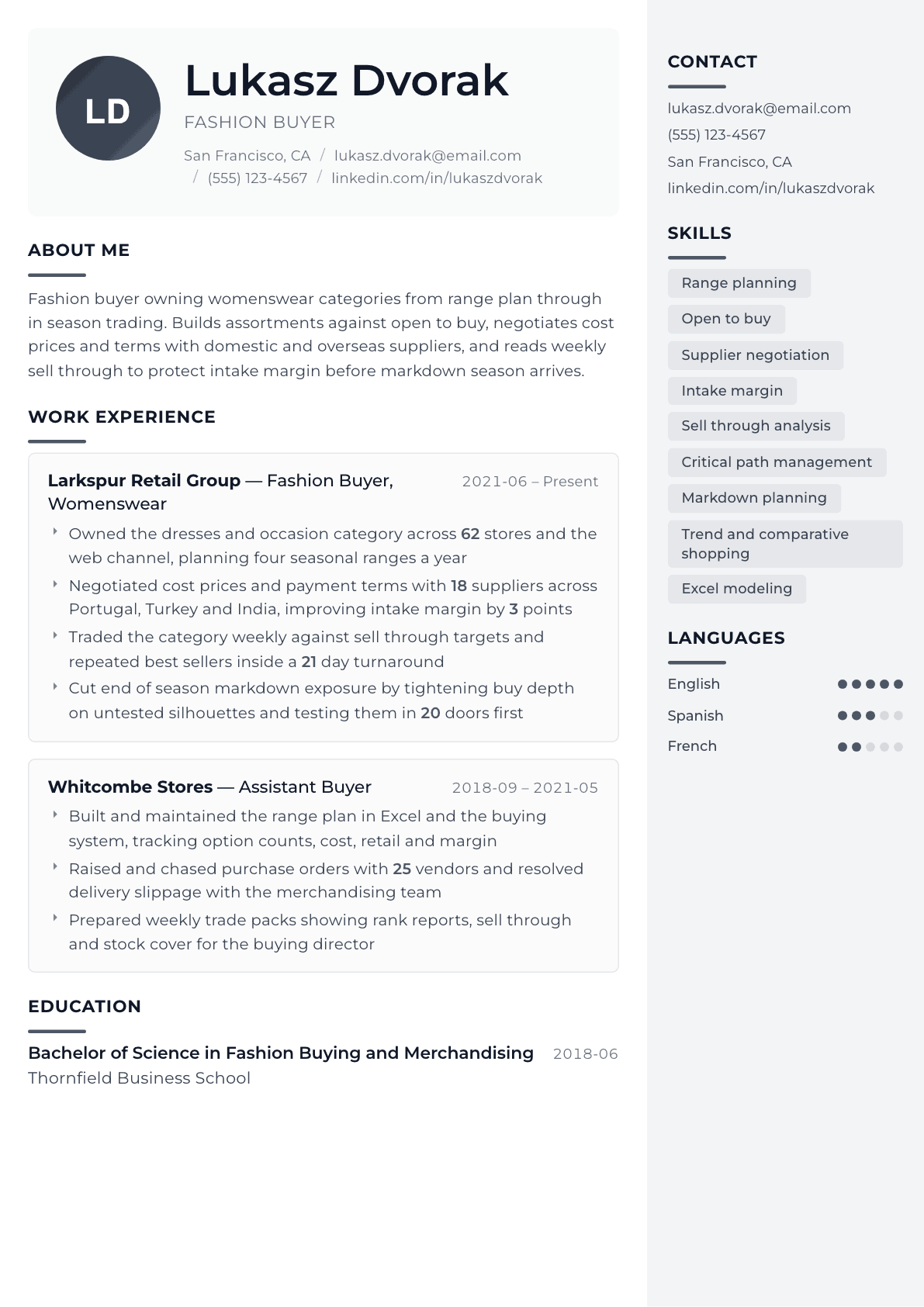
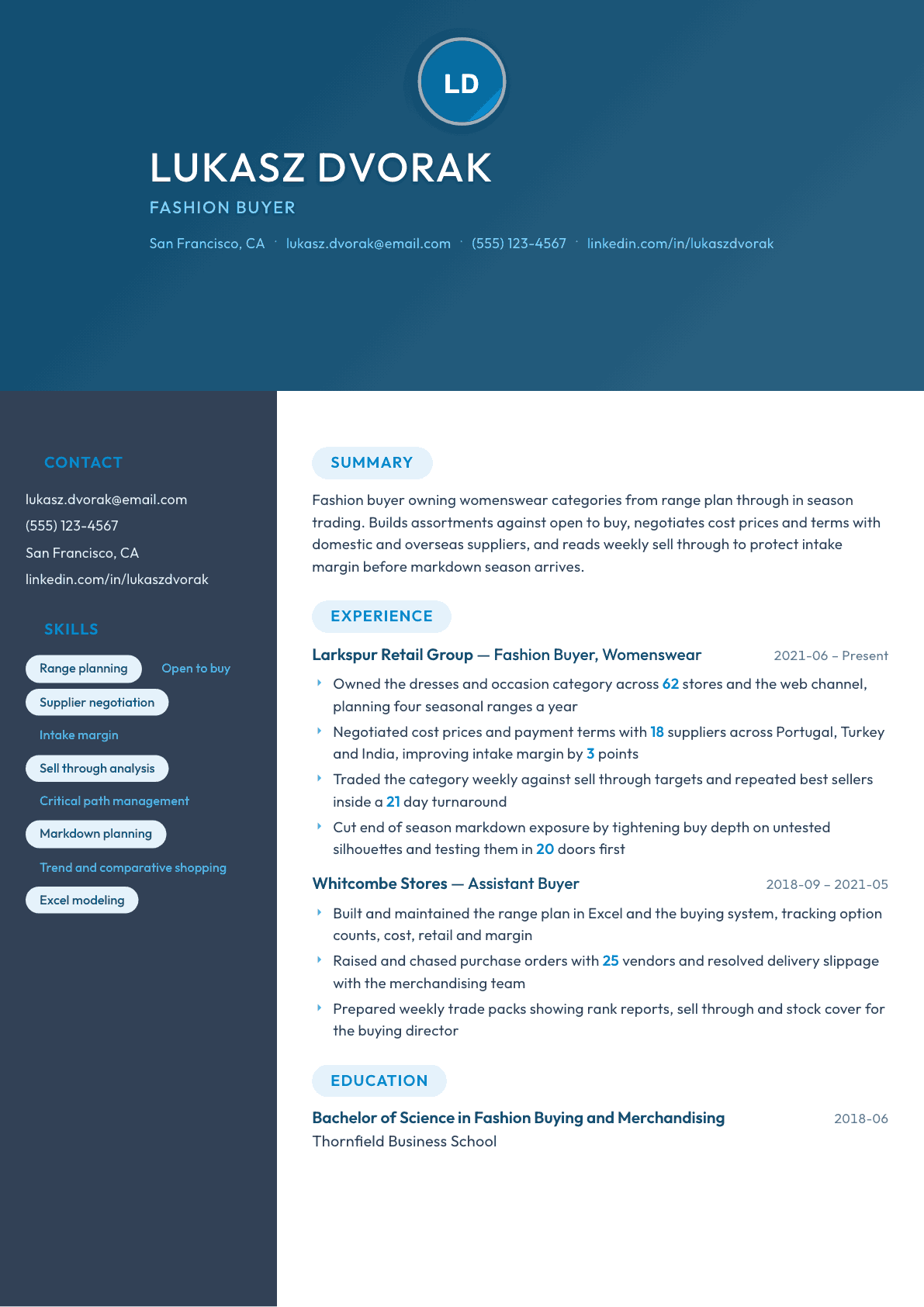
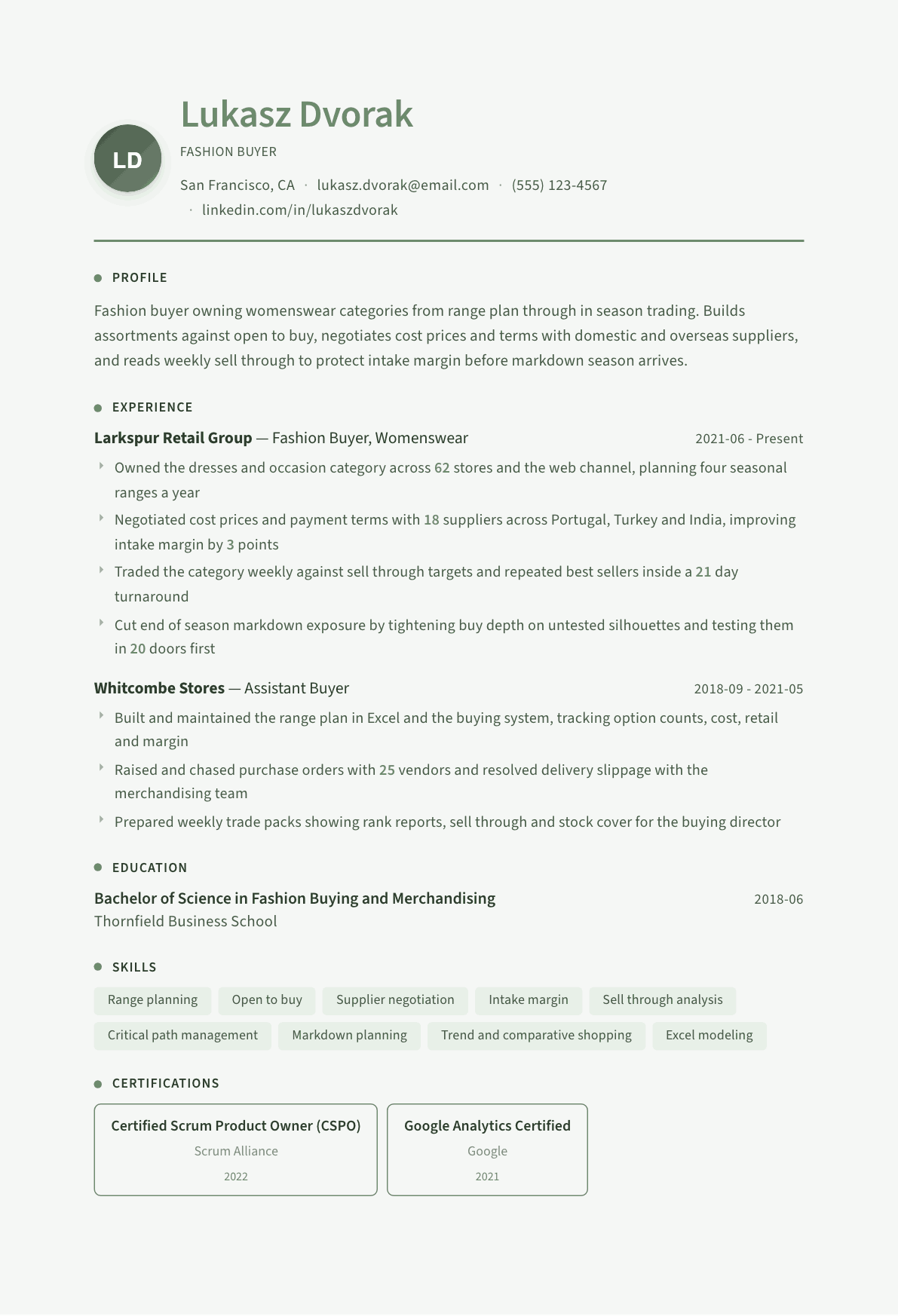
Example Fashion Buyer summary
Fashion buyer with six years owning womenswear categories across store and online channels. Builds seasonal ranges to an open to buy, negotiates cost prices and delivery terms with domestic and overseas suppliers, and trades the category weekly on sell through and stock cover. Focused on protecting intake margin early rather than rescuing the season with markdown.
Skills to list on a Fashion Buyer resume
- Range planning
- Open to buy management
- Assortment building
- Supplier negotiation
- Cost price and terms
- Intake and achieved margin
- Sell through and rank reporting
- Markdown and exit strategy
- Critical path management
- Comparative shopping
- Trend forecasting
- Fit session participation
- Vendor relationship management
- Excel and pivot analysis
- Retail planning systems
What actually gets this resume read
- Lead every job with the category you owned, the door count and the channel mix, since scope decides the interview.
- Quote margin, sell through and markdown outcomes as numbers, because buying is judged on trading results.
- Name the sourcing countries and supplier types you have negotiated with, from domestic mills to overseas factories.
- Show the critical path work: sample approvals, fit sessions, delivery windows and the chasing that keeps them.
- Separate range building from in season trading, because many resumes describe one and the employer wants both.
- Reference the systems you plan in, whether that is a retail planning suite or heavy Excel with pivot models.
How to write a fashion buyer resume
A fashion buyer resume is a trading document. The buying director reading it wants to know what you owned, how big it was, and whether the numbers moved the right way while you owned it. Category, door count, channel mix, intake margin, sell through and markdown exposure are the six facts that decide whether you get a first call, and most resumes state none of them clearly.
The second thing a reader checks is whether you can do both halves of the job. Plenty of candidates describe range building, the trips, the samples, the boards and the option plan, and stop there. Others describe in season trading, the rank reports and the repeat orders, and never show a range they built. A buyer who cannot evidence both is priced as an assistant.
This guide covers how to state scope, how to write bullets that survive a trading interview, what to say about supplier negotiation and the critical path, and the questions buyers ask when they move between retailers with different planning systems.
Format: two pages once you own a category
Reverse chronological, no columns, one page only if you are still an assistant. Buying resumes carry a lot of numbers and a two page layout with breathing room reads better than a dense single page where the margin figures disappear into the paragraph.
Under each job title, write one scope line before the bullets: category, department, door count, channels and annual range count. That line alone answers the question the reader would otherwise ask in the first five minutes of the interview.
- Header: name, city, phone, email, and the product areas you have bought.
- Sections in this order: summary, experience with scope lines, systems and tools, education.
- Assistant buyers add a short section on the analysis packs they build weekly.
Summary: category, channel, and the margin story
Name the product categories, the retailer type and the channels, then the years, then the one commercial habit you want remembered. Something like protecting intake margin at the negotiation stage rather than rescuing the season with markdown says more about how you buy than any list of adjectives.
If you are crossing between retail types, say it. Buying for a department store estate, a vertical brand and a pure play online retailer are three different jobs with different lead times and option counts. Name the transferable part, usually supplier negotiation and range architecture, and be direct about what will be new.
Experience: build the range, then trade it
Split each job into range building and in season trading, even if the bullets sit in one list. Range building bullets cover the open to buy, option counts, depth by option, price architecture, comparative shopping and the trips. Trading bullets cover weekly sell through, rank reports, repeats and their turnaround, cover, and how you exited slow lines.
Supplier work deserves its own bullet. Name the sourcing base by country and supplier type, domestic mills, overseas factories, agents or direct, and say what you negotiated: cost prices, payment terms, minimum order quantities, delivery windows. A buyer who has negotiated terms and not just prices is worth more, because terms move cash.
The critical path is where buying jobs quietly break. Sample approvals, fit sessions, lab dips, bulk fabric commitment and delivery chasing. A bullet showing you held a launch date by escalating a late supplier is more convincing than any claim of strong relationships.
Numbers: state them the way a trading meeting states them
Use the vocabulary of the weekly trade pack, because that is the language the reader thinks in: intake margin in points, sell through against target, weeks cover, terminal stock, markdown depth and rate of sale. Give a direction and a size, such as improving intake margin by three points across a supplier base, and be ready to explain it.
Where you cannot share a number, describe the mechanism instead. Tightening buy depth on untested silhouettes and testing them in a smaller door group before committing tells a reader how you think about risk, and costs you nothing in confidentiality.
Systems: planning tools and Excel depth
Name the retail planning suite you used and what you did inside it, then be specific about Excel. Most buying interviews include a spreadsheet exercise, so pivot tables, lookups, a working range plan model and the ability to rebuild a rank report from raw sales data are worth stating plainly rather than describing yourself as Excel proficient.
Add the surrounding tools if you used them: the purchase order system, product lifecycle management, the sample tracking sheet and any supplier portal. A candidate who has raised and chased orders in a live system needs less hand holding in the first month.
Fashion Buyer resume summary examples
Assistant buyer
Assistant buyer with two years supporting womenswear across 60 plus doors and the web channel. Builds and maintains the range plan, raises and chases orders with 25 vendors, and produces the weekly trade pack showing rank, sell through and cover for the buying director.
Category buyer
Fashion buyer with six years owning dresses and occasion wear across a 62 store estate and online. Plans four seasonal ranges a year to an open to buy, negotiates cost prices and terms across three sourcing countries, and trades the category weekly, improving intake margin by 3 points.
Senior buyer
Senior fashion buyer with ten years across department store and vertical retail, currently owning a womenswear division and managing two buyers. Sets price architecture and option strategy, leads supplier negotiations across Portugal, Turkey and India, and has cut end of season markdown exposure for three consecutive seasons.
Work experience bullets: before and after
Before: Responsible for buying womenswear products.
After: Owned the dresses and occasion category across 62 stores and the web channel, planning four seasonal ranges a year against an agreed open to buy.
Category, door count, channel and range cadence give the reader the scope that the word responsible hides.
Before: Negotiated with suppliers to get better prices.
After: Negotiated cost prices and payment terms with 18 suppliers across Portugal, Turkey and India, improving intake margin by 3 points without moving retail price points.
Supplier count, sourcing base and a margin outcome with the constraint attached make the negotiation verifiable.
Before: Monitored sales performance during the season.
After: Traded the category weekly against sell through and cover targets, repeating best sellers inside a 21 day turnaround with an agreed fabric holding position.
The trading rhythm, the metric and the repeat lead time show in season control rather than passive monitoring.
Before: Reduced markdown at the end of the season.
After: Cut end of season markdown exposure by tightening buy depth on untested silhouettes and trialing them in 20 doors before committing bulk.
Naming the mechanism explains how the outcome was produced, which is what a buying director probes in interview.
Before: Worked with the merchandising team on stock issues.
After: Resolved delivery slippage with merchandising by rephasing intake and escalating two late factories, protecting the launch window on 90 plus options.
The specific action and the thing protected turn a vague partnership line into critical path evidence.
Hard skills
- Range planning and assortment building
- Open to buy management
- Cost price and terms negotiation
- Intake and achieved margin
- Sell through and rank reporting
- Markdown and exit strategy
- Critical path management
- Comparative shopping
- Trend forecasting
- Fit session participation
- Price architecture
- Supplier and sourcing base management
- Excel modeling and pivot analysis
- Retail planning systems
Soft skills
- Commercial judgment
- Negotiation
- Working with merchandising
- Decisiveness under a deadline
- Presenting a range to leadership
- Supplier relationship building
Mistakes that cost fashion buyer candidates the interview
- Describing the range you bought without the door count, channel mix or option count that sets your scale.
- Listing trend and travel work while leaving out sell through, margin and markdown, the numbers a buying director hires on.
- Claiming ownership of a category you supported, which collapses under one question about who signed the open to buy.
- Ignoring the critical path, so the reader cannot tell whether you have ever chased a late bulk delivery.
- Writing the resume around brands you love rather than the commercial mechanics of the categories you traded.
- Leaving Excel as a one word skill when most buying interviews include a live spreadsheet exercise.
Fashion Buyer resume questions
How much financial detail should a fashion buyer resume include?
Enough to prove trading control without breaching confidentiality. Margin movement in points, sell through against target and markdown direction are normal to state. Absolute turnover figures usually are not, so give the shape of the number rather than the number itself.
Can I move from assistant buyer to buyer with this resume?
Yes if you evidence independent decisions rather than support tasks. Show a sub category you selected, a supplier you negotiated with directly, and a repeat call you made. Name the buyer you deputized for and the periods you traded the department alone.
Do I need retail planning software experience to be considered?
Most retailers train you on their own system, so the transferable proof is the underlying discipline: building a range plan, modeling option counts and depth, and rebuilding a rank report from raw sales. State the system you used and the depth of your Excel work.
How do I write a buying resume when moving between menswear and womenswear?
Lead with the mechanics that carry across: open to buy discipline, supplier negotiation, price architecture and trading rhythm. Then name what changes, usually size curves, lead times and option counts, and show any comparative shopping you have already done in the new area.
Should a fashion buyer resume mention sustainability sourcing?
Yes when you have done concrete work: supplier audits, certified fabric commitments, minimum order quantity changes to cut over buying, or a fiber standard you have bought against. State the specific practice, since a general statement of values adds no evidence.