Jewelry Designer Resume Examples: the lines they read
Craft a Jewelry Designer Resume That Sparkles
By Mustafa Tarabya, founder of CVBooster · Published · Updated
Build a jewelry designer resume showcasing your design skills, gemology knowledge, and craftsmanship with elegant creative templates.
Sample resumes for a jewelry designer
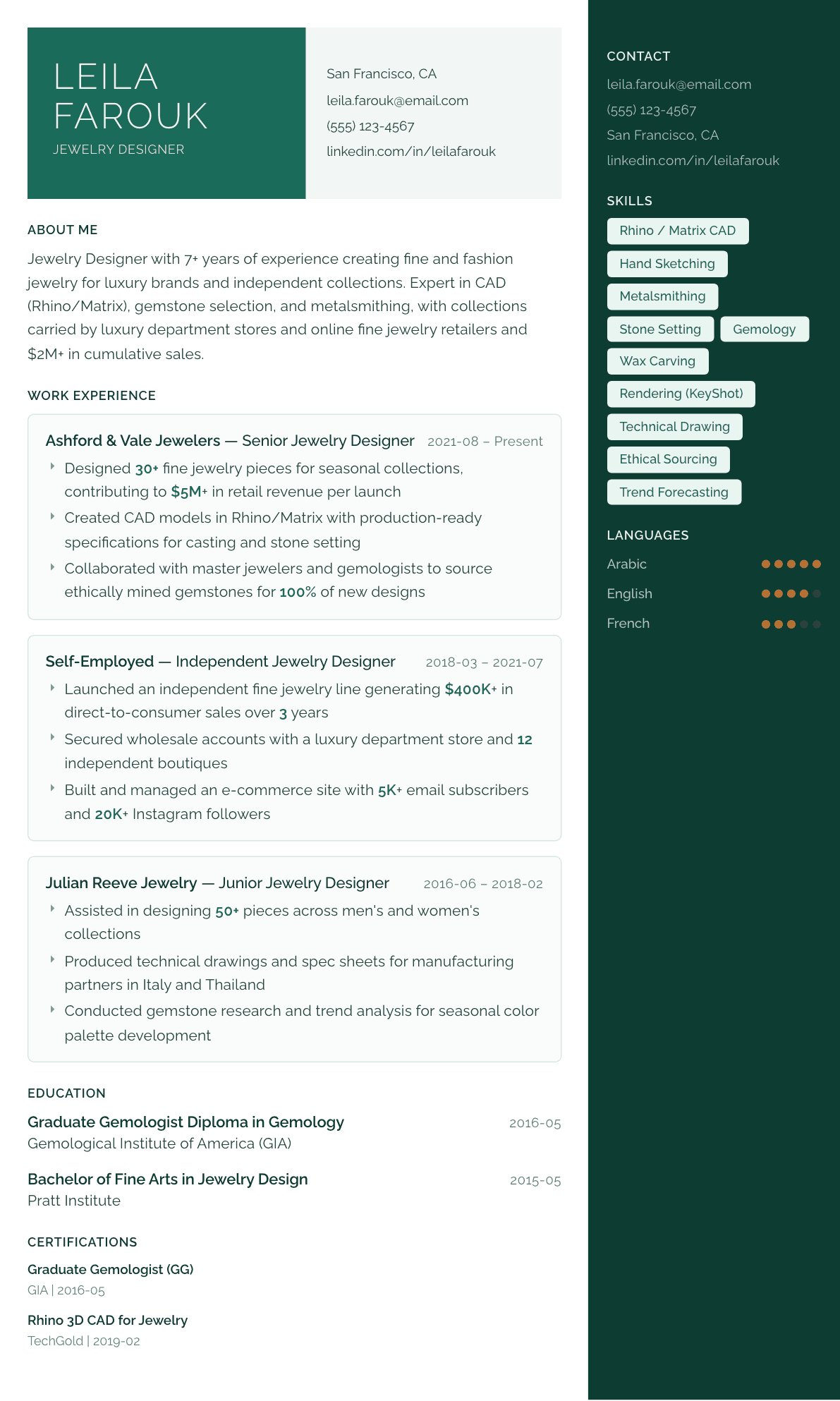
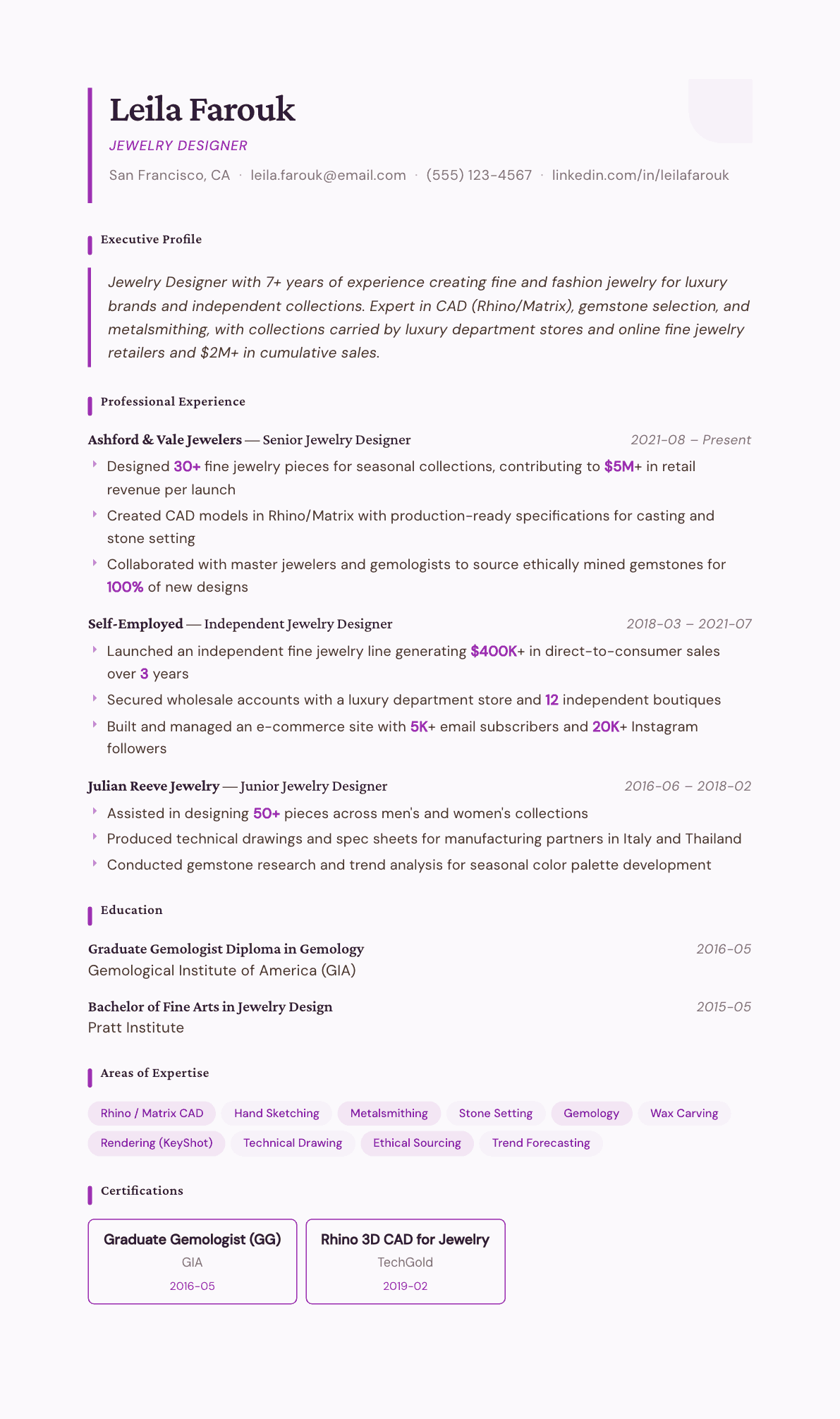
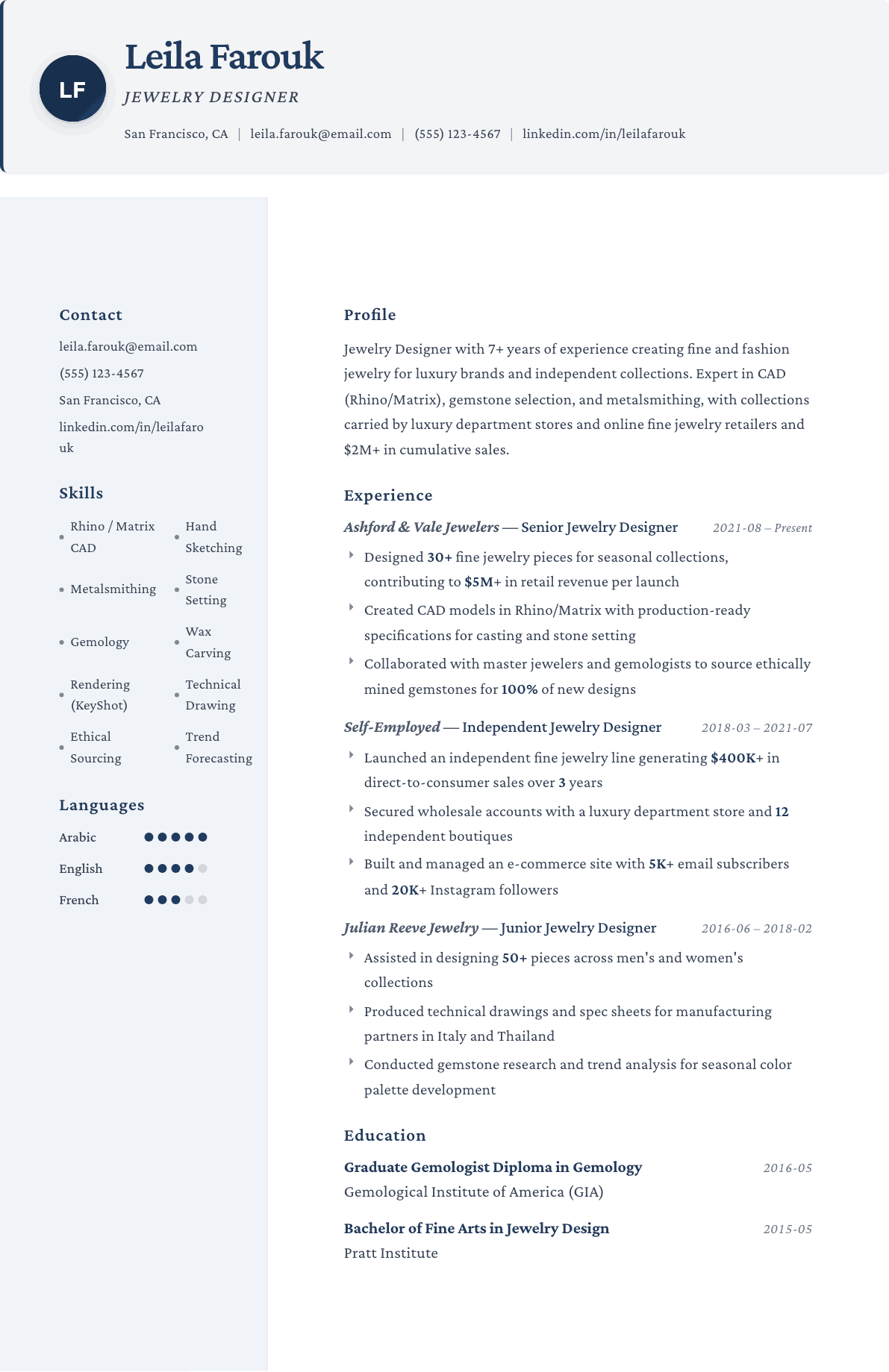
The same jewelry designer content laid out in three CVBooster templates, so you can see what the finished document looks like before you write a word.
Example Jewelry Designer summary
Jewelry Designer and GIA Graduate Gemologist, 7 years across fine and fashion jewelry for luxury houses and an independent line. Designs in Rhino and Matrix through to casting and setting specs, sources ethically mined stones for every new piece, and has $2M+ in cumulative sales through department store and boutique accounts.
Skills to list on a Jewelry Designer resume
- Rhino / Matrix CAD
- Hand Sketching
- Metalsmithing
- Stone Setting
- Gemology
- Wax Carving
- Casting
- Rendering (KeyShot)
- Technical Drawing
- Ethical Sourcing
- Trend Forecasting
- Photoshop
- Illustrator
- E-commerce
What actually gets this resume read
- Include high-quality photography of your pieces in your portfolio -- jewelry is judged visually first.
- Mention the brands and retailers where your work is sold for instant credibility.
- Highlight CAD skills (Rhino, Matrix, ZBrush for organic) alongside traditional bench skills.
- Include gemology credentials (GIA GG, FGA) as they are highly valued in the industry.
- Quantify sales impact: revenue generated, units sold, retail accounts secured.
- Show knowledge of ethical sourcing and sustainability -- increasingly important in luxury.
How to write a jewelry designer resume
Jewelry design sits between art and manufacturing, and hiring managers screen for both halves. The creative director at a fine jewelry house wants to see a point of view, a sense of proportion on the body, and drawings that read. The production manager standing next to her wants to know whether your computer aided design files can be grown and cast, whether your metal weights are realistic, whether your stone specifications match what the buying office can actually source, and whether your pieces can be set without the bench cursing your name.
The market segment matters as much as the skill set. Fine jewelry in precious metal with certified stones, bridal, fashion and costume jewelry in plated base metal, and independent studio work each have different cost structures, different vendors and different design constraints. A resume that names the segment, the metals, the price points and the production method answers most of the screening questions before the portfolio opens.
This guide covers the format a jewelry employer expects, how to describe collections so their commercial scale is visible, three summaries from bench-trained newcomer to design lead, before and after bullets, and the questions designers ask about gemology credentials, computer aided design software and moving between fine and fashion jewelry.
Format: one page, portfolio link in the header, segment stated up front
Keep it to a single clean page while you are building a body of work. State the segment directly under your name, because a fine jewelry house and a fashion accessories brand read a portfolio differently and both want to know immediately which world you come from.
The portfolio link belongs beside the email. Photograph finished pieces properly against a neutral ground with the scale clear, and include renderings and technical drawings next to the finals so a production reader can see how you work rather than only what you made.
- Header: name, segment line such as "Fine Jewelry Designer, Bridal and High Jewelry", city, email, portfolio link.
- Order: summary, experience, technical skills, gemology and credentials, education, awards and stockists.
- Bench-trained designers add a separate metalsmithing section listing the techniques they can execute by hand.
- Independent designers add a collections and stockists section rather than a conventional job history.
Summary: segment, metals, stones, and how you get from sketch to piece
Name the segment, the years, the materials you design in, and the route you take from idea to finished piece. A designer who hand carves wax and finishes at the bench and a designer who models in Rhino and hands files to a casting house are both valuable, and the summary is where you say which you are, or that you do both.
If you hold a gemology credential, put it here. Stone knowledge is expensive to acquire and directly affects what a designer can specify without a buyer correcting her, so it is worth the line.
Experience: collection size, price point and production route
For each role, give the brand, the segment, the price band in general terms, and the volume: how many styles per collection, how many collections a year, and whether the pieces were made in house, by a domestic casting house or overseas. Those facts let a hiring manager map your experience onto her own calendar.
Then write bullets across the real workflow: research and concept, hand sketching, computer aided design modeling, rendering for internal or client approval, wax growing and casting, stone selection and specification, setting method, finishing, and final quality inspection. Say which steps you owned and which you supervised.
Name the commercial constraints you worked inside. Metal weight targets that hold a margin, stone budgets and calibrated sizes, minimum order quantities from the casting house, and the difference between a piece that photographs well and one that sells at counter. Designers who talk about cost and sourcing get hired for the roles with responsibility attached.
Technical skills: computer aided design, bench craft and specification
Split the digital tools from the hand skills. Rhino, often with Matrix or a jewelry plugin, is the working environment across most of the trade, with ZBrush used for organic and sculptural forms and KeyShot or a similar engine for rendering. Say what you model to: prong geometry that will actually hold a stone, wall thickness that survives casting and polishing, and seat and gallery detail that a setter can work with.
Then the bench: wax carving, sawing and piercing, soldering, forming, stone setting methods from prong and bezel to pave and channel, polishing and finishing. Even in a digital studio, a designer who has set a stone designs better files, and employers say so openly.
- Digital: Rhino and Matrix modeling, ZBrush sculpting, KeyShot rendering, printable file preparation.
- Bench: wax carving, soldering, forming, stone setting, polishing and finishing.
- Specification: metal and alloy selection, weight estimates, stone shapes and calibrated sizes, tolerance for setting.
- Documentation: technical drawings, bill of materials, costing sheets, quality standards.
Gemology, sourcing and provenance
Gemology credentials belong in their own short section with the issuing institute named. Alongside them, say what you can do practically: grading diamonds by the four characteristics, identifying common colored stone treatments, judging calibrated goods, and working with a buying office on a stone budget.
Responsible sourcing is now a working requirement rather than a value statement, so describe it as process. Naming the chain of custody documentation you worked with, the recycled metal you specified, or the supplier audits you supported is credible. Calling yourself passionate about ethical sourcing is not.
Jewelry Designer resume summary examples
Bench-trained newcomer
Jewelry design graduate with bench training in fabrication, soldering and bezel setting, and a fifteen-piece silver and semi-precious collection carried from sketch to finished, hallmarked pieces. Models in Rhino, prepares printable files, and completed an internship supporting a bridal brand with technical drawings.
Six years in
Fine jewelry designer with six years in bridal and everyday gold, designing roughly 60 styles a year in 14 and 18 karat gold with diamonds and calibrated colored stones. Models in Rhino and Matrix, holds metal weight targets against margin, and works daily with a domestic casting house.
Design lead
Jewelry design lead with fourteen years across fine and high jewelry, a graduate gemologist credential, and responsibility for four collections a year plus bespoke commissions. Directs two designers, sets the house design language, and manages casting, setting and finishing vendors across two countries.
Work experience bullets: before and after
Before: Designed jewelry collections for the brand.
After: Designed four collections a year totaling about 70 styles in 14 karat gold with diamond and calibrated sapphire settings, from concept sketch through approved production sample.
Collection rhythm, style count, metal and stone type describe a workload rather than a job title.
Before: Used Rhino and Matrix for CAD work.
After: Modeled production-ready files in Rhino and Matrix with correct prong geometry, seat depth and gallery clearance, so pieces went from growing to setting without bench rework.
Naming the geometry and the downstream result proves the files were usable, not just pretty.
Before: Worked with the factory on production.
After: Managed the casting house relationship through wax growing, casting and finishing, ran first-article reviews on every new style, and held metal weights within the target range that protected the margin.
Vendor management plus a weight and margin constraint shows commercial ownership of the design.
Before: Selected gemstones for pieces.
After: Specified center and accent stones with the buying office, matching calibrated sizes to the design and grading parcels of melee for color and clarity consistency across a 20-style program.
Working with a buying office on calibrated goods and parcel consistency is a real gemological skill.
Before: Made sketches and renderings for clients.
After: Presented bespoke commissions with hand sketches, three metal and stone options and a photorealistic render, converting roughly two out of three consultations into orders.
The presentation format and a conversion outcome connect the drawings to revenue.
Hard skills
- Hand sketching and rendering
- Rhino modeling for jewelry
- Matrix and jewelry plugins
- ZBrush sculpting
- KeyShot rendering
- Wax carving
- Metalsmithing and fabrication
- Stone setting methods
- Gemstone grading and identification
- Metal and alloy specification
- Metal weight and cost estimating
- Casting and finishing processes
- Technical drawings and bills of materials
Soft skills
- Client consultation for bespoke work
- Presenting to a creative director
- Vendor and casting house communication
- Precision and patience
- Cost consciousness
- Mentoring junior designers
Certifications worth listing
- Graduate Gemologist (GG) (Gemological Institute of America)
- Graduate Jeweler (Gemological Institute of America)
- Applied Jewelry Professional (Gemological Institute of America)
- Gemmology Diploma (FGA) (Gem-A, The Gemmological Association of Great Britain)
Mistakes that cost jewelry designer candidates the interview
- Leaving the segment unnamed, so a fine jewelry house cannot tell whether you have worked in gold and diamonds or plated base metal.
- Showing renderings only, with no photographs of finished pieces, which suggests nothing you designed was ever made.
- Writing about design intent while omitting metal weights, stone specifications and casting, which is where the money is decided.
- Photographing pieces badly or without scale, so a reader cannot judge proportion on the body.
- Listing computer aided design software without saying whether your files come out clean enough to grow and set.
- Treating responsible sourcing as a sentiment rather than describing the documentation and suppliers you actually worked with.
- Omitting bench skills entirely, when a designer who has set a stone writes better files and employers know it.
Jewelry Designer resume questions
Do I need a gemology certificate to be a jewelry designer?
It is not required, but it is one of the few credentials this trade recognizes and it changes what you can specify without correction. In fine jewelry it is common enough that not having it can put you behind an otherwise equal candidate.
Is Rhino or hand carving more important for jewelry design jobs?
Most production roles now expect computer aided design, and Rhino with a jewelry plugin is the common standard. Hand carving and bench skill remain valuable because they teach you what castings and settings can survive, so the strongest candidates offer both.
How should a jewelry designer photograph work for a portfolio?
Shoot on a plain neutral ground with even light, include a shot that shows scale or the piece worn, and place the technical drawing or rendering next to the finished piece. Production readers judge you on the gap between the two.
How do I move from fashion jewelry to fine jewelry?
Learn the material rules that change: precious metal weights and cost, stone grading and calibrated sourcing, hallmarking and setting standards. Then build a small fine portfolio, ideally with pieces actually cast in gold or silver, rather than presenting plated designs as fine work.
What should an independent jewelry designer put instead of job history?
Use a collections section with the year, materials, number of pieces and where they sold, then a stockists line naming the shops, galleries or markets. Add production partners and any wholesale or trade show experience, since those show a working business.