Fast Food Manager Resume Examples: the lines they read
Write a Fast Food Manager Resume Franchise Owners Trust
By Mustafa Tarabya, founder of CVBooster · Published · Updated
Fast food manager resume examples with speed of service, labor and inspection metrics, plus a guide to store level hiring.
Sample resumes for a fast food manager
The same fast food manager content laid out in three CVBooster templates, so you can see what the finished document looks like before you write a word.
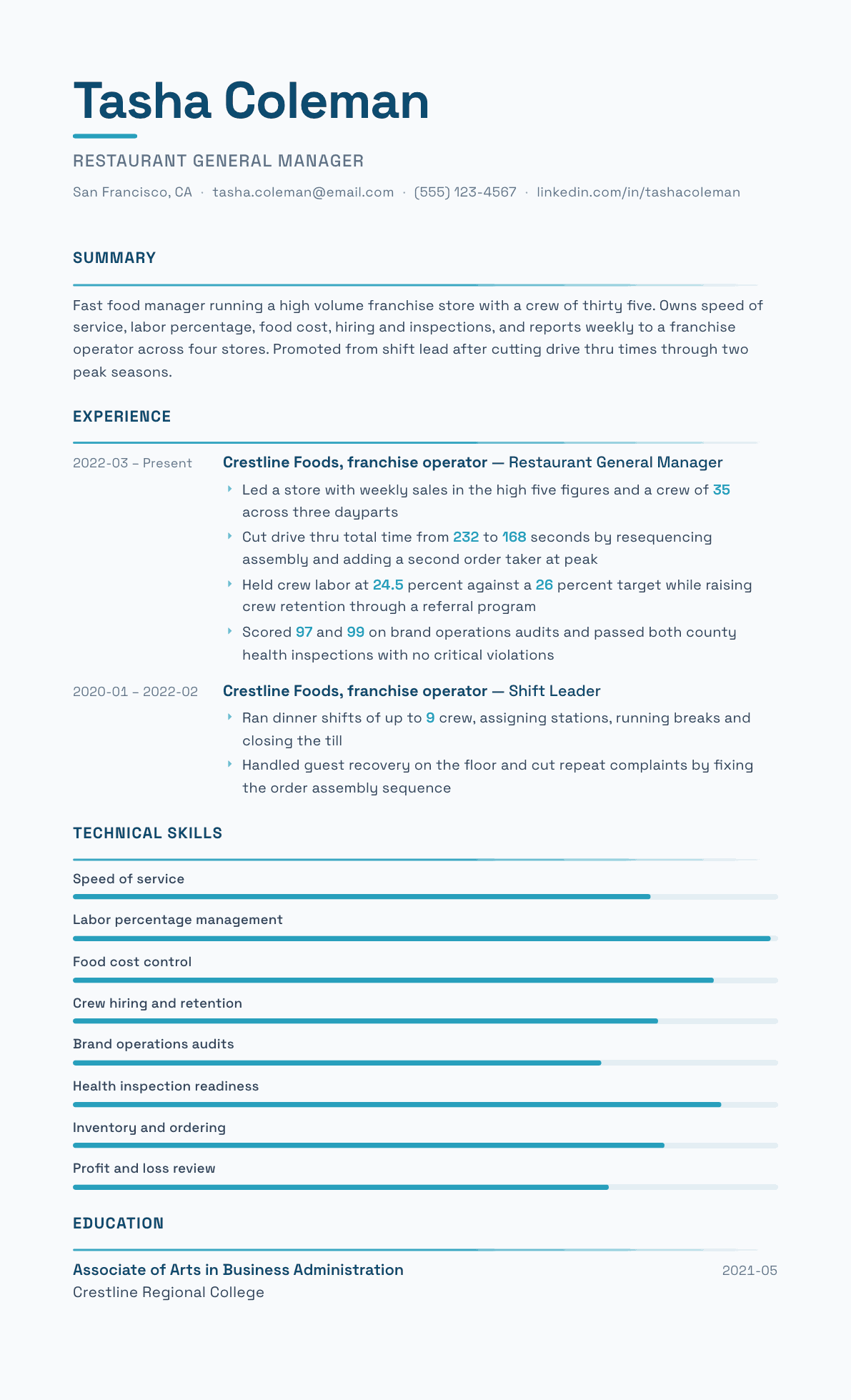
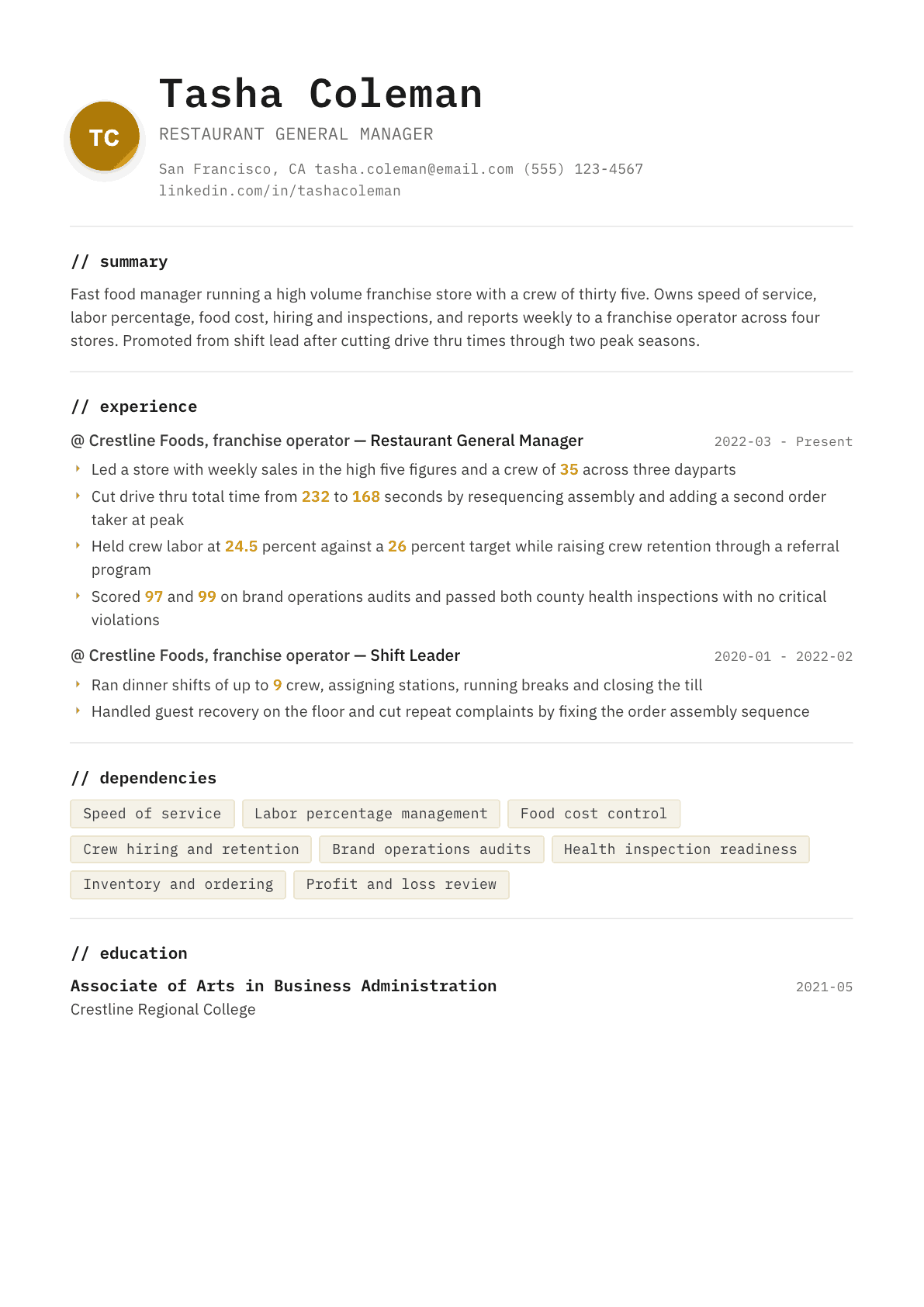
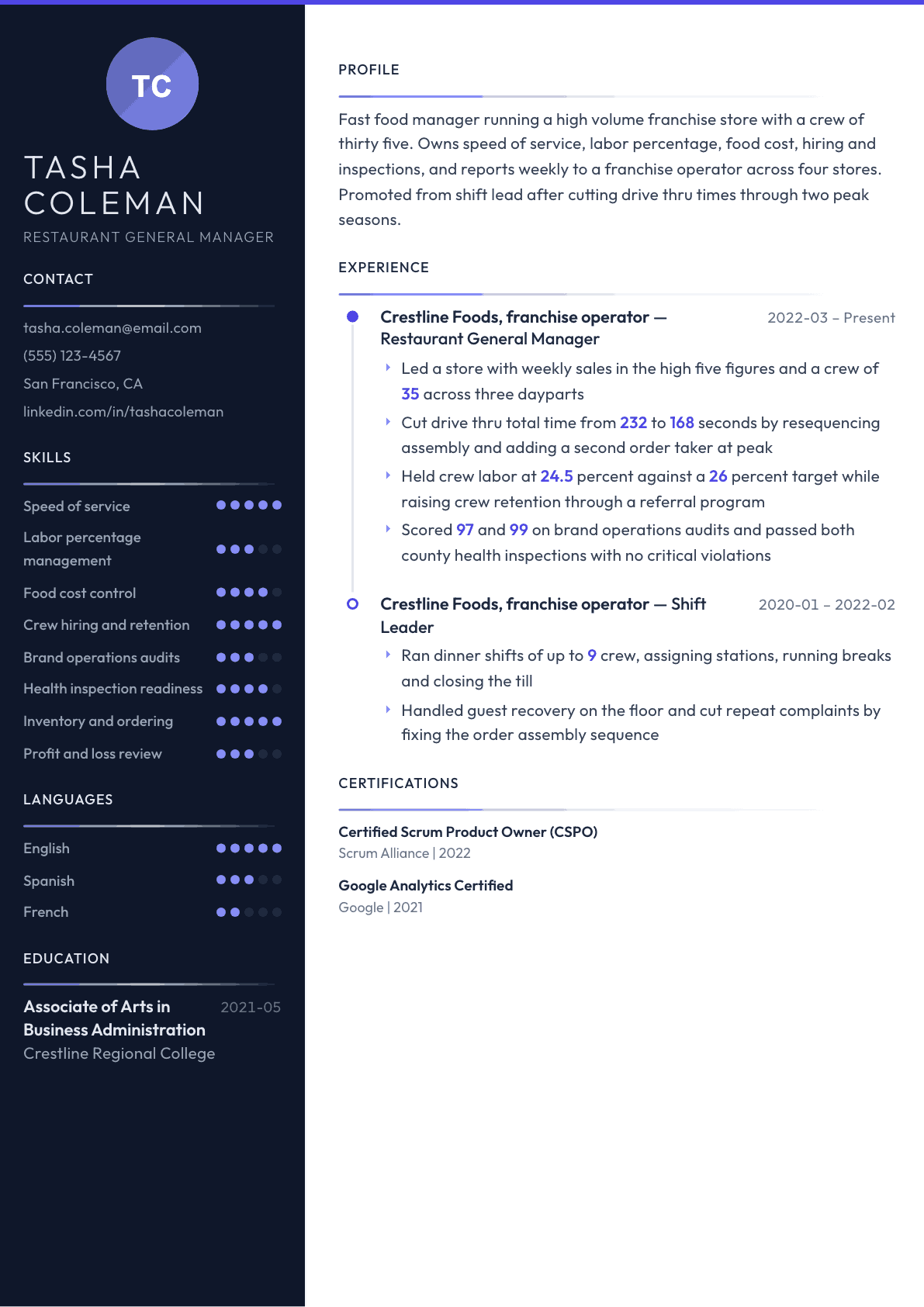
Example Fast Food Manager summary
Fast food manager with five years in franchise stores, running a crew of thirty five across three dayparts with full ownership of labor, food cost and speed of service. Cut drive thru total time by more than a minute through station resequencing, held labor under the brand target, and passed operations audits and county inspections without critical findings. ServSafe Manager certified.
Skills to list on a Fast Food Manager resume
- Store operations management
- Speed of service improvement
- Labor cost management
- Food cost and waste control
- Inventory and ordering
- Profit and loss ownership
- Crew hiring and onboarding
- Scheduling
- Brand standards audits
- Health inspection readiness
- Guest recovery
- Cash control and deposits
- Shift leadership
- Training and certification
What actually gets this resume read
- Lead with store volume, crew size and dayparts covered, since franchise operators size a candidate that way.
- Report speed of service as a before and after in seconds, because that is the metric brands audit hardest.
- Give labor and food cost against the target you were held to rather than as an isolated figure.
- Include your brand operations audit scores and your last two health inspection results.
- Show hiring and retention work by name: referral programs, open interview days, onboarding you rewrote.
- Name the brand systems you ran, whether scheduling, inventory or the mobile order platform.
How to write a fast food manager resume
A fast food manager resume is read by a franchise operator or an area coach who runs several stores and thinks entirely in store level numbers. Speed of service in seconds, labor as a share of sales, food cost against the brand target, operations audit scores, health inspection results and crew turnover. Those six figures are the interview.
Most candidates for this role write about leadership and customer focus and leave every one of those numbers off the page. The operator then has no way to tell a manager who cut drive thru times through two peak seasons from a manager who was simply present while the store ran itself.
This guide puts the store level metrics on the page in the format brands audit them, shows how to write hiring and retention work in an industry that struggles to keep crew, and how to position a shift leader who is ready for the general manager seat.
Format: one page, store size and volume in the first line
One page for a single store manager, two once you have carried multiple units or a training store. Franchise groups often screen through simple applicant tracking systems and then hand the file to an operator who reads on a phone, so keep it single column and plain.
Give each store a sizing line before the bullets: weekly sales band, crew size, dayparts covered, drive thru or dine in mix, and whether it was a training or high volume unit. Operators size a candidate that way before they read a single achievement.
- Order: summary, experience, education, certifications, systems and skills.
- Write sales as a volume band rather than an exact figure, which is both safer and easier to compare.
- If you were promoted inside the same operator, show both titles under one employer so the progression is visible.
Summary: crew size, dayparts, and the costs you own
Three lines. Years managing a store, the crew size and dayparts, full ownership of labor, food cost and speed of service, and the audit and inspection record. Then a food safety manager certification, which most brands require of the person holding the keys.
A shift leader aiming at a general manager seat should lead with the pieces already owned: station assignment, break scheduling, till close, guest recovery and inventory counts. That is most of a general manager day, and naming it makes the promotion look like a small step instead of a leap.
Speed of service and the metrics brands audit
Report drive thru performance as a before and after in seconds with the change that produced it. Total time cut by resequencing assembly, adding a second order taker at peak, moving the expeditor position, or fixing the pull forward rule. Brands measure this to the second and audit it hardest, so a manager who has moved it is speaking the language of the operations team.
Do the same for labor and food cost. Give the figure against the target you were held to, not as an isolated number, because a labor share means nothing without the target attached. Add the waste tracking, portion checks and ordering discipline that produced it.
Then the audits. Brand operations audit scores and the last two county health inspection results belong on the page. An operator who is preparing for their own audit will read that section first.
Hiring, retention and the crew bench
Crew turnover is the expensive problem in this industry, so retention work carries real weight. Write the programs by name: a referral bonus you launched, open interview days, an onboarding you rewrote, a certification path that gave crew a reason to stay, and the scheduling changes that stopped people leaving over hours.
Then the bench you built. Crew trainers you certified, shift leaders you promoted, and the store that could run a Saturday without you standing in it. Operators buy a manager who creates other managers, because that is what lets them open the next unit.
- Name the scheduling, inventory and mobile order platforms you ran.
- Include cash control: deposits, safe counts, variance and any loss prevention work.
- Say whether you owned the profit and loss review or contributed to it, and be precise about which.
Keywords franchise recruiters search
The searched vocabulary is short: fast food manager, restaurant general manager, shift leader, speed of service, drive thru times, labor cost, food cost, crew retention, brand standards, operations audit, health inspection, inventory management, profit and loss and franchise operations.
Include both the brand title and the generic one. Many groups post the role as restaurant general manager while the internal title is store manager, and a resume that uses only one of them can be filtered out of a search it should have led.
Fast Food Manager resume summary examples
Shift leader stepping up
Shift leader with three years at a high volume franchise store, running dinner shifts of up to 9 crew, assigning stations, scheduling breaks and closing the till. Handles guest recovery on the floor and covers weekly inventory counts. Food safety manager certified and ready for an assistant or store manager seat.
Store manager
Fast food manager running a high volume franchise store with a crew of 35 across three dayparts. Owns speed of service, labor, food cost, hiring and inspections, and cut drive thru total time from 232 to 168 seconds by resequencing assembly. Held crew labor at 24.5% against a 26% target while raising retention.
Multi unit operator
Restaurant general manager with eight years in franchise operations, currently covering three stores for an operator group with combined crew above 90. Runs the training store, promoted four shift leaders into management, and holds operations audit scores in the high nineties with no critical health violations across the portfolio.
Work experience bullets: before and after
Before: Improved drive thru speed.
After: Cut drive thru total time from 232 to 168 seconds by resequencing assembly and adding a second order taker through the lunch and dinner peaks.
Two real times and the operational change behind them are what an area coach audits, so the claim is checkable.
Before: Managed labor costs.
After: Held crew labor at 24.5% of sales against a 26% target while covering three dayparts, using a rolling forecast to build the schedule.
A figure against the target you were held to is comparable, while a bare share of sales means nothing.
Before: Kept the store to brand standards.
After: Scored 97 and 99 on brand operations audits and passed both county health inspections with no critical violations during the same period.
Audit and inspection results are the compliance record an operator is personally responsible for, so they carry weight.
Before: Hired and retained crew.
After: Raised crew retention through a referral bonus, monthly open interview days and a rewritten two week onboarding with a station certification path.
Naming the programs shows a repeatable system for the hardest recurring problem in the store.
Before: Handled customer complaints.
After: Handled guest recovery on the floor during peak and cut repeat complaints by fixing the order assembly sequence that caused missing items.
Fixing the cause rather than the individual complaint is the difference between a manager and a crew member with keys.
Hard skills
- Store operations management
- Speed of service improvement
- Labor cost management
- Food cost and waste control
- Inventory and ordering
- Profit and loss ownership
- Crew hiring and onboarding
- Scheduling and forecasting
- Brand standards audits
- Health inspection readiness
- Guest recovery
- Cash control and deposits
- Training and station certification
Soft skills
- Floor leadership at peak
- Coaching crew
- Conflict resolution
- Accountability across dayparts
- Clear delegation
- Composure during audits
Certifications worth listing
- ServSafe Food Protection Manager Certification (National Restaurant Association)
- ServSafe Alcohol (National Restaurant Association)
- Foodservice Management Professional (FMP) (National Restaurant Association)
- Certified Food Manager (CFM) (National Registry of Food Safety Professionals)
Mistakes that cost fast food manager candidates the interview
- Writing about leadership and customer focus with none of the six numbers an operator actually reviews.
- Giving a labor share with no target attached, which makes the figure impossible to judge.
- Leaving operations audit scores and health inspection results off the page when they were strong.
- Ignoring crew retention, the most expensive recurring problem the operator is hiring you to reduce.
- Claiming profit and loss ownership when you only attended the review, which unravels in the first interview question.
- Using only the internal store title so recruiters searching for restaurant general manager never see the resume.
- Listing every brand system as a skill without saying what you ran in it, such as the schedule or the weekly order.
Fast Food Manager resume questions
What numbers should a fast food manager put on a resume?
Speed of service in seconds before and after, labor share against the target you were held to, food cost, operations audit scores, the last two health inspections and crew retention. Those are the metrics the operator already reviews weekly.
Should I include the store sales figure?
Use a volume band rather than an exact number. It gives the operator the sizing they need without disclosing a franchisee number you may not be free to share, and it is easier to compare across brands and markets.
How do I move from shift leader to general manager?
Lead with what you already own: station assignment, breaks, tills, inventory counts, guest recovery and closing. Then add anything cost related you touched, because the gap between the two roles is mainly ownership of labor and food cost.
Does brand experience transfer between chains?
Largely yes, because the operating model repeats: dayparts, drive thru timing, station assembly, brand audits and inspections. Write the mechanics rather than internal brand jargon, so an operator from a different chain can read your work immediately.
What certification do fast food managers need?
A food safety manager certification is the standard requirement for whoever holds the keys, and alcohol certification is needed where the store serves it. Both are cheap, quick to renew, and their absence stalls an otherwise strong application.
Related resume examples
- Restaurant Manager Resume example
- Fast Food Worker Resume example
- Restaurant Supervisor Resume example
- Restaurant General Manager Resume example
- Assistant Restaurant Manager Resume example
- Kitchen Manager Resume example