Assistant Restaurant Manager Resume Examples: free score
Build an Assistant Restaurant Manager Resume for the Next Step
By Mustafa Tarabya, founder of CVBooster · Published · Updated
Assistant restaurant manager resume examples with scheduling, cost and service bullets, plus a guide to moving into full management.
Sample resumes for a assistant restaurant manager
The same assistant restaurant manager content laid out in three CVBooster templates, so you can see what the finished document looks like before you write a word.
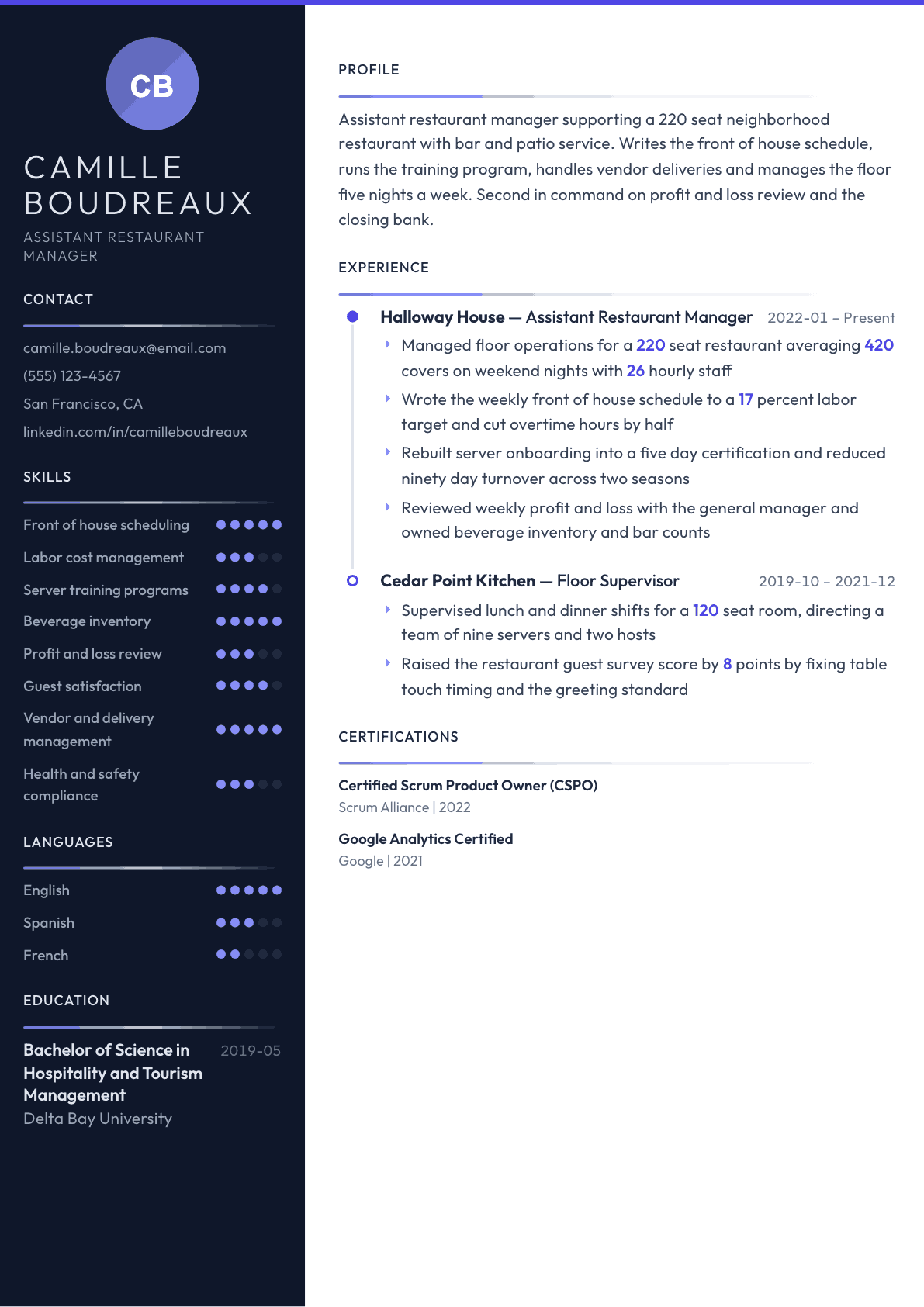
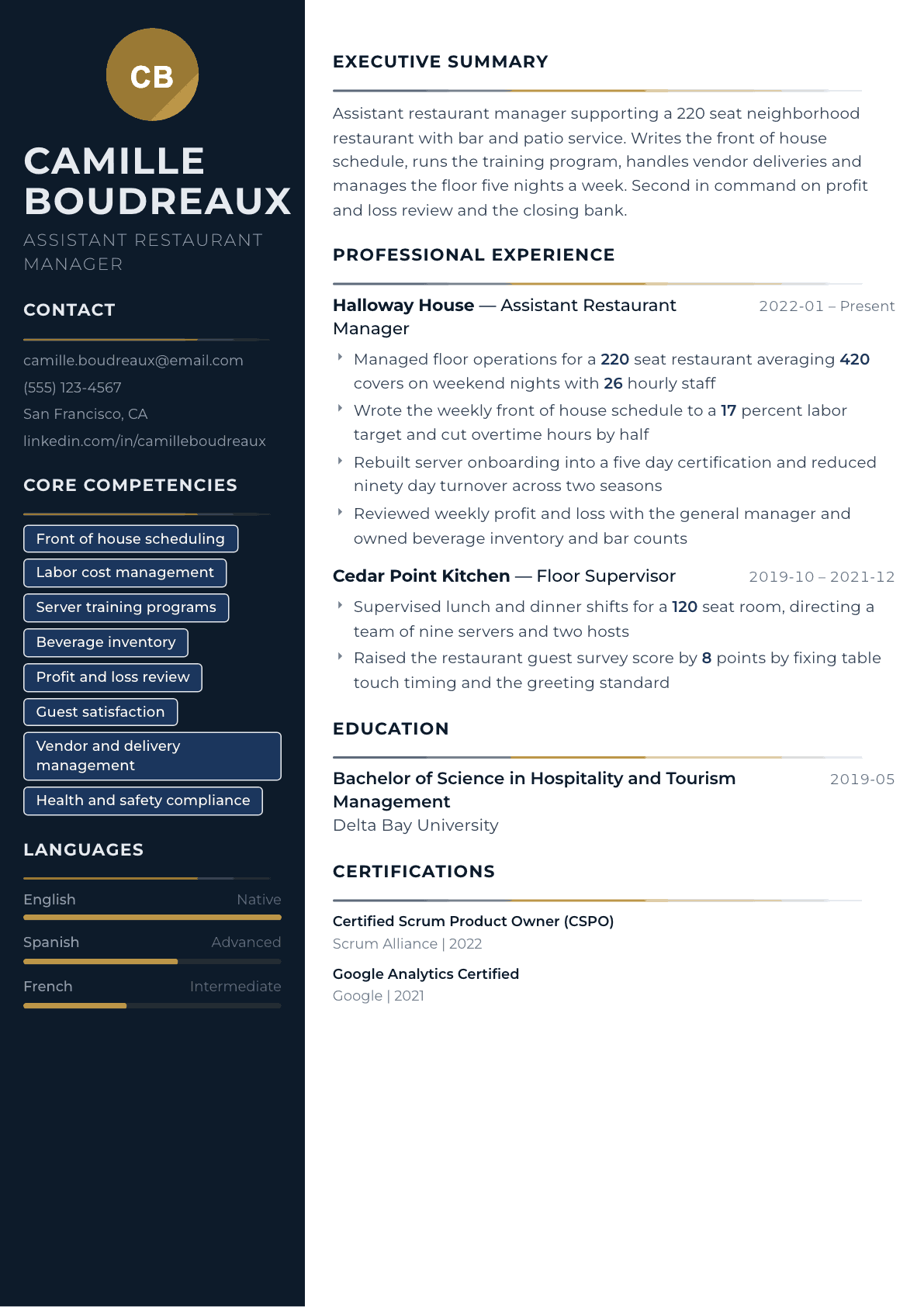
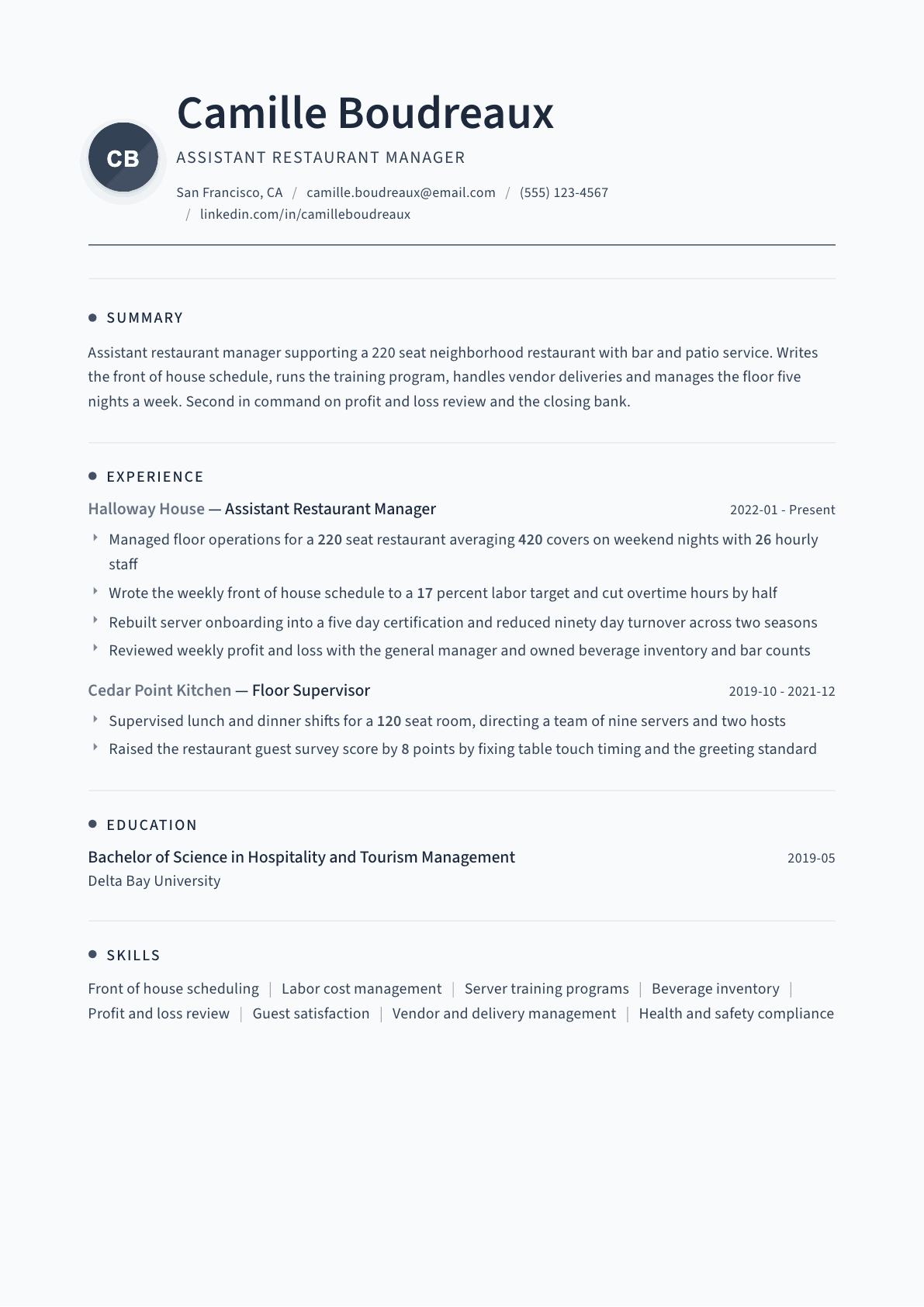
Example Assistant Restaurant Manager summary
Assistant restaurant manager with six years in full service dining, supporting a two hundred and twenty seat restaurant with bar and patio and a team of twenty six. Writes the front of house schedule to a labor target, owns beverage inventory and the closing bank, and rebuilt server onboarding into a five day certification that cut early turnover. Ready to step into a general manager seat.
Skills to list on a Assistant Restaurant Manager resume
- Floor operations management
- Front of house scheduling
- Labor cost control
- Profit and loss review
- Server and host training
- Hiring and onboarding
- Beverage and bar inventory
- Vendor and delivery management
- Guest satisfaction programs
- Point of sale administration
- Cash control and deposits
- Health and safety compliance
- Scheduling software
- Event and private dining support
What actually gets this resume read
- Name the parts of the business you owned outright, because assistant manager titles cover very different jobs.
- Give labor percentage, overtime hours or turnover numbers to prove you managed cost and not just the floor.
- Include profit and loss exposure even if you did not own the statement, since that is the promotion gate.
- Show your training program in detail: length, certification steps and the retention effect it had.
- Cover both front and back of house exposure if you have it, because general manager roles want both.
- Position the resume toward the general manager job you want next rather than the one you already hold.
How to write a assistant restaurant manager resume
Assistant restaurant manager is the least standardized title in the industry. In one restaurant it means a supervisor with a nicer schedule, and in the next it means the person who writes the schedule, runs the training program, takes the deliveries, counts the bar and sits in the weekly profit and loss review. A resume that does not say which version you held leaves the reader guessing, and guessing goes against you.
The reader is usually a general manager or an owner hiring their second in command, or a multi unit group looking for the next general manager. Either way they are checking for cost ownership. Floor skill is assumed at this level; what is not assumed is that you have managed labor as a number, held a vendor to an invoice and understood where the money went last month.
This guide shows how to name the parts of the business you owned outright, how to put labor, turnover and profit and loss exposure on the page, and how to point the whole resume at the general manager seat you want next rather than the job you already hold.
Format: one page, ownership stated under each job
One page for under seven years, two beyond that or across multiple concepts. Reverse chronological, single column, plain headings. Restaurant groups screen through applicant tracking systems and independent owners read on paper, and both drop resumes that hide dates inside a design.
Under each employer, write a scope line and then an ownership line. Scope is the seats, the covers on a weekend night, the staff count and whether there is a bar and patio. Ownership is the short list of what was actually yours: the front of house schedule, beverage inventory, server training, vendor deliveries, the closing bank. Two lines and the reader knows exactly what version of the title you held.
- Order: summary, experience, education, certifications, systems, then skills.
- Say who you reported to and who reported to you, since that fixes the level instantly.
- Mention back of house exposure separately, because general manager roles want both sides.
Summary: second in command, with numbers
Three lines. Years in full service management, the room size and team, the parts of the operation you own, and one measurable outcome. Then a closing line stating you are ready for a general manager seat, because that is the job most people reading this resume are hiring toward and it costs nothing to say.
A supervisor moving up should lead with cost exposure rather than floor skill. Scheduling to a labor target, inventory counts, ordering, and any part of the profit and loss you have seen. Floor command is what got you noticed; cost is what gets you promoted.
Cost, labor and profit and loss exposure
Labor is the number an assistant manager most often owns first. Write the schedule you built, the headcount, the labor target you scheduled against, and what happened to overtime. That single bullet does more for the reader than a paragraph about leading a team.
Then profit and loss exposure, stated honestly. Owning the statement, reviewing it weekly with the general manager, and preparing the numbers for it are three different things, and using the wrong one is the fastest way to lose credibility in an interview. Whichever is true, write that, because reviewing the statement weekly is the promotion gate and it counts.
Add beverage and bar inventory if it was yours. Bar counts, variance, pour cost and ordering are among the most commonly stolen from and most commonly mismanaged areas in a restaurant, so an assistant manager who has controlled them is buying trust with that bullet.
Training, retention and guest experience
Describe the training program in detail rather than as a duty. Its length, the certification steps, who delivered it, what it covered including allergens, the point of sale and the menu, and the effect on early turnover. Front of house turnover in the first ninety days is one of the costs an owner feels most sharply, so a rebuilt onboarding is a genuine achievement.
Guest experience needs a measure. A survey score, a review average, or a specific service failure you eliminated by changing table touch timing or the greeting standard. Then add the operational side of the floor: vendor deliveries checked against invoices, private dining and events supported, health and safety compliance and the last inspection outcome.
- Name the scheduling, point of sale and reservation platforms you administered.
- Give hiring numbers: interviews run, hires made, and how many are still there.
- Note any period you ran the restaurant while the general manager was absent, with its length.
Keywords hiring groups search
Common searches are assistant restaurant manager, assistant general manager, front of house management, labor cost, scheduling, server training, profit and loss, beverage inventory, guest satisfaction, cash control, vendor management, food safety compliance, covers per night and staff retention.
Include assistant general manager even if your title was different, because many groups post the role under that name and searches on it will pass over a resume that never uses the phrase.
Assistant Restaurant Manager resume summary examples
Floor supervisor stepping up
Floor supervisor with three years in a 120 seat room, directing a team of nine servers and two hosts across lunch and dinner service. Raised the guest survey score by 8 points by fixing table touch timing, runs new server onboarding, and counts the closing bank. Ready for an assistant manager seat with schedule and inventory ownership.
Three years as second in command
Assistant restaurant manager supporting a 220 seat neighborhood restaurant with bar and patio, averaging 420 covers on weekend nights with 26 hourly staff. Writes the front of house schedule to a 17% labor target, cut overtime hours by half, owns beverage inventory and the closing bank, and reviews the weekly profit and loss with the general manager.
Ready for the general manager seat
Assistant general manager with seven years in full service dining, running a 220 seat restaurant with bar, patio and private dining and a team of 34. Owns front of house scheduling, hiring, beverage inventory and vendor relationships, covered the general manager for a full quarter, and rebuilt onboarding into a five day certification.
Work experience bullets: before and after
Before: Helped manage the restaurant floor.
After: Managed floor operations for a 220 seat restaurant averaging 420 covers on weekend nights with 26 hourly staff across bar, dining room and patio.
Seats, covers, headcount and service areas define the operation instead of leaving the word manage undefined.
Before: Made the schedule each week.
After: Wrote the weekly front of house schedule to a 17% labor target across 26 staff and cut overtime hours by half through a fixed weekend rotation.
A labor target and an overtime outcome show that scheduling was cost management, not a calendar exercise.
Before: Trained the servers.
After: Rebuilt server onboarding into a five day certification with a signed skills sheet, and reduced ninety day turnover across two seasons.
The program structure and the retention effect turn training into the cost saving an owner cares about.
Before: Looked after the bar stock.
After: Owned beverage inventory and weekly bar counts, tracked pour cost against the target and closed a variance caused by an untracked comp process.
Bar variance is a real risk area, so naming the count, the target and a fix buys trust immediately.
Before: Involved in the weekly numbers meeting.
After: Reviewed the weekly profit and loss with the general manager, prepared the labor and beverage lines, and owned the corrective actions on both.
Precision about your exact role in the statement is more credible than an implied ownership that collapses under questioning.
Hard skills
- Floor operations management
- Front of house scheduling
- Labor cost control
- Profit and loss review
- Server and host training
- Hiring and onboarding
- Beverage and bar inventory
- Vendor and delivery management
- Guest satisfaction programs
- Point of sale administration
- Cash control and deposits
- Health and safety compliance
- Event and private dining support
Soft skills
- Second in command judgment
- Coaching and feedback
- Composure at peak
- Vendor negotiation
- Cross department communication
- Ownership without the title
Certifications worth listing
- ServSafe Food Protection Manager Certification (National Restaurant Association)
- ServSafe Alcohol (National Restaurant Association)
- TIPS Alcohol Certification (Health Communications, Inc.)
- Foodservice Management Professional (FMP) (National Restaurant Association)
Mistakes that cost assistant restaurant manager candidates the interview
- Leaving the title undefined, so the reader cannot tell a scheduling and cost owner from a supervisor with a better shift.
- Writing only floor achievements, when cost ownership is what separates this level from the one below it.
- Claiming to own the profit and loss when you reviewed or prepared parts of it, which collapses in the interview.
- Skipping beverage inventory and bar variance, one of the areas an owner most wants controlled.
- Describing the training program as a duty rather than as a structure with a retention result behind it.
- Omitting back of house exposure when the next job you want is a general manager seat that covers both.
- Pointing the resume at the job you already hold instead of the general manager role you are applying for.
Assistant Restaurant Manager resume questions
What separates an assistant restaurant manager resume from a supervisor resume?
Cost ownership. A supervisor runs shifts and solves problems on the floor. An assistant manager schedules to a labor target, counts inventory, handles vendors and sees the weekly numbers. Write the ownership explicitly and the level reads correctly.
How do I write about profit and loss if I did not own the statement?
Say what you actually did: reviewed it weekly with the general manager, prepared the labor and beverage lines, or owned corrective actions on specific categories. Precision reads as credibility, and reviewing weekly is already the promotion gate.
Should I include back of house experience?
Yes if you have it, in its own line. General manager roles cover both sides of the house, so kitchen exposure such as covering expo, ordering or running inventory with the kitchen manager makes you a materially safer hire.
How long should this resume be?
One page under about seven years, two once you have worked across multiple concepts or carried an opening. Never stretch to a second page with duties that every assistant manager in full service dining performs anyway.
How do I position myself for a general manager job?
Lead the summary with the ownership closest to that role: labor, hiring, inventory, vendors and the numbers meeting. Add any stretch where you ran the restaurant alone, with its length, and close by stating the seat you are aiming for.
Related resume examples
- Restaurant Manager Resume example
- Restaurant Supervisor Resume example
- Kitchen Manager Resume example
- Restaurant General Manager Resume example
- Restaurant Owner Resume example
- Fast Food Manager Resume example