Kitchen Manager Resume Examples: the lines they read
Build a Kitchen Manager Resume Built on Numbers
By Mustafa Tarabya, founder of CVBooster · Published · Updated
Kitchen manager resume examples with food cost, labor and inventory bullets, plus a guide to the metrics operators check first.
Sample resumes for a kitchen manager
The same kitchen manager content laid out in three CVBooster templates, so you can see what the finished document looks like before you write a word.
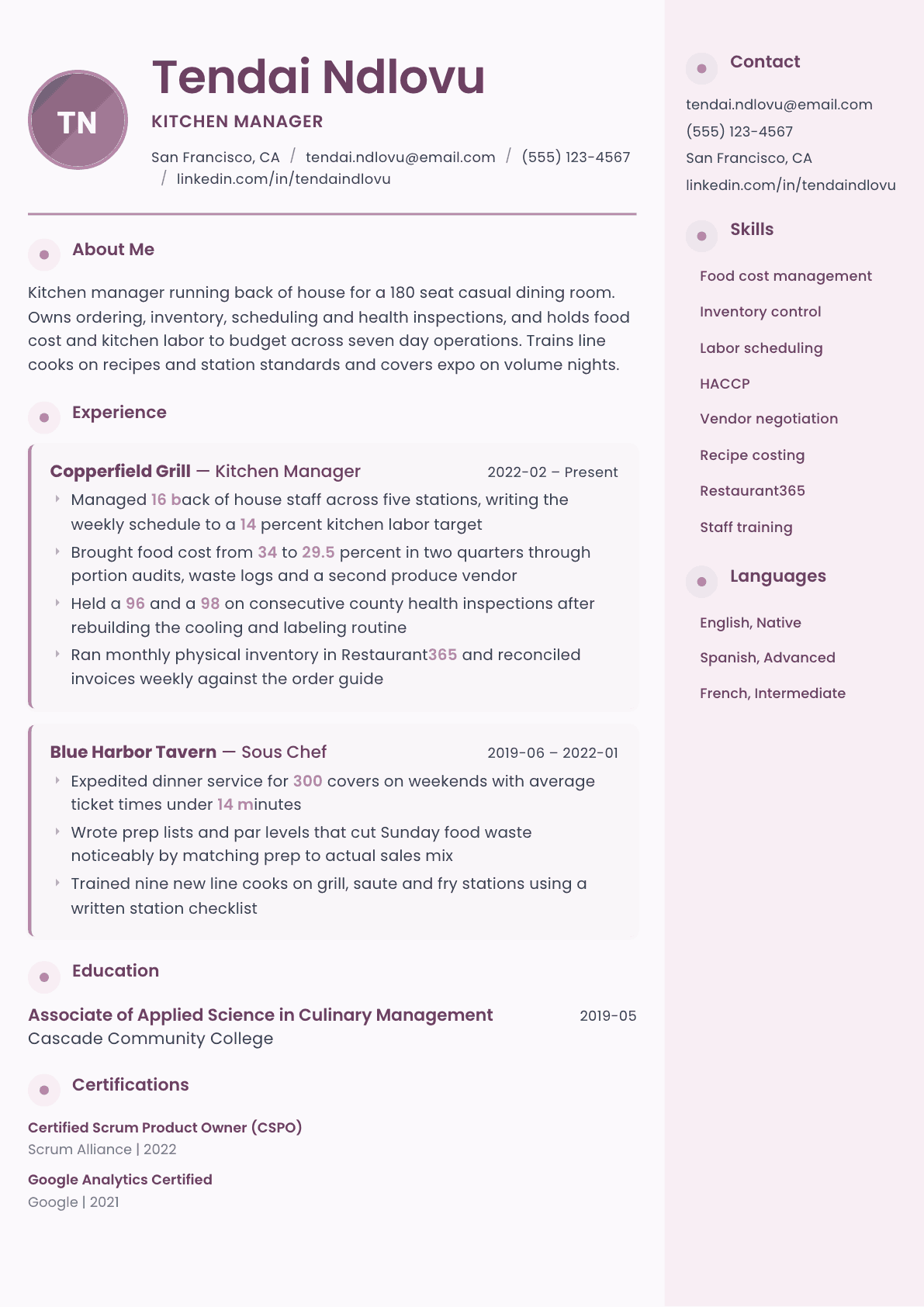
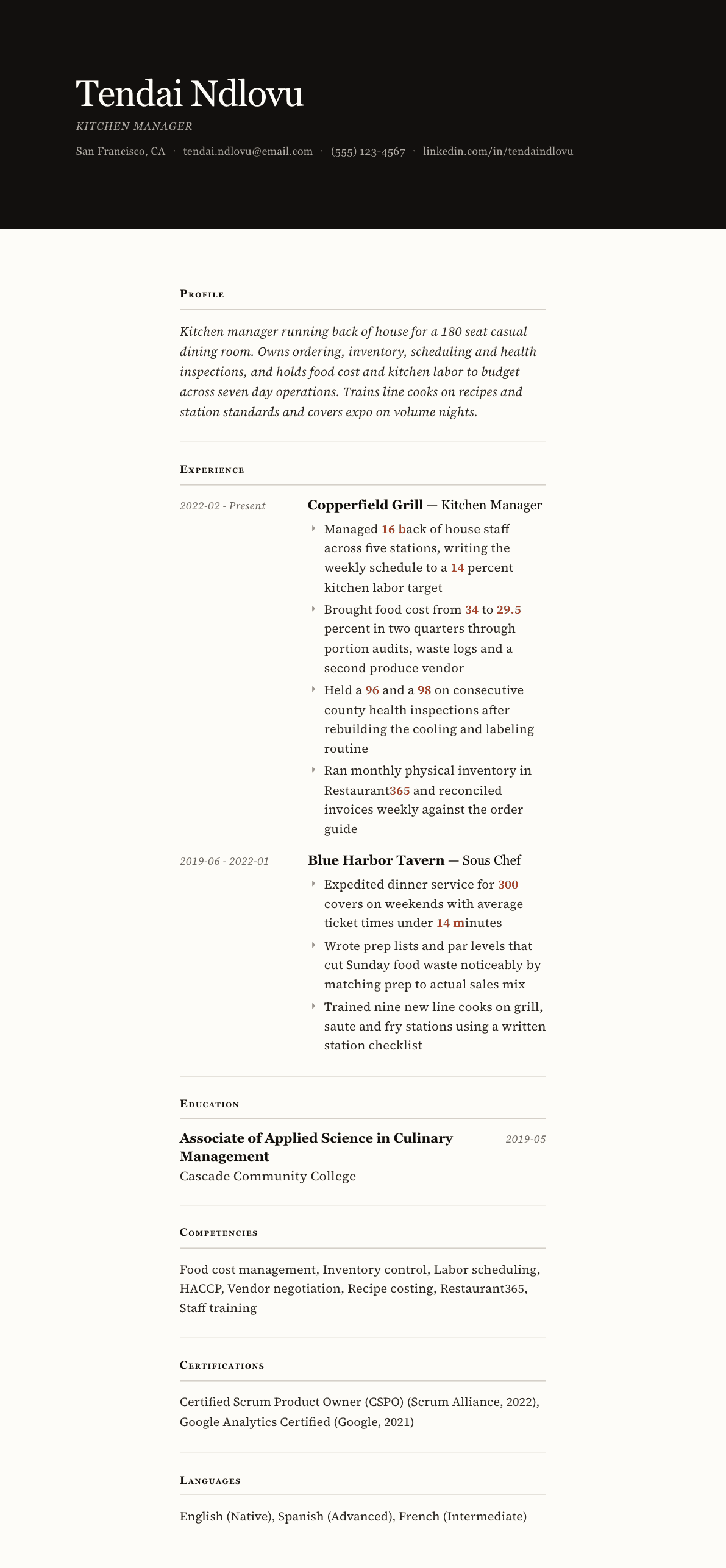
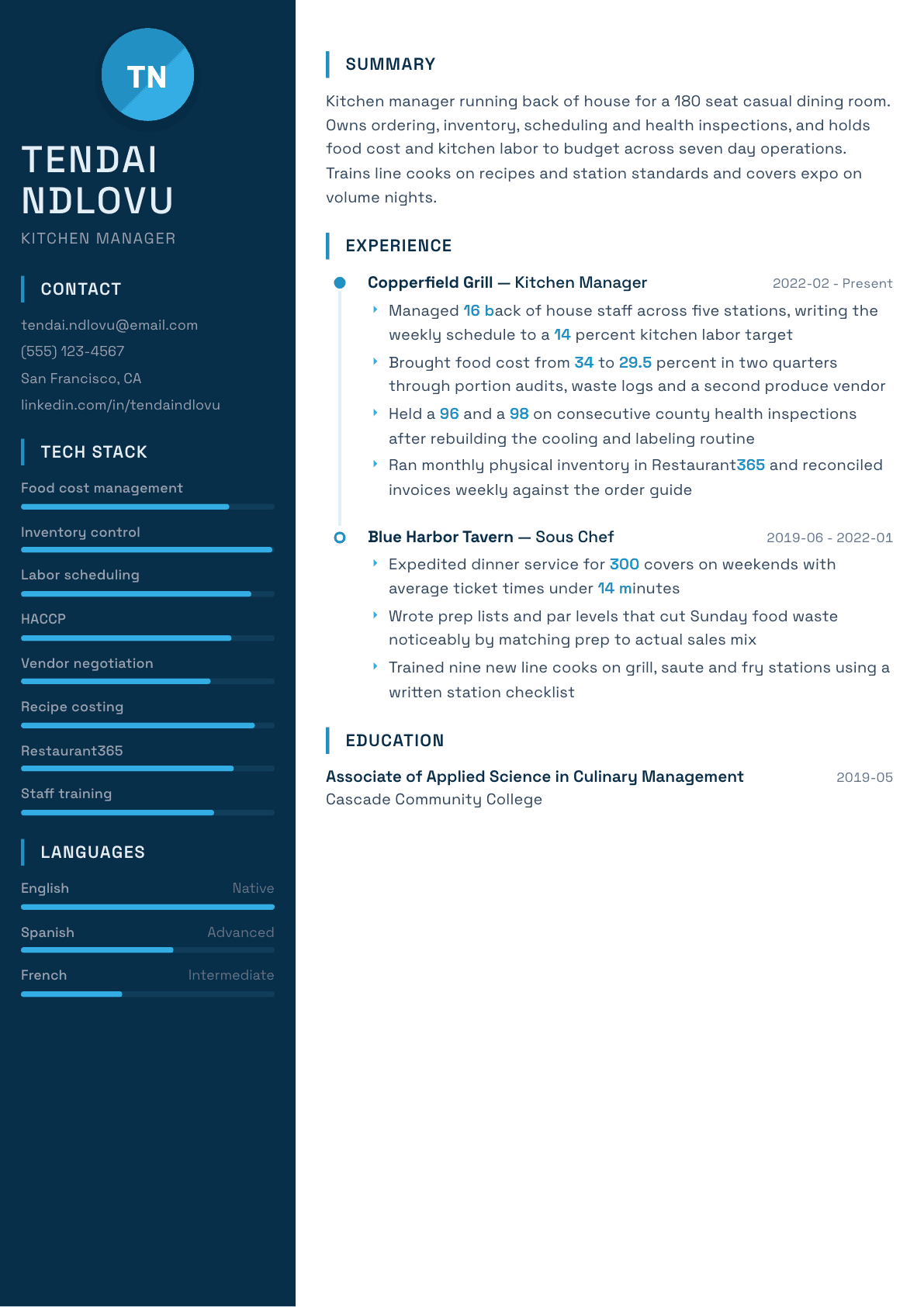
Example Kitchen Manager summary
Kitchen manager with six years running back of house in casual dining rooms of 150 seats and up. Owns ordering, inventory, scheduling and food safety, and has held food cost near thirty percent while covering seven day service with a crew of sixteen. ServSafe Manager certified with a record of clean county inspections and low cook turnover.
Skills to list on a Kitchen Manager resume
- Food cost control
- Kitchen labor management
- Inventory and par levels
- Vendor and purchasing
- Recipe costing
- Menu execution
- HACCP and food safety
- Health inspection readiness
- Scheduling
- Hiring and onboarding
- Line cook training
- Waste tracking
- Equipment maintenance
- Expediting
- POS and inventory software
What actually gets this resume read
- Open with the seat count, weekly sales volume band and crew size so the reader sizes your kitchen instantly.
- Give food cost and labor cost as a before and after with the window it took, not as a single number.
- Name the inventory and scheduling software you used, since operators screen for the systems they already run.
- Put your two most recent health inspection outcomes on the resume when they were strong.
- Show hiring and retention work: cooks are hard to keep, and a manager who keeps them is worth interviewing.
- Separate menu development from menu execution, because those are two different jobs to a hiring operator.
How to write a kitchen manager resume
A kitchen manager resume is graded on numbers before it is graded on cooking. The operator reading it has a profit and loss statement in front of them, and they are looking for evidence that you moved food cost, held kitchen labor to a target, kept the health inspector satisfied and stopped the cook turnover that has been bleeding them for two years.
Most candidates write the resume of a sous chef instead. They describe stations, menus and service, and never mention the order guide, the physical inventory, the par levels or the schedule. Those four things are the job, and leaving them out reads as someone who has been asked to manage but has only ever cooked.
This guide sizes the kitchen for the reader, puts food cost and labor on the page as movements rather than isolated figures, and shows how to write inspection results, vendor work and cook retention so an operator can picture you running their back of house on a Saturday night.
Format: one page, numbers visible in the first third
Reverse chronological, one page unless you have run multiple concepts, in which case two. Restaurant operators skim fast and often on a phone in the office between services, so keep a single column, plain headings and no icons. The reader should hit a cost figure before they finish the first job block.
Put a short line under each employer naming the concept, the seat count and the weekly volume band, then the bullets. That header line does the work of a paragraph: a 180 seat casual dining room with seven day service is a completely different job from a 60 seat bistro open five nights, and the reader needs to know which one you have run.
- Order: summary, experience, education, certifications, systems and skills.
- Under each job: concept type, seats, service days, crew size, who you reported to.
- Keep menu development in a separate line from menu execution, because operators treat them as different jobs.
Summary: kitchen size, crew size, and the two costs you own
Three lines. Name the years managing back of house, the seat count and volume you are used to, the crew size you have directed, and the food and labor cost you have held. Anything vague about leadership or passion for food is filler in a field where the reader can check your claims against their own numbers within one question.
If you are stepping up from sous chef, say so plainly and lead with the management pieces you already own: ordering, inventory, scheduling and training. Operators promote sous chefs constantly, so the move is normal, but they need the evidence in the summary rather than hidden in the third bullet.
Experience: move the cost, name the method
Food cost and labor cost belong on the page as a before and after with the window it took and the method that did it. A figure alone reads as a number you inherited. A movement with a portion audit, a waste log and a second produce vendor behind it reads as work you performed and can perform again.
Add the inspection record. Two recent county health inspection scores, or a clean record with the routine you rebuilt to get it, is one of the fastest trust signals in this field because the operator knows what a bad inspection costs them. Follow it with the systems work: monthly physical inventory, weekly invoice reconciliation against the order guide, par levels tied to actual sales mix.
Then the people. Cooks are the hardest hire in the building, so a manager who hired, trained and kept them is worth an interview on that basis alone. Write the number of cooks trained, the station checklist you wrote, and what happened to turnover.
Systems, vendors and food safety
Name the platforms. Inventory and recipe costing software, the scheduling tool, the point of sale, and the ordering portals for your prime vendor and produce accounts. Operators screen for the systems they already run because it removes weeks of ramp up, and a manager who has counted inventory in a real platform is a different candidate from one who used a clipboard.
Food safety belongs in its own short section: your food safety manager certification with the expiry, the cooling and labeling routine you own, allergen procedure, and any variance or written plan you have maintained. In back of house hiring, this section is a filter, not a decoration.
Keywords operators and their recruiters search
Postings for this role are built from a small vocabulary, and the applicant tracking systems used by multi unit groups search it directly: kitchen manager, back of house manager, food cost, labor cost, inventory control, par levels, purchasing, vendor management, food safety, health inspection, scheduling, line cook training, recipe costing and waste reduction.
Use each term where it is true rather than in a block. A bullet that says you rebuilt par levels against the weekly sales mix carries the keyword and the proof at the same time, which is what the human reader after the software is actually weighing.
Kitchen Manager resume summary examples
Sous chef stepping up
Sous chef of three years in a 140 seat scratch kitchen, already owning ordering, weekly inventory and the prep list, ready for a kitchen manager seat. Expedites 250 covers on weekends, wrote the station checklist used to train nine cooks, and holds a food safety manager certification. Comfortable with recipe costing and vendor calls.
Three years managing back of house
Kitchen manager running back of house for a 180 seat casual dining room with seven day service and a crew of sixteen. Owns ordering, inventory, scheduling and inspections, brought food cost from 34% to 29.5% in two quarters, and holds kitchen labor to a 14% target while covering expo on volume nights.
Multi unit back of house lead
Kitchen manager with eight years across casual and upscale casual concepts, including two openings and a period covering back of house for three sister restaurants. Rebuilt purchasing and par levels group wide, trained the cook bench that filled two sous chef promotions, and closed consecutive county inspections with no critical violations.
Work experience bullets: before and after
Before: Managed food cost for the kitchen.
After: Brought food cost from 34% to 29.5% in two quarters through portion audits, a daily waste log and a second produce vendor on competitive bids.
A movement with a window and three named methods proves you did the work rather than inherited a good number.
Before: Made the kitchen schedule.
After: Wrote the weekly schedule for 16 back of house staff across five stations to a 14% kitchen labor target, adjusting Sunday coverage to the actual sales mix.
Headcount, stations and the target turn a routine task into evidence that you manage cost with the schedule.
Before: Passed health inspections.
After: Scored 96 and 98 on consecutive county health inspections after rebuilding the cooling, dating and labeling routine and adding a twice daily temperature log.
Two real scores and the routine behind them tell an operator what their own next inspection will look like.
Before: Handled inventory and ordering.
After: Ran monthly physical inventory in Restaurant365 and reconciled invoices weekly against the order guide, catching pricing drift on four recurring produce items.
Naming the platform and the reconciliation habit shows a system, and the catch shows it worked.
Before: Trained new line cooks.
After: Trained nine line cooks on grill, saute and fry using a written station checklist, and moved two of them into lead cook roles within a year.
The method and the promotions turn training into retention, which is the number operators care about most.
Hard skills
- Food cost control
- Kitchen labor management
- Inventory and par levels
- Vendor and purchasing
- Recipe costing
- Menu execution
- Food safety systems
- Health inspection readiness
- Scheduling
- Hiring and onboarding
- Line cook training
- Waste tracking
- Equipment maintenance
- Expediting
Soft skills
- Calm under volume
- Direct feedback
- Vendor negotiation
- Cross shift communication
- Problem triage
- Retention focus
Certifications worth listing
- ServSafe Food Protection Manager Certification (National Restaurant Association)
- ServSafe Allergens (National Restaurant Association)
- Certified Food Manager (CFM) (National Registry of Food Safety Professionals)
- Foodservice Management Professional (FMP) (National Restaurant Association)
- Certified Sous Chef (CSC) (American Culinary Federation)
Mistakes that cost kitchen manager candidates the interview
- Writing a sous chef resume with a kitchen manager title on it, all stations and no ordering, inventory or schedule.
- Giving one cost figure with no starting point, so the reader cannot tell whether you moved it or inherited it.
- Omitting seat count and volume, which leaves the operator unable to size your kitchen against theirs.
- Skipping health inspection results when they were strong, because that is a trust signal you are giving away free.
- Leaving the inventory and scheduling platforms off the page when operators filter on the systems they already run.
- Claiming menu development when the recipes came from a corporate book, which falls apart in the interview.
- Ignoring cook retention entirely, when keeping cooks is the problem most operators are hiring to solve.
Kitchen Manager resume questions
What food cost number should a kitchen manager put on a resume?
Put the real one, as a movement. Give the starting figure, the figure you reached, the window it took and the actions behind it. An honest reduction from a bad number is more persuasive than a good number you cannot explain.
How do I move from sous chef to kitchen manager on paper?
Lead with the management work you already do: ordering, weekly inventory, prep lists, par levels, training and any scheduling. Then show the cost effect of that work. Operators promote sous chefs often, but they need the evidence in the summary.
Should I list health inspection scores?
Yes when they were strong, with the county and the two most recent results. If a score was poor before you arrived, write the recovery instead: the routine you rebuilt and the result that followed, which is a stronger story than a clean record you inherited.
Do I need to name the inventory software?
Name it. Operators screen for the platforms they run because it cuts training time, and a manager who has counted a real inventory and reconciled invoices inside a system is treated differently from one who managed on paper.
How long should a kitchen manager resume be?
One page for a single concept and under six years. Two pages once you have run multiple restaurants, handled an opening or carried a regional role. Do not stretch to two pages with duties every back of house manager performs.
Related resume examples
- Restaurant Manager Resume example
- Executive Chef Resume example
- Sous Chef Resume example
- Restaurant General Manager Resume example
- Head Chef Resume example
- Food and Beverage Manager Resume example