Restaurant General Manager Resume Examples: free score
General Manager Restaurant Resume That Proves P and L Ownership
By Mustafa Tarabya, founder of CVBooster · Published · Updated
General manager restaurant resume example with a complete sample page, and how to write sales volume, cost lines, turnover and inspection results.
Sample resumes for a restaurant general manager
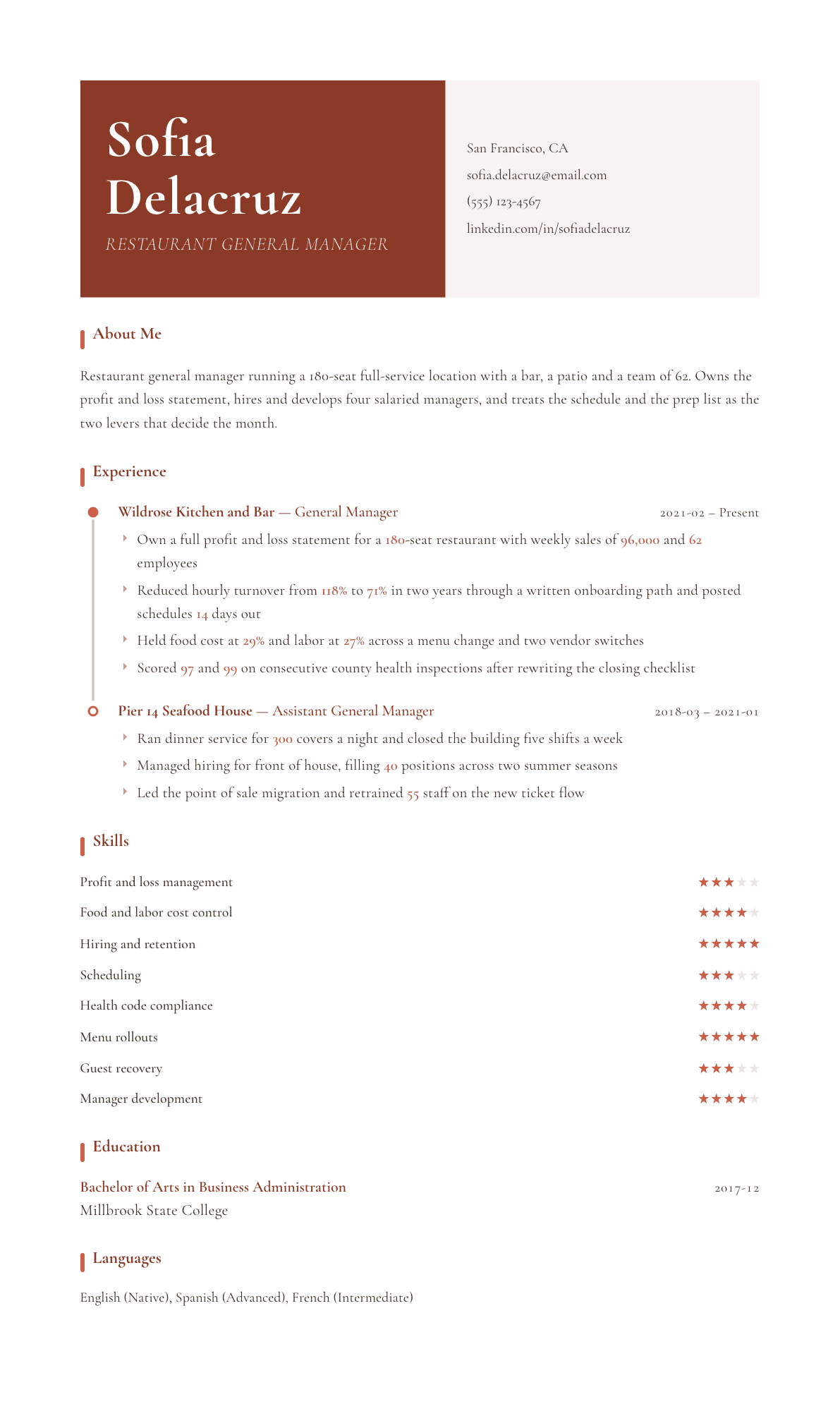
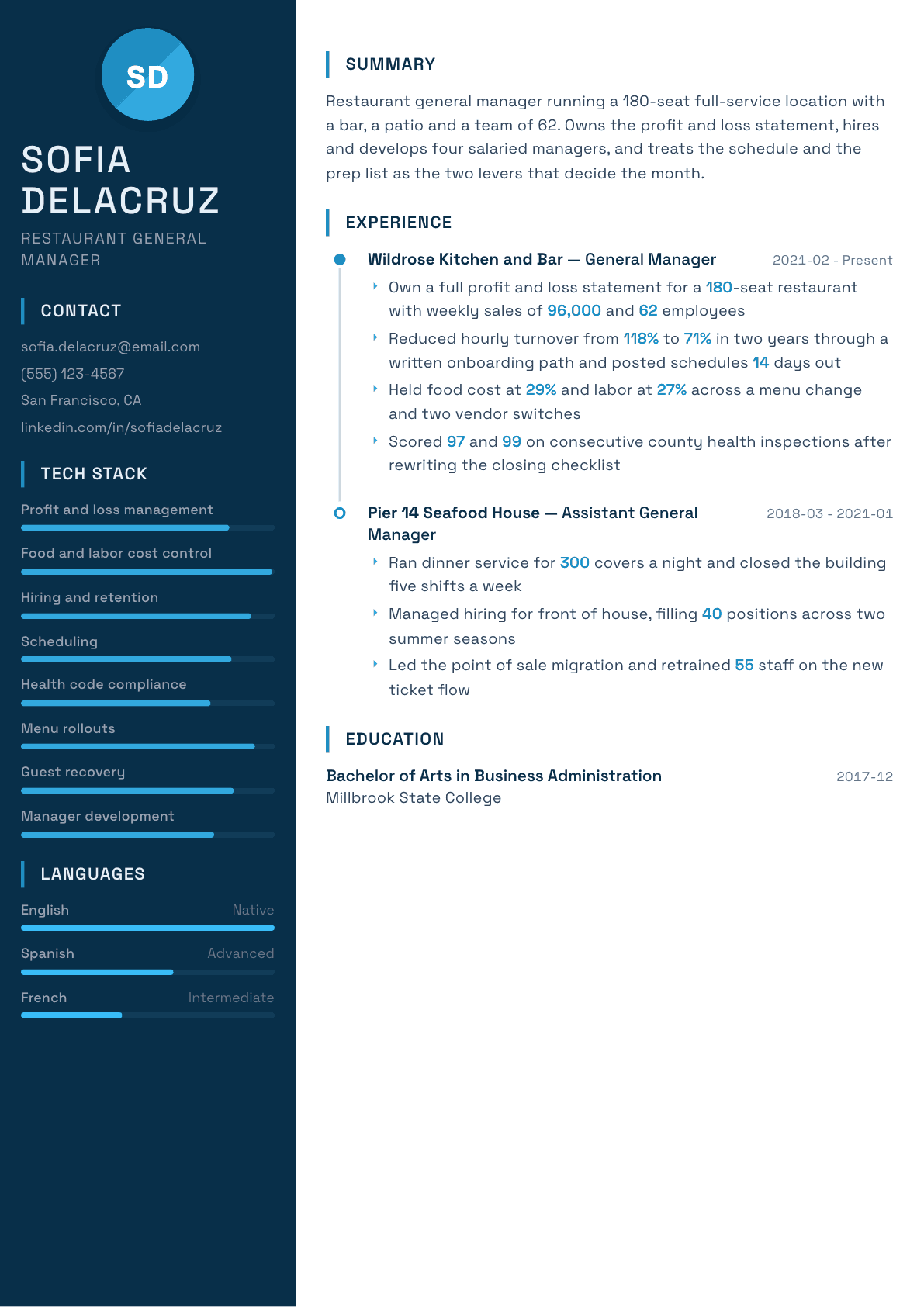
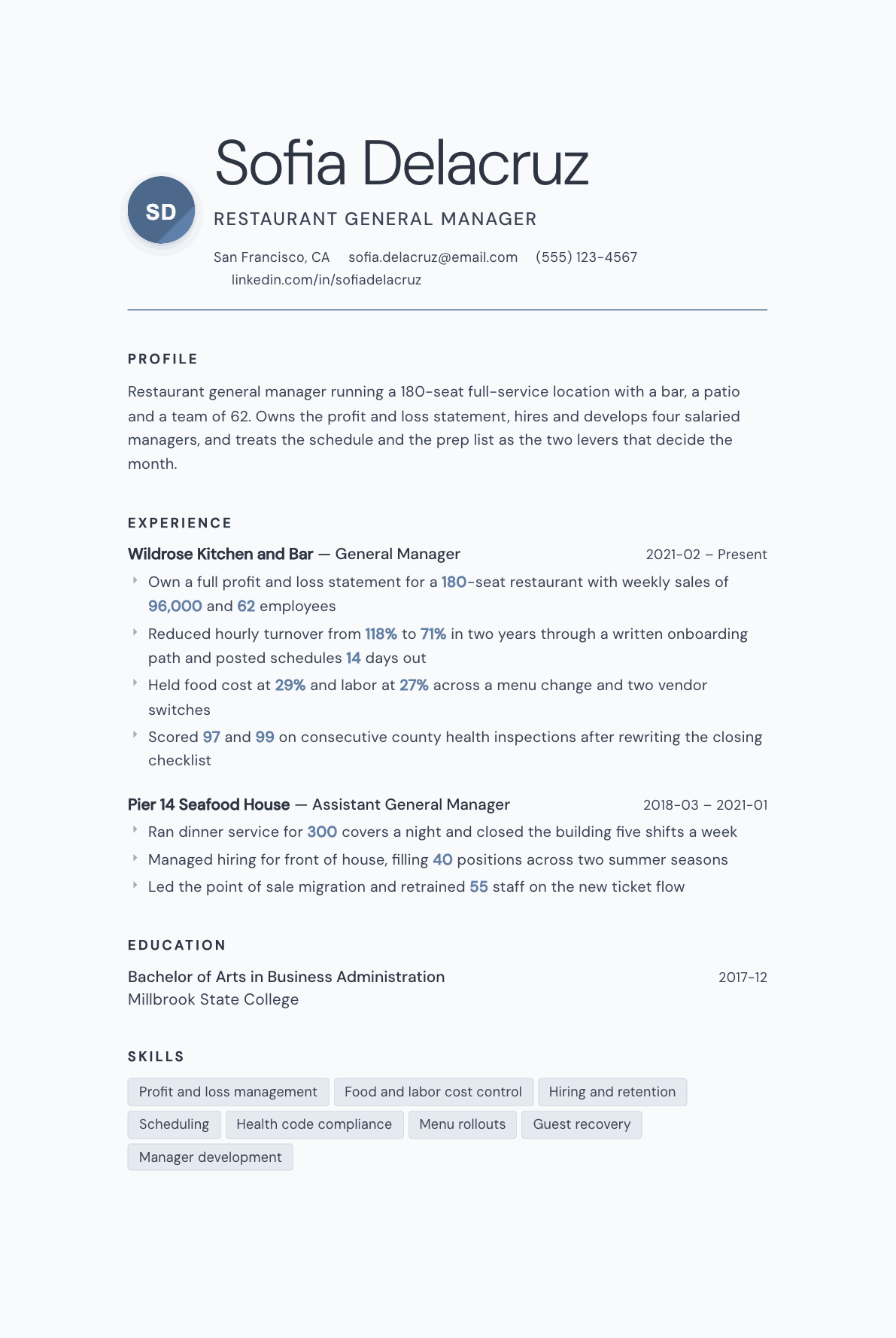
The same restaurant general manager content laid out in three CVBooster templates, so you can see what the finished document looks like before you write a word.
Example Restaurant General Manager summary
Restaurant general manager with nine years in full-service operations, currently running a 180-seat location with a bar and a team over 60. Owns the profit and loss statement, holds food and labor within target through menu and schedule discipline, and has cut hourly turnover sharply two years running. Seeking a multi-unit or flagship general manager role.
Skills to list on a Restaurant General Manager resume
- Profit and loss ownership
- Food cost control
- Labor cost control
- Hiring and onboarding
- Turnover reduction
- Scheduling
- Inventory and ordering
- Health code compliance
- Menu rollouts
- Point of sale administration
- Guest recovery
- Manager coaching
- Vendor management
- Local store marketing
- Cash handling controls
What actually gets this resume read
- State the volume you ran: weekly or annual sales, seat count, cover count and head count in the first line.
- Claim the profit and loss statement directly if you owned it, and name the cost lines you moved.
- Turnover is the number multi-unit operators ask about, so show where it started and where you took it.
- Include health inspection scores and any food safety certification, since a general manager signs for both.
- Show manager development: how many salaried leaders you hired, trained or promoted out of your building.
- Give one bullet to a project outside daily service, such as a remodel, a system migration or a menu launch.
How to write a restaurant general manager resume
A restaurant general manager resume is a business document. The multi-unit director or owner reading it is deciding whether to hand you a building that turns over a large amount of money every week, and she reads for four things: volume, the cost lines, turnover, and whether the health department is a problem when you are in charge. Service philosophy comes later, if at all.
Most general manager resumes fail on vagueness. They say the candidate managed daily operations, led a team and delivered excellent guest experiences, which is true of every person who has ever held the title and therefore tells the reader nothing. The fix is arithmetic: seats, sales volume, head count, cost percentages, turnover, inspection scores.
This guide lays out how operators actually read the file, a complete general manager restaurant resume sample, three summaries from assistant manager to multi-unit candidate, before and after bullets built from the lines that appear on real restaurant resumes, and the questions general managers ask when they are moving between segments or stepping up from an assistant role.
Format: one page for a single unit, two once you carry more
Reverse chronological, single column, no graphics. Restaurant groups run applicant tracking systems that mangle side columns, and franchise recruiters open files on a phone between store visits.
Start every job with a unit line: concept type, seat count, weekly or annual sales volume, head count and whether there was a bar, a patio or catering. An operator can size you from that line alone, and she will not read the bullets carefully until she has.
- Header: name, city and state, phone, email.
- Sections in this order: summary, restaurant experience, certifications, education, systems.
- Assistant managers should say in the unit line which shifts they closed and which periods they owned.
Own the profit and loss statement out loud
If you carried the profit and loss statement, say the words. Then name the lines you moved: food cost, labor cost, controllables, and any period where you defended margin through a price increase or a menu change. An operator is scanning for a manager who reads a period report and knows which line to attack first.
When you did not own the full statement, describe the portion you did control, such as scheduling to a labor target or ordering to a food cost target. Overstating this is the fastest way to lose an interview, because the follow-up questions are specific and immediate.
Turnover is the number they ask about
Hourly turnover in restaurants is high everywhere, so a manager who has moved it is genuinely rare and genuinely valuable. Give the starting figure, the ending figure and the mechanism: posted schedules further out, a written onboarding path, a promotion ladder, or simply a building people want to work in.
Add manager development on top of it. How many hourly staff you promoted to supervisor, how many supervisors became salaried managers, and how many stayed. Multi-unit directors hire general managers who produce their next general managers.
Compliance, cash and the things that go wrong at night
Health inspection scores belong on the resume with the practice that produced them. So does cash control: deposit procedure, void and comp review, and any loss you found and closed. These read as boring, and boring is exactly what an owner wants from the person holding the keys.
Put your food protection manager certification and alcohol service training in their own short block with the issuing body, since most jurisdictions require a certified manager on the premises during operating hours.
Systems and one project outside daily service
Name the point of sale, the scheduling and labor tool, the inventory system and the guest feedback platform. Groups screen on these and use them to estimate your ramp time in their building.
Then give one bullet to a project beyond running shifts: a remodel, a system migration, a menu launch, opening a new unit, or a training rollout across several stores. That bullet is what separates a candidate for one restaurant from a candidate for a district.
General manager restaurant resume sample: one complete page
A general manager restaurant resume works best on one page for a single location: a header with the concept and seat count in the title line, a summary built on volume and the cost lines, then each restaurant as its own entry with results underneath. The sample below is invented. Keep the order and replace every detail with your own numbers from the profit and loss statement and the schedule.
- Header and summary: Marcus Bell, Restaurant General Manager. General manager of a 140-seat full-service restaurant with a bar and private dining room, leading a team of fifty and three salaried managers; owns the profit and loss statement, the schedule and the hiring plan.
- Experience, current: General Manager, an independent full-service restaurant. Brought prime cost down over two years by rebuilding the prep list and moving labor scheduling to forecast covers; cut hourly turnover by starting a structured first two weeks for every new hire; passed every health inspection without a critical violation.
- Experience, earlier: Assistant General Manager, a casual dining chain location. Ran the floor on the busiest nights, owned inventory and ordering, and opened a second location as part of the training team.
- Certifications and systems: ServSafe Manager, the point of sale and scheduling systems you use every week, and inventory software.
- Education: hospitality or business degree if you have one; otherwise list management training programs completed with the employer.
Restaurant General Manager resume summary examples
Assistant manager stepping up
Assistant general manager at a 220-seat seafood restaurant, closing five shifts a week and running dinner service for 300 covers. Owns front of house hiring, filled 40 positions across two summer seasons, and led the point of sale migration with 55 staff retrained. Ready for a general manager assignment.
Running a full-service unit
Restaurant general manager of a 180-seat full-service location with a bar and patio, weekly sales near 96K and a team of 62. Owns the profit and loss statement, holds food at 29% and labor at 27%, and has cut hourly turnover from 118% to 71% over two years.
Ready for multi-unit
General manager of a flagship unit and training store for a six-restaurant group, responsible for a team above 80 and for certifying new managers before they take their own building. Opened one location from construction through the first ninety days and holds every cost line within target.
Work experience bullets: before and after
Before: Managed all daily operations of the restaurant.
After: Ran a 180-seat full-service restaurant with a bar and patio doing weekly sales near 96K with 62 employees and four salaried managers reporting in.
Seats, sales volume and head count size the job; daily operations describes every restaurant on earth.
Before: Responsible for controlling costs and hitting budget.
After: Owned the full profit and loss statement and held food cost at 29% and labor at 27% through a menu change and two vendor switches.
Naming the statement and the two cost lines proves you read a period report rather than receiving one.
Before: Reduced employee turnover.
After: Cut hourly turnover from 118% to 71% in two years by posting schedules 14 days out and giving every new hire a written path to their next role.
Both endpoints plus the two mechanisms turn the single most valuable metric in the field into something repeatable.
Before: Maintained health and safety compliance.
After: Scored 97 and 99 on consecutive county health inspections after rewriting the closing checklist and adding a manager line check before each dinner service.
The scores are the evidence and the checklist is the cause, which is what an owner wants to hear.
Before: Hired and trained staff members.
After: Promoted seven hourly team members into supervisor roles and developed two into salaried managers, both of whom now run their own units in the group.
Promotions that stuck show you build the bench a multi-unit director is actually hiring for.
Hard skills
- Profit and loss ownership
- Food and labor cost control
- Inventory, ordering and vendor management
- Scheduling to a labor target
- Hiring, onboarding and retention
- Health code and food safety compliance
- Cash control and void review
- Menu rollouts and pricing
- Point of sale administration
- Guest feedback and recovery
- Local store marketing
- New unit openings
Soft skills
- Reading a room mid-service
- Direct feedback
- Bench building
- Owner communication
- Decisions during a rush
- Holding a standard on a slow night
Certifications worth listing
- ServSafe Food Protection Manager (National Restaurant Association)
- ServSafe Alcohol (National Restaurant Association)
- TIPS Certification (Health Communications, Inc.)
- Foodservice Management Professional (FMP) (National Restaurant Association)
Mistakes that cost restaurant general manager candidates the interview
- Writing daily operations, team leadership and guest experience with no volume, cost or head count attached.
- Hiding the sales volume of your unit, which is the first thing an operator wants to size.
- Claiming profit and loss ownership you did not have, since the interview questions expose it in minutes.
- Leaving turnover off the resume even when you improved it, which wastes the strongest number you have.
- Skipping inspection results and food safety certification in a role that legally signs for both.
- Listing the same three bullets at every unit instead of showing what each building needed from you.
Restaurant General Manager resume questions
How do I show general manager readiness as an assistant manager?
Name the pieces of the building you already carry: which shifts you close, whether you order, whether you write the schedule, and whether you sit in the period review. A hiring operator promotes the assistant who already does most of the job without being asked.
Do I need to include sales volume on a restaurant resume?
Yes, in weekly or annual terms. Volume is how operators compare candidates, and a manager from a high-volume building is assumed to handle pressure differently. If your former employer treats the exact number as confidential, give a range or the cover count instead.
How do I move from quick service to full service, or the reverse?
Lead with the parts that transfer: cost control, scheduling, hiring and compliance are identical in both. Then address the gap directly in one bullet, such as bar and alcohol experience moving into full service, or throughput and speed of service moving the other way.
What does a general manager restaurant resume need on the first page?
Your title with the concept and seat count, a summary built on sales volume and the cost lines you own, then each restaurant with its results: prime cost, labor, turnover and inspection outcomes. Go back about ten years in detail, compress older server and line cook jobs into one line, and list ServSafe Manager and your systems.
What if I closed a location or left after a franchise change?
State it plainly in the bullet, such as a unit closure or an ownership transfer, and keep the results you delivered while it was open. Operators know closures happen for reasons above the general manager, and an unexplained gap raises more concern than the closure itself.
Related resume examples
- Restaurant Manager Resume example
- Executive Chef Resume example
- Assistant Restaurant Manager Resume example
- Kitchen Manager Resume example
- Restaurant Owner Resume example
- Fast Food Manager Resume example