Tattoo Artist Resume Examples: free ATS score and gap list
Build a Tattoo Artist Resume That Leaves a Mark
By Mustafa Tarabya, founder of CVBooster · Published · Updated
Create a tattoo artist resume highlighting your artistic style, client management, and safety compliance with creative resume templates.
Sample resumes for a tattoo artist
The same tattoo artist content laid out in three CVBooster templates, so you can see what the finished document looks like before you write a word.
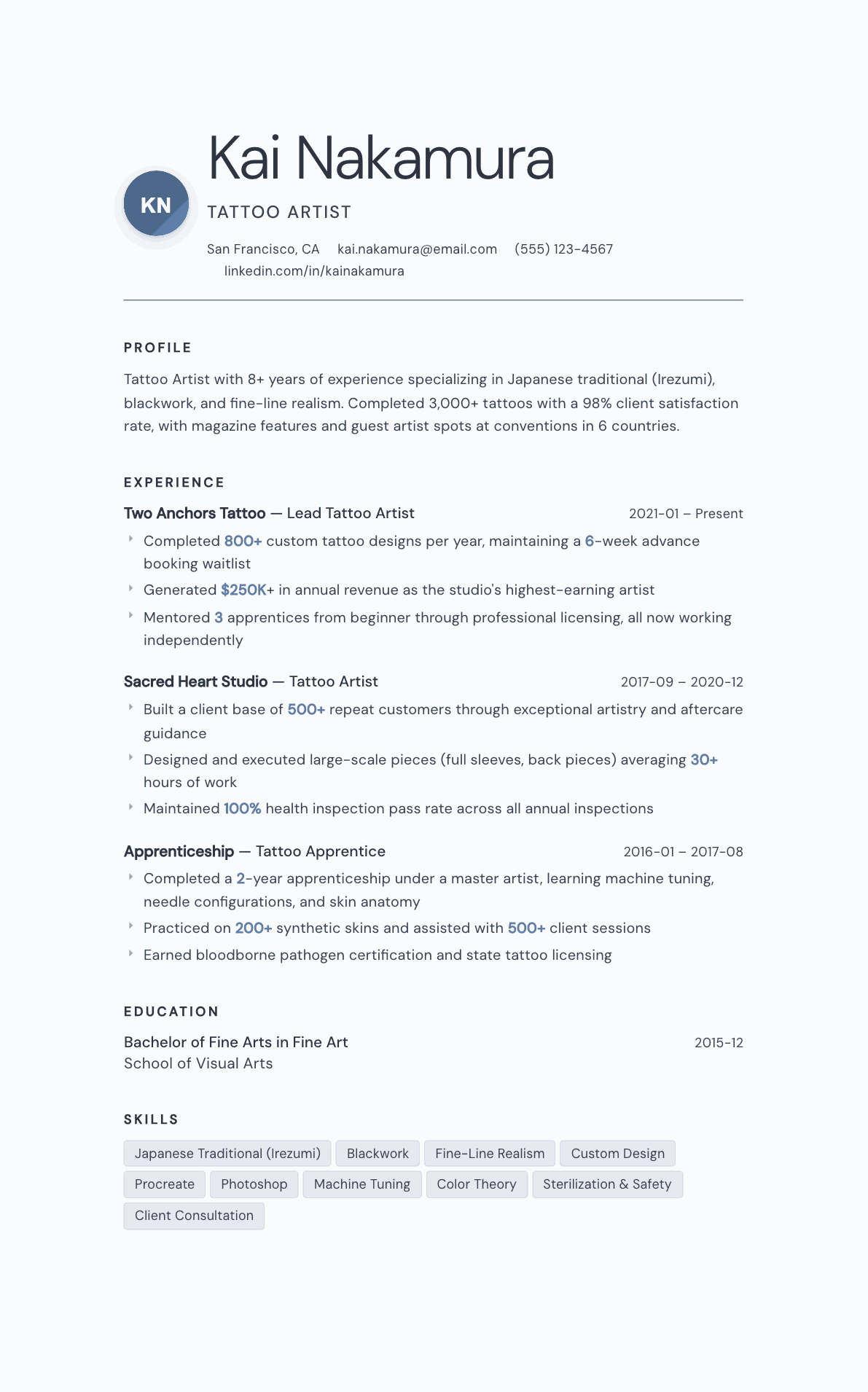
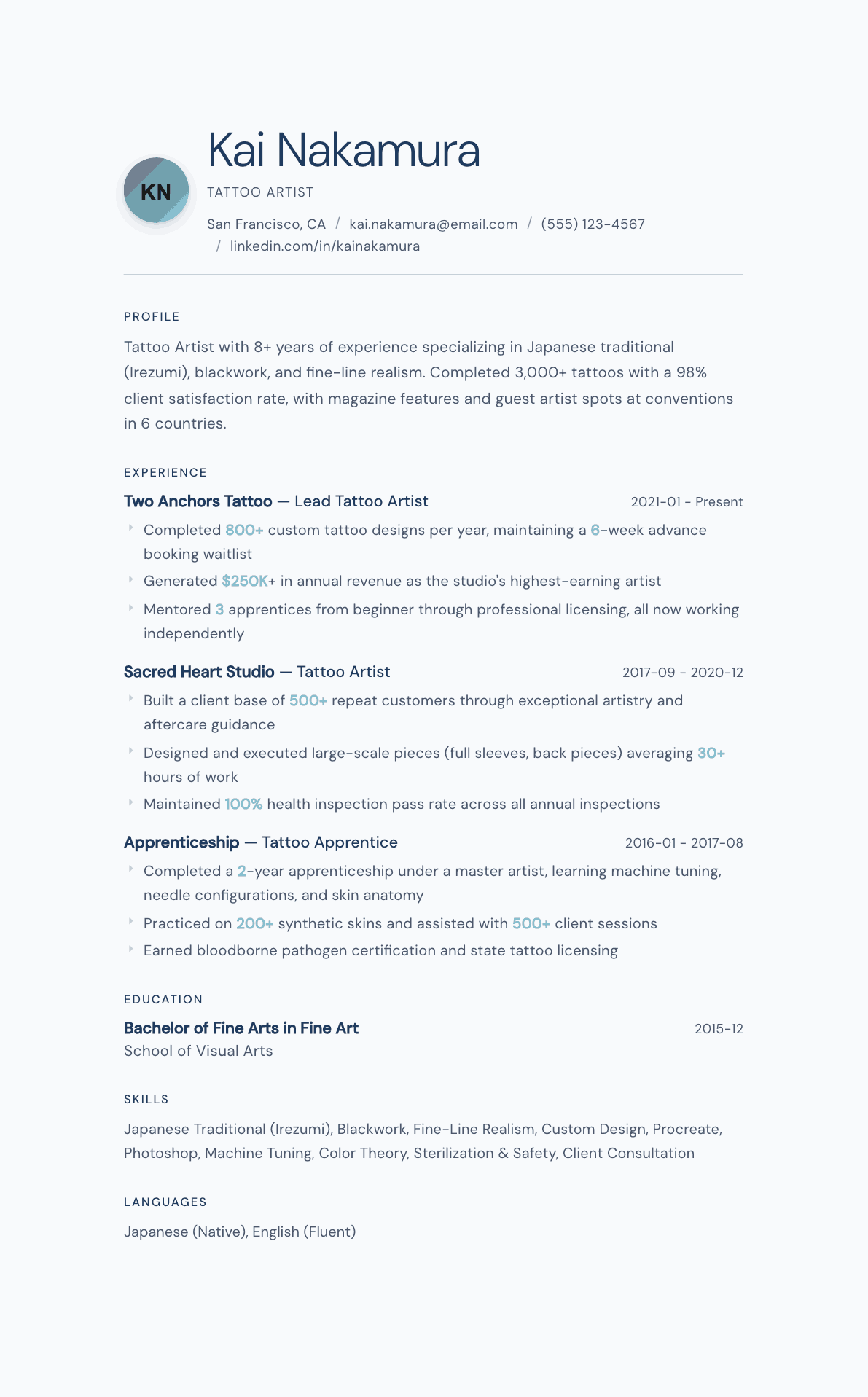
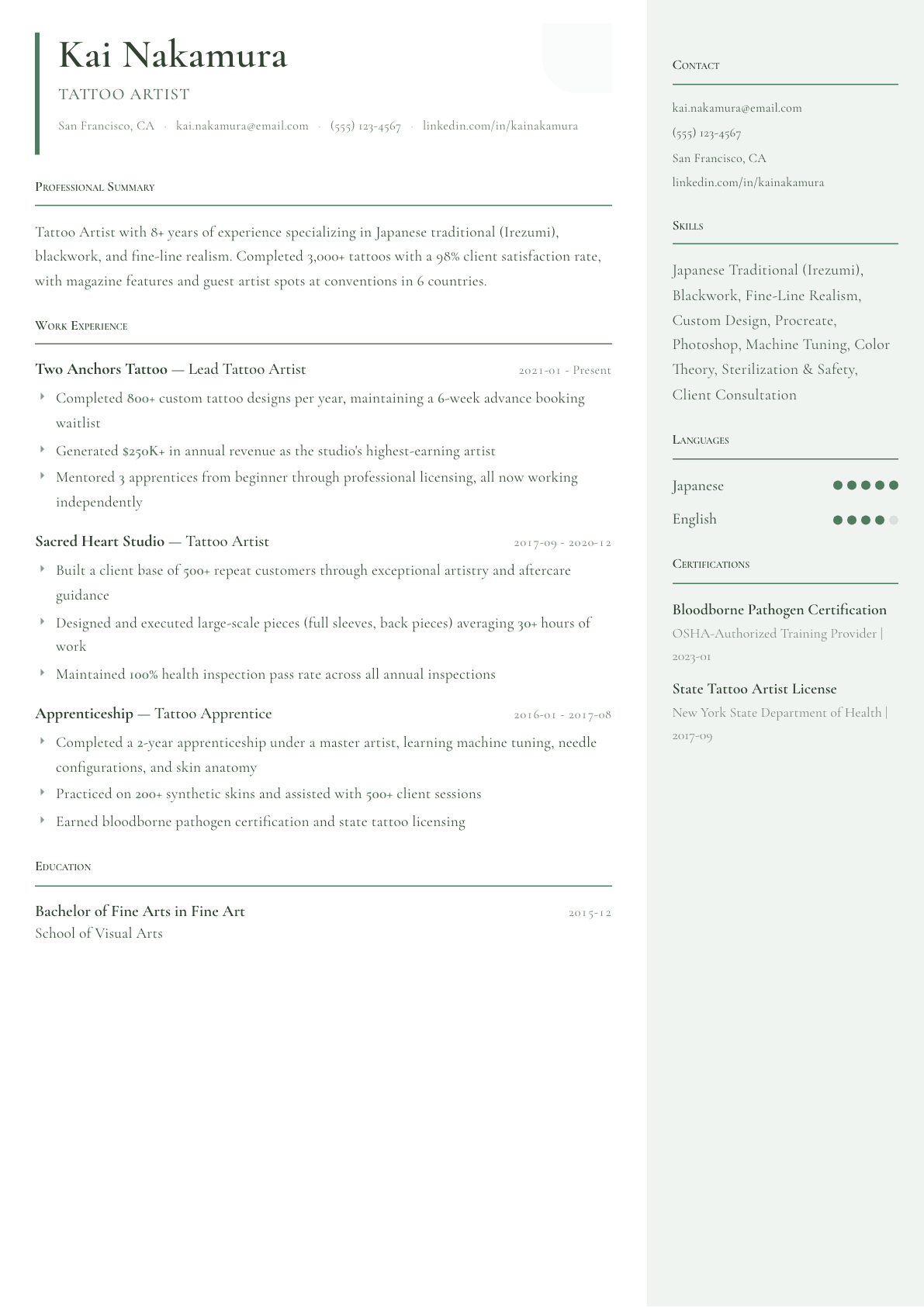
Example Tattoo Artist summary
Award-winning Tattoo Artist with 8 years of experience and 3,000+ completed pieces. Specializing in Japanese traditional and fine-line realism with a 98% client satisfaction rate and 6-week advance booking waitlist. Featured in trade magazines and a guest artist at international conventions.
Skills to list on a Tattoo Artist resume
- Japanese Traditional
- Neo-Traditional
- Blackwork
- Fine-Line Realism
- Watercolor Tattoo
- Custom Design
- Procreate
- Photoshop
- Machine Tuning
- Color Theory
- Sterilization
- Client Consultation
- Aftercare Education
- Cover-Up Techniques
What actually gets this resume read
- Your Instagram or portfolio link is the single most important element -- place it prominently.
- Mention your specialties by name: Japanese traditional, neo-traditional, realism, blackwork, watercolor, geometric.
- Include safety and compliance credentials: bloodborne pathogen cert, state license, CPR/First Aid.
- Quantify your experience: years tattooing, pieces completed, client retention, booking lead times.
- Highlight any convention appearances, magazine features, or awards to build credibility.
- Mention mentorship or apprentice training if you have guided others.
How to write a tattoo artist resume
A tattoo artist gets hired on the portfolio and kept on the paperwork. A shop owner reading your resume is checking two things in parallel: whether your work fits the styles his clients book, and whether you will pass a health inspection, keep a station clean and not create liability. Beautiful work with an expired bloodborne pathogen certificate is not a hire, and a spotless license with a weak portfolio is not one either.
The document also has a second audience. Convention organizers, guest spot bookings, apprenticeship programs, cosmetic and paramedical clinics and equipment sponsors all ask for something written. Each wants a slightly different emphasis, but the core is the same: styles, volume, licensing, and the business you bring with you.
What follows is the layout shop owners expect, how to write about styles honestly, three summaries covering apprentice through resident artist, before and after bullets that turn craft into evidence, and the questions artists ask when they leave an apprenticeship or move cities.
Format: one page, portfolio and license in the header
One page. The header carries your name, city, phone, email, the portfolio link and the Instagram handle that functions as your working book. Directly under it, put a short credentials line: state or county tattoo license number and expiry, bloodborne pathogen certification and its date, and first aid or CPR if current. Putting that line at the top saves a shop owner from having to ask, and it signals you understand that the license is not an afterthought.
Section order: summary, styles, experience, credentials and compliance, guest spots and conventions, publications and awards, apprenticeship and training. Keep every image out of the file. The portfolio lives at the link, and shop owners will look at the link before they read a word.
- Header: name, city, phone, email, portfolio URL, working Instagram handle.
- Credentials line: license and expiry, bloodborne pathogen certification date, CPR if current.
- Say whether you work as an employee, a booth renter or an independent contractor, since it changes the arrangement.
- State your booking model: waitlist, flash days, deposit policy, and whether clients follow you between shops.
Styles: be specific and be honest
Styles are the first filter. Name the two or three you genuinely execute at a professional standard, using the terms the trade uses: American traditional, Japanese traditional, blackwork, fine line, neo traditional, realism and black and gray, script and lettering, geometric and ornamental, watercolor, cover up work. Then add what you are competent to execute but do not lead with.
Resist listing everything. A shop owner reading a list of nine styles assumes you are a generalist who is average at all of them, and he cannot picture where you fit in the shop. Two strong styles plus a competent range is a much stronger position, because it tells him which clients to send you.
Scale is part of style. Say whether you work in large scale multi session pieces such as sleeves, back pieces and body suits, or in small to medium single session work. They are different businesses, with different booking rhythms and different money, and shops staff for both.
Experience: volume, booking, retention and money
Each shop entry gets the shop name, city, your arrangement and the dates. Then bullets built on the numbers a shop owner runs his floor by: sessions or pieces completed per week or per year, average session length, how far out your books are, deposit and no show rate, and the proportion of your work that is custom versus flash or walk in.
Client retention and referral are the strongest lines an artist can write. Repeat clients who come back for a second and third piece, multi session projects carried to completion, and a following that books before flash drops all tell an owner you will fill a chair rather than depend on his foot traffic. If clients will follow you to a new shop, say how many and how you know.
Do not skip the mundane part of the craft: machine tuning and needle configuration, stencil preparation, drawing time per piece, aftercare instruction and follow up, and touch up policy. Owners hire artists who take responsibility for healed results, because a healed piece is what actually gets photographed and reposted.
- Give one bullet to volume, one to the kind of work, one to clients and one to standards.
- Include your consultation and design process, since custom work is sold at the consultation.
- Mention drawing tools such as Procreate and the printer or thermal workflow you use for stencils.
- Note mentoring or apprentice supervision if you have done it, because it is a step toward running a shop.
Compliance and station discipline
This is the section people underwrite and it is the one that keeps a shop open. Cover single use needle and cartridge practice, barrier film and station setup, cross contamination control, sharps disposal, autoclave operation and spore testing where applicable, and the local health department requirements you have worked under. Naming the inspection regime you passed is stronger than saying you follow safety protocols.
Client screening belongs here too: medical history intake, consent forms, age verification and identification checks, contraindications such as skin conditions or recent procedures, and how you handle a client you decide not to tattoo. An artist who declines work for the right reasons is protecting the shop, and an owner will read that as maturity rather than lost revenue.
Conventions, guest spots and the public record
Guest spots and conventions belong on the page because they prove you can work outside your own station, set up fast in an unfamiliar space, and hold your standard under time pressure. List the convention, the city and the year, plus any awards from a judged category. Judged convention awards are the closest thing this trade has to a formal credential from a peer group.
Publications and features count when the outlet is real. Trade magazines, established tattoo publications and shop features carry weight. Aggregator accounts that repost work do not, and listing them alongside a real feature weakens both. Keep the same standard as the portfolio: if you would not show it to another artist, do not put it on the page.
Tattoo Artist resume summary examples
Newly licensed out of apprenticeship
Tattoo artist recently licensed after a two year apprenticeship in American traditional and blackwork, completing 300 supervised sessions on the floor. Current bloodborne pathogen certification, comfortable with machine tuning and stencil preparation, and building a client base through small custom flash pieces.
Five years, custom booking
Tattoo artist with five years of full time floor work specializing in fine line and black and gray realism. Completes around 400 custom pieces a year on a six week waitlist, designs every piece in Procreate from consultation, and holds a clean record across five annual health inspections.
Resident artist and mentor
Resident tattoo artist with twelve years in Japanese traditional and large scale blackwork, carrying multi session sleeves and back pieces booked eight months out. Has trained three apprentices through to licensure, guest spots internationally, and manages the shop's sterilization and inspection procedures.
Work experience bullets: before and after
Before: Tattooed clients with a variety of designs and styles.
After: Completed roughly 400 custom pieces a year in fine line and black and gray realism, from single session pieces to sleeves carried across six to eight sittings.
Annual volume plus the scale and style range shows a shop owner exactly what kind of chair you fill.
Before: Kept my station clean and followed safety rules.
After: Ran a single use cartridge station with full barrier film setup, sharps disposal and documented autoclave spore testing, passing every county health inspection without a citation.
Naming the actual practices and a clean inspection record turns a claim about safety into a verifiable one.
Before: Had a lot of repeat clients who liked my work.
After: Built a client base where more than half of bookings were returning clients, with 30 clients following the move to a new shop and rebooking within the first two months.
Portable clients are the single most valuable thing an artist brings, and this quantifies it.
Before: Designed the tattoos before the appointment.
After: Ran paid consultations for every custom piece, drawing in Procreate and presenting one full concept plus placement mock ups before the session, which cut day of redraw time to almost nothing.
A described design process shows an owner why your sessions run on schedule instead of overrunning the chair.
Before: Attended tattoo conventions and did guest spots.
After: Worked 8 conventions across three countries and 12 guest spots, setting up a compliant station in unfamiliar shops and placing in a judged category for large scale black and gray.
The count, the travel and a judged placement prove your standard holds outside your own station.
Hard skills
- American traditional tattooing
- Japanese traditional tattooing
- Blackwork and ornamental
- Fine line technique
- Black and gray realism
- Script and lettering
- Cover up and rework
- Custom design and drawing
- Procreate
- Stencil preparation
- Machine tuning and needle configuration
- Sterilization and autoclave operation
- Cross contamination control
- Client consultation and aftercare instruction
Soft skills
- Reading a nervous client
- Setting expectations before the needle
- Endurance across long sittings
- Saying no to unsafe or unwise requests
- Booking and deposit discipline
- Mentoring apprentices
Certifications worth listing
- Bloodborne Pathogens Training for Tattoo Artists (OSHA-compliant provider recognized by your local health department)
- CPR and First Aid Certification (American Red Cross)
- Basic Life Support (BLS) (American Heart Association)
Mistakes that cost tattoo artist candidates the interview
- Leaving the license and bloodborne pathogen certification off the page, which makes a shop owner assume they have lapsed.
- Listing nine styles, which reads as a generalist and gives the owner no idea which clients to send you.
- Embedding tattoo photos in the resume file instead of linking a portfolio that actually loads.
- Skipping the compliance section entirely, when that is the part that keeps the shop licensed and insured.
- Describing pieces without ever naming volume, session length or how far out your books are.
- Padding awards with reposts from aggregator accounts alongside genuine judged convention placements.
Tattoo Artist resume questions
What certifications does a tattoo artist need to list?
The state or county tattoo license with its number and expiry, and current bloodborne pathogen training. Add CPR and first aid if you hold them. Put all of it in a credentials line near the top, because a shop owner cannot hire you without seeing it.
How many styles should I put on a tattoo artist resume?
Two or three that you execute at a professional level, then a shorter line of styles you are competent in. A long list reads as average across the board and gives a shop owner no way to decide which clients belong in your chair.
What do I put on a resume straight out of an apprenticeship?
The apprenticeship itself with the mentor, the shop and the length, plus the supervised session count, the practice work you completed, the machine and needle knowledge you were taught, and the licensing and safety credentials you earned. Then link the portfolio you built during it.
Should I mention my client following when applying to a new shop?
Yes, and quantify it. The number of returning clients, how far out your books run, and how many followed you across a previous move all tell an owner whether you will fill a chair on your own or depend on the shop bringing you walk in traffic.
How do I present booth rental work on a resume?
State the arrangement clearly under each shop, since booth renters are independent operators. Then show the business side: your own booking system, deposit policy, supply purchasing, client records and insurance. Owners read that as a low maintenance artist who runs their own chair properly.