Fine Dining Server Resume Examples: the lines they read
Fine Dining Server and Waitress Resume for Tasting Menu Floors
By Mustafa Tarabya, founder of CVBooster · Published · Updated
Fine dining server resume example with tasting menu, wine and coursing detail, plus tips, keywords and a guide written for upscale hiring.
Sample resumes for a fine dining server
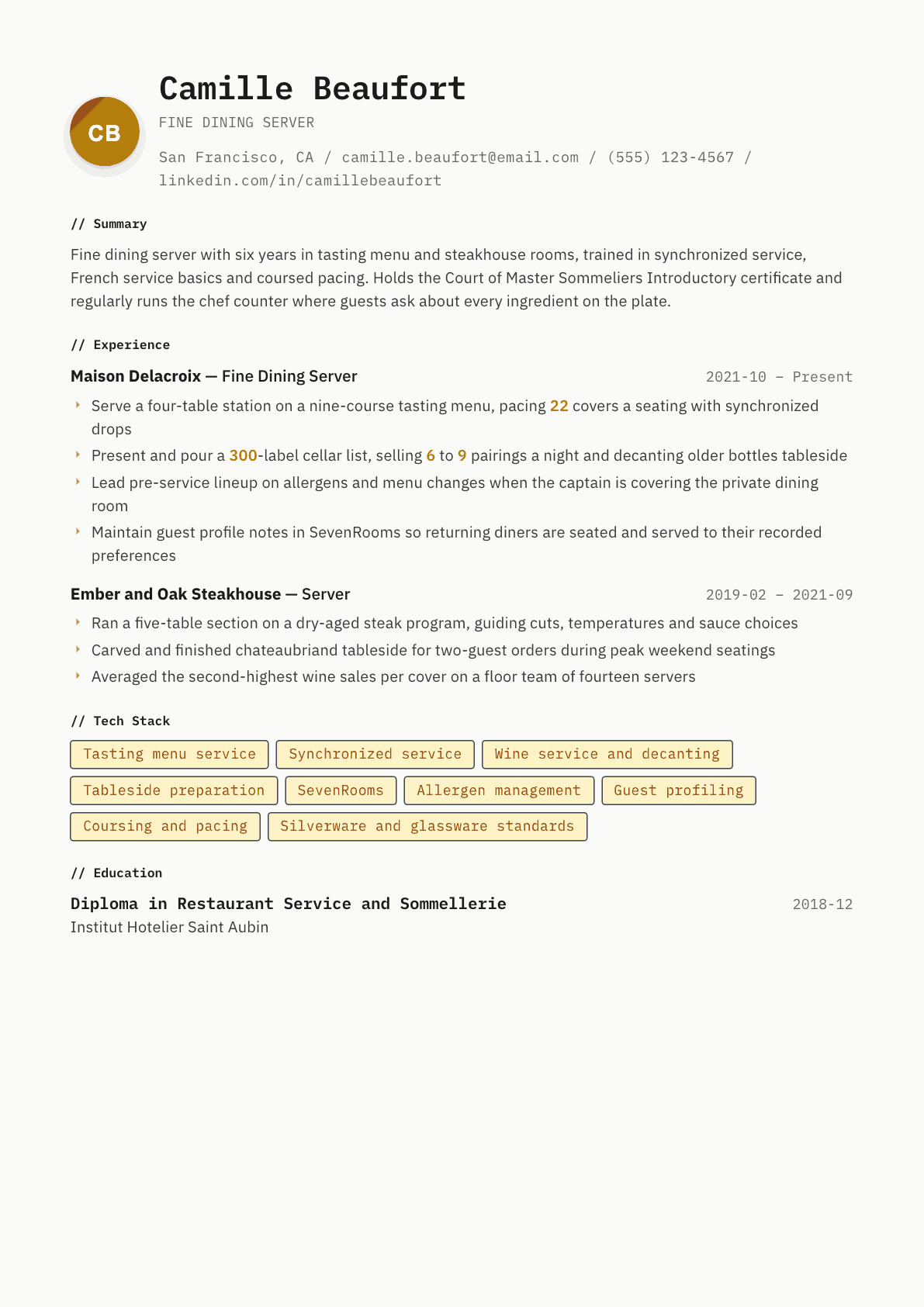
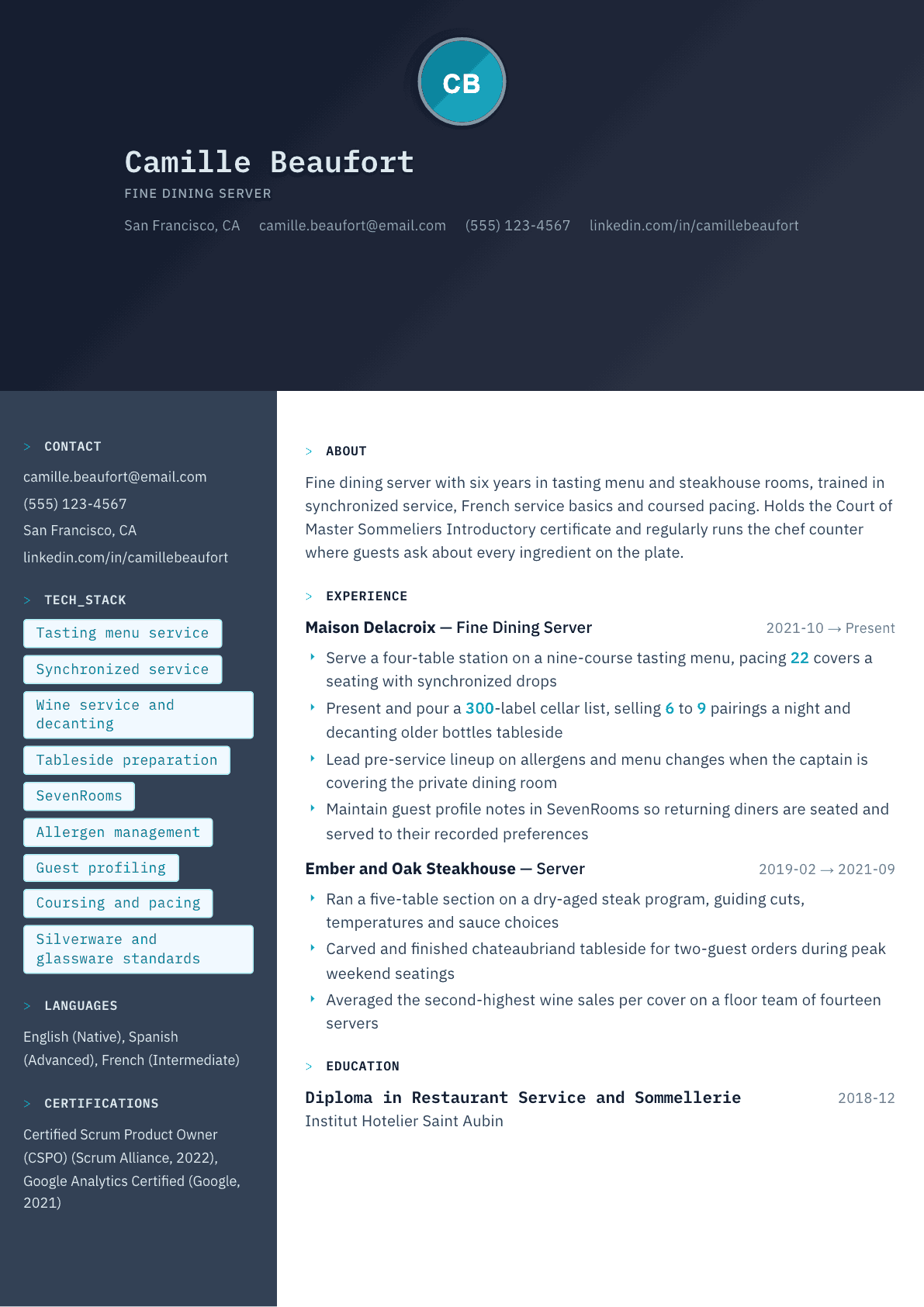
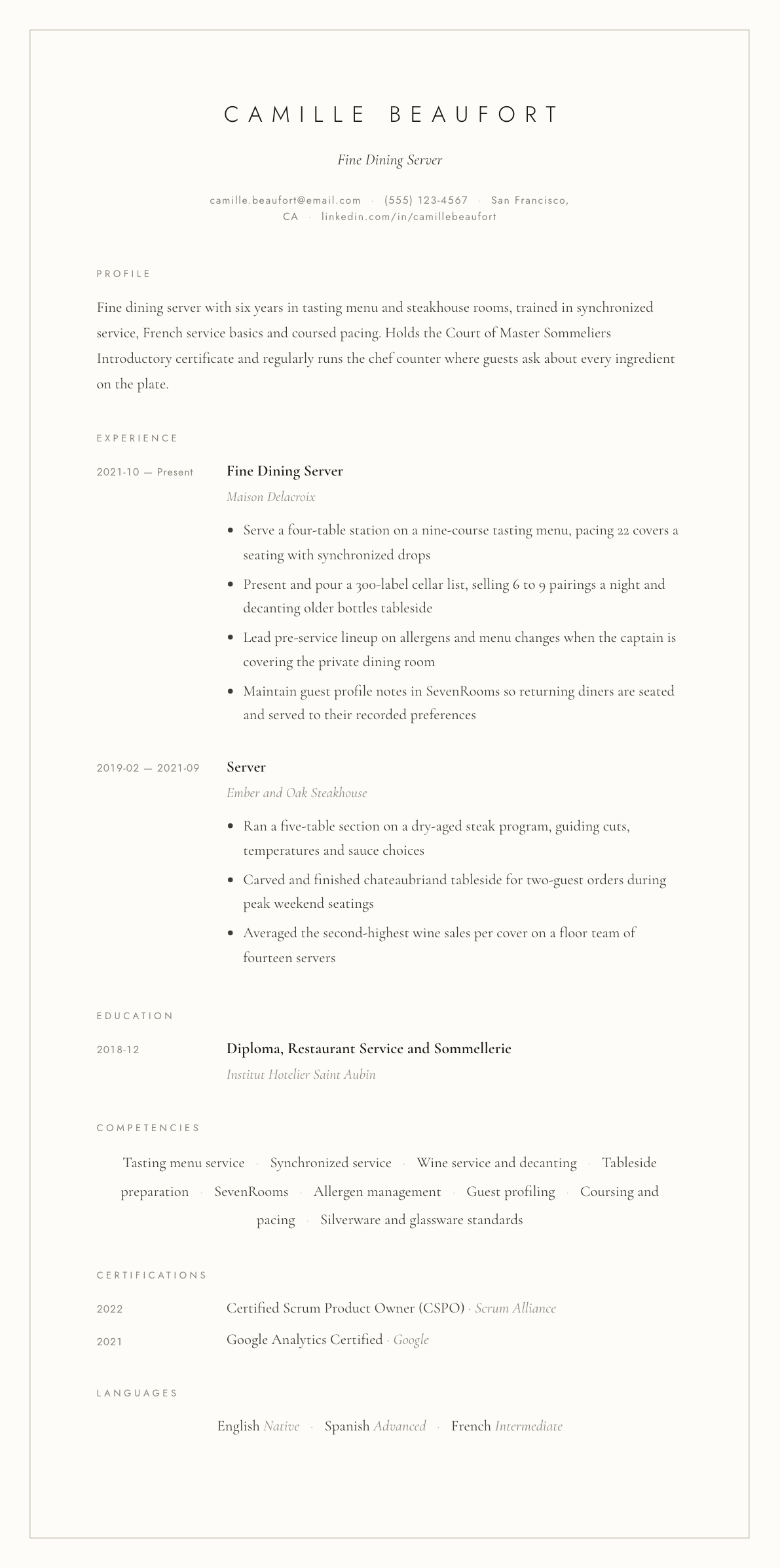
The same fine dining server content laid out in three CVBooster templates, so you can see what the finished document looks like before you write a word.
Example Fine Dining Server summary
Fine dining server with six years in tasting menu and steakhouse rooms, running a four-table station across a nine-course menu with synchronized drops and coursed pacing. Presents a 300-label cellar list, sells six to nine pairings a night, and decants and carves tableside. Holds the Court of Master Sommeliers Introductory certificate and keeps guest preference notes current in SevenRooms.
Skills to list on a Fine Dining Server resume
- Tasting menu service
- Synchronized service
- Wine list presentation
- Decanting and pairing
- Tableside preparation
- Coursing and pacing
- Allergen and dietary management
- Guest profile notes
- SevenRooms
- Resy
- OpenTable
- Sequence of service standards
- Silver service basics
- Pre-service lineup
- Upselling pairings
What actually gets this resume read
- Name the service style precisely: tasting menu, prix fixe, a la carte upscale or steakhouse, because each room hires for a different rhythm.
- State your wine credential and the size of the list you presented, since cellar depth tells a director what level you have worked at.
- Describe station size in tables and covers per seating rather than a nightly total, as upscale rooms are staffed seating by seating.
- Show tableside work by naming it: decanting, carving, gueridon finishing, caviar or cheese service, dessert flambe or coffee presentation.
- Mention the reservation and guest profile system you used, such as SevenRooms, Resy or OpenTable, because guest notes drive the service.
- List any award, guide rating or notable chef you worked under carefully and only where it is factual and verifiable in a reference call.
How to write a fine dining server resume
A fine dining server resume is read by a general manager or service director who is hiring for a specific rhythm. A nine-course tasting room, a prix fixe dining room, an upscale a la carte restaurant and a dry-aged steakhouse all call themselves fine dining, and none of them run the same floor. The first job of your resume is to say precisely which of those rooms you came from, because that is what the reader is matching against.
The second is wine. In upscale rooms beverage carries the check, and the director wants to know the depth of the list you presented, whether you poured and decanted at the table, and whether you hold a recognized wine credential. A server who can sell pairings is treated as revenue; a server who takes drink orders is treated as staffing.
This guide covers the sections in the order an upscale service director reads them, with summaries for a first upscale room, a six-year server and a captain track candidate, before-and-after bullets drawn from tasting menu and steakhouse floors, and the questions servers ask when moving up. Everything here applies whether the posting says server, waiter or waitress: a fine dining waitress resume is the same document under a different job title, and it is read by the same director.
Format: one page, restrained, with the credential visible
One page, reverse chronological, generous margins and a single clean typeface. The design of the page is itself a signal in this segment, and a resume covered in color blocks and icons reads against the restraint the room is selling.
Put a short credentials strip under the contact line: wine certification with the awarding body, any food safety or alcohol service card, the reservation and guest profile system you used, and the languages you serve in. That strip is the fastest route past the first screen.
- Header: name, city, phone, email, wine credential, languages.
- Sections in this order: summary, credentials, experience, education and training, skills.
- A first upscale role leads with wine study, coursed service experience and any tableside work already performed.
Summary: room type, station, cellar depth, service standard
Three lines. Name the format precisely: tasting menu with a course count, prix fixe, upscale a la carte or steakhouse. Give the station size in tables and the covers per seating, because upscale rooms are staffed seating by seating rather than by a nightly total. Then the cellar depth and your pairing sales, and close with the service standard you were trained in.
If you are stepping up from a casual room, say so and name the bridge honestly: wine study in progress, coursed service you have already run, or a section where you handled decanting. Overclaiming a standard you have not worked ends in the trail service, and upscale rooms talk to each other.
Experience: station, seating, and the standards you executed
Head each job with the restaurant, the format, the seat count and the seatings per night. A line such as "Fine dining server, nine-course tasting menu, 46 seats, two seatings" tells the reader more about your night than any paragraph could.
Then three to five bullets. Lead with station size, covers per seating and the pacing standard: synchronized drops, coursed timing against the kitchen, and how the table was reset between courses. Follow with the wine bullet: list size, pairings sold per service, decanting and older bottle handling. Then a bullet on tableside work by name, and a bullet on guest profiling and allergen management, which is where an upscale room measures precision.
Here is one entry written out for an invented waitress, Sofia Reyes, moving into her second upscale room. Job line: Server, The Larkspur, eight-course tasting menu, 52 seats, two seatings, four nights a week. Bullet one: Ran a four-table station per seating with synchronized drops and coursed pacing called from the pass. Bullet two: Presented a 300-label list and sold the wine pairing to most two-tops on weekend seatings, decanting older reds at the table. Bullet three: Recorded allergies and anniversaries in SevenRooms and served to those notes on the return visit.
Cut every sentence that would be equally true in a casual restaurant. "Delivered exceptional guest experiences" belongs to no segment at all, and in this one it actively works against you.
Tableside, wine and guest profiles: the three proofs
Tableside work is the clearest evidence of training, so name what you performed rather than saying you did tableside service: decanting, carving, gueridon finishing, cheese or caviar service, dessert flambe, or coffee and digestif presentation. Each of those was taught to you by someone, and naming it tells the reader who you were trained by even when you cannot name the mentor.
Guest profile discipline is the quieter proof. Recording preferences, allergies, anniversaries and seating requests in the reservation system, and serving to those notes on the return visit, is what turns a good room into a room guests come back to. Name the system by brand, because upscale groups standardize on one and will move a matching resume forward.
- Tableside skills, each named individually rather than as a category.
- Cellar depth and pairings sold per service.
- Reservation and guest profile system: SevenRooms, Resy, OpenTable or another.
- Allergen and dietary management within a fixed menu.
- Pre-service lineup and menu change briefings you have led.
Credentials and keywords for upscale screening
List wine credentials exactly as the awarding body names them, since a service director knows the difference between the levels and an inflated line is caught immediately. A first-level sommelier certificate or an early wine award is a strong entry credential and should be written plainly, without dressing it up.
For keywords, use the vocabulary the segment writes its postings in: sequence of service, synchronized service, coursing and pacing, mise en place, guest profiles, pairings, decanting, allergen management and pre-service lineup. Each one should sit next to something you actually did, because in this segment the interview will ask you to explain any term you used.
Fine Dining Server resume summary examples
First upscale room
Server with three years in an upscale casual dining room, moving into fine dining. Has run coursed service on a set menu, poured and decanted at the table, and holds a first-level wine certificate. Comfortable with allergen protocol on a fixed menu and with maintaining guest preference notes in the reservation system.
Six years in
Fine dining server with six years in tasting menu and steakhouse rooms, running a four-table station across a nine-course menu with synchronized drops. Presents a 300-label cellar list, sells six to nine pairings a night, and decants and carves tableside. Holds an introductory sommelier certificate and keeps guest profiles current.
Captain track
Senior fine dining server on the captain track with ten years in tasting menu rooms, leading pre-service lineup on allergens and menu changes and covering the private dining room. Trains new servers on sequence of service and gueridon work, and manages the wine service standard across a floor team of twelve.
Work experience bullets: before and after
Before: Served guests at a high-end restaurant.
After: Served a four-table station on a nine-course tasting menu, pacing 22 covers a seating with synchronized drops coordinated to the kitchen call.
Station size, course count, covers per seating and the pacing standard describe the room instead of labeling it.
Before: Sold wine and made recommendations.
After: Presented and poured from a 300-label cellar list, selling six to nine pairings a night and decanting older bottles tableside for the guest to taste.
Cellar depth, nightly pairing sales and the decanting detail prove beverage command at an upscale standard.
Before: Did tableside preparations for guests.
After: Carved and finished chateaubriand tableside for two-guest orders during peak weekend seatings, plating and saucing in front of the table.
Naming the dish and the moment shows a trained skill rather than a category anyone can claim.
Before: Remembered regular guests and what they liked.
After: Maintained guest preference, allergy and occasion notes in SevenRooms so returning diners were seated and served to their recorded profile without being asked twice.
The system and the outcome turn a memory claim into a repeatable service standard the room depends on.
Before: Helped run the team before service.
After: Led the pre-service lineup on allergens, menu changes and eighty-sixed items when the captain was covering the private dining room, then walked the floor for setting and glassware standards.
The content of the lineup and the floor walk show leadership responsibility rather than attendance at a meeting.
Hard skills
- Tasting menu and coursed service
- Synchronized service
- Sequence of service standards
- Wine list presentation and pairing
- Decanting and older bottle handling
- Tableside carving and finishing
- Allergen and dietary management
- Guest profile maintenance
- SevenRooms
- Resy
- OpenTable
- Glassware and silverware standards
- Pre-service lineup and briefing
Soft skills
- Precision under a fixed pace
- Reading a table without intruding
- Discretion with prominent guests
- Composure through a long seating
- Mentoring newer servers
- Diplomatic handling of a returned dish
Certifications worth listing
- Introductory Sommelier Certificate (Court of Master Sommeliers, Americas)
- Level 2 Award in Wines (Wine & Spirit Education Trust)
- Certified Specialist of Wine (Society of Wine Educators)
- ServSafe Alcohol (National Restaurant Association)
Mistakes that cost fine dining server candidates the interview
- Calling the room fine dining without naming the format, so a tasting menu director cannot tell whether you have ever run coursed service.
- Giving a nightly cover total instead of covers per seating, which is how upscale rooms are actually staffed.
- Writing "tableside service" as a category rather than naming the decanting, carving or finishing you were trained to perform.
- Inflating a wine credential level, which a service director will identify from the awarding body in the first minute.
- Using a heavily designed template with color blocks, which reads against the restraint the segment expects.
- Claiming a guide rating or a famous chef association that a reference call cannot confirm.
Fine Dining Server resume questions
How do I move from casual dining into fine dining?
Lead with the overlaps that matter: coursed service, wine service, allergen protocol on a set menu and any tableside work. Then add wine study, because an entry-level certificate signals you will keep learning, which is what upscale rooms hire on.
Which wine certification is worth putting on the resume?
Any genuine one from a recognized awarding body, written exactly as the body names it, including the level. An introductory sommelier certificate or an early wine award is respected. Inventing a level or omitting the issuer costs you more credibility than having no credential at all.
Should I name the chefs or restaurants I worked under?
Name the restaurants, always, because the room itself is the credential in this segment. Name a chef only where the association is factual and a reference call would confirm it, since service directors in upscale dining know each other well.
Should a fine dining waitress resume say waitress or server?
Use the title the restaurant actually gave you in the job line, and the word the posting uses in your summary. Most upscale rooms post for servers, captains and back servers, so a waitress applying there can write "fine dining server" in the summary without changing any job title she held.
Does a fine dining server resume need a formal education section?
A hospitality or restaurant service diploma helps but is not required. What matters more is documented training: wine courses, service standards you were taught, and any structured orientation you completed or later delivered to new servers on your floor.
Related resume examples
- Bartender Resume example
- Restaurant Manager Resume example
- Server Resume example
- Waiter Resume example
- Banquet Captain Resume example
- Sommelier Resume example