Server Resume Examples: what a hiring manager reads first
Server Job Resume: How to Write Server Experience That Gets You on the Floor
By Mustafa Tarabya, founder of CVBooster · Published · Updated
Restaurant server sample resume and server resume examples by restaurant type, with section counts, POS systems, sales per shift and upsell bullets, plus a writing guide.
Sample resumes for a server
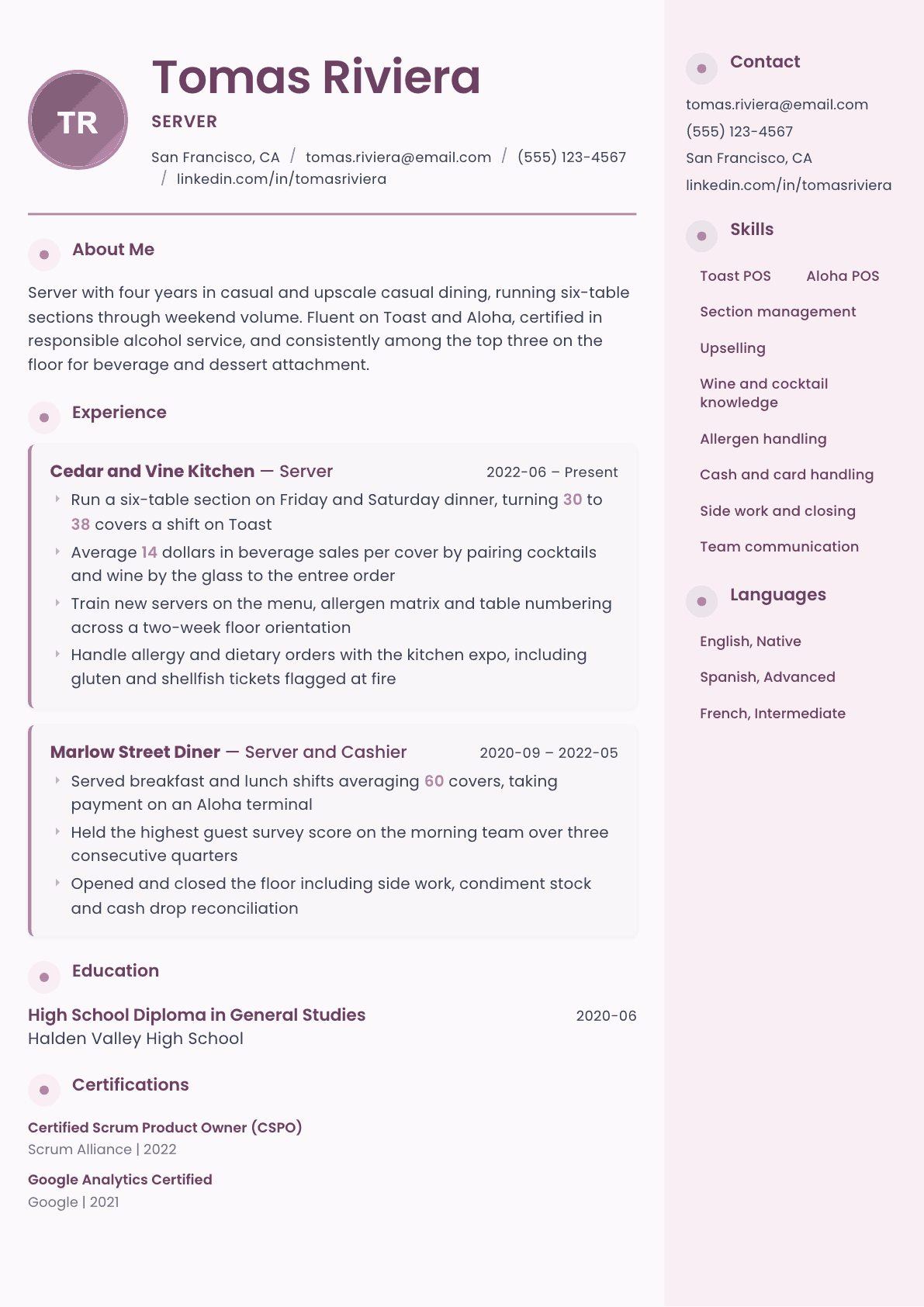
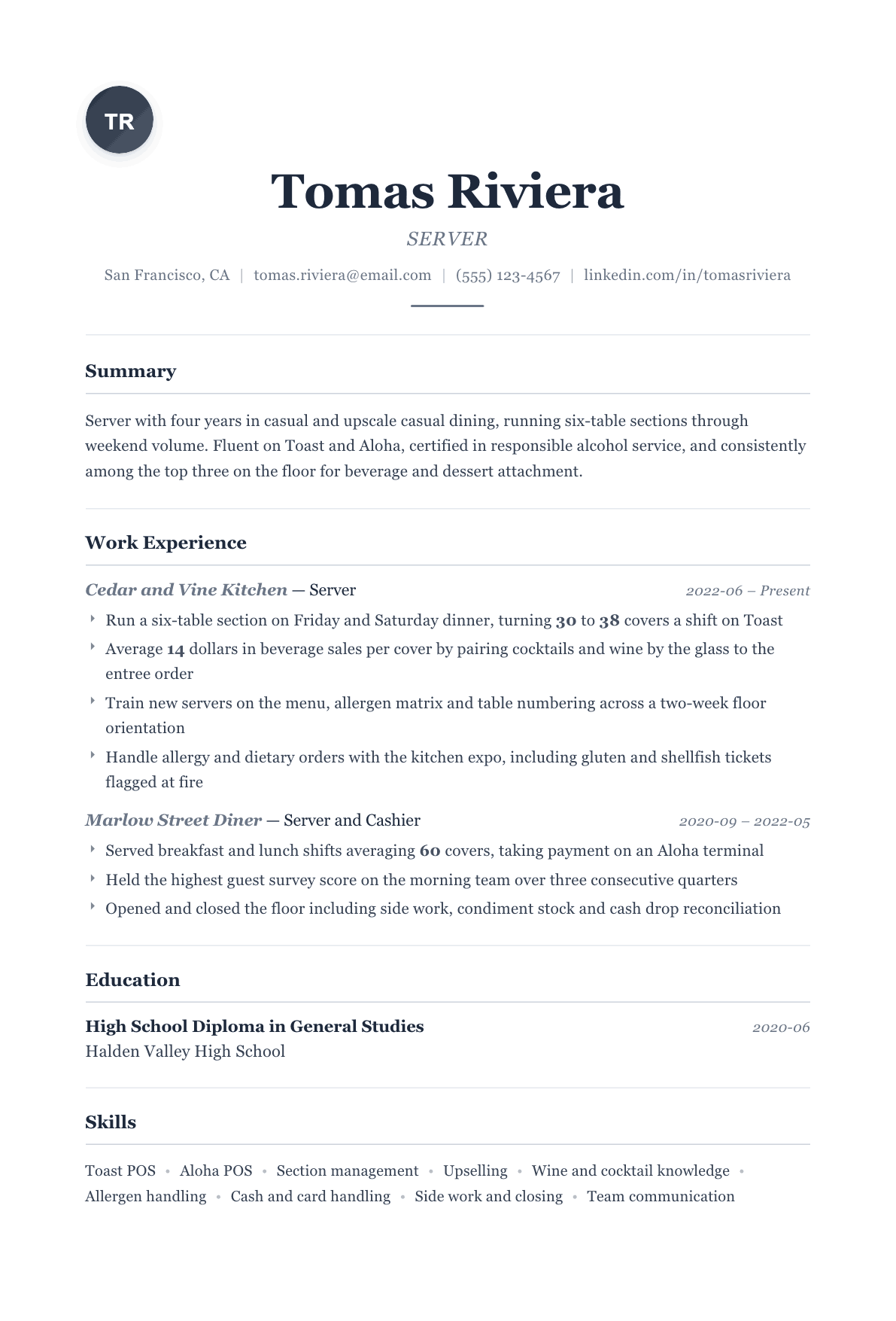
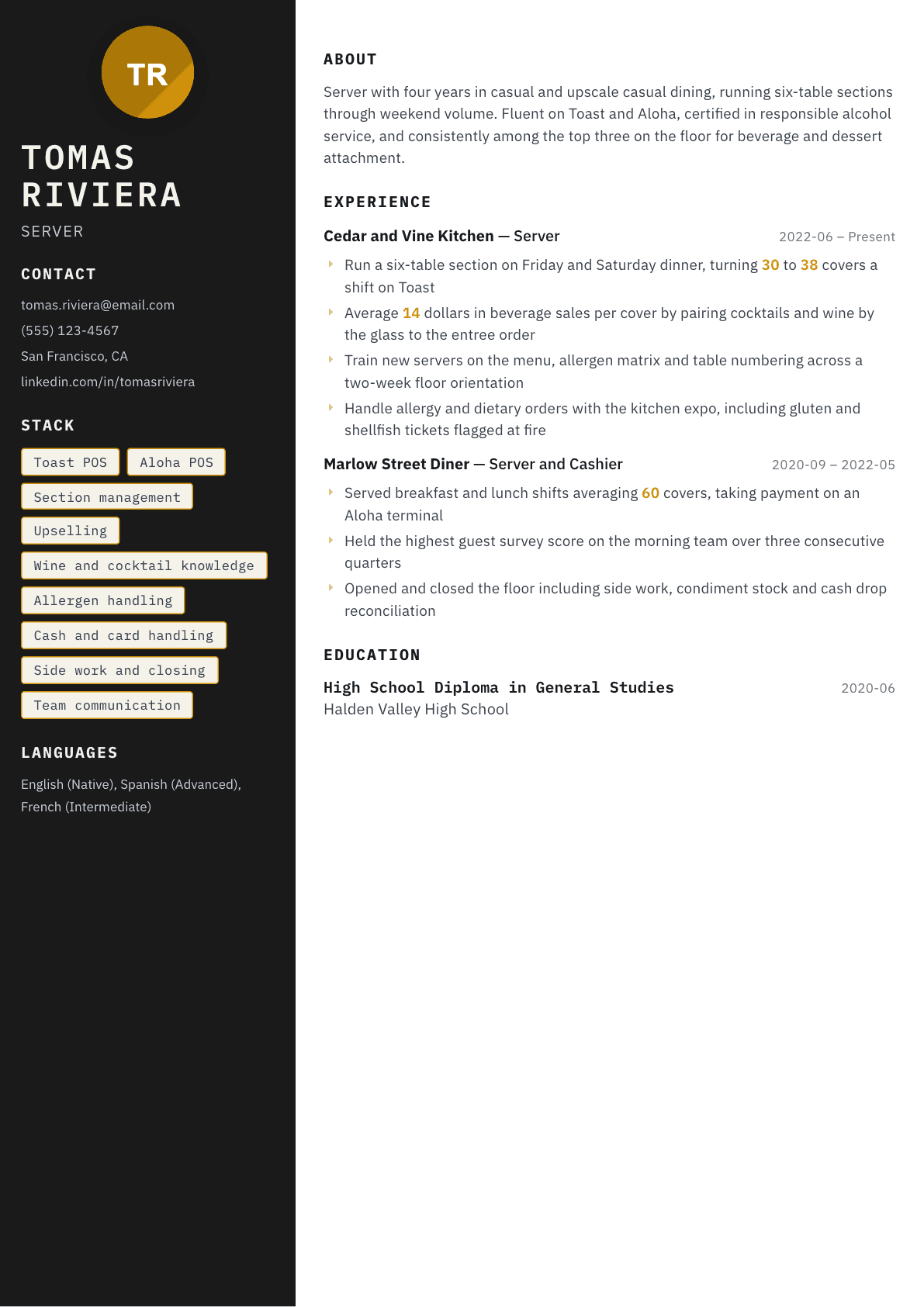
The same server content laid out in three CVBooster templates, so you can see what the finished document looks like before you write a word.
Example Server summary
Server with four years in casual and upscale casual dining, running a six-table section through 30 to 38 covers on weekend dinner shifts. Works fluently on Toast and Aloha, averages 14 dollars of beverage sales per cover, handles allergy tickets directly with expo, and trains new servers on the menu and floor plan. Certified in responsible alcohol service and available for nights and weekends.
Skills to list on a Server resume
- Section management
- Toast POS
- Aloha POS
- Square POS
- Order accuracy
- Upselling and suggestive selling
- Wine and beer knowledge
- Allergen and dietary handling
- Cash and card payments
- Table turning
- Food safety
- Responsible alcohol service
- Side work and closing duties
- Guest recovery
What actually gets this resume read
- State the size of your section in tables and the covers you turn per shift, because that is how a manager measures floor capability.
- Name the point of sale system you know, since a restaurant on Toast, Aloha, Square or Micros wants to skip terminal training.
- Show sales per cover or beverage attachment if you can, as revenue per guest separates a strong server from an order taker.
- List your alcohol service certification with the issuing program and the state, because many venues cannot schedule you without it.
- Describe the service style you worked, whether counter, casual, upscale casual or fine dining, so the reader can judge the fit.
- Include opening, closing and side work duties, which tell a manager you can be trusted to run a shift without supervision.
How to write a server resume
A server resume is read in under a minute by a general manager who is short two people on the weekend schedule. That person is not looking for personality on paper, because personality is what the trail shift is for. They are looking for capacity: how many tables you can hold, how many covers you turned, which point of sale terminal you already know, and whether you carry the alcohol service certification that lets them put you on the floor without waiting on a class.
The second thing they check is revenue per guest. Two servers can work the same section on the same night and produce very different checks, and the difference comes from beverage and dessert attachment. A server who can show sales per cover, or a standing on the floor team for add-on revenue, moves from a body on the schedule to a hire the manager competes for.
This guide shows how to write server resume experience so a manager can picture you on the floor, covers the sections in the order a restaurant manager reads them, with summaries for a first floor job, a four-year server and a lead or trainer, before-and-after bullets built from real service, and the questions servers ask when they finally sit down to write.
Restaurant server sample resume: a complete entry
This restaurant server sample resume is for a server with four years in casual and upscale dining. A manager hiring servers checks section size, covers, the POS system, the alcohol certification and whether you can sell, so every one of those is on the page.
Summary: Restaurant server with four years in full service dining, carrying a five table section and up to 120 covers on a Saturday. Sells wine by the glass and desserts on every table, closes out cleanly on the POS and trains new servers. Alcohol server and food handler certified.
The same sample works in any restaurant once the summary line changes. Resume examples for servers by restaurant type:
Fine dining: Server at a 70 seat tasting menu restaurant, delivering seven courses to a four table section with full wine service, plate descriptions and allergy handling on every ticket.
Casual dining: Server at a 200 seat family restaurant, handling a six table section, large parties and takeout orders through the dinner rush.
Breakfast and diner: Server on the morning shift of a 24 hour diner, turning tables fast, running food and covering the register when the host is on break.
Banquet and events: Banquet server for weddings and corporate events of up to 300 guests, setting rooms and serving plated and buffet meals to a timeline.
First serving job: Busser and food runner moving up to server, with two years running food, resetting tables and learning the menu on a 150 seat floor.
The experience entry for the first sample, Server, Willow Street Kitchen, reads as the bullets below.
- Serve a five table section in a 140 seat restaurant, up to 120 covers on Friday and Saturday nights.
- Recommend wine pairings and desserts, and hit the house add-on target most weeks.
- Enter every order and modifier in Toast and close out with no cash shortages.
- Train new servers on the menu, the steps of service and opening sidework.
- Check ID on every alcohol order under the house policy.
Format: one page, always, with the certification line up top
One page, reverse chronological, plain and readable. Restaurant hiring often happens on a printed stack in a back office or on a phone in a walk-in interview, so anything clever with columns and icons costs you legibility for no gain.
Put a short credentials line under your contact details: alcohol service certification with the issuing program, food handler card, the point of sale systems you know, and your availability. A manager filling a Friday night shift will read that line first and the rest second.
- Header: name, city, phone, email, and availability in plain words.
- Sections in this order: summary, certifications and systems, experience, education, skills.
- First-time servers move any hosting, bussing, barista or retail work up and describe volume in covers or transactions.
Summary: service style, section size, covers, what you sell
Three lines. Say what kind of room you worked, because casual, upscale casual, fine dining and high-volume counter service are four different rhythms and a manager hires for the one they run. Then the section size and covers per shift, then the terminal you know, then one line on what you sell beyond the entree.
Avoid opening with a claim about being passionate about hospitality. Every applicant writes it, none of them are screened out by it, and it takes the line where your covers number belonged.
Server resume experience: section, covers, and the parts of the shift you owned
Head each job with the restaurant, the concept, the seat count and the shifts you worked. A line such as "Server, 120-seat upscale casual kitchen, Friday and Saturday dinner" is worth more than three bullets of adjectives, because it tells the reader the volume and the daypart in one read.
Then three to five bullets. Lead with the section size and covers you turned. Follow with the revenue bullet: beverage attachment, wine or cocktail pairing, dessert and appetizer add-ons. Then a bullet on the operational side of the job that managers quietly weigh heavily: allergy and dietary tickets run with the kitchen expo, opening and closing side work, cash drops and reconciliation, and training new servers.
With several restaurant jobs, list the last two or three in full and fold older ones into a single line such as "Earlier: server and host roles in two casual dining restaurants". Written out for an invented server, Malik Fontaine, the second entry reads: Server, Harbor Grill, 90 seats, weekday lunch and Sunday brunch. Held a four table section at brunch, ran large party checks on split payment, and covered expo when the kitchen fell behind.
Cut anything that describes the job rather than your version of it. "Took orders and delivered food to tables" is what the word server means, and a manager who reads it learns nothing they did not already know from the job title.
Numbers a restaurant manager can actually use
Four figures carry a server resume. Section size in tables tells the manager how much floor you can hold. Covers per shift shows the volume you have survived. Sales per cover or beverage attachment is the revenue proof. Guest survey scoring, where your venue tracked it, closes the loop on service quality.
Give figures you can back up in an interview from memory of your own reports. A manager who has run floor sales for years can tell the difference between a real number and a hopeful one within about two follow-up questions.
- Section size in tables and total seats in the room.
- Covers turned per shift and the daypart they were turned in.
- Beverage or dessert attachment, or sales per cover.
- Point of sale system: Toast, Aloha, Square, Micros or another by name.
- Side work, opening and closing duties, and cash reconciliation.
Certifications and keywords: the line that decides the schedule
Alcohol service certification is not a nice extra. In many states a venue cannot roster you on a shift that serves alcohol without it, so list the program name and the state it is valid in. Add a food handler card with the issuing body. If you have neither, say which one you are booked to take and when.
For keywords, mirror the language restaurant postings use: section management, covers, upselling and suggestive selling, allergen handling, food safety, guest recovery, side work, opening and closing. Use each once where a bullet proves it. A stacked block of restaurant words at the bottom of the page reads as filler to a manager who has been reading resumes since the lunch rush ended.
Server resume summary examples
First serving job
Host and food runner with 14 months in a 90-seat casual restaurant, moving to the floor. Knows the menu and allergen matrix, runs a Toast terminal, and has covered service on light sections during weekday lunch. Food handler certified and available nights, weekends and holidays.
Four years in
Server with four years across casual and upscale casual dining, running a six-table section through 30 to 38 covers on weekend dinner shifts. Fluent on Toast and Aloha, averages 14 dollars of beverage sales per cover, and handles allergy tickets directly with expo. Certified in responsible alcohol service.
Lead server and trainer
Lead server with eight years in high-volume dining rooms, running the largest sections and covering key-holder shifts. Trains new servers on menu, allergen protocol and floor plan across a two-week orientation, holds the top beverage attachment on a floor team of eleven, and reconciles nightly cash drops.
Work experience bullets: before and after
Before: Served customers in a busy restaurant.
After: Ran a six-table section on Friday and Saturday dinner service, turning 30 to 38 covers a shift on a Toast terminal in a 120-seat dining room.
Section size, covers, daypart and room size let a manager work out your capacity without asking.
Before: Upsold drinks and desserts to guests.
After: Averaged 14 dollars of beverage sales per cover by pairing cocktails and wine by the glass to the entree order, holding the top attachment figure on the weekend team.
Sales per cover with the method behind it is a revenue claim a manager can verify against their own reports.
Before: Handled food allergies carefully.
After: Ran gluten, shellfish and nut allergy tickets directly with the kitchen expo, flagging them at fire and confirming the plate at the pass before it left the line.
Naming the allergens and the two checkpoints shows a real protocol instead of a claim about being careful.
Before: Trained new employees.
After: Trained six new servers over two years on the menu, allergen matrix and table numbering through a two-week floor orientation, including their first solo section.
A trainee count and the content of the orientation turn a throwaway line into evidence of a lead-track server.
Before: Did opening and closing duties.
After: Opened and closed the floor including side work, condiment and station stock, and end-of-night cash drop reconciliation with no shortages recorded over two years.
The specific closing tasks and the cash record show you can be trusted to run a shift without supervision.
Hard skills
- Section management
- Toast point of sale
- Aloha point of sale
- Square point of sale
- Covers and table turn discipline
- Suggestive selling and beverage attachment
- Wine and beer service
- Allergen and dietary handling
- Cash and card payment handling
- Food safety and temperature control
- Responsible alcohol service
- Side work, opening and closing duties
Soft skills
- Reading a table quickly
- Composure during a rush
- Guest recovery after a mistake
- Coordination with expo and bar
- Teamwork on a shared floor
- Schedule reliability
Certifications worth listing
- ServSafe Food Handler (National Restaurant Association)
- ServSafe Alcohol (National Restaurant Association)
- TIPS Alcohol Certification (Health Communications, Inc.)
- Certified Guest Service Professional (CGSP) (American Hotel & Lodging Educational Institute)
Mistakes that cost server candidates the interview
- Leaving out section size and cover counts, so the manager cannot tell a four-table lunch shift from a weekend dinner floor.
- Skipping the alcohol service certification, which in many states decides whether you can be scheduled at all.
- Writing "point of sale system" instead of Toast, Aloha, Square or Micros, and losing the terminal training advantage.
- Listing five short restaurant jobs in full instead of condensing the oldest two into a single line.
- Filling the page with adjectives about being friendly when the interview and the trail shift already test that.
- Ignoring the closing side of the job, which is exactly what a manager needs covered when they are short on a Sunday night.
Server resume questions
What should a server job resume include?
One page with your section size and covers, the type of restaurant, the POS system you used, your alcohol server and food handler certifications, and one or two lines that show you can sell. The restaurant server sample resume above shows that order, and the examples by restaurant type show how to adjust it.
Do I need alcohol service certification before applying?
It depends on your state, but holding it removes a scheduling obstacle and often decides between two similar applicants. If you have not taken it, name the program you are booked on and the date, so the manager can plan your first shifts around it.
How do I write a server resume with no restaurant experience?
Lead with volume from wherever you have it: retail transactions, cafe counter service, catering shifts or hosting. Then show menu learning ability, cash handling accuracy and availability, since those are the three things a manager risks on a new floor hire.
Should I put my tips or average check on the resume?
Average check or sales per cover is useful because it maps to what the restaurant earns. Tip totals are less useful, since they depend on the venue, the tip pool and the price point, and a manager cannot compare them across concepts.
How do I list server experience from several short restaurant jobs?
Write out the two or three most recent jobs with seats, section size and covers, then group older ones into one line. Give dates honestly and add a short reason where one exists, such as a seasonal closure or a relocation, since managers ask about every unexplained gap.
Related resume examples
- Bartender Resume example
- Restaurant Manager Resume example
- Host Resume example
- Food Runner Resume example
- Banquet Server Resume example
- Waiter Resume example