Sommelier Resume Examples: free ATS score and gap list
Craft a Sommelier Resume That Reflects Your Refined Expertise
By Mustafa Tarabya, founder of CVBooster · Published · Updated
Build an elegant Sommelier resume highlighting wine program management, cellar curation, guest service excellence, and revenue growth through beverage sales.
Sample resumes for a sommelier
The same sommelier content laid out in three CVBooster templates, so you can see what the finished document looks like before you write a word.
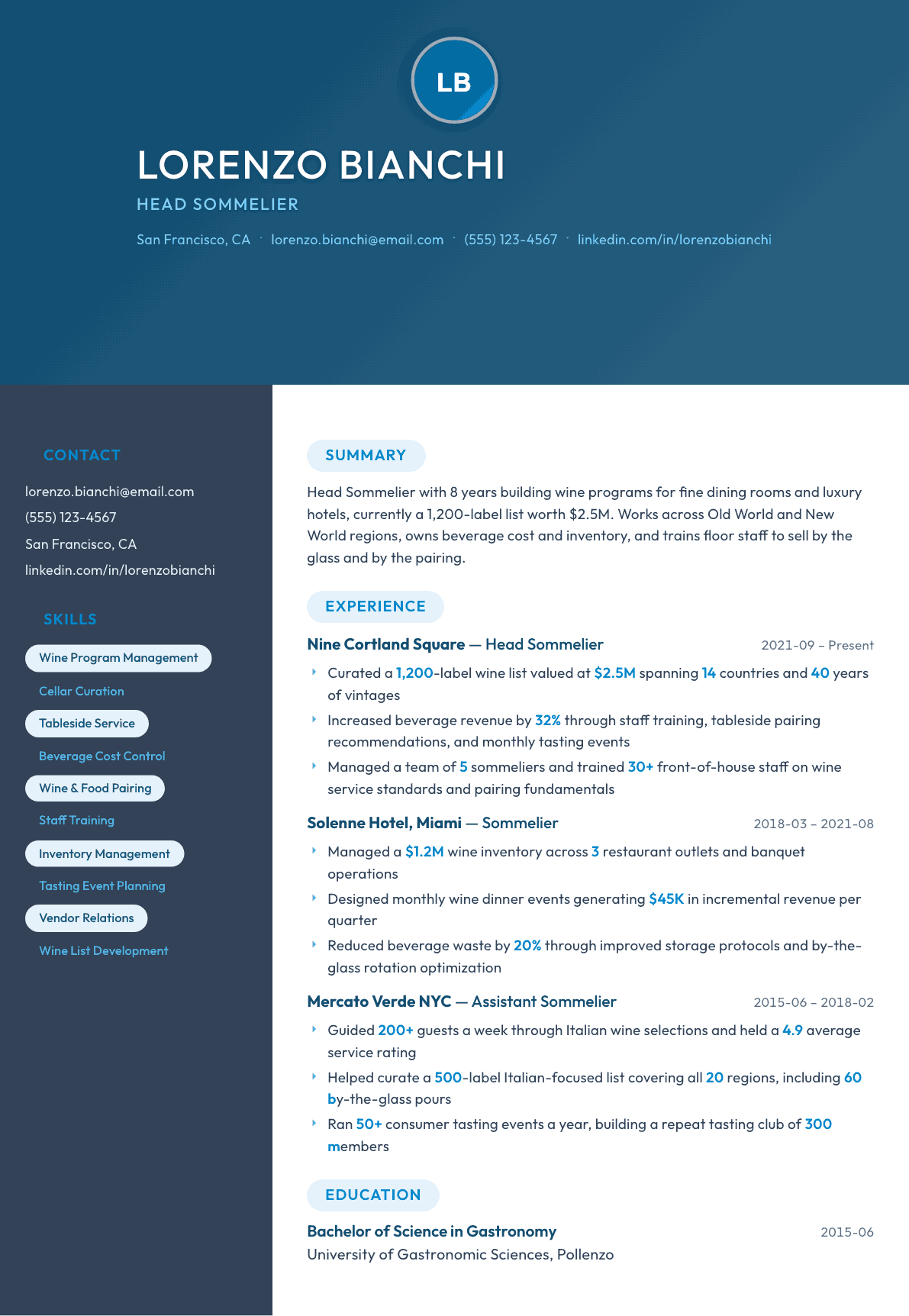
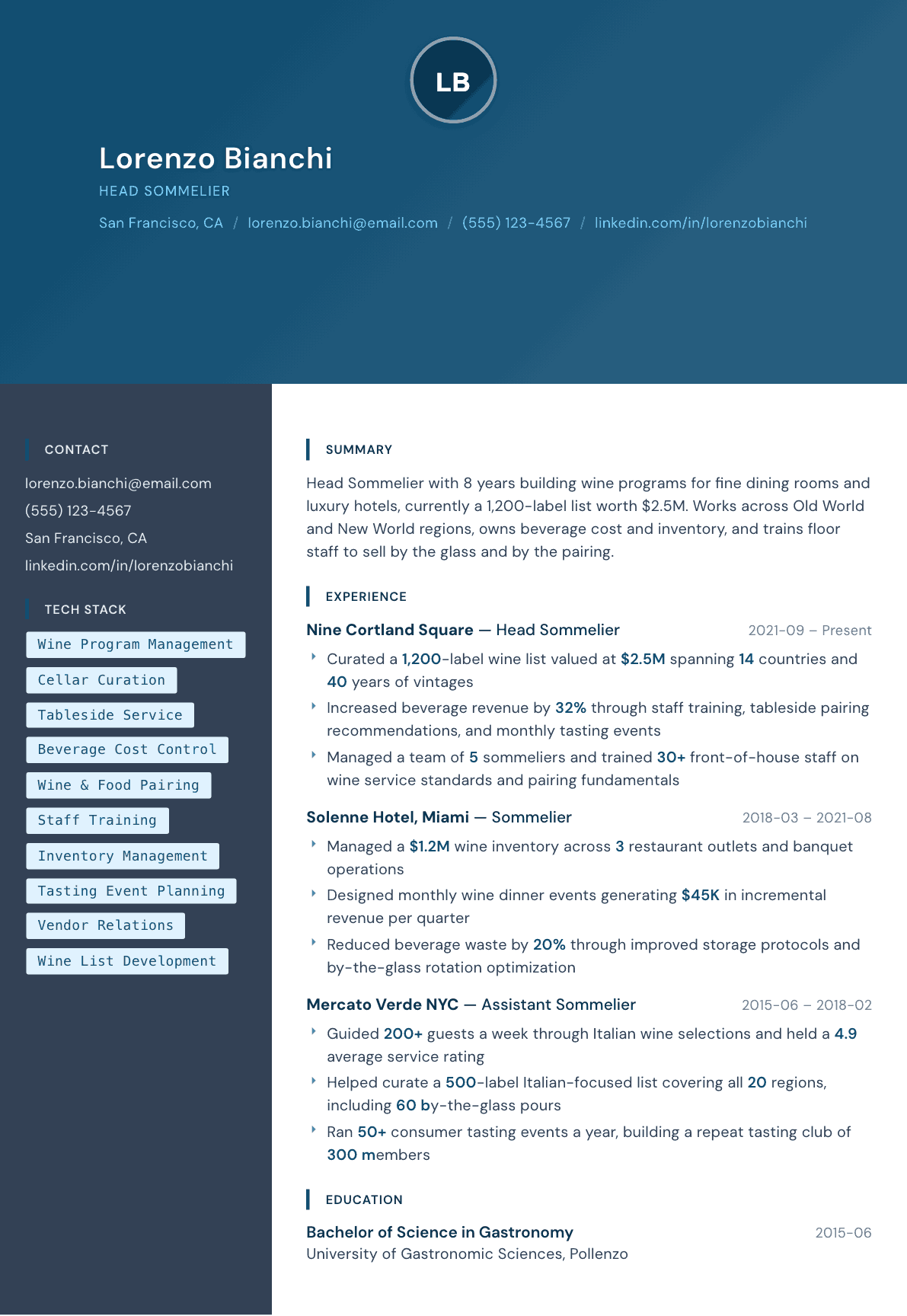
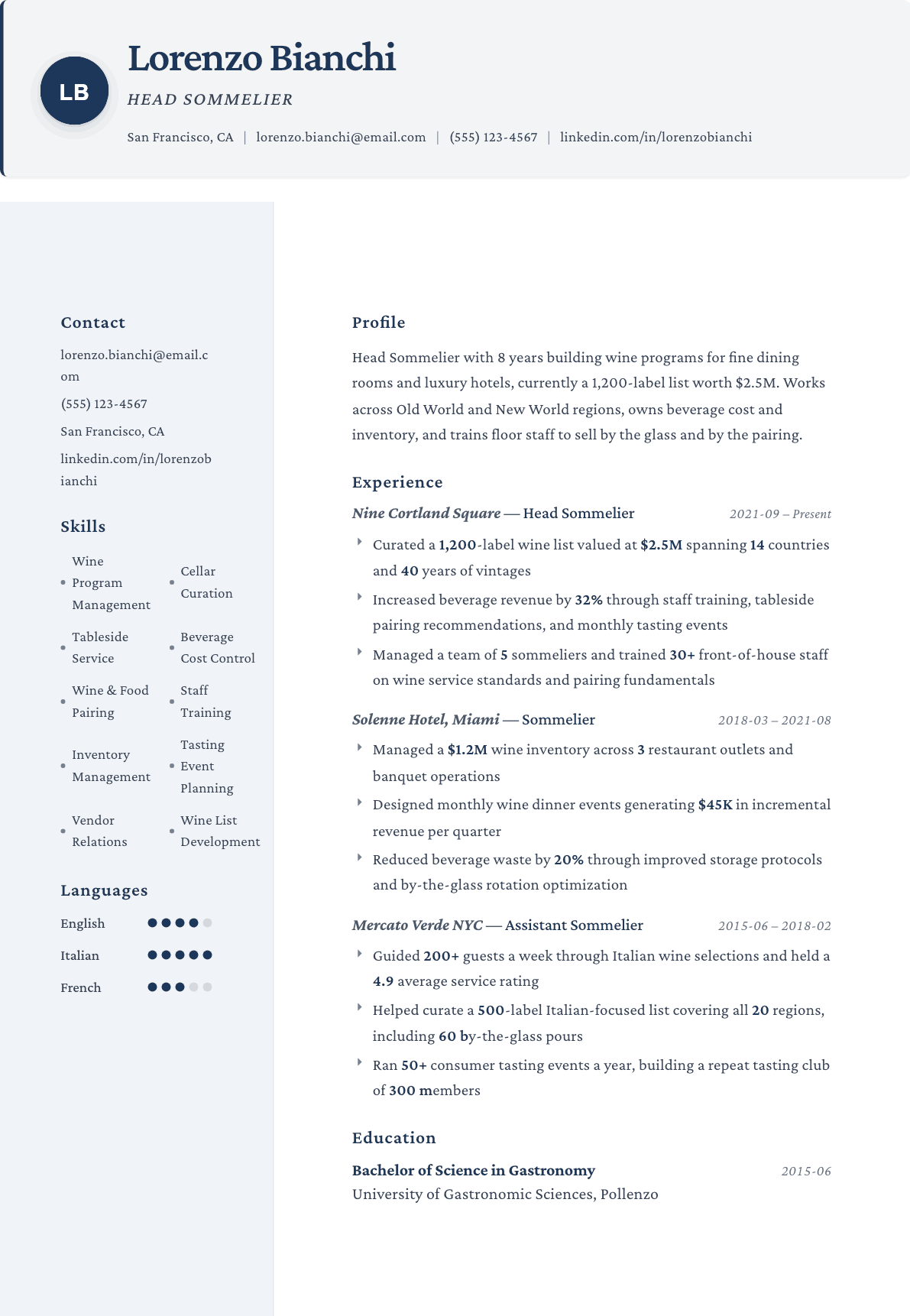
Example Sommelier summary
Head Sommelier running a 1,200-label, $2.5M cellar and a team of 5. Grew beverage revenue 32% and trained 30 floor staff on service and pairing. Advanced Sommelier (CMS), WSET Level 3.
Skills to list on a Sommelier resume
- Wine Program Management
- Cellar Curation & Inventory
- Wine & Food Pairing
- Tableside Service
- Beverage Cost Management
- Staff Wine Training
- Tasting Event Planning
- Vendor & Distributor Relations
- Old World & New World Wines
- Spirits & Cocktail Knowledge
- Wine List Design
- Guest Relationship Building
- POS Systems
- Sensory Evaluation
What actually gets this resume read
- Give the program scope up front: number of labels, cellar value, by-the-glass count, and the beverage cost percentage you held.
- Quantify revenue impact through beverage sales growth, average check increases, and event revenue.
- List certifications prominently (CMS, WSET, ISG) as they carry significant weight in sommelier hiring.
- Showcase guest experience skills with specific examples of tableside service and personalized recommendations.
- Include team training accomplishments and their impact on overall beverage sales.
How to write a sommelier resume
A sommelier resume is read by a beverage director, a general manager or a restaurant owner who has to answer two questions at once: can this person sell wine on the floor without making guests feel small, and can they run the cellar as a piece of inventory worth real money. Candidates almost always write for the first question and forget the second, which is why so many wine resumes stall.
The certification is the entry ticket rather than the argument. What differentiates one wine professional from another is the program: how many labels, what the list was worth, which regions it went deep on, how the by the glass rotation worked, how much of the check the beverage side carried, and how the staff was trained to sell when you were not standing at the table. Those facts are the resume.
This guide sets out the section order beverage directors expect, how to describe a wine program without turning it into a tasting note, the inventory and revenue figures worth quoting, three summaries from floor sommelier to beverage director, and the errors that make an experienced sommelier read as a hobbyist.
Format: certifications visible, program profile under each house
One page is standard, two only if you have run beverage across multiple venues. Reverse chronological. Put your wine credentials in the header beside your name and again in their own section with the awarding body and the year, because they are the first filter a beverage director applies.
Under each restaurant or hotel, write a program profile line: the house, the cuisine and price point, seats and average covers, the number of labels and bottles on the list, the value of the cellar in relative terms, the by the glass count, and the size of the beverage team. Then the bullets.
- Header: name, city, phone, email, and your highest wine credential with the awarding body.
- Order: summary, wine and beverage experience with program profiles, certifications and education, languages, awards.
- Languages belong on a wine resume. French, Italian, German and Spanish reading ability is directly useful when buying and it is a genuine differentiator.
Summary: the house, the list, the number you moved
Three lines. The kind of restaurant or hotel, the scale of the list you have curated, your regional depth, and one commercial result. Beverage directors hire for a specific gap: a list that needs rebuilding, a wine team that needs training, a beverage cost that has drifted, or a recognized award the owner wants.
Say where your palate and buying strength sit. Burgundy and the Rhone, Italian regional depth, German and Austrian riesling, Champagne and sparkling, natural and low intervention producers, or fortified and spirits. A sommelier who claims equal depth everywhere is read as claiming none.
Experience: the program, the floor, and the cellar
Split each job into three kinds of bullet. The program: labels curated, regions added or cut, by the glass rotation, pairing menus written, verticals and back vintages held, half bottles and large formats, and any list award the program earned. The floor: covers guided per service, tableside service and decanting standards, pairing sales, the way you handle a guest who has a budget they do not want to say out loud.
The cellar: receiving and storage conditions, inventory counts and variance, breakage and shrink, allocation relationships with importers and distributors, purchasing calendar, and the beverage cost percentage you held. This is the part most sommelier resumes skip, and it is the part an owner worries about.
Add training. How many front of house staff you taught, the format of the session, what they had to know before service, and whether beverage sales moved as a result. A sommelier who lifts the whole floor is worth several who only sell at their own tables.
Numbers that belong on a wine resume
Wine is a measured department and the figures are usually available to whoever asks. Quote the ones you influenced and be ready to explain the method.
- Beverage share of total check, wine attachment rate, and average wine spend per cover.
- Beverage cost against target, inventory variance, and shrink or breakage.
- List size in labels and bottles, by the glass count, and turns on the by the glass program.
- Growth in a specific category you built: Champagne, large format, half bottles, back vintages, non alcoholic pairings.
- Staff trained, tastings run, and the movement in floor wine sales after the training.
- Events: wine dinners, tastings and pairing menus run per year, and covers or attendance at each.
Certifications, awards and how to list them honestly
Wine credentials are hierarchical and the industry knows exactly where each level sits, so list the level you actually hold with the awarding body and never round upward. A candidate who lists a level they have only sat the exam for gets caught in the first conversation.
List awards with what they measured and who gave them. A list award, a competition placing, a regional wine scholar credential or an appearance on a best-of list are all worth space when the reader can tell what the standard was.
Sommelier resume summary examples
Floor sommelier
Sommelier with three years on the floor of a 90-seat Italian restaurant, guiding 200 guests a week through a 500-label list across 20 regions. Certified through the second level of a recognized sommelier program, running weekly staff tastings and organizing consumer tasting events that built a 300-member mailing list.
Head sommelier
Head sommelier for a fine dining restaurant with a 900-label list and a 40-selection by the glass program, buying across Burgundy, the Rhone and Piedmont. Grew beverage share of the average check by 18%, held beverage cost inside target for three years, and ran a monthly wine dinner series to a full room.
Beverage director
Beverage director overseeing wine, cocktails and non alcoholic programs across three outlets and banquet operations, with a 1,200-label cellar and a team of five sommeliers. Earned a national list award for two consecutive years and trained 30 front of house staff on service standards and pairing fundamentals.
Work experience bullets: before and after
Before: Managed the restaurant wine list and helped guests choose wine.
After: Curated a 900-label list across nine countries with a 40-selection by the glass program, and guided roughly 60 tables a service through pairings for a five-course tasting menu.
The size of the list and the number of tables show both the buying scope and the floor workload.
Before: Increased wine sales.
After: Raised beverage share of the average check from 24% to 32% over two years by rebuilding the mid-price tier of the list and adding a three-glass pairing flight alongside the full pairing.
It names the metric, the movement and the two structural changes that produced it rather than crediting enthusiasm.
Before: Trained staff on wine service.
After: Ran a weekly pre-service tasting for 30 front of house staff covering two producers and one service technique, with a short blind check each month before anyone could recommend from the list.
The format, the cadence and the competence check make the training a program instead of a good intention.
Before: Handled wine inventory and ordering.
After: Managed cellar receiving, monthly counts and allocation relationships with 15 importers, holding inventory variance under 1% and eliminating stock-outs on the by the glass list.
Counting discipline, supplier relationships and a variance figure address the part of the job the owner worries about.
Before: Organized wine dinners and tasting events.
After: Designed and hosted a monthly winemaker dinner series for 40 guests, working with importers on visiting producers and building a repeat guest list that filled most dinners before public announcement.
Format, capacity, supplier involvement and demand together prove the events made money rather than just happened.
Hard skills
- Wine list curation and buying
- Cellar management and storage
- By the glass program design
- Food and wine pairing
- Blind tasting and deductive assessment
- Beverage cost and inventory control
- Importer and distributor relations
- Tableside service and decanting
- Wine dinner and tasting event production
- Staff wine training programs
- Spirits, sake and beer program support
- Non alcoholic pairing development
Soft skills
- Reading a guest budget without asking
- Hospitality without condescension
- Persuasion at the table
- Teaching servers to sell
- Composure in a full dining room
- Supplier negotiation
Certifications worth listing
- Certified Sommelier (Court of Master Sommeliers)
- Advanced Sommelier (Court of Master Sommeliers)
- WSET Level 3 Award in Wines (Wine & Spirit Education Trust)
- WSET Diploma in Wines (Wine & Spirit Education Trust)
- Certified Specialist of Wine (CSW) (Society of Wine Educators)
- French Wine Scholar (Wine Scholar Guild)
Mistakes that cost sommelier candidates the interview
- Writing tasting notes instead of a record. Poetic description of terroir tells an owner nothing about whether you can run a cellar.
- Listing a credential level you have not been awarded, which is the fastest way to lose an offer in a small industry.
- Omitting the size and value of the list, so the reader cannot tell a 200-label neighborhood program from a grand award cellar.
- Leaving out beverage cost, inventory variance and shrink, which is the commercial half of the job.
- Claiming depth in every region on earth rather than naming the two or three you genuinely buy in.
- Forgetting the staff training work, when lifting floor wine sales is often the reason the position exists.
Sommelier resume questions
Do I need a sommelier certification to get hired?
Not always, but it shortens the conversation and many fine dining and hotel postings screen on it. If you are working toward a level, list the one you currently hold and note the exam you are sitting, without implying you already passed it.
How do I describe a wine list on my resume?
By numbers and shape rather than adjectives: label count, bottle count, by the glass selections, the regions the list goes deep on, the price spread, and any award it holds. That gives a beverage director an immediate picture of the program you have run.
What if my wine experience is in retail rather than restaurants?
Translate it. Buying, allocation relationships, inventory turns, staff training and customer education all carry across, and retail sales figures are strong evidence. Then lead with any tastings, dinners or on-premise service you have done to answer the floor question.
Should I include languages on a sommelier resume?
Yes. Reading French, Italian, German or Spanish labels and technical sheets is directly useful in buying, and speaking a second language on the floor of a hotel or a destination restaurant is a practical advantage a beverage director will notice.
How do I show I can sell wine without sounding like a salesperson?
Use the guest outcome alongside the number. Pair the growth in beverage share or attachment rate with the method: a broadened mid-price tier, a pairing flight, a by the glass rotation that let guests try more. That reads as hospitality with a commercial result attached.
Related resume examples
- Bartender Resume example
- Food & Beverage Director Resume example
- Restaurant Manager Resume example
- Bar Manager Resume example
- Fine Dining Server Resume example
- Executive Chef Resume example