Flooring Installer Resume Examples: the lines they read
Write a Flooring Installer Resume That Wins Steady Work
By Mustafa Tarabya, founder of CVBooster · Published · Updated
A flooring installer resume sample plus the substrate, subfloor prep and product keywords contractors search, with a full writing guide.
Sample resumes for a flooring installer
The same flooring installer content laid out in three CVBooster templates, so you can see what the finished document looks like before you write a word.
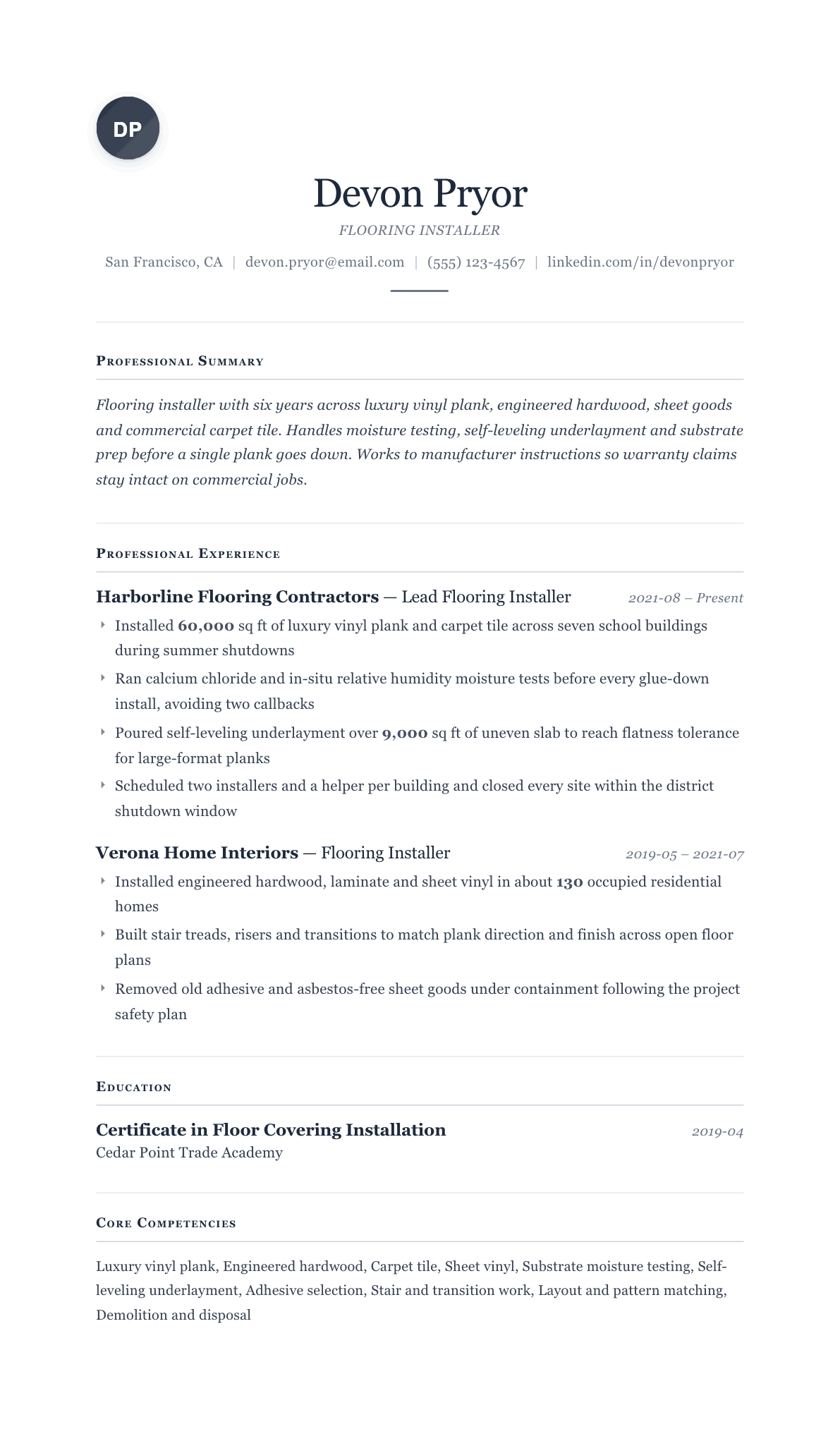
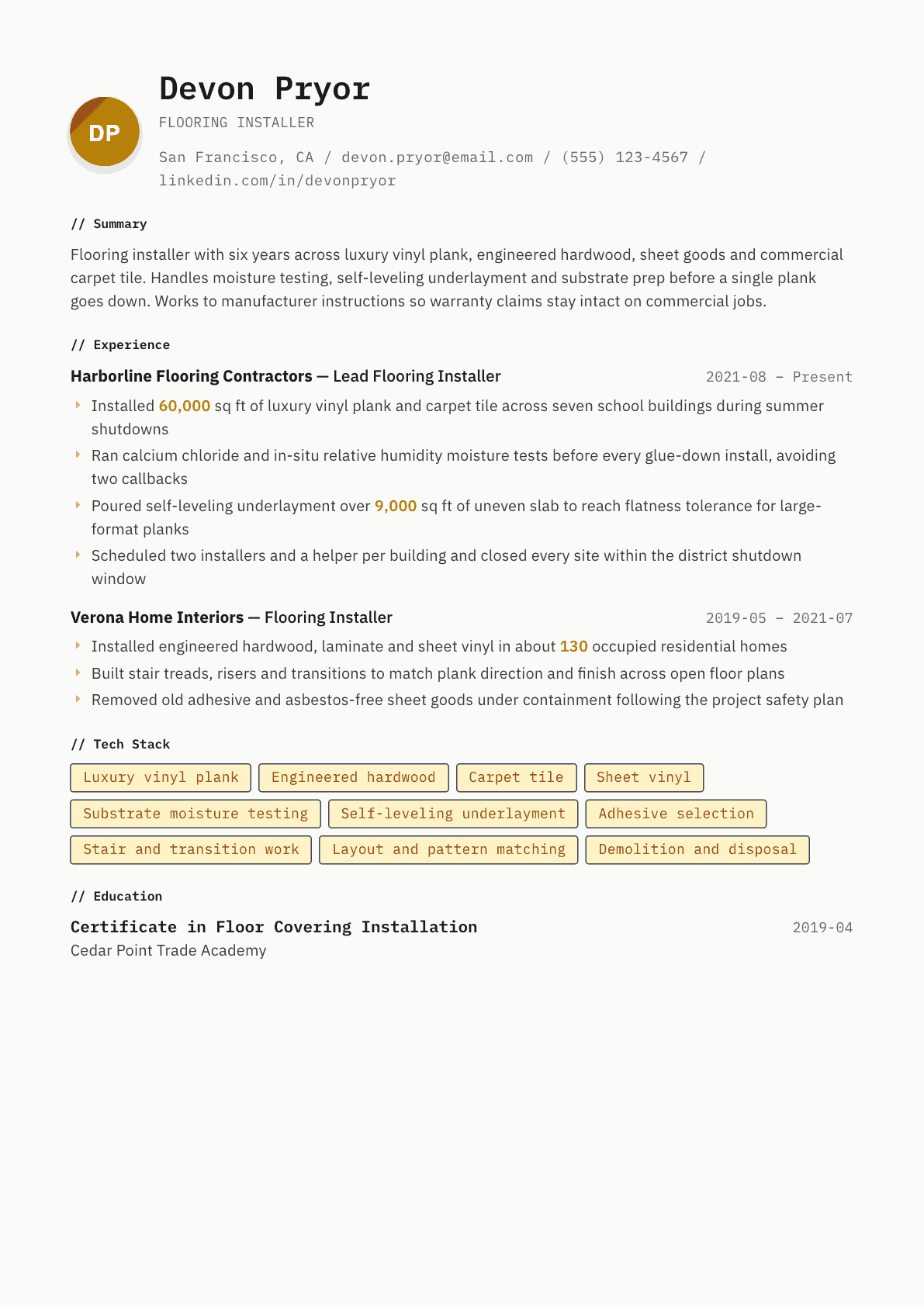
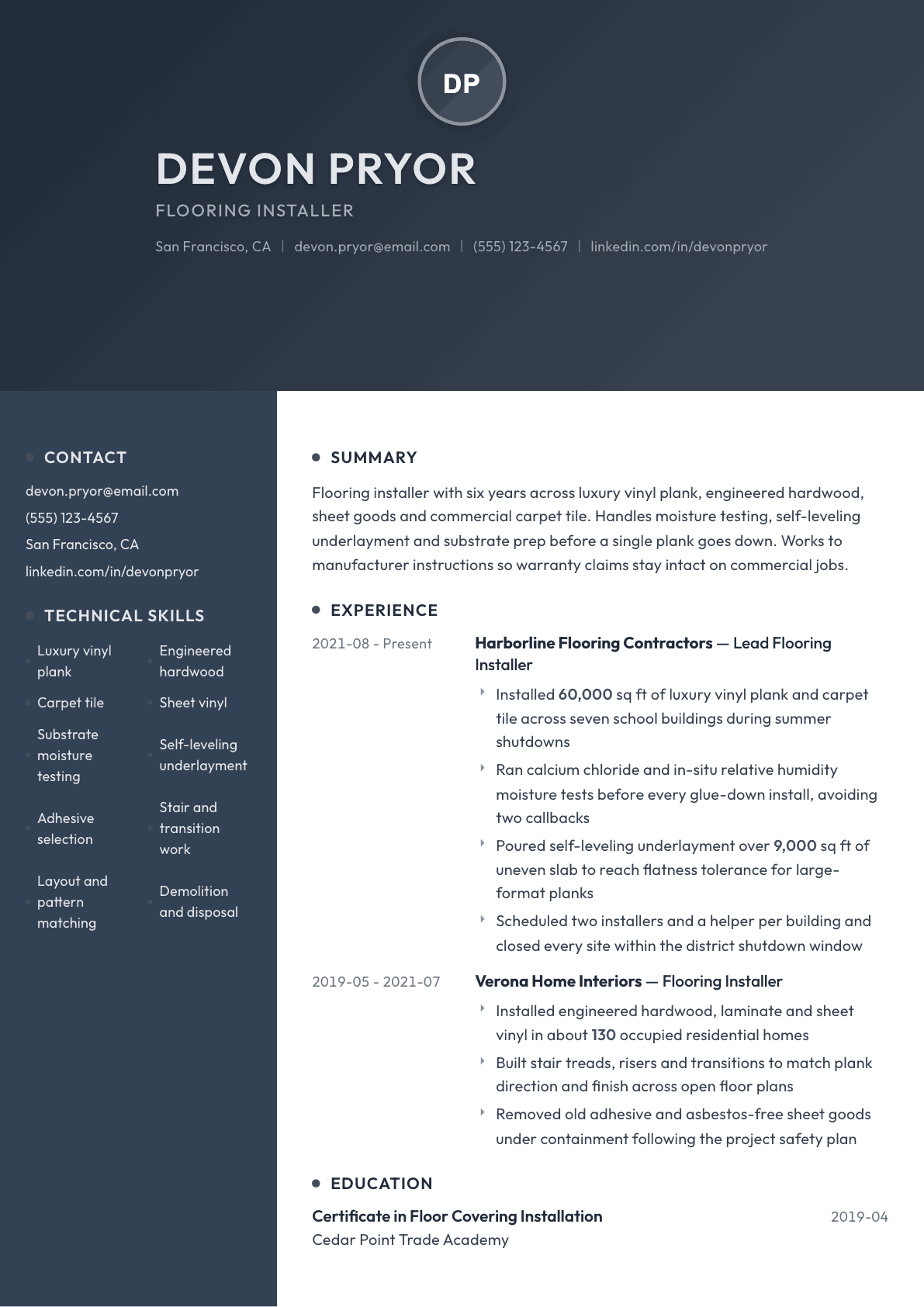
Example Flooring Installer summary
Flooring installer with six years placing luxury vinyl plank, engineered hardwood, sheet goods and carpet tile on commercial and residential jobs. Runs moisture testing and self-leveling underlayment so glue-down installs hold their warranty. Leads a small crew through occupied buildings and summer shutdown schedules, and finishes stairs, transitions and trim to match the specified pattern.
Skills to list on a Flooring Installer resume
- Luxury vinyl plank installation
- Hardwood installation and sanding
- Carpet and carpet tile
- Sheet vinyl and welded seams
- Laminate floating floors
- Subfloor preparation
- Moisture testing
- Self-leveling underlayment
- Adhesive and trowel selection
- Layout and dry lay
- Stair treads and nosing
- Transition and trim work
- Floor demolition
- Blueprint and finish schedules
- Job site protection
What actually gets this resume read
- List every product family you install, because a hardwood installer and a resilient installer are bid as different trades.
- Show substrate prep by name: grinding, patching, self-leveling underlayment and moisture mitigation systems.
- Give square footage per project so a project manager can size you against the scope on the next bid.
- Say which moisture tests you run, since glue-down failures on concrete slabs are the costliest callback in the trade.
- Name manufacturer certifications or training, as warranty-backed commercial installs often require a certified installer.
- Separate occupied residential work from new commercial construction, since scheduling and protection differ entirely.
How to write a flooring installer resume
The person hiring a flooring installer has been burned before. Somewhere in his history is a glue-down job that bubbled six weeks after handover, a plank floor that telegraphed every dip in the slab, and an invoice he had to eat. So when he reads your resume he is looking for one thing above craft: evidence that you prepare the substrate properly and follow the manufacturer instructions that keep a warranty alive.
The second thing he wants is range. Flooring is not one trade. Resilient, hardwood, carpet, sheet goods and specialty coatings each have their own tools, adhesives, tolerances and failure modes, and a company bidding a mixed scope needs to know which of those you can be sent to alone.
This guide covers how to structure the resume, what belongs in each section, three summaries at different career stages, before and after bullets, and the questions installers ask when they finally sit down to write the thing.
Format: one page, product families up front
Keep it to a single page, reverse-chronological, plain layout. A flooring contractor will scan it in under a minute on a phone in a truck, so the top third has to carry the product families you install and the settings you have worked in. Everything below that is proof.
Include your city, your travel radius, whether you have your own van and tools, and whether you carry insurance if you have ever worked as a subcontractor. Those practical facts often decide who gets called first on a Monday when a crew falls short.
- Header: name, trade, city and state, phone, email, travel radius, own tools and transport.
- Order: summary, product families, work history with projects, prep and testing skills, certifications.
- Subcontractors add a line on insurance and business registration near the header.
Summary: which materials, which settings, who prepped the slab
Three lines. Name the products you install, the settings, and the prep you handle yourself. An installer who does his own moisture testing, grinding and self-leveling is worth more than one who needs a prep crew ahead of him, and that difference belongs in the first sentence.
If you specialize, say so rather than listing everything. A hardwood installer who sands and finishes on site is a specific hire, and burying that under a general flooring claim wastes the strongest thing on the page.
Experience: square footage, substrate and schedule
For each employer, give the company, your title and the type of work, then bullets that carry a number. Square footage per project or per day is the currency here, because it tells an estimator how you fit a bid. Add the building type, since a school on a summer shutdown, an occupied apartment turn and a new retail buildout are three different working conditions.
Substrate work deserves its own bullet on any commercial job. Grinding and shot blasting, patching, self-leveling pours, moisture mitigation coatings, and the tests you ran before you committed adhesive. This is the part of the trade that separates an installer who gets warranty work from one who does not.
Do not write installed flooring for residential and commercial customers. It describes the job title, not the work, and every applicant in the stack has written some version of it.
- Square footage or unit count, plus the calendar window you had to do it in.
- The substrate condition you inherited and what you did about it.
- The adhesive or fastening method and the trowel or fastener schedule you followed.
- Any coordination with tile setters, painters or millwork crews at transitions.
Prep, testing and tools: the section that wins bids
Give moisture testing its own line and name the methods: calcium chloride, in-situ relative humidity probes, and pH testing on concrete. Then list the prep equipment you operate, from planetary grinders and shot blasters to ride-on scrapers and mixing stations for self-leveler.
Add the install tools that mark experience: hot air and hot wedge welders for sheet vinyl seams, power stretchers and kickers for carpet, flooring nailers and cleat guns for hardwood, big roller weights, and the saws you use for scribing and undercutting door casings.
Keywords a flooring contractor searches for
Mirror the vocabulary of the postings you are answering. Luxury vinyl plank, resilient sheet, heat welded seams, carpet tile, broadloom, engineered hardwood, solid nail-down, floating floor, underlayment, moisture mitigation, transition strips, flatness tolerance, finish schedule. Use each once where it is true and once inside a bullet that proves it.
Flooring Installer resume summary examples
Apprentice installer
Flooring apprentice with eighteen months on residential crews installing laminate, luxury vinyl plank and carpet. Trained on layout, undercutting casings, trowel selection and transition strips. Handles demolition, subfloor patching and site protection independently, and is working toward running small jobs alone.
Five years in
Flooring installer with five years across resilient, engineered hardwood and carpet tile on commercial and residential work. Runs his own moisture testing and self-leveling prep, welds sheet vinyl seams, and finished twelve school buildings inside two summer shutdown windows without a callback.
Lead installer and crew leader
Lead flooring installer with thirteen years and a manufacturer certification, leading crews of four through hospital, retail and multifamily projects. Owns substrate assessment, moisture mitigation and adhesive selection on every job, trains new installers, and handles warranty inspections for the company.
Work experience bullets: before and after
Before: Installed vinyl and carpet in commercial buildings.
After: Installed roughly sixty thousand square feet of luxury vinyl plank and carpet tile across seven school buildings inside a nine-week summer shutdown.
Area, product and calendar window together let a project manager judge whether you can hold their schedule.
Before: Prepared the floor before installing.
After: Ground and patched slab high spots, then poured self-leveling underlayment over about nine thousand square feet to reach the flatness tolerance large-format plank required.
The specific prep sequence proves you understand why plank telegraphs a bad slab, which is what a contractor is really testing for.
Before: Checked for moisture in the concrete.
After: Ran in-situ relative humidity probes and calcium chloride tests on every glue-down slab, holding the install until readings met the adhesive manufacturer limit.
Naming the test methods and the decision you made with the result shows judgment rather than a box being ticked.
Before: Did stairs and trim work.
After: Built stair treads, risers and nosings to match plank direction across three open floor plans, scribing transitions at every doorway and fireplace hearth.
Stairs are the hardest visible detail in the trade, so describing them concretely signals finish quality better than the word quality would.
Before: Worked in homes while people were living there.
After: Completed installs in about a hundred and thirty occupied homes, protecting adjacent finishes, containing dust during demolition and leaving each space usable the same evening.
Occupied work is a separate skill, and describing how you managed it tells a residential contractor you will not generate complaints.
Hard skills
- Luxury vinyl plank and tile installation
- Resilient sheet vinyl and heat welded seams
- Engineered and solid hardwood installation
- On-site sanding and finishing
- Carpet tile and broadloom installation
- Laminate and floating floor systems
- Concrete moisture testing
- Self-leveling underlayment
- Grinding, shot blasting and patching
- Adhesive and trowel selection
- Layout, dry lay and pattern matching
- Stair treads, nosings and transitions
- Floor demolition and adhesive removal
- Finish schedule and plan reading
Soft skills
- Working cleanly around occupants
- Scheduling around other trades
- Problem solving on bad substrates
- Customer communication on site
- Training junior installers
Certifications worth listing
- NWFA Certified Installer (National Wood Flooring Association)
- INSTALL Floorcovering Installer Certification (INSTALL)
- OSHA 10-Hour Construction (OSHA Outreach Training Program)
Mistakes that cost flooring installer candidates the interview
- Listing products without settings, so a reader cannot tell whether the work was a spare bedroom or a hospital corridor.
- Omitting substrate preparation entirely, which is the single area a commercial flooring contractor worries about most.
- Claiming every product family at once, which reads as inexperience rather than range unless each one has a project attached.
- Forgetting to mention moisture testing on glue-down work, since that omission suggests you have never owned a failed slab.
- Writing about attention to detail instead of describing stairs, seams, borders or transitions where detail is visible.
- Leaving out manufacturer training, which is often required before a company can offer a warranty-backed commercial install.
Flooring Installer resume questions
How much square footage should I put on a flooring installer resume?
Give a figure for two or three of your largest projects and, if you can, a typical daily output for the product you install most. Those numbers let an estimator match you to a bid, which is the fastest route from resume to phone call.
Do manufacturer certifications actually matter for flooring work?
They matter most on commercial jobs where the owner wants an extended warranty, because many manufacturers will only back an install done by a trained installer. On residential work they matter less, but they still separate you from applicants with no verifiable training at all.
Should I list every product I have ever installed?
List the families you would happily be sent to alone, and attach at least one project to each. A long list with nothing behind it invites a working interview you may not want, while a focused list with proof reads as an installer who knows his own limits.
How do I write a flooring resume if most of my work was as a subcontractor?
Treat your own business as the employer and list the general contractors, builders or retailers you installed for underneath. Add a line on insurance, registration and crew size, because a company hiring a sub cares about those before it cares about craft.
What belongs in the skills section that is not just a product list?
Put the prep and testing work there: moisture testing methods, grinding and shot blasting, self-leveling, adhesive selection and seam welding. Those are the abilities that decide whether a job holds up, and most applicants leave them off entirely.
Related resume examples
- Carpenter Resume example
- Tile Setter Resume example
- Painter Resume example
- Finish Carpenter Resume example
- Drywall Installer Resume example
- Carpenter Apprentice Resume example