Cabinet Maker Resume Examples: free ATS score and gap list
Write a Cabinet Maker Resume That Shows Shop Craft
By Mustafa Tarabya, founder of CVBooster · Published · Updated
Cabinet maker resume examples covering casework construction, CNC and machine work, finishing and the keywords custom shops screen for.
Sample resumes for a cabinet maker
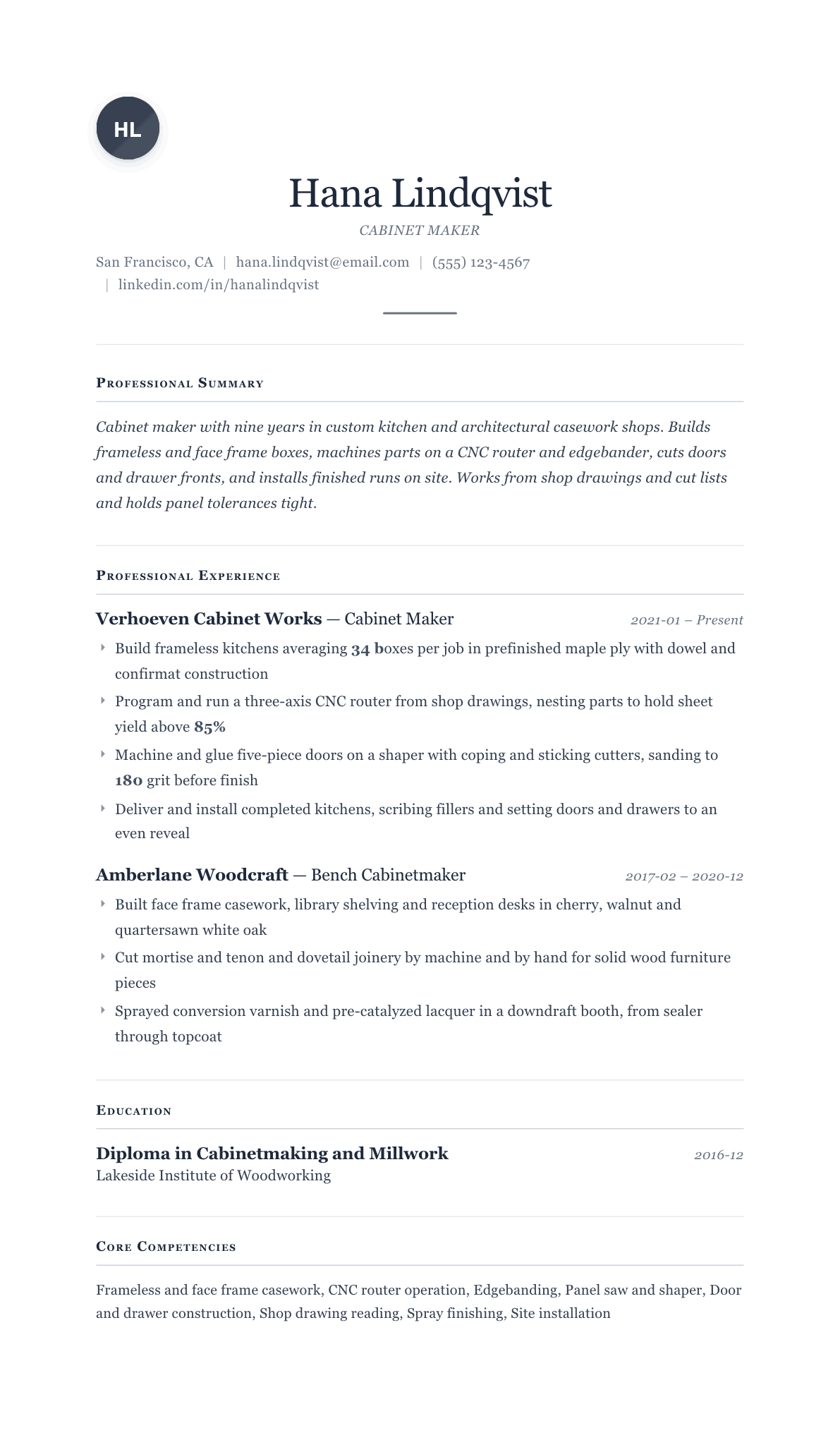
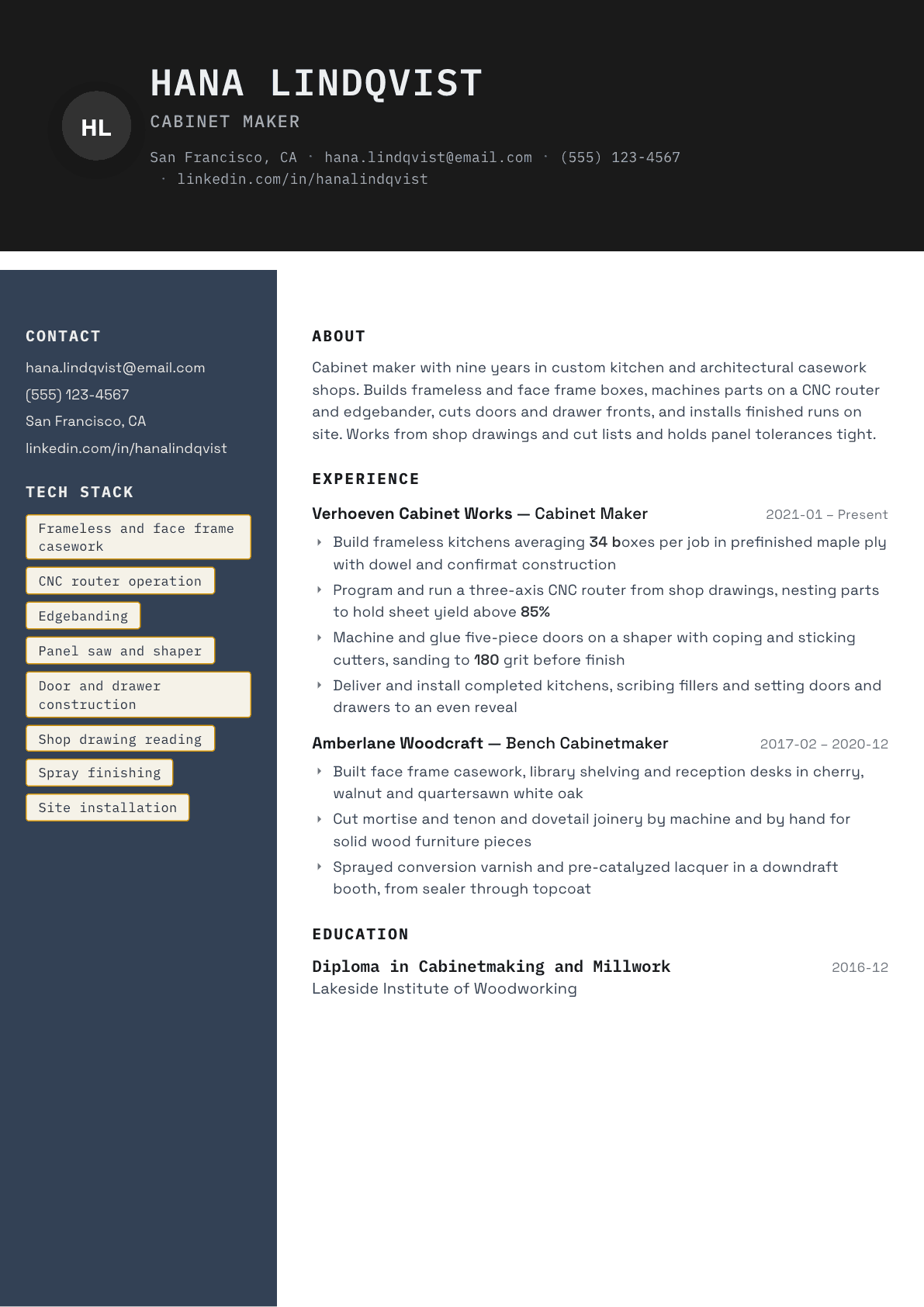
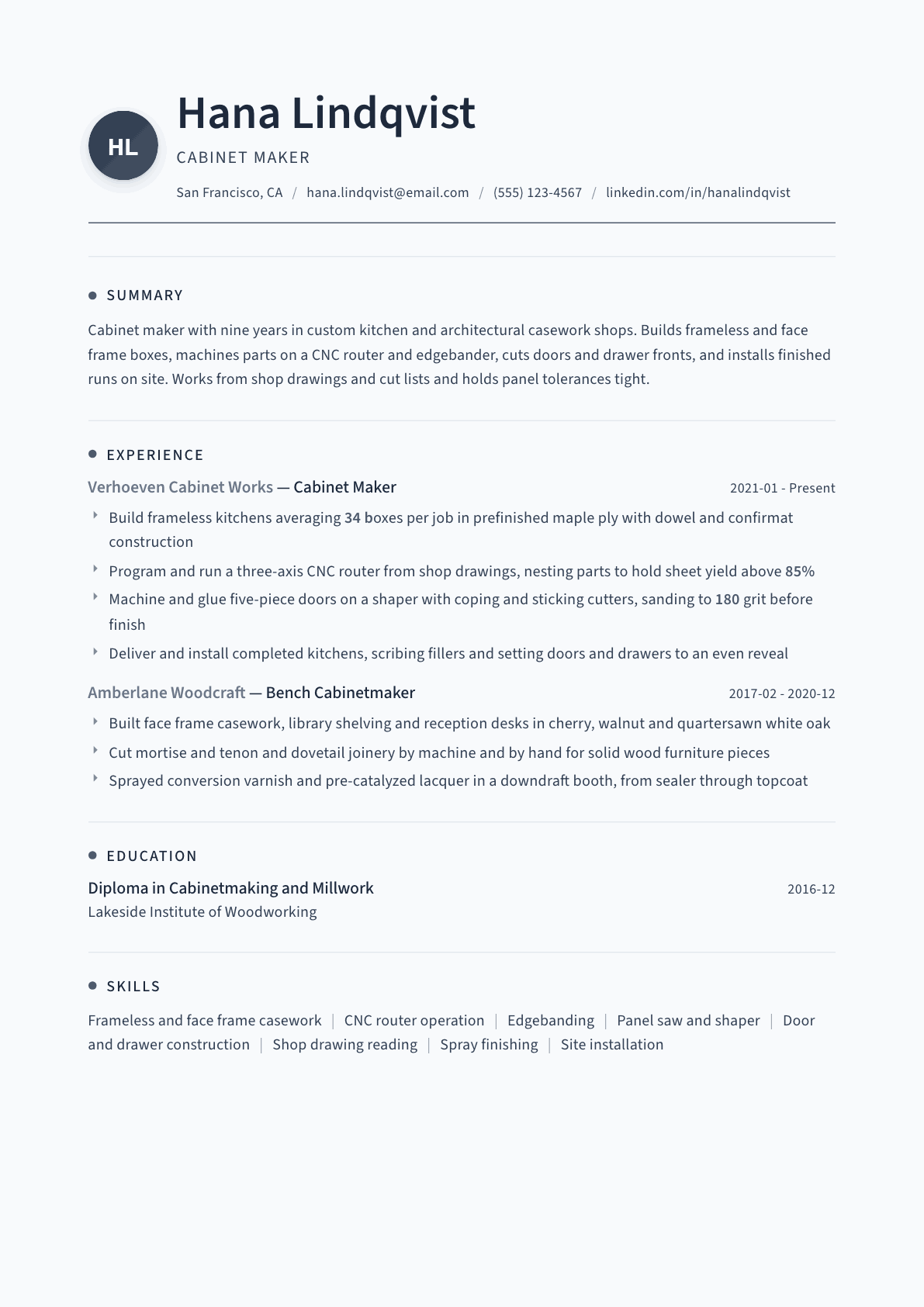
The same cabinet maker content laid out in three CVBooster templates, so you can see what the finished document looks like before you write a word.
Example Cabinet Maker summary
Cabinet maker with nine years in custom kitchen and architectural casework shops. Builds frameless and face frame boxes, programs and runs a three-axis CNC router from shop drawings, machines five-piece doors on a shaper, and sprays conversion varnish. Also delivers and installs finished runs, scribing to site conditions and setting even reveals. Looking for a shop doing custom work rather than repeat catalog boxes.
Skills to list on a Cabinet Maker resume
- Frameless casework
- Face frame casework
- CNC router operation
- Nesting and cut lists
- Edgebanding
- Panel saw and sliding table saw
- Shaper and router table
- Door and drawer box construction
- Dovetail and mortise joinery
- Hardware and hinge boring
- Spray finishing
- Shop drawing reading
- Cabinet Vision
- Site installation and scribing
- Wood species and veneer matching
What actually gets this resume read
- Say which construction systems you build, frameless or face frame, and which joinery method each shop used.
- List the machines you set up and run yourself, from panel saw and edgebander to CNC router and wide belt sander.
- Name the software you draw or program in, such as Cabinet Vision, Microvellum, SketchUp or a CAM package.
- Separate bench work, machine work, finishing and installation, because shops hire into one of those seats.
- Include the materials and species you handle, from prefinished ply and thermofoil to walnut and quartersawn oak.
- Add a portfolio link with photos of completed kitchens or casework, since shops hire from pictures first.
How to write a cabinet maker resume
A cabinet maker resume is read by a shop foreman or an owner who is trying to fill one seat. Shops are organized into stations, and each station hires differently: machine room, bench assembly, doors, finishing, and delivery and installation. A resume that says cabinetmaking without saying which stations you can run leaves the reader guessing, and a busy shop will move on to the applicant who answered the question.
The second thing a shop weighs is construction system and software. Frameless casework built from a nested cut list on a router is a different production world from face frame boxes built at a bench, and shops that draw in a cabinet design package want someone who can already open their files. Naming both puts you ahead of most applicants immediately.
This guide covers the station-by-station structure that works for cabinet makers, how to describe shop work so a foreman can price it, three summaries from bench helper to lead, before and after bullets, and the questions that come up when a woodworker with real skill writes a thin resume.
Format: one page, stations and systems up front
One page is standard, with a portfolio link in the header. Keep the layout plain and reverse chronological. Under your contact details, add a capability line naming the stations you can run and the construction systems you build, such as frameless and face frame, and the joinery methods you use for each.
That capability line matters more here than a summary paragraph. A shop with an open machine room seat and a shop with an open bench seat are reading the same resume looking for different words, and the line answers both in a single pass.
- Header: name, city and state, phone, email, portfolio link.
- Capability line: stations run, construction systems, joinery methods, software.
- Then experience by shop, machines operated, education and training, skills.
Experience: product, volume and construction method
Give every shop the kind of product it makes: custom kitchens, architectural casework for offices and clinics, retail fixtures, furniture, or a mix. Then say what you built and how much of it. Boxes per job, linear feet of casework, doors machined per week, or jobs completed per month are all figures a foreman uses to judge throughput.
Construction method belongs in the same breath. Dowel and confirmat assembly, dado and rabbet, pocket screw face frames, mortise and tenon for solid wood, dovetailed drawer boxes, and the edgebanding and hardware systems you use. Two cabinet makers with identical years can build in completely different ways, and the method decides whether you can start without retraining.
If you install as well as build, treat that as its own group. Delivery, scribing fillers, setting boxes level on an uneven floor, adjusting doors and drawers to an even reveal, and fitting countertop substrate are separate skills that many bench-only makers do not have.
Machines, software and setup ability
The distinction that matters is between running a machine and setting one up. Say which you do for each: panel saw or sliding table saw, edgebander with its glue and trim stations, wide belt sander, shaper with coping and sticking cutters, line boring machine, and a router with its tooling and vacuum hold-down. Setup ability is what a foreman is short of.
Software is worth its own line. Cabinet design and manufacturing packages that generate cut lists and machine code, plus drawing tools for shop drawings, both come up in postings. Name the packages you have used and whether you have drawn, nested or only run the output, because the honest version of that answer is checked in the first week anyway.
Materials, finishing and quality
Name the materials you handle: prefinished plywood, melamine and thermally fused panels, high pressure laminate, veneer, and the solid species you machine such as maple, cherry, walnut and quartersawn oak. Veneer and grain matching deserve a specific mention, since sequence matching a run of doors is a skill many shops have to hire for.
Finishing is a separate station and a separate hire. If you spray, say what: sealer and topcoat schedules, conversion varnish, pre-catalyzed lacquer, water-based finishes, and whether you work in a booth with a specific gun setup. Add the sanding sequence you follow, because finish quality is decided before the first coat.
Keywords a cabinet shop searches on
Shops search on concrete terms: cabinet maker, frameless, face frame, casework, millwork, router, edgebander, panel saw, shaper, line boring, cut list, nesting, dovetail, doors, drawer boxes, spray finishing, installation. Attach each to a product you actually built. A list of machine names with no product behind it reads as a tour rather than a trade.
Cabinet Maker resume summary examples
Bench helper
Woodworker with two years in a custom shop, assembling face frame boxes, cutting parts on a panel saw to a printed cut list, edgebanding by hand and machine, and sanding to finish grade. Comfortable reading shop drawings and keeping a bench organized for the next job.
Nine years, machine and bench
Cabinet maker with nine years in custom kitchen and architectural casework shops. Builds frameless and face frame boxes, programs and runs a three-axis router from shop drawings, machines five-piece doors on a shaper, and delivers and installs completed kitchens on site.
Lead cabinet maker
Lead cabinet maker running a four-person shop floor across machine room, bench and finishing. Draws and nests jobs from architectural drawings, sets up the edgebander and shaper for each run, sequences veneer for door and panel runs, and trains new hires on the shop construction standard.
Work experience bullets: before and after
Before: Built kitchen cabinets for customers.
After: Built frameless kitchens averaging 34 boxes per job in prefinished maple plywood using dowel and confirmat construction, from cut list through hardware installation.
Box count, material and the assembly system tell a foreman what you produce and how fast you can produce it.
Before: Operated the CNC router.
After: Programmed and ran a three-axis router from shop drawings, nesting parts to hold sheet yield above 85% and swapping tooling for dados, hinge boring and part labeling.
Programming, yield and tool changes distinguish someone who sets the machine from someone who presses start.
Before: Made cabinet doors.
After: Machined and glued five-piece doors on a shaper with matched coping and sticking cutters, then sanded to a consistent grit before the doors moved to finishing.
Naming the cutter setup and the sanding handoff shows a door process rather than a general woodworking claim.
Before: Installed the cabinets at the customer house.
After: Delivered and installed completed kitchens, scribing fillers to out-of-plumb walls, leveling boxes on uneven floors, and setting doors and drawers to an even reveal before signoff.
Installation problems named specifically prove you can finish a job in the field, not only in the shop.
Before: Did the finishing work too.
After: Sprayed conversion varnish and pre-catalyzed lacquer in a downdraft booth from sealer through topcoat, scuffing between coats and controlling overspray on veneer faces.
The products, the booth and the between-coat step describe a finishing schedule a shop can rely on.
Hard skills
- Frameless and face frame casework
- Router programming and nesting
- Panel saw and sliding table saw
- Edgebander operation and setup
- Shaper, router table and tooling
- Line boring and hardware installation
- Door and drawer box construction
- Dovetail, dowel and mortise joinery
- Veneer and grain sequence matching
- Spray finishing and sanding schedules
- Shop drawing and cut list reading
- Delivery, scribing and site installation
Soft skills
- Setup precision
- Working to a shop standard
- Material yield awareness
- Training new bench hands
- Care with finished surfaces
Certifications worth listing
- Sawblade Certificate (Woodwork Career Alliance of North America)
- OSHA 10-Hour General Industry (OSHA Outreach Training Program)
- Carpentry Level 2 (NCCER)
Mistakes that cost cabinet maker candidates the interview
- Not naming the stations you can run, which leaves a shop unable to match you to the seat that is actually open.
- Listing machines without saying whether you set them up, when setup ability is what most shops are short of.
- Leaving out the construction system, so a frameless shop cannot tell whether you would need retraining.
- Skipping software when many shops now draw, nest and machine from one package and hire on that basis.
- Sending no photographs in a trade where the work is judged by looking at a finished kitchen or casework run.
- Treating installation as an afterthought when many shops need one person who can both build and set the job.
Cabinet Maker resume questions
Should a cabinet maker resume mention specific machine brands?
Name the machine type first and the brand second, and only when the brand implies a control system a shop would recognize. What a foreman needs to know is whether you set up the machine and change tooling yourself.
Do I need design software experience to get hired?
Not everywhere, but it widens the search considerably. Shops that draw and nest in one package prefer someone who can open a job file. If you have only run the output, say that honestly rather than implying you draw.
How do I show quality on a cabinet maker resume?
Use measurable habits: sheet yield, sanding grit before finish, reveal consistency after installation, and how many jobs came back for adjustment. Those beat any adjective, and a shop owner recognizes each one immediately.
Is furniture making experience useful for a cabinet shop?
Yes, particularly for the joinery and the solid wood machining. Name the joints you cut and the species you work in, then connect them to casework tasks such as five-piece doors, face frames and solid edge treatments.
Should I include installation work if the job is bench only?
Keep one short line. It shows you understand how a box behaves in a real house, which affects how you build, and it makes you useful on the weeks the shop is short a delivery hand.
Related resume examples
- Carpenter Resume example
- Construction Worker Resume example
- Finish Carpenter Resume example
- Framer Resume example
- Glazier Resume example
- Masonry Worker Resume example