Travel Nurse Resume Examples: free ATS score and gap list
Format a Travel Nurse Resume Recruiters Can Submit Fast
By Mustafa Tarabya, founder of CVBooster · Published · Updated
Travel nurse resume example showing how to list short contracts, licenses, EMR systems and float experience without looking like a job hopper.
Sample resumes for a travel nurse
The same travel nurse content laid out in three CVBooster templates, so you can see what the finished document looks like before you write a word.
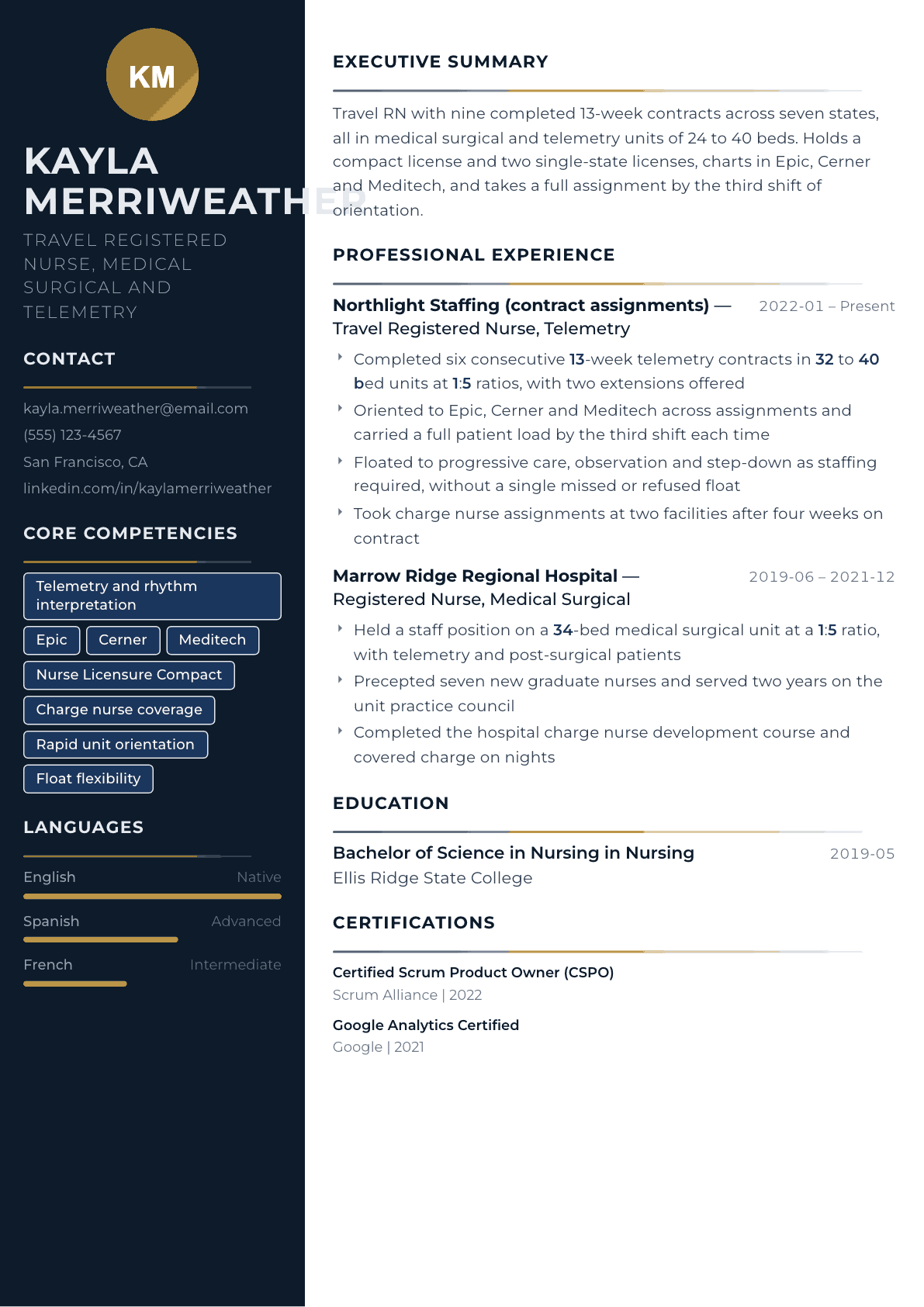
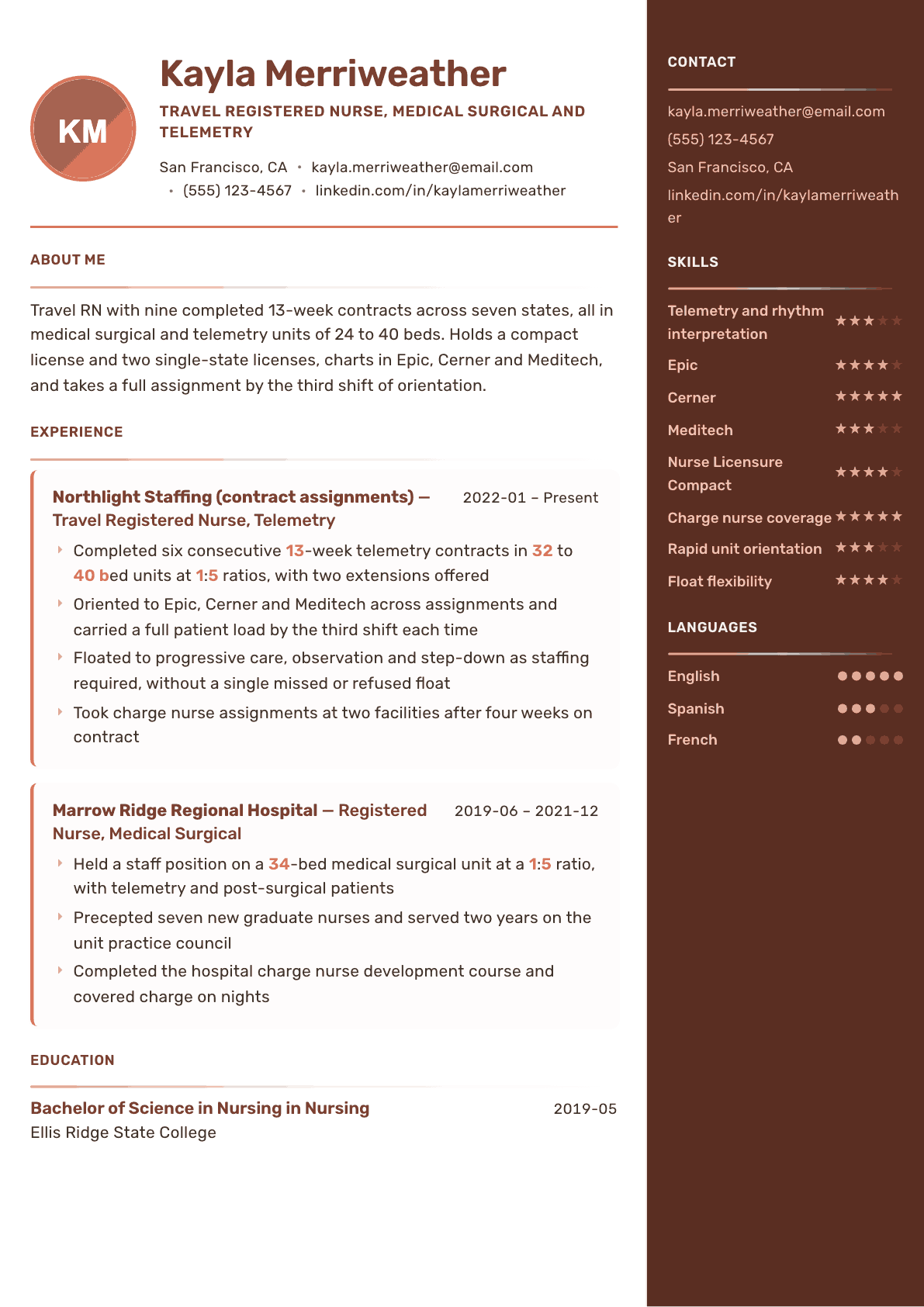
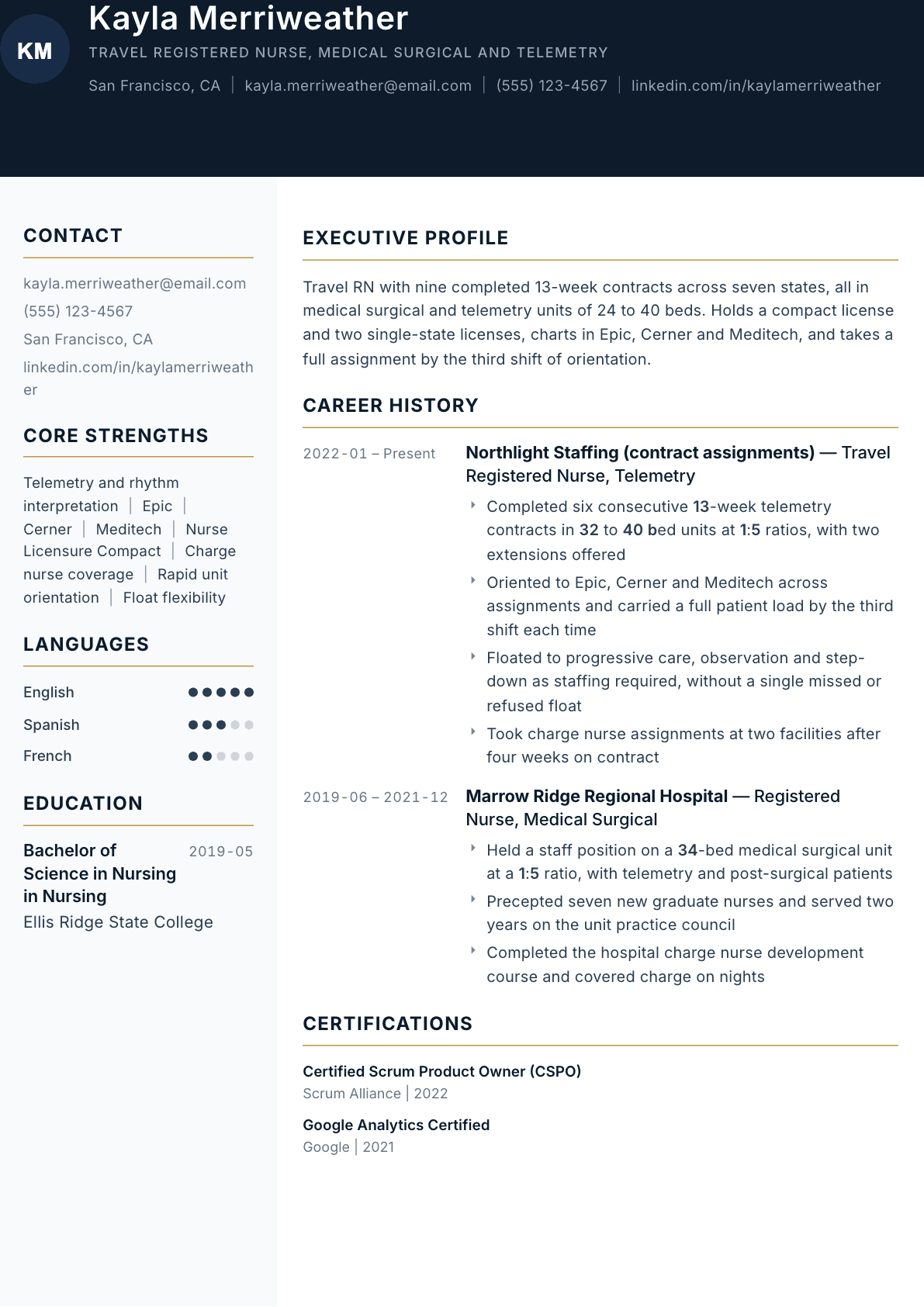
Example Travel Nurse summary
Travel nurse with nine completed thirteen-week contracts in seven states, all medical surgical and telemetry units between 24 and 40 beds. Holds a compact license, charts fluently in Epic, Cerner and Meditech, floats without complaint, and takes a full assignment by the third shift of orientation. Two facilities offered extensions and two used me in charge. Available for crisis and rapid-start contracts.
Skills to list on a Travel Nurse resume
- Telemetry monitoring
- Medical surgical nursing
- Rhythm interpretation
- IV therapy and blood administration
- Wound care
- Epic
- Cerner
- Meditech
- Charge nurse coverage
- Rapid orientation and float readiness
- Discharge planning
- Nurse Licensure Compact
- Patient education
- ACLS resuscitation
What actually gets this resume read
- Group contracts under the agency name with each facility, unit, bed count and ratio underneath, so short dates read as assignments.
- List every active license with the state and expiration, and say plainly whether you hold a compact multistate license.
- Name each electronic record you have charted in, because recruiters submit on the EMR match more than on anything else.
- Give bed counts, ratios and unit types for every assignment, since travel managers hire on acuity fit alone.
- State how quickly you take a full assignment after orientation, because that is the entire promise of a traveler.
- Keep certifications current and dated on the page, because an expired ACLS card stops a submission cold.
How to write a travel nurse resume
A travel nurse resume has a different job from a staff resume. It is not read once by a hiring manager, it is read first by an agency recruiter who has to submit you inside a few hours, then skimmed by a facility manager comparing several profiles at once. That means the file has to be complete, current and scannable, because a missing license expiration or an unnamed electronic record can stall a submission long enough for the contract to fill.
The second problem is presentation. Thirteen-week assignments look like job hopping to anyone reading the layout carelessly. Grouping contracts under the agency, with each facility, unit, bed count and ratio nested underneath, turns what looks like instability into a record of successful placements.
This guide covers how to structure contract history, what belongs in the license and certification block, how to make unit acuity comparable across facilities, and the questions travelers ask when they take a first contract or move back into a staff position.
Structure: agency as employer, contracts as assignments
List the agency as the employer and each contract as a nested assignment. Under the agency line, give the facility name or type, the city and state, the unit, the bed count, the ratio and the contract dates. A reader then sees one continuous period of work with a series of placements rather than six unrelated jobs in two years.
When you have worked through several agencies, keep them chronological and let the contracts sit under each. Do not reorder assignments to hide a gap, because credentialing will surface every date anyway.
- Agency name and the period you worked through it.
- Each assignment: facility type, city and state, unit, bed count, ratio, dates.
- Group staff positions separately and clearly, above or below the contract block.
- Note extensions offered, since an extension is the strongest reference a traveler has.
Licenses and certifications: the part that stalls submissions
Build a block listing every active license with the state and the expiration month, and say plainly whether you hold a multistate license through the Nurse Licensure Compact and which state is your primary residence. Recruiters filter on compact status before anything else, because a compact license means you can start in a covered state without waiting for an endorsement.
List every certification with the expiration month attached. An expired advanced life support card is one of the most common reasons a submission stops, and dates on the page let the recruiter confirm compliance without a round of emails. Add the extras that travel assignments often require, such as trauma nursing courses, hazardous materials training or a stroke certification.
Unit acuity: make assignments comparable
Facilities differ wildly, so give every assignment the same set of facts: unit type, bed count, nurse to patient ratio, and the patient population. A travel nurse who says she held 1:5 on 32 to 40 bed telemetry units has drawn a straight comparison line across six contracts.
Add the things that only travelers can claim: floating to progressive care, observation or step-down as staffing required, taking charge after a few weeks on contract, and covering holiday and night blocks. Managers hire travelers precisely because they will float and cover, and evidence that you already do is the strongest selling point on the page.
Electronic records and orientation speed
Name every charting system you have used, because recruiters match submissions on the record system almost as often as on the unit type. Epic, Cerner, Meditech, Allscripts and CPSI each carry their own workflow, and a nurse who already knows the one in place saves the facility days of orientation.
Then state your orientation pattern plainly: how many shifts you take before you carry a full assignment. That is the entire promise of the role, and putting a number on it, such as taking a full load by the third shift, tells a manager what she is buying.
Staff history, references and going back to permanent
Keep your staff experience visible. The years you spent in a permanent position are the foundation the contract work rests on, and they carry the precepting, committee and charge experience that contract assignments rarely produce. Present them as a separate block so the reader sees a stable base before the placements.
If you are moving back into a staff role, reframe the contract history as breadth: multiple electronic records, multiple facility cultures, fast adaptation, and no orientation cost to the new employer. Then name the reason you want to settle, because a manager will otherwise assume you will leave again in three months.
Travel Nurse resume summary examples
First contract
Registered nurse with two years of staff experience on a 34-bed medical surgical unit at a 1:5 ratio, now moving into contract work. Holds a compact multistate license, charts in Epic and Cerner, and has floated to observation and progressive care. Available for immediate thirteen-week assignments.
Nine contracts completed
Travel nurse with nine completed thirteen-week contracts in seven states, all medical surgical and telemetry units between 24 and 40 beds. Holds a compact license, charts fluently in Epic, Cerner and Meditech, floats without complaint, and takes a full assignment by the third shift of orientation.
Crisis and charge traveler
Critical care traveler with eighteen contracts across eleven states, including crisis response assignments and rapid-start placements. Carries intensive care assignments on arrival, has taken charge at four facilities, and holds compact licensure with three additional single-state licenses kept active for repeat clients.
Work experience bullets: before and after
Before: Worked several travel contracts at different hospitals.
After: Completed six consecutive thirteen-week telemetry contracts in units of 32 to 40 beds at 1:5 ratios, with two facilities offering extensions at the end of the term.
Contract count, unit size, ratio and extensions turn an unstable-looking history into a record of repeat success.
Before: Learned new computer systems quickly.
After: Oriented to Epic, Cerner and Meditech across assignments, completing system training and carrying a full patient load by the third shift at every facility.
Naming the systems and the shift count gives the recruiter the match criteria and the ramp time in one line.
Before: Floated to other units when needed.
After: Floated to progressive care, observation and step-down as staffing required, without a single refused float across nine contracts.
Float reliability is the specific behavior facilities buy travelers for, and the refusal record makes it verifiable.
Before: Sometimes acted as charge nurse.
After: Took charge nurse assignments at two facilities after four weeks on contract, running the board, admissions and break coverage for a 36-bed unit.
Naming the facilities involved, the timing and the duties shows trust earned quickly rather than an occasional favor.
Before: Held a staff nursing job before traveling.
After: Held a staff position on a 34-bed medical surgical unit for two and a half years, precepting seven new graduate nurses and serving on the unit practice council.
The staff block proves depth and teaching ability that short contracts cannot demonstrate on their own.
Hard skills
- Telemetry monitoring and rhythm interpretation
- Medical surgical nursing
- Intravenous therapy and blood administration
- Wound care
- Discharge planning
- Epic charting
- Cerner charting
- Meditech charting
- Charge nurse coverage
- Nurse Licensure Compact requirements
- Rapid unit orientation
- Float pool and cross-unit coverage
Soft skills
- Adapting to unfamiliar workflows
- Building rapport with a new team fast
- Asking for the right resource on day one
- Flexibility on shift and float assignment
- Independence away from a home unit
- Professional boundaries as an outsider
Certifications worth listing
- Basic Life Support (BLS) (American Heart Association)
- Advanced Cardiovascular Life Support (ACLS) (American Heart Association)
- Pediatric Advanced Life Support (PALS) (American Heart Association)
- Trauma Nursing Core Course (TNCC) (Emergency Nurses Association)
- Medical-Surgical Nursing Certification (MEDSURG-BC) (American Nurses Credentialing Center)
- PCCN (Progressive Care Nursing) (American Association of Critical-Care Nurses)
Mistakes that cost travel nurse candidates the interview
- Listing each contract as a separate employer, which makes a productive traveler look like a serial job leaver.
- Leaving license expiration months off, which stops a submission while the recruiter chases the dates.
- Failing to state compact license status, the single filter recruiters apply before they read anything else.
- Omitting the charting system for each assignment, when that is a primary matching criterion.
- Giving no bed counts or ratios, so a manager cannot judge whether your acuity matches her unit.
- Hiding the staff years that carry your precepting, charge and committee experience.
Travel Nurse resume questions
How do I keep thirteen-week contracts from looking like job hopping?
Group assignments under the agency as the employer and nest each facility, unit and date underneath. Add extensions offered and repeat placements at the same client, because both signal that facilities wanted to keep you past the original term.
How much staff experience do I need before traveling?
Most agencies and facilities look for at least a year in your specialty, and many prefer two, because a traveler is expected to carry a full assignment with minimal orientation. Put those staff years in their own block so the requirement is easy to verify.
Should I list every state I have been licensed in?
List active licenses with their states and expiration months, and note compact status and your primary state of residence. Lapsed licenses can go in a short line if they show geographic range, but never present an expired one as if it were current.
How do I go back to a staff position after traveling?
Reframe the contract history as breadth in electronic records, facility types and acuity, then state plainly why you want to settle in one place. Managers hire returning travelers readily, but they need a reason to believe you will stay past orientation.
What do agency recruiters look for first on a travel nurse resume?
License and compact status, current certifications with expiration dates, the specialty and unit type, the charting system, and the last two assignments. If those five are easy to find near the top, your file gets submitted while the contract is still open.