Restaurant Owner Resume Examples: the lines they read
Write a Restaurant Owner Resume That Proves Business Results
By Mustafa Tarabya, founder of CVBooster · Published · Updated
Build a restaurant owner resume with a full worked example, owner level keywords, and tips for showing food cost, labor and growth.
Sample resumes for a restaurant owner
The same restaurant owner content laid out in three CVBooster templates, so you can see what the finished document looks like before you write a word.
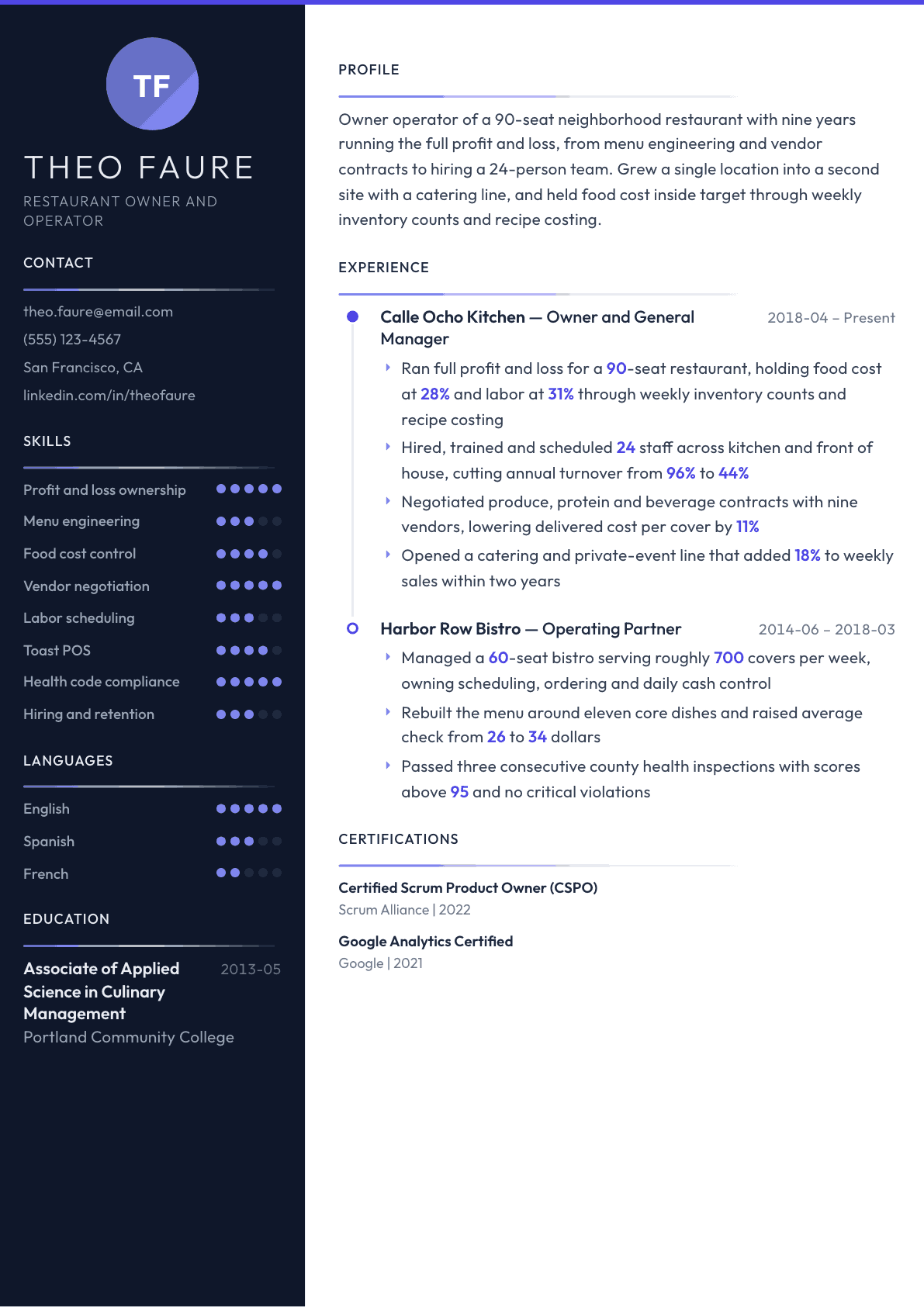
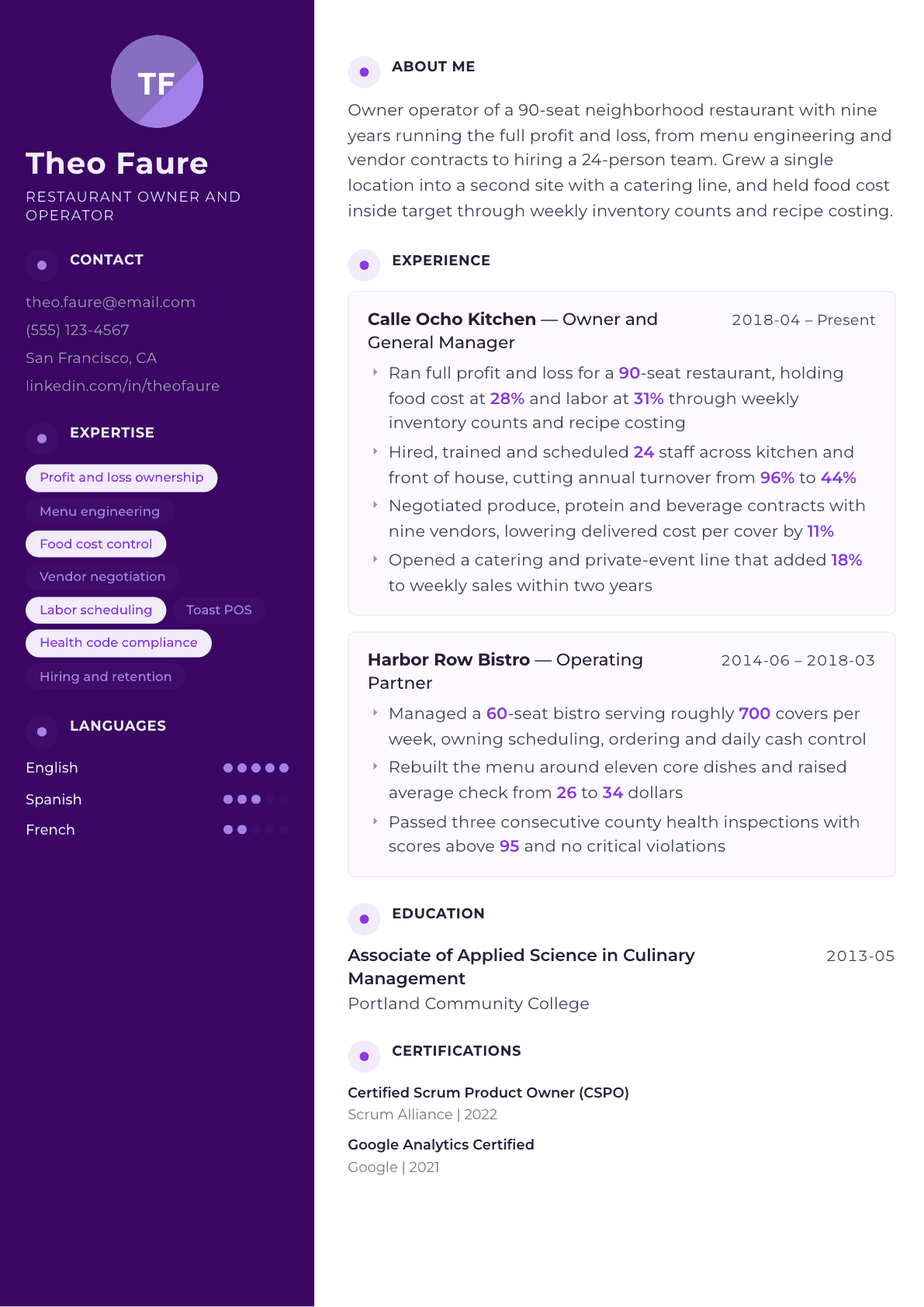
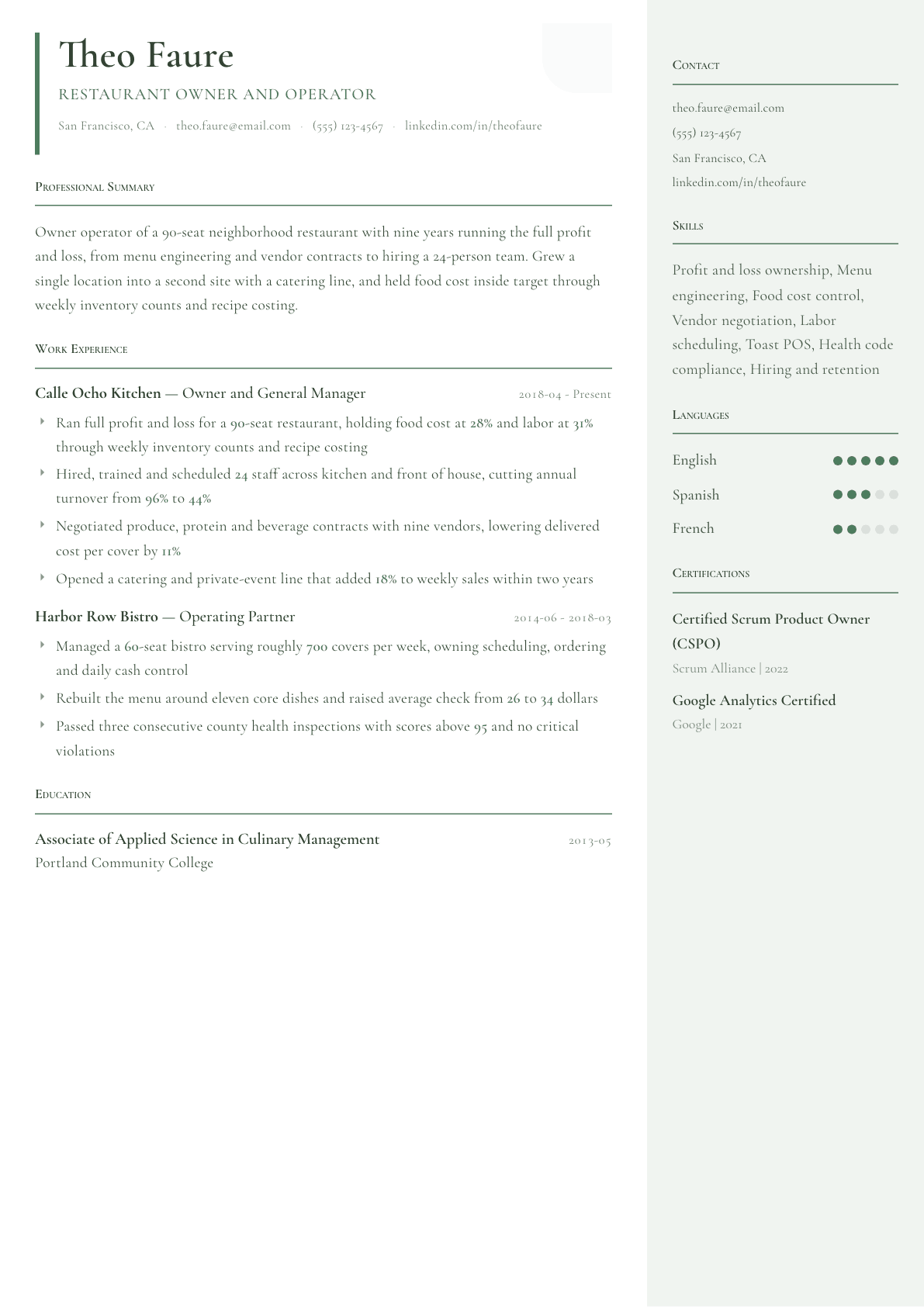
Example Restaurant Owner summary
Restaurant owner with nine years operating an independent 90-seat concept and a second catering site. Responsible for the entire profit and loss, including menu pricing, purchasing, payroll and lease negotiation, with food cost held near 28% and staff turnover cut by half. Comfortable moving between the line, the office and the dining room, and now looking for a multi-unit operations role.
Skills to list on a Restaurant Owner resume
- Profit and loss management
- Food cost control
- Labor cost control
- Menu engineering
- Vendor and supplier negotiation
- Inventory management
- POS systems
- Staff hiring and training
- Health and safety compliance
- Cash handling and reconciliation
- Marketing and community outreach
- Catering and events
- Payroll administration
- Scheduling
What actually gets this resume read
- Lead with profit and loss ownership: name the revenue band, the seat count, and the margin you held.
- Show food cost and labor cost as percentages, because those two lines are how operators judge every owner.
- Name the point of sale and inventory systems you ran, since a buyer or partner wants to see real reporting habits.
- If you are applying for a salaried role, translate ownership into management scope: headcount, covers, and units.
- Give health inspection outcomes and any liquor or food safety certification their own line near the top.
- Describe openings, closings and remodels as projects with dates, budgets and the result you delivered.
How to write a restaurant owner resume
A restaurant owner resume is unusual because the reader is rarely a recruiter. It is a multi-unit operator deciding whether you can run three of his stores, a franchisor screening you as a candidate operator, a lender reading the file behind a loan application, or a buyer weighing whether the business runs without you. Each of them opens the document looking for the same thing: proof that you controlled money, not just that you loved the work.
That proof is narrow and specific. Seat count, average check, weekly covers, food cost and labor cost as a share of sales, the direction those two lines moved while you held them, and what happened to the concept after you took it over. An owner who writes about passion for hospitality and leaves the operating lines out reads as someone who was present in the building rather than accountable for it.
This guide sets out the section order that operators expect from an owner file, how to translate ownership into employable management scope when you are applying for a salaried job, worked summaries at three stages, and rewritten bullets that turn a story about a restaurant into evidence about you.
Format: two pages, business results before duties
Reverse chronological, two pages, and the first third of page one carries the numbers. Owners often bury results under a paragraph about the concept, the neighborhood and the menu philosophy. Move the concept description down to one line under the job header and let the bullets carry the weight.
Give every venture a header line that reads like a business fact sheet: legal role, concept name, seats, service style, weekly covers or annual revenue band, and headcount. A reader who can see scope in one line will actually read the bullets underneath it.
- Header: name, city and state, phone, email, and the number of units you have opened or operated.
- Sections in this order: summary, operating results, ownership and management experience, openings and projects, certifications, education.
- Give an operating results block near the top when the numbers are strong enough to lead with.
- Keep the menu, the awards and the press to a short final section rather than mixing them into the bullets.
Summary: units, seats, revenue band, and the line you controlled
Four lines at most. Name what you own or ran, how long, the size in seats and staff, and one operating line you moved. Then say plainly what you want next, because owner resumes are ambiguous by nature and the reader cannot tell whether you are selling, expanding, or looking for a salaried job.
If you are moving from ownership into an employed role, address it in the summary rather than leaving the reader to guess. Operators worry that a former owner will not take direction. Naming the move, and the reason, removes that objection before the interview.
Experience: run the profit and loss down the page
Order your bullets the way an operator reads a statement. Sales first, then cost of goods, then labor, then the controllables, then the people and the guest result. Someone who reviews store numbers every Monday will follow that order without effort and will notice immediately if a line is missing.
Attach a mechanism to every number. Food cost moving is a claim; weekly inventory counts, recipe costing sheets, a price change on nine menu items and a switch of protein vendor is a method. Operators hire the method, because the method travels to a store they own and the number does not.
Treat openings, closings, remodels and menu relaunches as separate project bullets with a date range, a budget scale, and what you protected while it happened. A remodel finished without losing trading days is a stronger line than a remodel finished at all.
- One bullet on sales: revenue direction, average check, covers, and which day parts you grew.
- One bullet on cost of goods: the level you held, the counting rhythm, and the vendor work behind it.
- One bullet on labor: hours per cover or labor as a share of sales, plus how you scheduled to it.
- One bullet on people: headcount, turnover, and anyone you promoted into a management role.
- One bullet on compliance: health inspection scores, alcohol service records, and any audits you passed.
Translating ownership into management scope
When the target job is general manager, area manager or director of operations, rewrite ownership in the vocabulary of the role you want. A salaried operator is measured on units, headcount, covers and adherence to a system, so lead with those and let the equity story sit quietly in the job title.
Say which systems you built rather than which you inherited. Owners usually wrote their own opening checklists, prep lists, line checks, cash procedures and training paths. That is exactly the work a growing group needs, and it is invisible unless you name it.
Do not hide gaps between ventures. A closed restaurant with an honest line about why it closed and what it cost you to learn reads better than a two year hole. Operators have all closed something.
Systems, certifications and the keywords in owner postings
Name the point of sale, the inventory platform, the scheduling tool and the accounting package by name. Multi-unit postings screen on them, and an owner who can name the systems he reported in is far more credible than one who says he tracked everything closely.
Food safety manager certification belongs near the top for any hands-on role, and alcohol service certification belongs with it when the concept has a bar. Keep the certifying body and the state on the line, because both are checked.
The recurring phrases in operator postings are consistent: profit and loss ownership, food cost, labor cost, menu engineering, vendor negotiation, multi-unit operations, health code compliance, staff scheduling and catering. Mirror the ones that are true of you once in the summary and once inside a bullet where they are demonstrated.
Restaurant Owner resume summary examples
First venture, two years in
Owner operator of a 45-seat counter service concept opened from a shell space, running the full profit and loss alone for two years with a nine-person team. Built prep lists, recipe costing and a weekly count that held food cost at 30%. Now seeking a general manager role inside an established group.
Independent owner, nine years
Restaurant owner with nine years operating a 90-seat neighborhood concept and a second catering site, accountable for menu pricing, purchasing, payroll and lease terms. Held food cost near 28%, cut annual turnover from 96% to 44%, and added a private-event line worth 18% of weekly sales. Targeting a multi-unit operations role.
Multi-unit operator
Multi-unit restaurant owner and operator with four locations, 130 staff and a shared commissary, plus two brands taken from single site to franchise-ready. Built the training system, the recipe database and the weekly reporting pack now used across every unit. Looking for a director of operations seat in a growing group.
Work experience bullets: before and after
Before: Owned and operated a successful restaurant for nine years.
After: Owned and operated a 90-seat neighborhood restaurant for nine years, carrying full profit and loss responsibility for a 24-person team across kitchen and dining room.
Seats, years, headcount and the phrase profit and loss give the reader scope instead of an adjective.
Before: Kept food costs under control.
After: Held food cost at 28% through weekly physical inventory counts, recipe costing on every menu item, and a quarterly rebid of produce and protein across nine vendors.
The number is credible only once the counting rhythm and the vendor work behind it are visible.
Before: Hired and managed staff.
After: Hired, trained and scheduled 24 employees, rebuilt the onboarding path around a five-shift training plan, and brought annual turnover down from 96% to 44%.
Turnover moving in a named direction is the people metric an operator actually screens for.
Before: Grew the business and opened a second location.
After: Opened a second site and a catering line from the existing kitchen, adding 18% to weekly sales within two years without adding a second management layer.
Growth becomes evidence when the reader sees the vehicle, the timeline and what it cost to run.
Before: Maintained health and safety standards.
After: Passed six consecutive county health inspections with no critical violations by running documented line checks, daily temperature logs and a monthly self-audit against the inspection form.
Inspection outcomes plus the routine that produced them prove compliance rather than assert it.
Hard skills
- Profit and loss ownership
- Food cost control
- Labor cost control
- Menu engineering and pricing
- Recipe costing
- Vendor and supplier negotiation
- Inventory and par management
- Point of sale administration
- Payroll and scheduling systems
- Health code compliance
- Lease and contract negotiation
- Catering and private events
- Cash handling and reconciliation
- Marketing and community outreach
Soft skills
- Decision making under margin pressure
- Hiring judgment
- Conflict resolution with guests and staff
- Negotiation
- Delegation to department leads
- Composure during service
Certifications worth listing
- ServSafe Food Protection Manager Certification (National Restaurant Association)
- ServSafe Alcohol (National Restaurant Association)
- ServSafe Allergens (National Restaurant Association)
- Foodservice Management Professional (FMP) (National Restaurant Association)
Mistakes that cost restaurant owner candidates the interview
- Writing about the concept, the neighborhood and the menu philosophy instead of the operating lines you controlled.
- Leaving food cost and labor cost off entirely, which reads to an operator as a decision to hide them.
- Failing to say why you are leaving ownership, so the reader assumes the business failed.
- Listing every dish and award while omitting headcount, seats and covers.
- Skipping the systems you actually used, which makes the numbers unverifiable and the file generic.
- Presenting a closed unit as a gap in employment rather than a venture with dates and a lesson.
- Using an ornate two-column design that hides the job header lines a franchisor scans first.
Restaurant Owner resume questions
Should a restaurant owner put revenue on the resume?
Use a band rather than an exact figure: annual sales in the low seven figures, or weekly covers and average check. A band answers the scope question, keeps private numbers private, and still lets an operator place you against his own stores.
How do I write a resume when my restaurant closed?
Give it a normal job entry with real dates, then one honest line on the cause, such as a lease that reset or a location that never recovered its lunch trade. Follow it with what you changed as an operator afterward. Every experienced hirer has closed something.
Will an operator think a former owner cannot take direction?
Yes, unless you answer it first. Say in the summary that you want a system to run rather than one to invent, and include a bullet showing you followed an external standard, such as a franchise audit, a brand specification or a health department corrective plan.
What job title should I use if I owned the business?
Use the working title plus the ownership fact: Owner and General Manager, or Operating Partner. A bare Owner line makes the reader guess whether you ran service daily or held equity and visited on weekends, and guessing rarely goes your way.
Do I need food safety certification if I hire certified managers?
List it anyway. Most jurisdictions require a certified food protection manager on shift, and a hiring operator wants to know you can cover that requirement yourself. Include the certifying body, the certificate number if you have one, and the expiry.
Related resume examples
- Restaurant Manager Resume example
- Food & Beverage Director Resume example
- Restaurant General Manager Resume example
- Kitchen Manager Resume example
- Assistant Restaurant Manager Resume example
- Food and Beverage Manager Resume example