Food Production Worker Resume Examples: read this first
Write a Food Production Worker Resume Plants Trust
By Mustafa Tarabya, founder of CVBooster · Published · Updated
Food production worker resume example, keywords and guide covering batching, cook steps, critical control points, allergen changeover and sanitation logs.
Sample resumes for a food production worker
The same food production worker content laid out in three CVBooster templates, so you can see what the finished document looks like before you write a word.
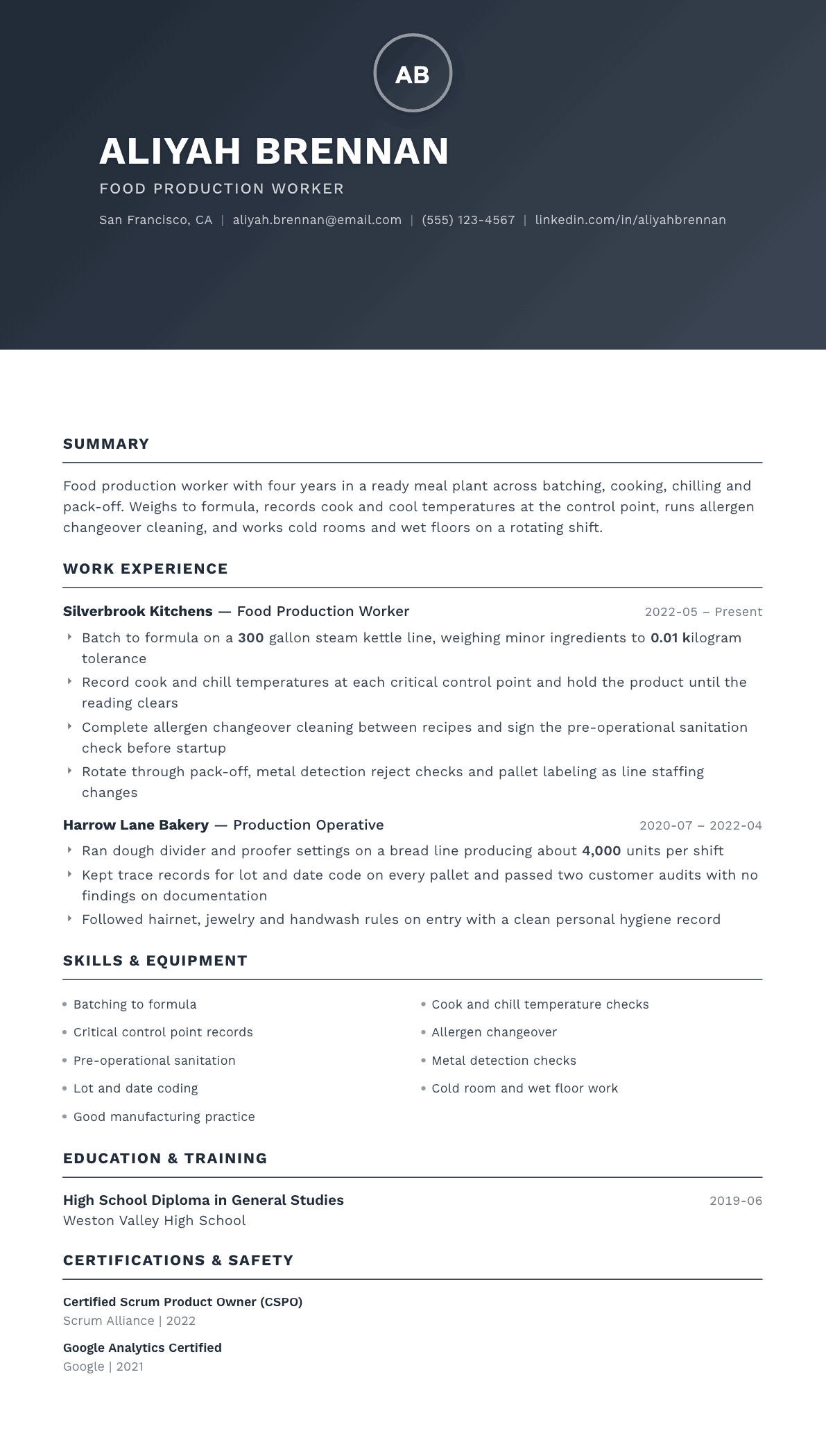
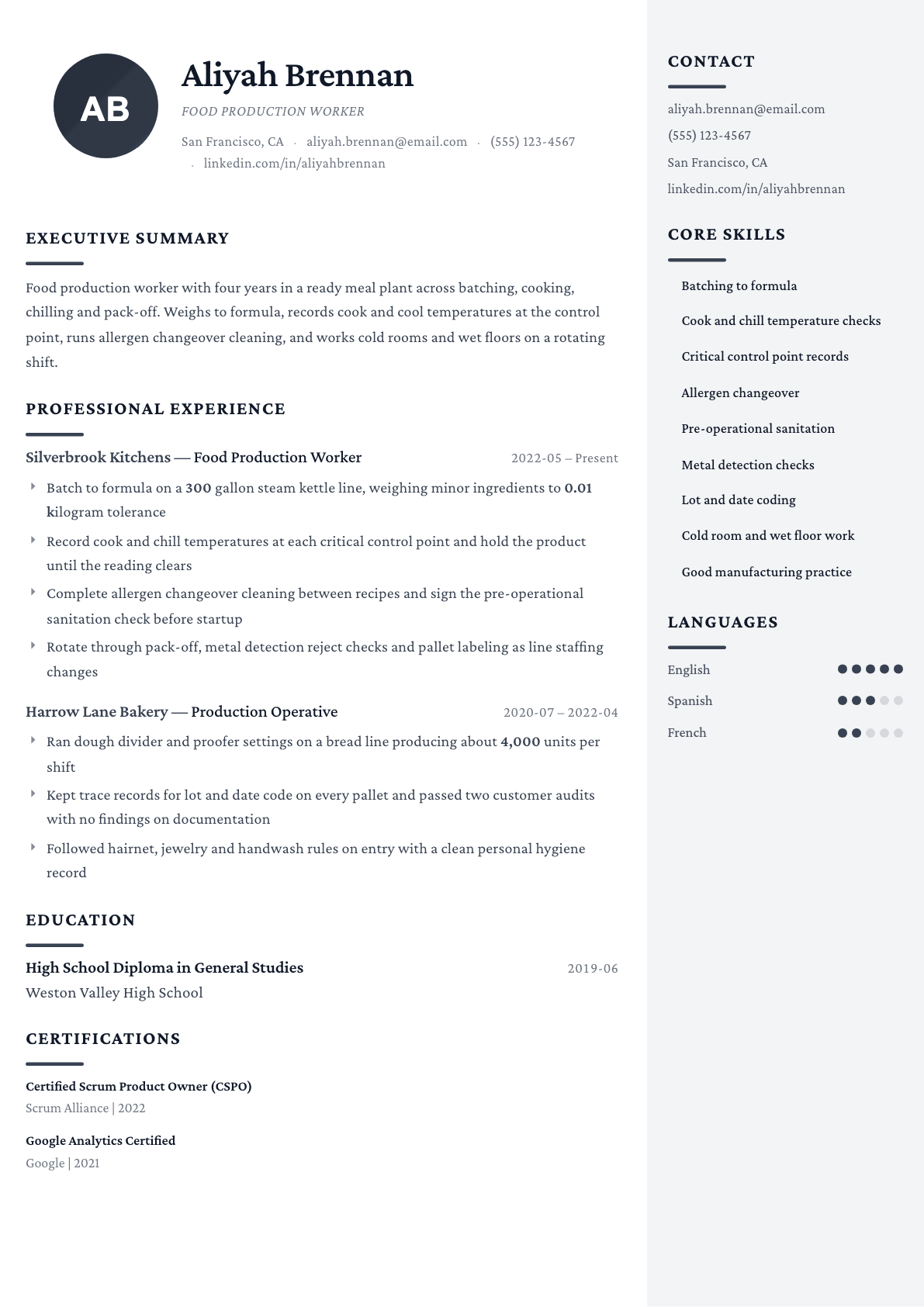
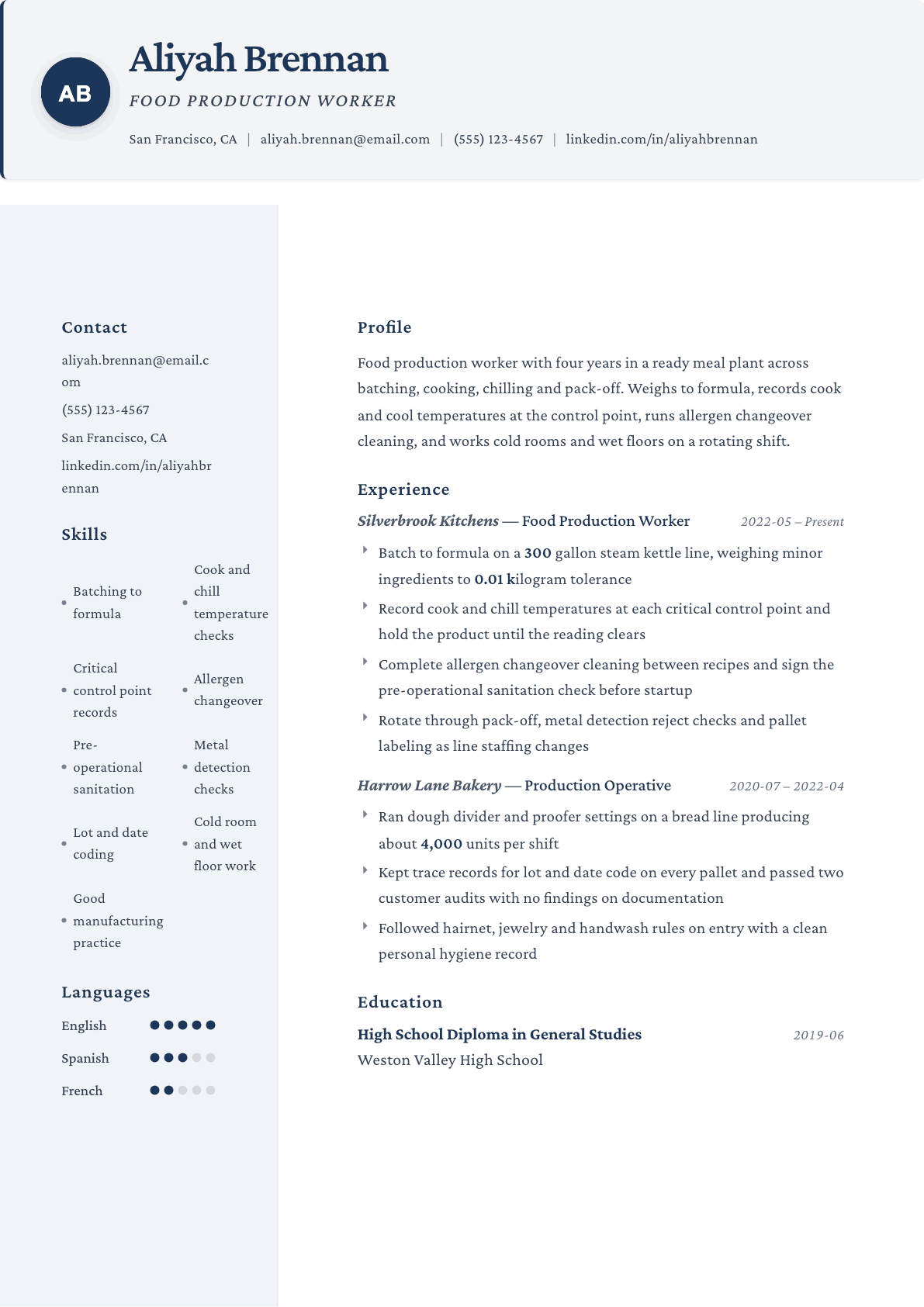
Example Food Production Worker summary
Food production worker with four years in a ready meal plant covering batching, cooking, chilling and pack-off. Weighs minor ingredients to a tight tolerance, records cook and chill temperatures at each critical control point, and holds product until the reading clears. Runs allergen changeover cleaning, signs the pre-operational sanitation check, and has worked two customer audits without a documentation finding. Comfortable in cold rooms on rotating shifts.
Skills to list on a Food Production Worker resume
- Batching and weighing to formula
- Kettle and cook step operation
- Blast chilling and cool down records
- Critical control point monitoring
- Metal detection verification
- Allergen changeover cleaning
- Pre-operational sanitation checks
- Good manufacturing practice
- Lot coding and traceability
- Pack-off and case weight checks
- Cold room and wet floor working
- Hygiene and gowning rules
- Waste and yield recording
- Customer and third party audit support
What actually gets this resume read
- Name the product category you have made, because a bakery line and a ready meal line hire differently.
- Show the temperature and weight records you sign, since audit readiness is what a plant manager buys.
- Say which stations you can cover: batching, cooking, chilling, pack-off, metal detection, palletizing.
- Put allergen changeover on the page with who verifies your cleaning before the line restarts.
- State the environment you can work: cold rooms, wet floors, standing shifts and rotating start times.
- Mention audits you have worked through and whether your documentation drew any findings at all.
How to write a food production worker resume
Food plants hire for reliability and for documentation. A production manager filling a line seat needs somebody who turns up for a rotating start, works a cold wet room without complaint, weighs to the formula, and writes down the temperature reading correctly the first time. Every one of those is checkable, and a resume that shows them beats one full of enthusiasm.
The trap is writing the job as unskilled. A food production worker who batches to formula, monitors a cook step at a critical control point and signs a sanitation check before startup is doing regulated work. Describing that as helped with production throws away the part a plant manager actually pays for.
This guide covers how a food manufacturing resume should be ordered, what to write in the summary, how to describe stations and records, before and after bullet examples, the food safety terms a screener looks for, and the questions people ask when moving between bakery, meat, dairy and ready meal plants.
Format: stations, shifts and the environment you can work
One page, reverse chronological, with a station block near the top. List the positions you can cover: ingredient weighing, batching, cook or bake step, chilling, filling, pack-off, metal detection, palletizing and clean down. A supervisor building a shift roster reads that block as a staffing plan.
Add an environment line, because it removes the doubt that stops most food plant interviews. Cold rooms at refrigeration temperature, wet floors, standing shifts, rotating or night starts and lifting limits are all facts a plant will otherwise spend an interview probing. Putting them on the page marks you as somebody who has already done the job.
- Station block listing every line position you can cover without supervision.
- Environment line: chilled and frozen areas, wet processing, standing shifts, rotating or night starts.
- Records you sign named directly: temperature logs, weight checks, sanitation verification, traceability sheets.
- Product category for each employer, since bakery, dairy, meat and ready meals hire from different pools.
Summary: product, stations, records, availability
Say what you have made, which stations you cover, which records you complete and what shifts you can work. Four short facts. A production manager reading that summary knows whether to call you before she has reached your first job, which is the only thing a summary needs to accomplish.
If you have worked audits, put it here. Plants live under customer audits and certification schemes, and a worker whose paperwork has never drawn a finding is a low risk hire. Say it plainly rather than claiming attention to detail, which every resume in the pile already claims.
Experience: formulas, control points and clean down
Each job starts with the product and the line: what was made, at what volume, on how many shifts. Then bullets grouped by what the plant cares about. Batching first: weighing minor ingredients to tolerance, allergen segregation at the scale, double checks on high impact ingredients and the sign off that lets a batch move.
Process monitoring second: the cook, bake, chill, freeze or pasteurization step you watched, the reading you took, the limit it had to meet and what you did when it failed. The correct answer is that you held the product and told a supervisor, and writing exactly that shows a plant you will not release something questionable to keep a line moving.
Clean down third. Pre-operational sanitation checks, allergen changeover between recipes, equipment strip and rebuild, chemical concentration checks and who verified your work before the line restarted. Then finish with pack-off and traceability: case counts, date and lot coding, pallet labels and the metal detection or checkweigher verification you ran.
Food safety language that gets a resume through the screen
Use the plant vocabulary rather than everyday words. Critical control point, corrective action, hold and release, traceability, allergen changeover, pre-operational inspection, good manufacturing practice, gowning and foreign body control all mean something specific in a food plant, and using them correctly identifies you as trained.
Personal hygiene rules belong in one honest line: hairnet and beard cover, no jewelry, handwash and sanitizer stations at every entry, and reporting illness before starting a shift. That last item is the one a quality manager quietly cares about most, and almost nobody writes it.
Volume, waste and the numbers that fit this job
You may not have output figures, so use what you did control. Units or trays produced per shift, batch count, yield or giveaway against target, waste recorded, and the number of audits worked through are all things a line worker can honestly report. Give the figure with its target so a reader can judge it.
Where you have no numbers at all, use scope instead: how many products the line ran, how many recipes you knew, how many stations you covered and how often you trained somebody new. Scope is a legitimate measure and it beats padding the page with invented percentages.
Food Production Worker resume summary examples
First plant job
Reliable worker moving into food manufacturing after 2 years in commercial kitchen prep. Holds a food handler certificate, comfortable in chilled rooms and on standing shifts, and trained in handwash, gowning and allergen rules. Seeking a line position with training toward batching.
Four years in
Food production worker with 4 years in a ready meal plant covering batching, cook, chill and pack-off. Weighs minor ingredients to a 0.01 kilogram tolerance, records control point temperatures, runs allergen changeover cleaning and has worked 3 customer audits without a documentation finding.
Line trainer
Senior production operative with 9 years across bakery and chilled foods, covering every station on two lines and training new starters. Owns pre-operational sanitation sign off, holds product when a reading fails, and has kept traceability records clean through 6 third party audits.
Work experience bullets: before and after
Before: Worked on the production line making food products.
After: Covered batching, kettle cook, blast chill and pack-off on a chilled ready meal line producing about 3,000 trays a shift across nine recipes.
Stations, product, volume and recipe count let a manager slot you into a real roster.
Before: Weighed ingredients for recipes.
After: Batched to formula on a steam kettle line, weighing minor ingredients to 0.01 kilogram tolerance with a second person check on allergen bearing additions.
The tolerance and the double check show trained batching rather than general scale work.
Before: Checked temperatures during production.
After: Recorded cook and chill temperatures at every critical control point, held one batch that failed the cool down limit and escalated it for disposition before it reached pack-off.
A hold decision proves you follow the control point rather than only filling in the log.
Before: Cleaned equipment at the end of shift.
After: Stripped and rebuilt the filler for allergen changeover, checked chemical concentration against the sanitation plan and signed the pre-operational check before line release.
Naming the changeover, the chemical check and the release signature shows audited cleaning.
Before: Followed food safety rules at all times.
After: Worked to gowning, handwash and no jewelry rules on every entry, reported illness before shift start as required, and passed 3 customer audits with no personal hygiene observations.
Specific rules plus an audit outcome make the claim verifiable instead of decorative.
Hard skills
- Batching and weighing to formula
- Ingredient allergen segregation
- Kettle, oven and fryer step monitoring
- Blast chilling and cool down records
- Critical control point monitoring
- Metal detector and checkweigher verification
- Pre-operational sanitation checks
- Allergen changeover cleaning
- Equipment strip down and rebuild
- Date and lot coding
- Traceability record keeping
- Pack-off and case count checks
- Palletizing and pallet labeling
- Waste and yield recording
Soft skills
- Turning up on time for rotating and night starts
- Writing a reading down as it is rather than as it should be
- Speaking up when a line is running product that looks wrong
- Working shoulder to shoulder in a cold noisy room
- Learning a new recipe quickly when the schedule changes
Certifications worth listing
- ServSafe Food Handler (National Restaurant Association)
- Accredited HACCP Training Certificate (International HACCP Alliance)
Mistakes that cost food production worker candidates the interview
- Describing the work as general labor when batching and control point monitoring are regulated tasks.
- Leaving out the product category, which decides whether a plant sees relevant experience at all.
- Naming no records, so a quality manager cannot tell whether you have ever signed for anything.
- Skipping the environment facts, which turns the interview into a long conversation about cold rooms and shifts.
- Writing attention to detail instead of a tolerance, a check interval or an audit result.
- Hiding the one time you held a batch, which is the strongest evidence of judgment a line worker has.
Food Production Worker resume questions
Do I need a food safety certificate to apply?
Many plants train you on arrival, so a missing certificate rarely blocks an application. Holding a food handler certificate still helps because it shows you understand temperature control, cross contact and hygiene before the plant spends a day teaching you.
How do I move between food sectors, for example bakery to chilled foods?
Lead with the transferable parts: batching, control point monitoring, sanitation and traceability work the same way everywhere. Then name the sector differences you already understand, such as chilled storage limits or allergen risk, so the reader sees you know what changes.
Should I mention shift patterns on my resume?
Yes, and it belongs near the top. Plants run nights, weekends and rotating patterns, and a candidate who states availability plainly removes the biggest reason applications get set aside before anyone reads the experience section at all.
What if I have gaps between plant jobs?
State the gap in plain words and move on. Agency and seasonal work is normal in food manufacturing, so list agency assignments with the plants and products, which turns what looks like instability into evidence of broad line experience.
How do I show I am ready for a team leader role?
Show training and sign off responsibility rather than seniority. Number of new starters trained, stations you sign competence on, sanitation checks you release and shifts you ran when the leader was absent are the concrete signals a manager promotes on.
Related resume examples
- Food Service Resume example
- Production Worker Resume example
- Meat Cutter Resume example
- Food Safety Inspector Resume example
- Production Operator Resume example
- Packaging Operator Resume example