Production Operator Resume Examples: what gets the call
Write a Production Operator Resume That Runs the Line
By Mustafa Tarabya, founder of CVBooster · Published · Updated
Production operator resume example with line, changeover and OEE keywords, plus a guide to writing run rates, scrap and safety records.
Sample resumes for a production operator
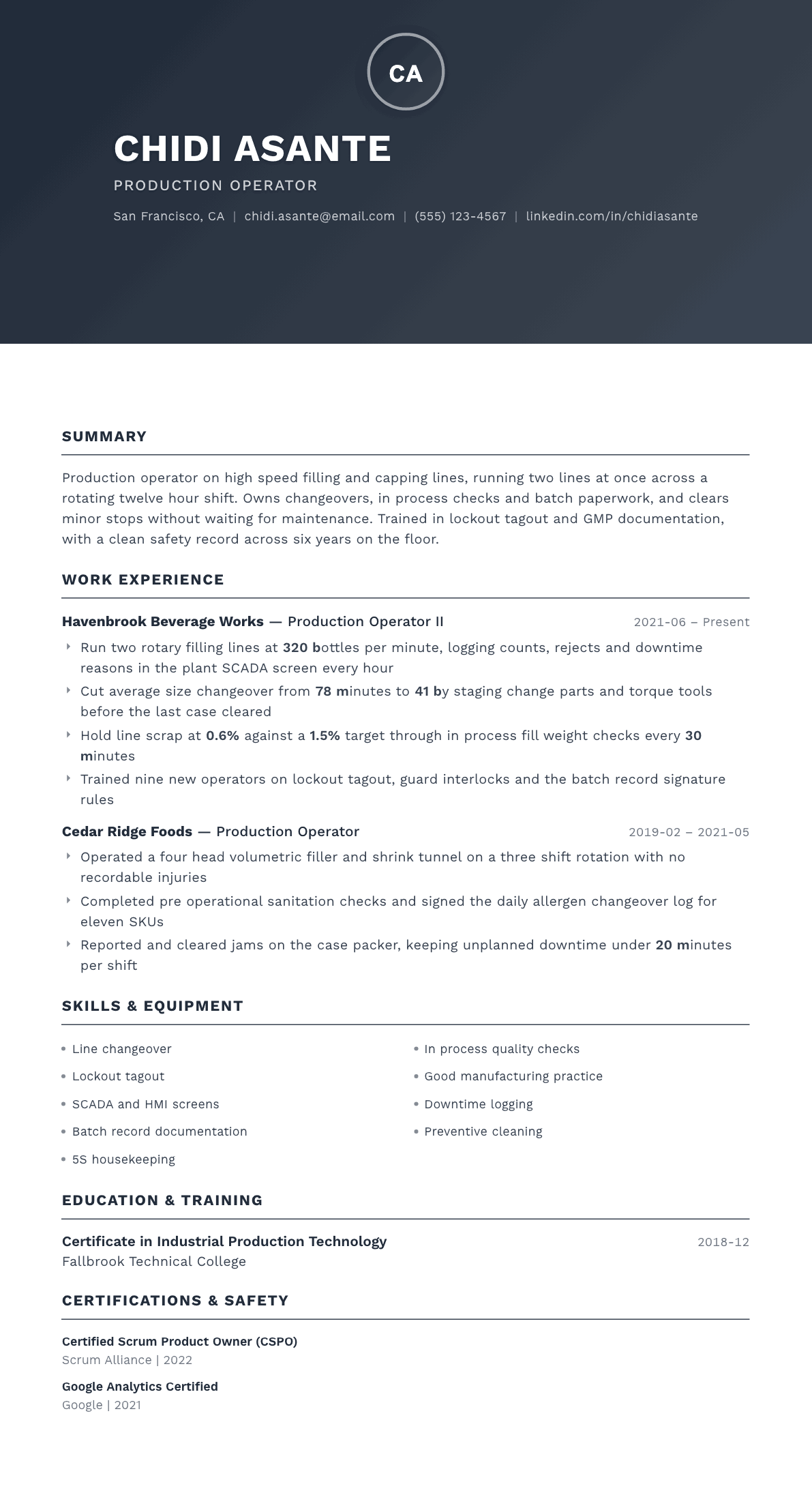
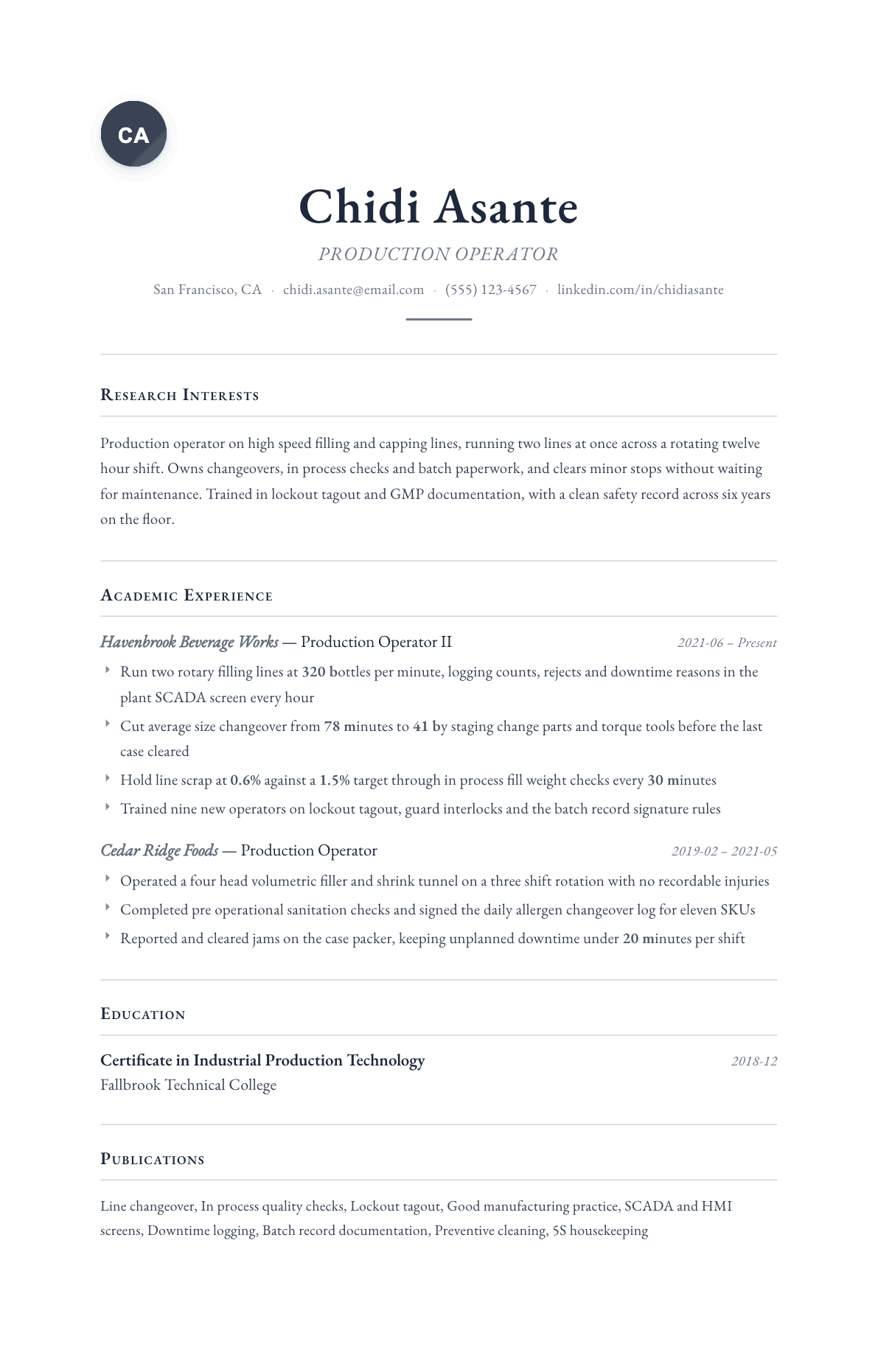
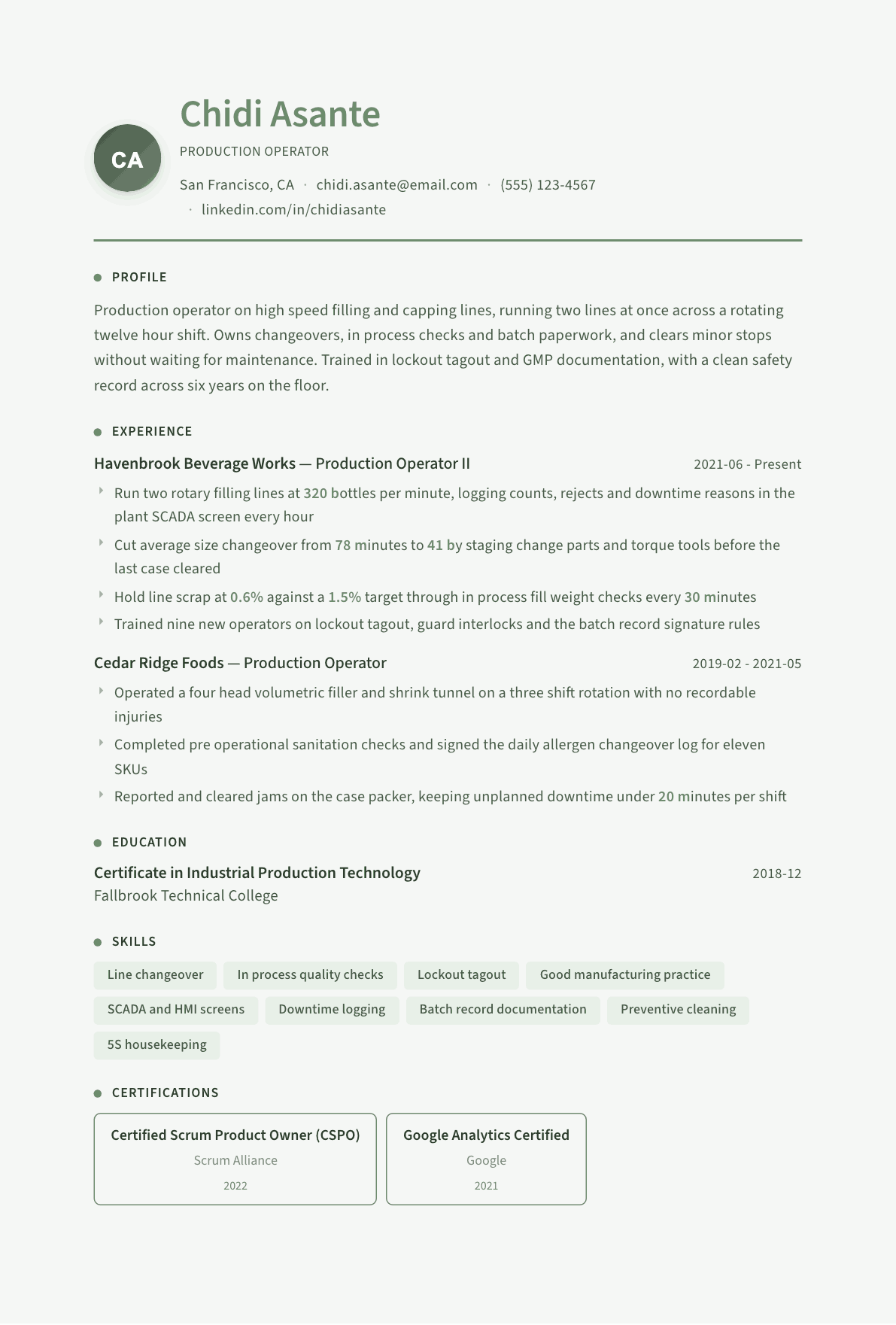
The same production operator content laid out in three CVBooster templates, so you can see what the finished document looks like before you write a word.
Example Production Operator summary
Production operator with six years on high speed filling, capping and case packing lines in food and beverage plants. Runs two lines on a twelve hour rotation, owns size changeovers, and holds scrap below target through hourly fill weight checks. Reads HMI screens, logs downtime by reason code, completes batch records to GMP standard, and trains new operators on lockout tagout.
Skills to list on a Production Operator resume
- Line operation and monitoring
- Product changeover
- In process inspection
- Downtime tracking
- Lockout tagout
- Good manufacturing practice
- Batch record completion
- HMI and SCADA operation
- Minor mechanical adjustment
- Sanitation and pre operational checks
- Pallet and case handling
- Standard work adherence
- 5S and workplace organization
- Shift handover reporting
What actually gets this resume read
- Name the line, the product and the run rate you hold, because a plant manager hires against a specific line.
- Put changeover time on the resume, since fast, correct changeovers are the number a scheduler cares about most.
- State your scrap or reject rate against the target you were given, not as a bare number without context.
- List lockout tagout, confined space and any safety training by name, because plants screen for them first.
- Say which control screens you read: SCADA, HMI, or a paper count sheet, so the reader knows your comfort level.
- Add batch record and GMP documentation experience if you have worked in food, beverage or pharmaceutical plants.
How to write a production operator resume
A production operator resume is screened by a plant that already knows exactly which line it needs covered. The recruiter checks shift availability, safety training and whether you have touched equipment resembling theirs. The production supervisor who makes the actual call reads for one thing: can this person hold the run rate on my line without a babysitter.
Most operator resumes fail because they describe the building instead of the job. Naming the employer and writing that you worked in a manufacturing environment tells the supervisor nothing. Naming the line, the product, the speed, the changeover time and the scrap rate tells him everything, and it takes the same number of lines on the page.
This guide covers the format plants expect, what belongs in every job entry, how to turn hourly counts and downtime logs into evidence, and the questions operators ask when they sit down to rewrite a resume that has been getting no calls.
Format: one page, reverse chronological, shift availability visible
Keep it to one page unless you have more than a decade across several plants. Reverse chronological order is the only format that works here, because a plant reads dates for gaps and for how long you last in a job. Turnover is the industry's expensive problem, so a candidate who stayed three years somewhere is already ahead.
Skip graphics, columns and skill rating bars. Many plants run resumes through a basic applicant tracking system and print the text for the supervisor, and a two column layout comes out of that pipeline scrambled. Plain headings, plain bullets, and a header that includes your city, phone and the shifts you can work.
- Header: your name, city and state, phone, email, and one line stating the shifts and overtime you accept.
- Order the page as summary, then plant experience, then equipment and skills, then training and certifications.
- Put safety training such as lockout tagout and confined space where a screener sees it without scrolling.
Summary: the line, the product, the speed
Three sentences. Say what kind of line you run, what it makes, how fast it goes and what you own beyond pressing the start button. An operator who writes that he runs two rotary fillers at over three hundred bottles a minute and does his own size changeovers has answered the supervisor's question before the experience section starts.
If you are moving between industries, name the transferable part in the summary rather than hoping the reader works it out. Filling and capping in a beverage plant maps cleanly onto a pharmaceutical line, but you have to say so, because the reader is sorting a stack and will not build the bridge for you.
Experience: line, rate, changeover, scrap, downtime
Start each job with a line that fixes the context: the plant type, the line or department, the equipment and the product. Something like staff operator on a three lane bottling line running juice and isotonic drinks gives more information than the next four bullets usually do.
Then three to five bullets, each carrying a number or a piece of equipment. The four numbers a plant cares about are run rate, changeover time, scrap or reject rate, and unplanned downtime. If you know yours, write them. If you do not know them, they are on the shift report you sign every day, and getting them is worth more than another round of applications.
Include the paperwork. Batch records, sanitation logs, allergen changeover sheets and process control charts are audited, and an operator who fills them out correctly the first time saves the quality department real work. That is worth a bullet in food, beverage and pharmaceutical plants.
- Anchor line for each job: plant type, line or cell, equipment, product and shift pattern.
- One bullet on changeovers with the time you achieve and how you shortened it.
- One bullet on quality checks: what you measure, how often, and what you do when it drifts.
- One bullet on what you clear yourself versus what you escalate to maintenance.
Equipment and systems: be specific enough to be checkable
The equipment list is where a supervisor decides whether your training will take two weeks or two months. Name machine types and, where you know them, the tonnage, head count or lane count. Rotary filler, capper, labeler, case packer, palletizer, shrink tunnel, checkweigher and metal detector are all separate lines of experience to a plant that owns them.
Name the control layer too. Reading an HMI screen, acknowledging alarms, entering a recipe and pulling a downtime reason code is a different skill from watching a mechanical counter. If you have worked with a plant floor system for counts and downtime, say which one and what you entered into it.
Safety and training: the section that gets you past the recruiter
Safety training is a filter, not a bonus. List lockout tagout, machine guarding, hazard communication, confined space, hot work, powered industrial truck clearance and any first aid training with the year kept off the page and the issuing employer or provider named. A plant with a recordable injury problem hires on this section.
Add the improvement work if you have it. Operators who have sat on a kaizen event, written a one point lesson, or trained new hires on their line are the ones who get promoted to lead, and hiring managers look for the early signs of it.
Production Operator resume summary examples
First plant job
Reliable operator with warehouse and food service background moving into production. Completed OSHA 10 and forklift training, comfortable on twelve hour rotating shifts, and quick on repetitive tasks with a strict quality standard. Seeking a line operator seat where cross training into changeovers is available within the first year.
Three years on the line
Production operator with three years on filling and case packing lines running 240 units per minute. Performs size changeovers unassisted, records hourly counts and downtime codes on the plant floor system, and holds scrap under 1% through fill weight checks every half hour. Lockout tagout trained.
Senior operator and trainer
Senior production operator running two high speed lines at once across a rotating twelve hour shift, with seven years in beverage and household goods plants. Owns changeovers, clears photo eye and jam faults without maintenance, trains new operators on GMP documentation, and has never had a recordable injury on a crew he led.
Work experience bullets: before and after
Before: Operated production machinery in a manufacturing plant.
After: Ran two rotary filling and capping lines at 320 bottles per minute across a twelve hour rotating shift, logging counts and downtime codes hourly.
The machine type, the rate and the shift pattern let a supervisor size the job against his own line instead of guessing.
Before: Performed changeovers between products.
After: Cut average size changeover from 78 to 41 minutes by staging change parts, torque tools and the new label reel before the last case cleared the line.
The before and after time plus the method shows a habit the plant can copy, not a task that happened to you.
Before: Responsible for quality control on the line.
After: Checked fill weights every 30 minutes against the control chart and held line scrap at 0.6% against a 1.5% target across the year.
Naming the interval, the tool and the target turns a claim of responsibility into a measured result.
Before: Followed all safety rules and procedures.
After: Applied lockout tagout on every guard entry, completed daily pre operational checks, and finished four years with no recordable injury on the line.
Safety is only credible when it names the specific practice and the record it produced.
Before: Helped train new employees.
After: Trained nine new operators on lockout tagout, guard interlocks and batch record signature rules, with all nine cleared to run the line solo inside three weeks.
A count and a clearing time prove the training worked instead of merely happening.
Hard skills
- High speed line operation
- Size and product changeover
- In process fill and weight checks
- HMI and plant floor system entry
- Downtime reason coding
- Lockout tagout
- Good manufacturing practice documentation
- Batch record completion
- Pre operational sanitation checks
- Jam and fault clearing
- Pallet jack and forklift operation
- 5S and standard work
Soft skills
- Pace under a running clock
- Shift handover clarity
- Escalation judgment
- Attention on repetitive checks
- Coaching new operators
Certifications worth listing
- Certified Production Technician 4.0 (CPT 4.0) (Manufacturing Skill Standards Council)
- OSHA 10-Hour General Industry (OSHA Outreach Training Program)
- Certified Manufacturing Associate (CMfgA) (SME)
Mistakes that cost production operator candidates the interview
- Writing that you worked in a manufacturing environment without ever naming the line, the machine or the product.
- Leaving out run rate, changeover time and scrap, which are the only numbers a plant scheduler is reading for.
- Hiding shift availability at the bottom, when night and rotating coverage is often the deciding factor.
- Listing safety training as a single word like safety when the plant is searching for lockout tagout by name.
- Using a two column template with icons that a plant applicant tracking system flattens into unreadable text.
- Claiming machine troubleshooting without saying where you stop and hand the fault to a maintenance technician.
Production Operator resume questions
What if my plant never told me the run rate or scrap numbers?
They are on the shift report, the downtime log or the production board you pass every day. Ask your lead for last month's line summary. If you truly cannot get them, describe the volume in cases, pallets or units per shift instead, which is still far better than nothing.
Do I need a high school diploma on a production operator resume?
Yes, list it, because a large share of plant postings set it as a minimum requirement and the recruiter checks. Add any technical certificate, apprenticeship or trade coursework underneath it, and keep the whole education block to two or three lines.
How do I show I can move up to a lead role?
Give evidence rather than ambition. Training new hires, covering as relief lead, running the startup meeting, sitting on an improvement event or owning a line audit all signal readiness, and each one belongs as a bullet under the job where you did it.
Should I list every plant I have worked at through a staffing agency?
Group short agency placements under the agency name with the client plants listed underneath, so the page does not read as five jobs in two years. Keep full detail for any assignment longer than six months or on equipment relevant to the posting.
Does a production operator resume need a skills section?
Yes, because it is where the applicant tracking system finds equipment names and safety terms. Keep it to machines, control systems, documentation types and safety training, and leave personality traits out of the list where they cannot be checked.
Related resume examples
- Production Worker Resume example
- Machine Operator Resume example
- Production Supervisor Resume example
- Packaging Operator Resume example
- Sewing Machine Operator Resume example
- Line Supervisor Resume example