Production Worker Resume Examples: the lines they read
Write a Production Worker Resume That Gets You Hired Fast
By Mustafa Tarabya, founder of CVBooster · Published · Updated
Production worker resume example, keyword list and writing guide covering line rates, quality checks, changeovers, safety and shift reliability.
Sample resumes for a production worker
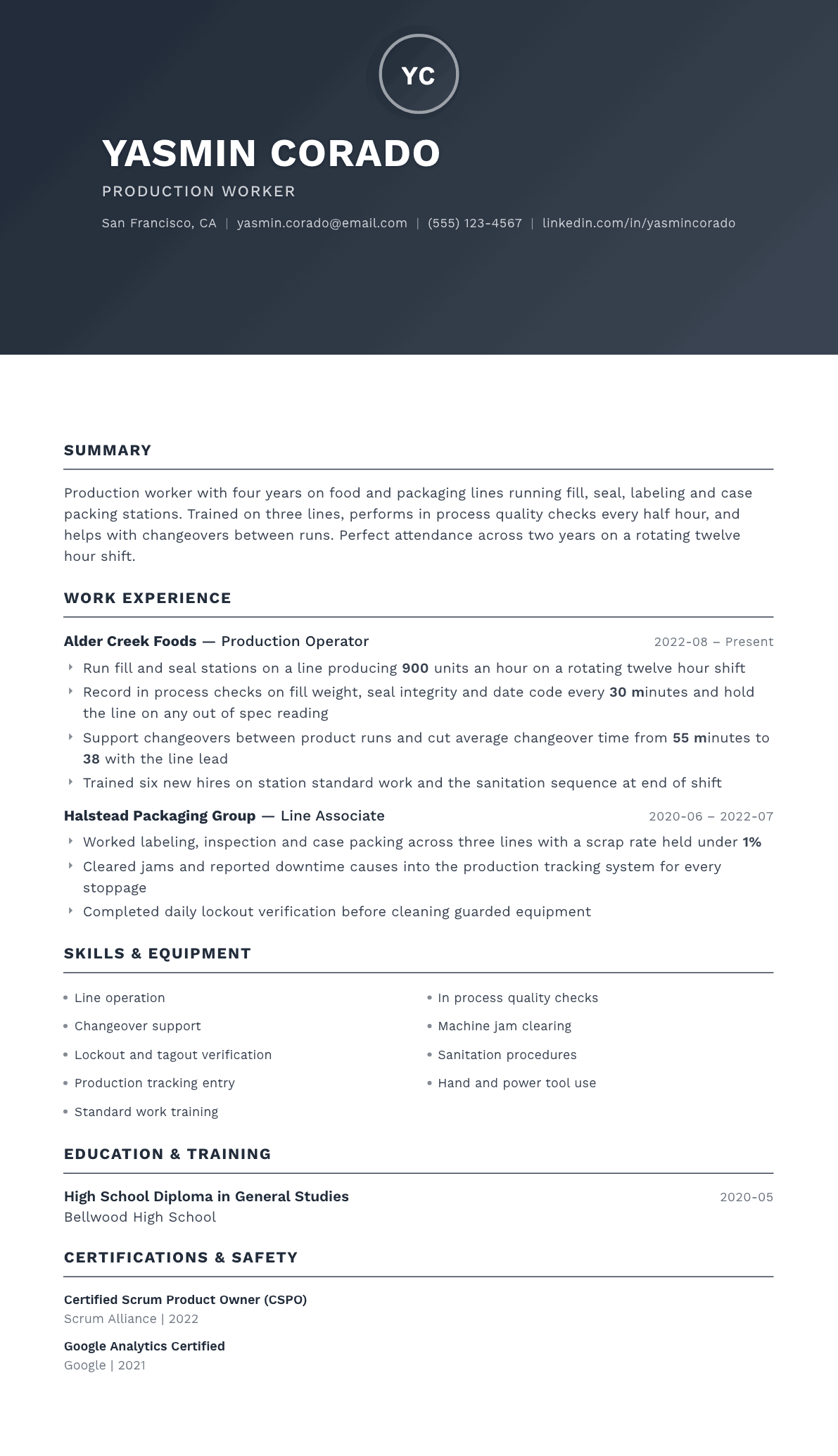
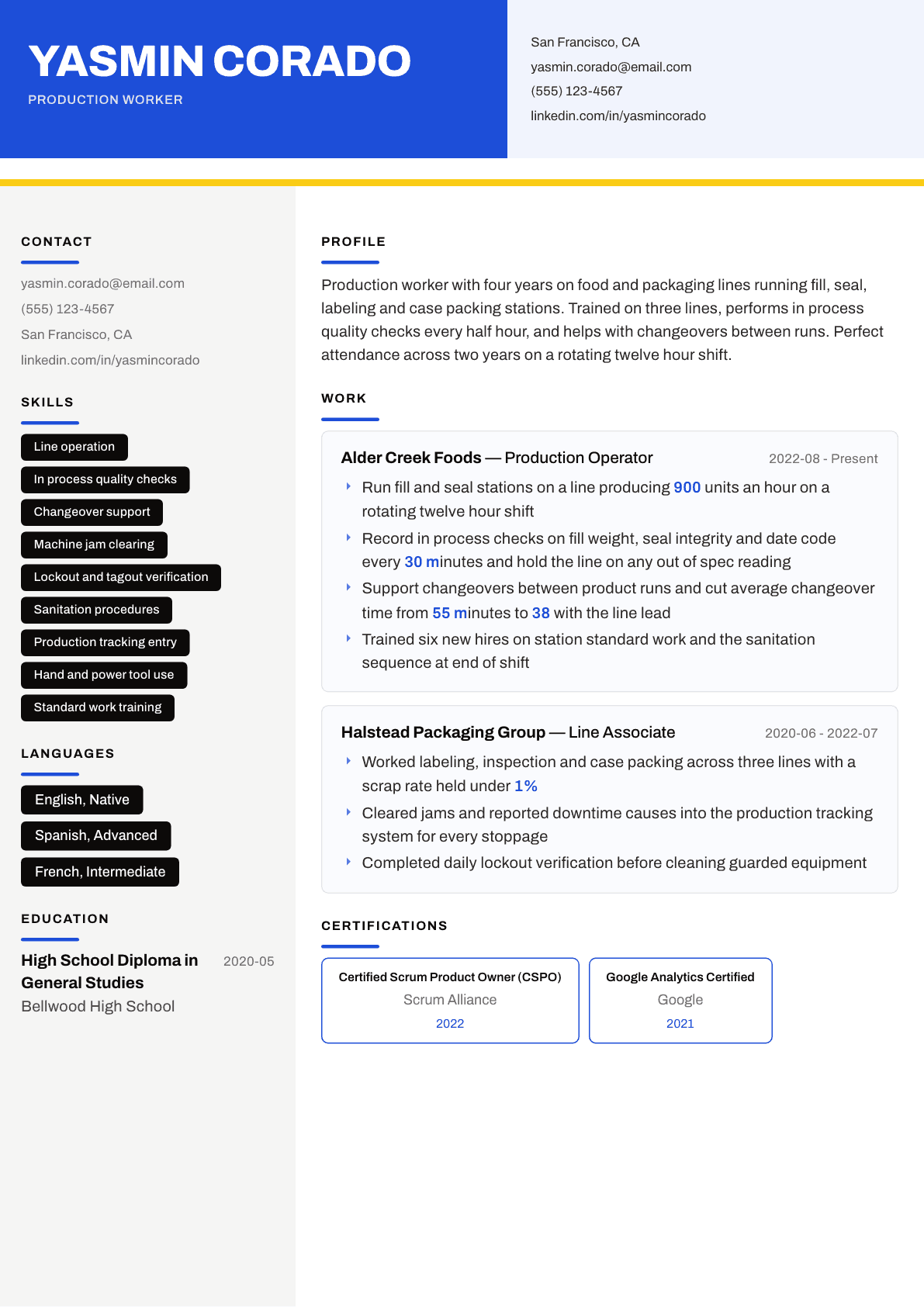
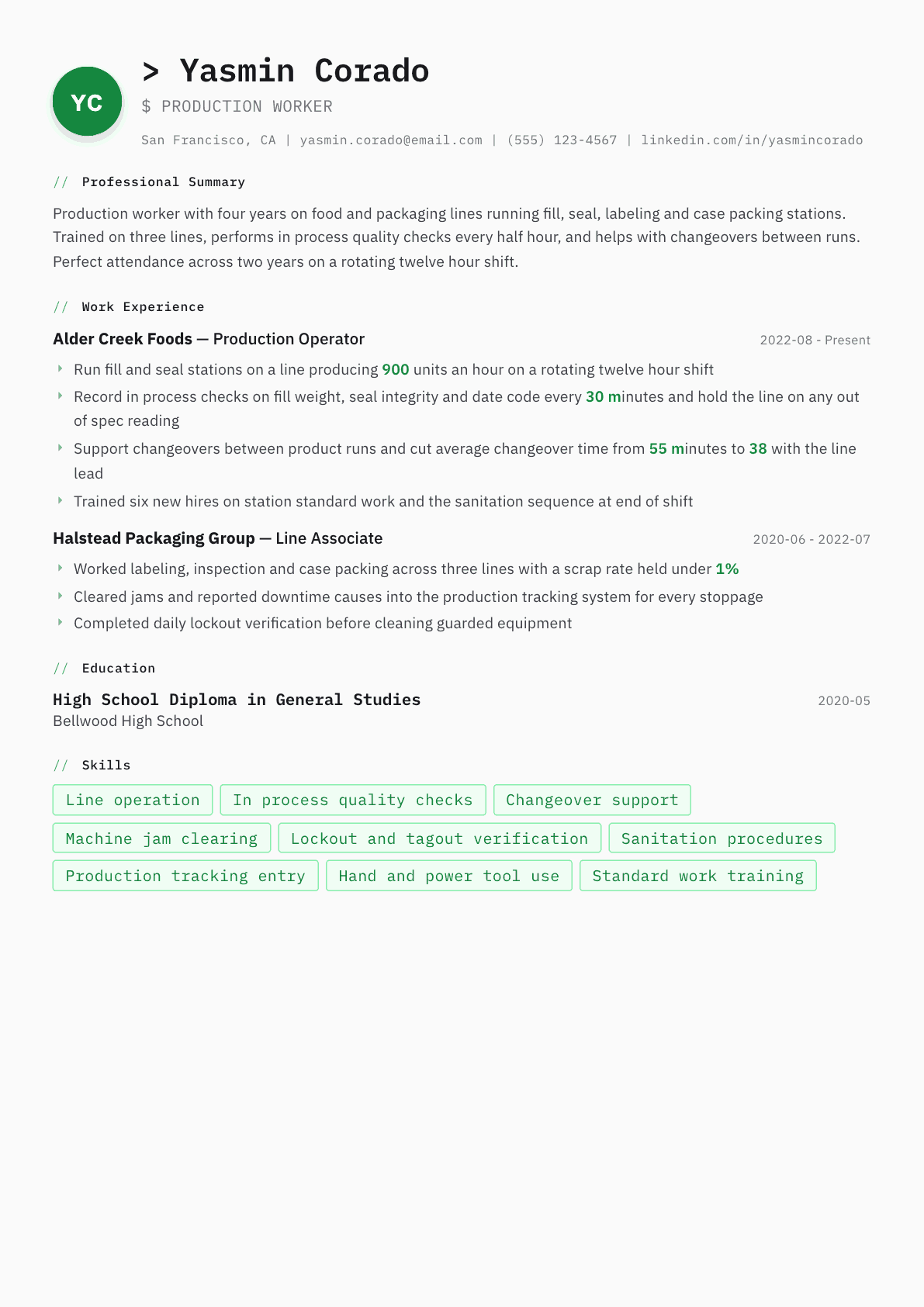
The same production worker content laid out in three CVBooster templates, so you can see what the finished document looks like before you write a word.
Example Production Worker summary
Production worker with four years on food and packaging lines, trained across fill, seal, labeling, inspection and case packing stations. Runs a line at 900 units an hour, records in process checks on weight, seal and date code every half hour, holds the line on out of spec readings, and supports changeovers that were cut from 55 minutes to 38. Perfect attendance on a rotating twelve hour shift.
Skills to list on a Production Worker resume
- Production line operation
- Machine setup and adjustment
- Changeover and product run switching
- In process quality inspection
- Measuring tools and gauges
- Scrap and downtime recording
- Lockout and tagout
- Good manufacturing practices
- Sanitation and clean down
- Material staging and stocking
- Pallet jack operation
- Forklift operation
- Standard work and five S
- Cross training and peer coaching
What actually gets this resume read
- Name the product type and the line speed you have run, because a food line and a metal press hire on different evidence.
- Say how many stations or lines you are trained on, since cross trained operators are the ones supervisors fight to keep.
- Put your quality check routine on the page with the frequency and what you do when a reading falls out of spec.
- Mention changeovers with a time, because reducing changeover minutes is the number a plant manager tracks weekly.
- State your shift pattern and your attendance record, since reliability decides most hires at this level.
- List safety training such as lockout, forklift or confined space, and say when each was last refreshed.
How to write a production worker resume
A production worker resume gets about fifteen seconds from a plant human resources coordinator who has forty of them to sort before the shift starts. She is checking three things: can you run a line, will you show up on the shift pattern we need, and are you going to hurt yourself in the first month. Everything you write should serve one of those three questions.
The mistake almost every applicant makes is writing duties instead of capability. Operated machinery, followed instructions and maintained a clean work area describe a person who was present. They do not tell a supervisor which stations you can be dropped onto, what line speed you have kept up with, or whether you know what to do when a fill weight drifts out of specification.
This guide covers how to build a production worker resume that gets a call the same week, what to write when you have no factory history at all, three summaries for different levels of experience, before and after bullets from food and packaging lines, and the questions people ask when they want to move from temporary agency work to a permanent badge.
Format: one page, plain, and readable by a parsing system
One page, reverse chronological, no graphics and no columns. Plants use applicant tracking systems that are often older than the ones office employers run, and a document with tables or text boxes can arrive at the coordinator as scrambled text. A clean layout is not a style choice here, it is a delivery method.
Put a short capability block under your contact details listing the stations and equipment you can run, the shift patterns you accept, and your safety cards. That block answers all three of the coordinator questions before she reaches your job history, which is the whole game at this level.
- Capability block for a line worker: stations run, machines operated, line speeds kept, and any forklift or pallet jack certification.
- Availability line naming the shift patterns you will work, including nights, rotating twelve hour shifts and weekend coverage.
- Safety block: lockout training, powered industrial truck certification, food safety card and any confined space or chemical handling course.
- Job entries with the plant type, the product, the line speed and the number of stations you were trained on.
Summary: product, stations, speed and reliability
Two or three lines. Name the type of plant you have worked, the product, the stations you are trained on, the line speed you have kept up with, and your attendance. Attendance is not filler in this trade. Absenteeism is the single biggest operational headache a shift supervisor carries, and a stated attendance record is a real competitive advantage.
If you have no factory history, use these lines to bridge honestly. Warehouse, kitchen, agricultural, construction and cleaning work all build the same underlying abilities: standing a full shift, working to a pace set by someone else, following a written procedure exactly and noticing when something looks wrong.
Experience: stations, rates, quality checks and changeovers
Start each job by describing the line rather than the company. The product, the line speed in units per hour, the crew size and the shift pattern give a supervisor an instant picture. A person who has held a station on a line running nine hundred units an hour has proved something that no adjective can substitute for.
Then write four things. Stations: how many you were trained on and which ones, because a cross trained operator is the person a supervisor uses to cover absences and is therefore the person he keeps. Quality: the in process checks you perform, how often, and what you do when a reading falls outside specification. Changeovers: the time they take and whether you helped bring that time down. Downtime: how you clear a jam, when you call maintenance, and how you record the stoppage cause.
The quality bullet is the one applicants skip and the one that separates candidates. A production worker who stops a line on an out of specification reading, rather than letting it run and hoping, is worth training. Say plainly that you hold the line and escalate, because plants have been burned by the opposite behavior.
Safety, sanitation and the training that lets you start on time
Safety training decides how quickly you become useful. Lockout and tagout verification before cleaning guarded equipment, machine guarding awareness, chemical handling for the sanitation chemicals in your plant, and a powered industrial truck certification if you hold one. Give the training and roughly when it was last refreshed, since a certification from years back with no recent use is a different claim.
On a food or pharmaceutical line, sanitation is production work, not housekeeping. Name the clean down sequence you run at end of shift, the good manufacturing practice rules you work under, allergen changeover procedure if your plant handles allergens, and any hygiene or food handling card you hold. That vocabulary tells a food plant coordinator you have actually been in a regulated facility.
- Lockout verification before cleaning or clearing guarded equipment.
- Powered industrial truck and pallet jack certification with the issuing employer or training provider.
- Good manufacturing practice, allergen changeover and end of shift clean down experience.
- Personal protective equipment used routinely, including hearing protection, cut resistant gloves and eye protection.
Words a plant screens for, and what to write with no experience
Postings for line work recycle a narrow vocabulary: production line, line speed, standard work, in process inspection, changeover, downtime, scrap, lockout, good manufacturing practices, pallet jack, forklift, cross trained and shift work. Put each one you can honestly claim into the skills area, and back at least four of them with a bullet that shows the work.
With no factory background, build the page from transferable evidence: a job where you worked to a timed pace, a job with a written procedure you followed exactly, a job where you noticed a defect and stopped, and physical work that proves you can stand a long shift. Then add whatever training you can obtain cheaply, because a coordinator choosing between two inexperienced applicants takes the one who already has a safety card.
Production Worker resume summary examples
First factory job
Warehouse and kitchen worker seeking a first production line role, comfortable on a timed pace and a full standing shift. Followed written prep procedures exactly, spotted and pulled defective stock, and holds a pallet jack certification and a food handler card. Available for nights and rotating shifts.
Two years on a line
Production worker with two years on packaging lines, trained on labeling, inspection and case packing across three lines with scrap held under 1%. Clears jams, records downtime causes in the tracking system, and completes lockout verification before cleaning guarded equipment.
Cross trained operator
Production operator with four years on food and packaging lines running fill, seal, labeling and case packing at 900 units an hour. Records in process checks every thirty minutes, holds the line on out of specification readings, supports changeovers and has trained six new hires on standard work.
Work experience bullets: before and after
Before: Operated machinery on the production line.
After: Ran fill and seal stations on a food line producing 900 units an hour on a rotating twelve hour shift, and was trained across three lines for absence cover.
Station names, line speed, shift pattern and cross training tell a supervisor exactly where he can place you.
Before: Checked products for quality.
After: Recorded in process checks on fill weight, seal integrity and date code every thirty minutes, and held the line for a supervisor call whenever a reading fell outside specification.
The check types, the frequency and the escalation behavior are what a quality manager needs to trust you.
Before: Helped change over the line between products.
After: Supported changeovers between product runs, including guide adjustment and allergen clean down, and worked with the line lead to cut average changeover time from 55 minutes to 38.
Naming the changeover tasks and the time saved turns a routine duty into a measurable contribution.
Before: Kept the work area clean and safe.
After: Completed lockout verification before every clean of guarded equipment and ran the end of shift clean down sequence under good manufacturing practice rules.
The specific safety and sanitation procedures prove regulated plant experience where a tidy area proves nothing.
Before: Trained new employees on the job.
After: Trained six new hires on station standard work, the in process check sheet and the sanitation sequence, then signed them off with the line lead before they ran a station alone.
A training count with a sign off step shows real responsibility rather than casually showing someone the ropes.
Hard skills
- Production line operation
- Machine setup and minor adjustment
- Changeover and product run switching
- In process quality inspection
- Measuring tools, scales and gauges
- Jam clearing and downtime recording
- Scrap tracking and rework handling
- Lockout and tagout verification
- Good manufacturing practices
- Allergen changeover and clean down
- Pallet jack and forklift operation
- Material staging and line stocking
- Standard work and workplace organization
Soft skills
- Holding a pace for a full twelve hour shift
- Speaking up the moment a reading looks wrong
- Working the same station beside people you did not choose
- Turning up on nights and weekends without drama
- Learning a new station quickly from a written procedure
Certifications worth listing
- Certified Production Technician (Manufacturing Skill Standards Council)
- OSHA 10-Hour General Industry Outreach Training (OSHA Training Institute)
- ServSafe Food Handler (National Restaurant Association)
Mistakes that cost production worker candidates the interview
- Writing duties such as operated machinery instead of naming the stations, the product and the line speed you held.
- Leaving out the number of lines or stations you are trained on, which is what makes an operator worth keeping.
- Skipping the quality check routine, so a supervisor cannot tell whether you would stop a line or let it run.
- Omitting the shift patterns you will accept, when shift coverage is often the reason a plant is hiring at all.
- Using a designed template with columns that arrive at the plant system as scrambled and unreadable text.
- Hiding temporary agency assignments instead of listing the plants, the lines and the length of each placement.
Production Worker resume questions
How do I get a production job with no factory experience?
Build the page from transferable work: anything with a timed pace, a written procedure or physical stamina. Warehouse, kitchen, farm and cleaning jobs all count. Then add a safety card and a food handler card, which make you the easier of two inexperienced applicants.
Should I list temporary agency assignments separately?
List the agency once and the plants under it, with dates, the line worked and why each assignment ended. Hiding agency work leaves gaps that look worse than the assignments themselves, and many plants hire permanent staff directly out of their temporary pool.
Does attendance really belong on a resume?
Yes at this level, and it carries genuine weight. Absenteeism is the operational problem shift supervisors complain about most. A line saying you had perfect attendance across a stated period, or no unexcused absences, is one of the strongest short claims you can make.
What should I say about line speed if I never tracked it?
Give whatever measure you do know: units per case, cases per hour, pallets built per shift or batches completed. Any rate gives the supervisor a sense of pace. Never invent a figure, because the interview question about it is specific and easy to fail.
How do I move from a line role into a lead or technician job?
Collect cross training on as many stations as possible, take on changeover and setup work, learn the tracking system entries and start training new hires. Then rewrite the resume around setup, quality escalation and coaching rather than around running a single station.
Related resume examples
- Machine Operator Resume example
- Assembly Line Worker Resume example
- Manufacturing Technician Resume example
- Warehouse Worker Resume example
- Production Associate Resume example
- Manufacturing Associate Resume example