Packaging Operator Resume Examples: the lines they read
Write a Packaging Operator Resume That Shows Line Uptime
By Mustafa Tarabya, founder of CVBooster · Published · Updated
Packaging operator resume example, keyword list and guide covering fillers, cartoners, labelers, checkweighers, changeovers and line uptime.
Sample resumes for a packaging operator
The same packaging operator content laid out in three CVBooster templates, so you can see what the finished document looks like before you write a word.
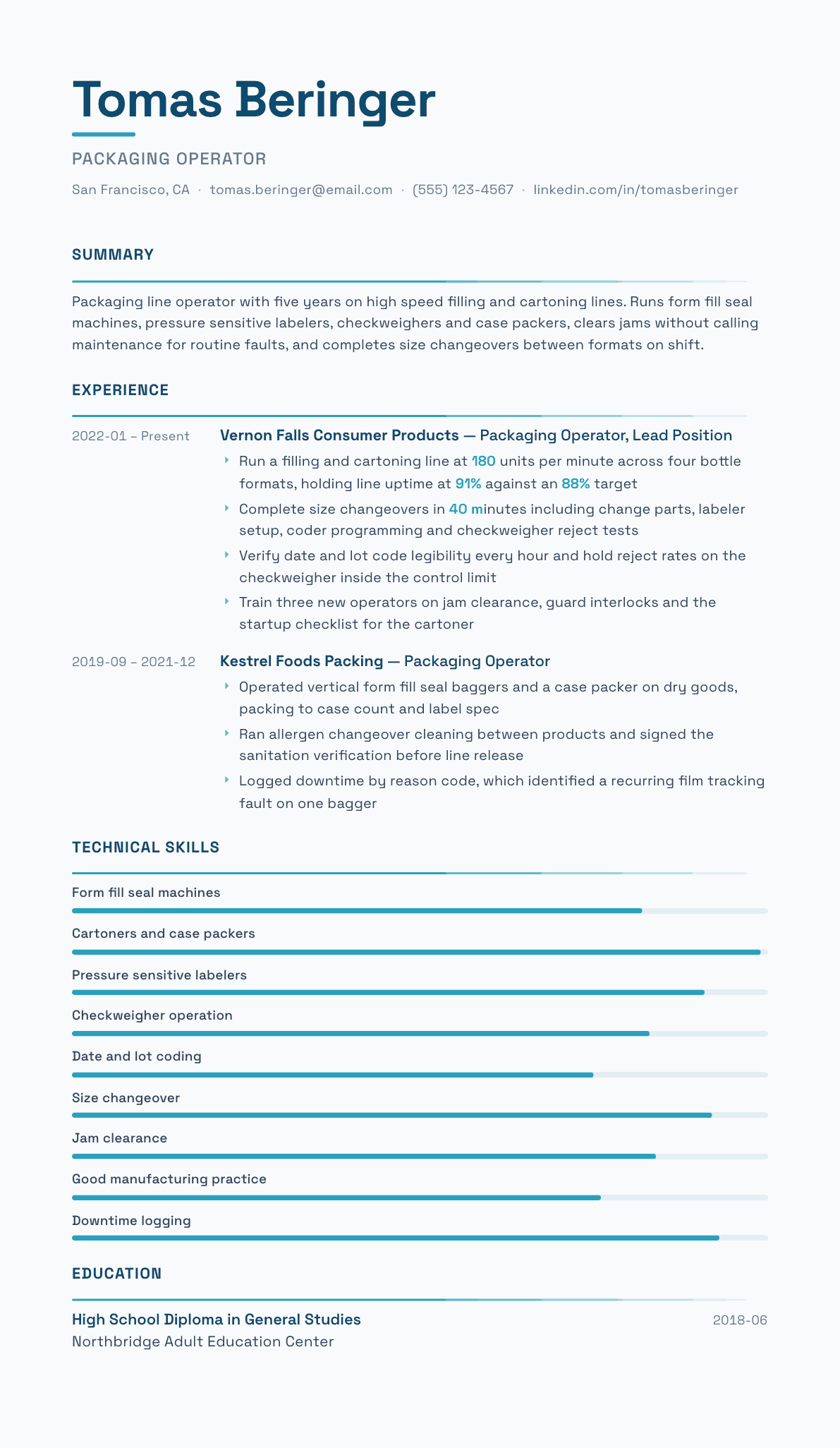
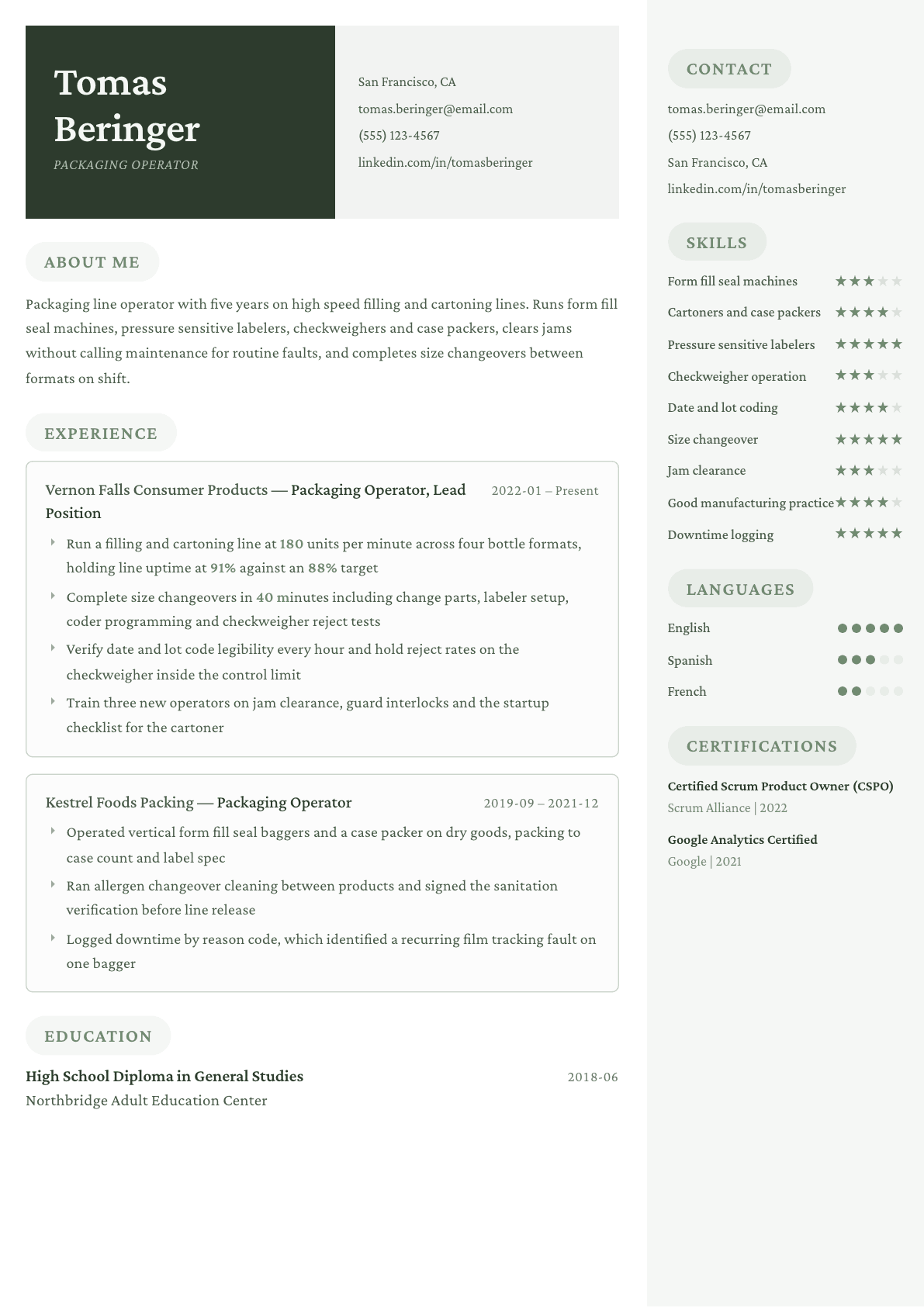
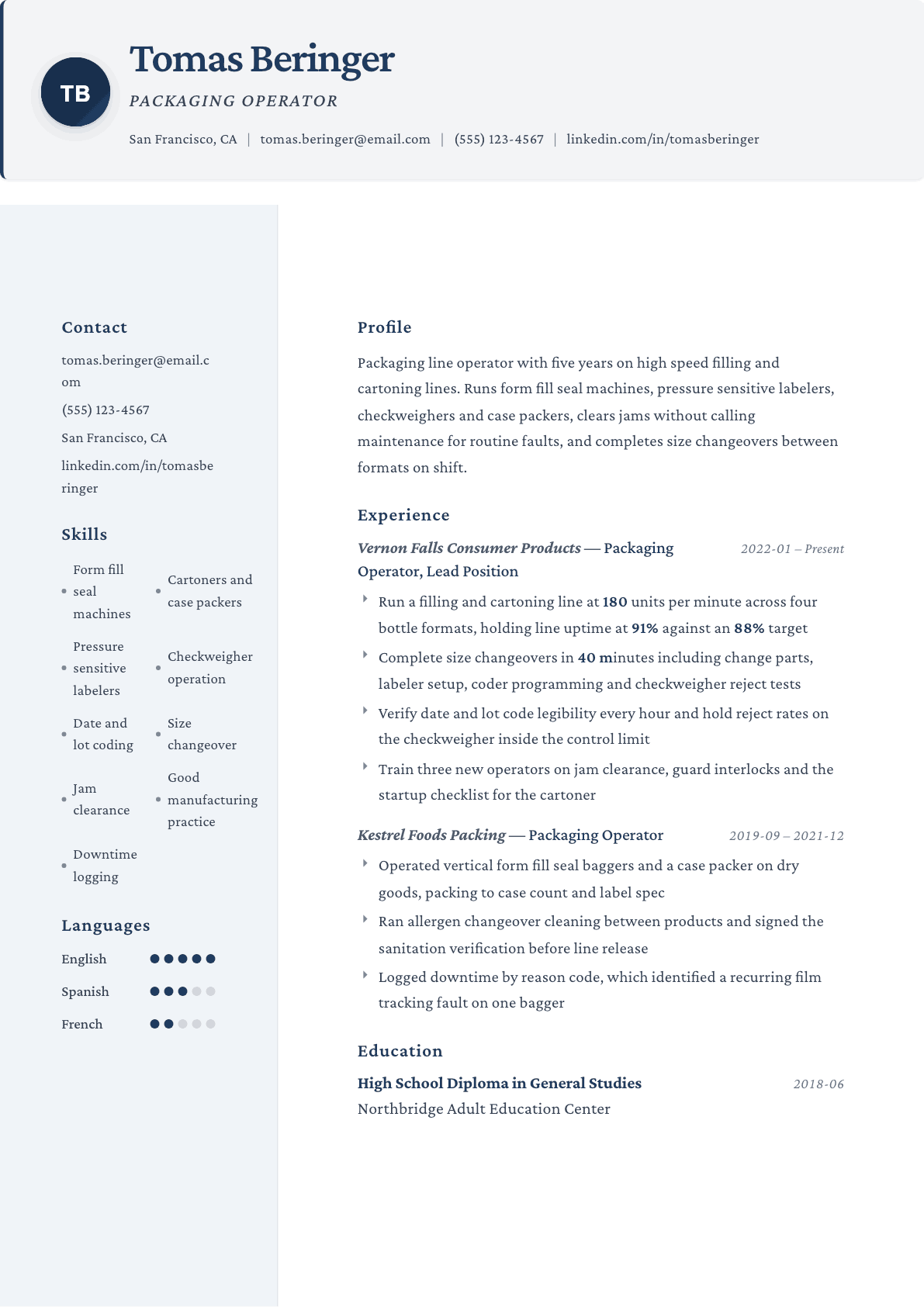
Example Packaging Operator summary
Packaging operator with five years on high speed filling and cartoning lines running fillers, labelers, coders, checkweighers and case packers. Holds line uptime above target at 180 units per minute, completes format changeovers inside the standard including change parts and coder programming, and clears routine jams without pulling a mechanic off another line. Verifies date and lot codes hourly and runs allergen changeover cleaning before line release.
Skills to list on a Packaging Operator resume
- Vertical and horizontal form fill seal
- Liquid and powder filling
- Capping and sealing
- Pressure sensitive labeling
- Cartoner operation
- Case packing and palletizing
- Checkweigher and metal detection
- Date and lot code programming
- Size changeover and change parts
- Jam clearance and minor stops
- Guard interlocks and safe access
- Good manufacturing practice
- Sanitation and allergen changeover
- Downtime reason coding
- Pallet labeling and staging
What actually gets this resume read
- Name each machine on your line: filler, capper, labeler, coder, checkweigher, case packer, palletizer.
- Give line speed in units per minute alongside uptime, because one number without the other means little.
- Put your changeover time on the page with the format count, since that is the plant bottleneck.
- Say which faults you clear yourself and which go to maintenance, so a supervisor can size your independence.
- Include coding and label verification, because a wrong date code turns into a recall conversation quickly.
- Mention allergen and sanitation changeovers if you work food, along with who signs the release.
How to write a packaging operator resume
Packaging is where a plant either makes its schedule or loses it. The line runs at a set rate, and every minor stop, jam and changeover comes straight off the day. So the supervisor reading a packaging operator resume is looking for someone who keeps a line running and who does not create a labeling or coding mistake that turns into a customer recall.
Most resumes for this role read like a list of verbs: operated, packed, inspected, maintained. None of that tells the reader which machines you can start alone. A filler, a capper, a pressure sensitive labeler, a cartoner, a checkweigher and a palletizer are separate machines with separate faults, and naming them is the single biggest upgrade you can make.
This guide covers the resume structure a packaging supervisor scans, the numbers that make the page credible, how to write about changeovers and jams, before and after bullets, the food safety language that matters when you package edible product, and the questions operators ask about moving into a lead or technician seat.
Format: line layout first, then the jobs
One page, reverse chronological, opening with a line block instead of an objective. Describe your line the way the plant does, in flow order: filler, capper, induction sealer, labeler, coder, checkweigher, metal detector, case packer, palletizer. A supervisor reading that sees immediately where you overlap with her equipment.
Then the jobs, each opened with the product type and the line speed. Packaging pharmaceuticals, packaging dry cereal and packaging motor oil share machine categories but nothing else about the rules, and the reader wants that context before your bullets rather than after.
- Line block in flow order, with the machine categories you can start, run and clear alone.
- Product type and format count per line, since format variety is what makes changeover skill valuable.
- A separate line for coding, labeling and verification work, which is the highest risk task on the line.
- Food or drug plant rules named where they applied: sanitation, allergen control, gowning, line clearance.
Summary: speed, uptime, changeover, independence
Give line speed in units per minute, uptime or overall equipment effectiveness against the target you were held to, changeover time with the number of formats, and how much you fix without calling maintenance. Those four items describe a packaging operator completely, and a supervisor can compare them against her own line without translation.
The independence point deserves its own clause. Plants have a limited number of mechanics, and an operator who resets a labeler, rethreads film, clears a cartoner infeed and adjusts a capper torque without a work order is worth more per shift than one who stops and waits, even when both hold the same job title.
Experience: uptime, minor stops and changeover time
Write bullets around the four things a packaging line is measured on. Rate is first: units per minute sustained, not the machine nameplate. Uptime is second, given against the plant target so a reader can judge whether your number is strong. Third is changeover: time, format count, and the parts involved such as change parts, timing screws, star wheels, label reels and coder programs.
Fourth, and the one candidates undersell, is minor stops. Packaging lines die from small repeating faults, not from big failures. Say which faults you clear and how fast: film tracking on a bagger, an infeed jam on a cartoner, a label web break, a reject gate that trips on good product, a capper cross thread. Then say what you escalate and why.
If you track waste, put it in. Film, cartons, labels and product given up during startup and changeover are real cost, and an operator who reduced startup waste by tuning the sequence has a story that no general statement about efficiency can match.
Coding, verification and the audit trail
The most expensive mistake a packaging operator makes is not a jam. It is a wrong date code, a wrong label or a missed line clearance that lets one product carry another product identity into distribution. Describe how you verify: code checks at startup and at set intervals, label reconciliation, first case approval and the second signature that releases the line.
For food and drug plants, name the controls you worked under: allergen changeover cleaning, pre-operational sanitation checks, metal detector and checkweigher challenge tests with test pieces, and retained samples. Those phrases tell a hiring plant that you already work inside an audited system rather than needing to be taught what one is.
Keywords a packaging posting screens for
Postings repeat the same terms: form fill seal, cartoner, case packer, palletizer, checkweigher, metal detector, labeler, coder, changeover, change parts, line clearance, good manufacturing practice, overall equipment effectiveness and minor stops. Put them where the work is real and let each one appear in a bullet that shows something.
Add the systems you touch. Operators who enter production counts, downtime reasons and waste into a plant system without being reminded are quietly more useful than those who leave the paperwork to a lead, and putting that on the page costs one short bullet.
Packaging Operator resume summary examples
First packaging job
Warehouse and production background moving into packaging, with 7 months on a case packer and palletizer running dry goods. Trained in guard interlocks, jam clearance, pallet labeling and good manufacturing practice. Seeking a packaging operator seat with progression onto filling equipment.
Four years in
Packaging operator with 4 years on filling and cartoning lines at 180 units per minute. Holds uptime at 91% against an 88% target, completes four format changeovers in 40 minutes each, and clears film, infeed and labeler faults without a maintenance call.
Line lead
Packaging line lead with 9 years across food and household product plants, running crews of six on two lines. Owns changeover sequence and startup approval, cut startup waste by a third on the bagger line, and trains operators on coding verification and line clearance.
Work experience bullets: before and after
Before: Operated packaging machinery on the production line.
After: Ran a filling and cartoning line at 180 units per minute across four bottle formats, covering filler, capper, labeler, coder, checkweigher and case packer.
Naming every machine in flow order shows the reader exactly where you overlap with her line.
Before: Performed changeovers between products.
After: Completed size changeovers in 40 minutes including change parts, labeler setup, coder programming and a checkweigher reject test before release.
The step list makes the time believable and shows the release check that closes a changeover.
Before: Fixed problems on the line as they came up.
After: Cleared film tracking faults on the bagger and cartoner infeed jams without a work order, keeping minor stops under six an hour on the fastest format.
Specific faults and a stop rate turn a vague claim into a supervisor level measurement.
Before: Checked date codes and labels.
After: Verified date and lot code legibility at startup and hourly, ran metal detector challenge tests with test pieces each shift, and held two lines for a coder fault before product left the room.
The verification interval and the hold decision are what protect the plant from a recall.
Before: Helped reduce waste on the line.
After: Cut startup carton and label waste by resequencing the changeover so the coder and labeler were proved on scrap stock before the filler released product.
The mechanism shows how the saving happened and lets a supervisor apply it elsewhere.
Hard skills
- Vertical and horizontal form fill seal
- Liquid, powder and auger filling
- Capping, torque setting and induction sealing
- Pressure sensitive and wrap around labeling
- Cartoner and case packer operation
- Palletizer and stretch wrapper operation
- Checkweigher and metal detector challenge tests
- Date and lot coder programming
- Size changeover and change parts
- Minor stop and jam clearance
- Line clearance and label reconciliation
- Allergen changeover and sanitation checks
- Waste and downtime recording
- Guard interlock and safe access rules
Soft skills
- Keeping the check rhythm when the line is running well
- Deciding fast whether a fault is yours or the mechanic's
- Handing a running line over without losing the fault history
- Working a crew position without breaking someone else's rhythm
- Staying calm during an audit walk on your line
Certifications worth listing
- ServSafe Food Handler (National Restaurant Association)
- Certified Production Technician (CPT) (Manufacturing Skill Standards Council)
- OSHA 10-Hour General Industry (OSHA Outreach Training Program, U.S. Department of Labor)
Mistakes that cost packaging operator candidates the interview
- Writing operated packaging equipment without naming a single machine in the line flow.
- Giving nameplate speed instead of the rate you actually sustained across a shift.
- Leaving changeover time off the page when it is the number a packaging supervisor lives with daily.
- Ignoring minor stops, which are the real reason a packaging line misses its schedule.
- Skipping coding and label verification, the tasks that carry the highest consequence on the whole line.
- Using warehouse language for line work, which makes a packaging operator read as a general laborer.
Packaging Operator resume questions
How do I show uptime if my plant never gave me the number?
Use what you can defend: cases produced per shift against the standard, minor stops per hour, or the count of shifts you finished the order. Never invent an efficiency figure, because a supervisor will ask how it was measured and where it came from.
Does packaging experience transfer between industries?
Machine skills transfer well and the rules do not. A cartoner behaves the same in a cosmetics plant and a food plant, but sanitation, allergen control and documentation change completely. Name your machines first, then show which rule set you already work under.
Should I mention forklift or pallet jack work?
Include it briefly if you hold a current employer evaluation, since packaging operators often stage pallets and load a wrapper. Keep it to one line so the resume still reads as a machine operator page rather than a material handler page.
How do I move from operator to packaging technician?
Shift the emphasis from running the line to fixing it. Show the faults you diagnosed, the change parts you set, the timing adjustments you made and any preventive maintenance you performed. Technicians are hired on repair evidence, not on years on the line.
What if I worked several lines rather than one?
That is a strength, so present it as coverage. List each line by product and machine set, then say how many you could start alone. A supervisor with holiday cover and absence to plan values an operator who can move between lines the same week.
Related resume examples
- Production Worker Resume example
- Machine Operator Resume example
- Warehouse Associate Resume example
- Production Supervisor Resume example
- Injection Molding Operator Resume example
- Meat Cutter Resume example