Meat Cutter Resume Examples: free ATS score and gap list
Build a Meat Cutter Resume That Proves Your Yield
By Mustafa Tarabya, founder of CVBooster · Published · Updated
Meat cutter resume example, keyword list and guide covering primals, boning, band saw work, yield tracking, case sets and cold chain records.
Sample resumes for a meat cutter
The same meat cutter content laid out in three CVBooster templates, so you can see what the finished document looks like before you write a word.
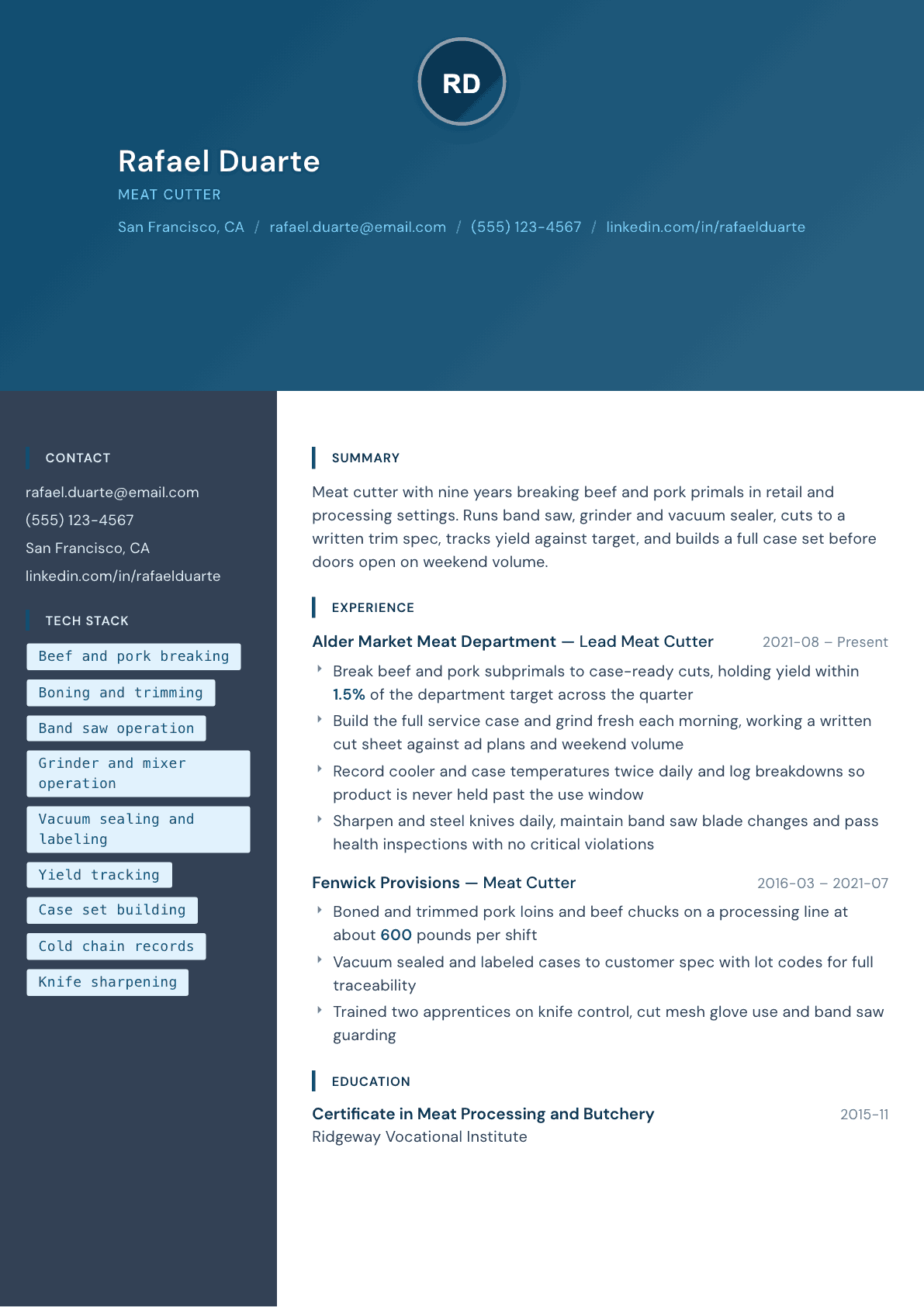
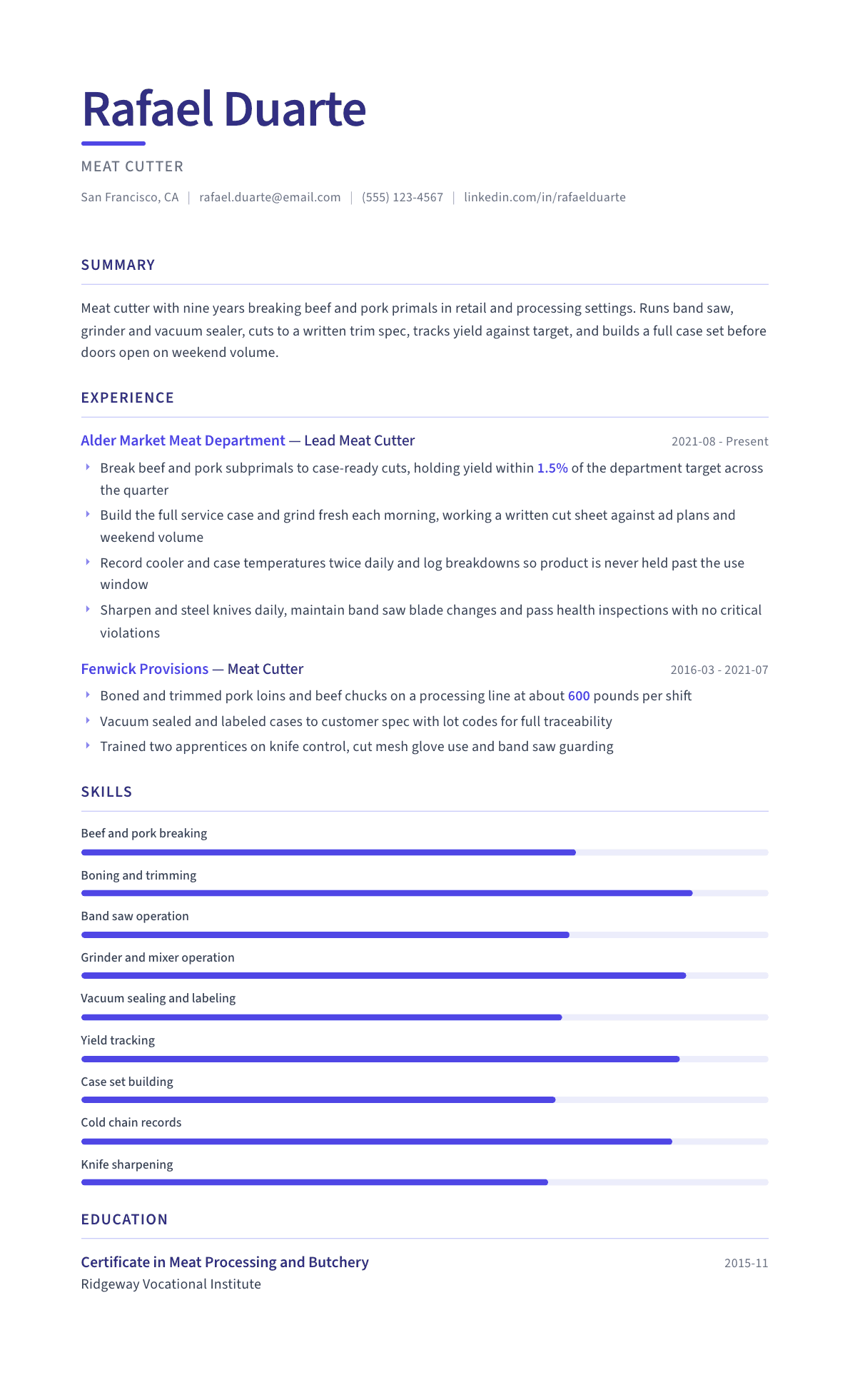
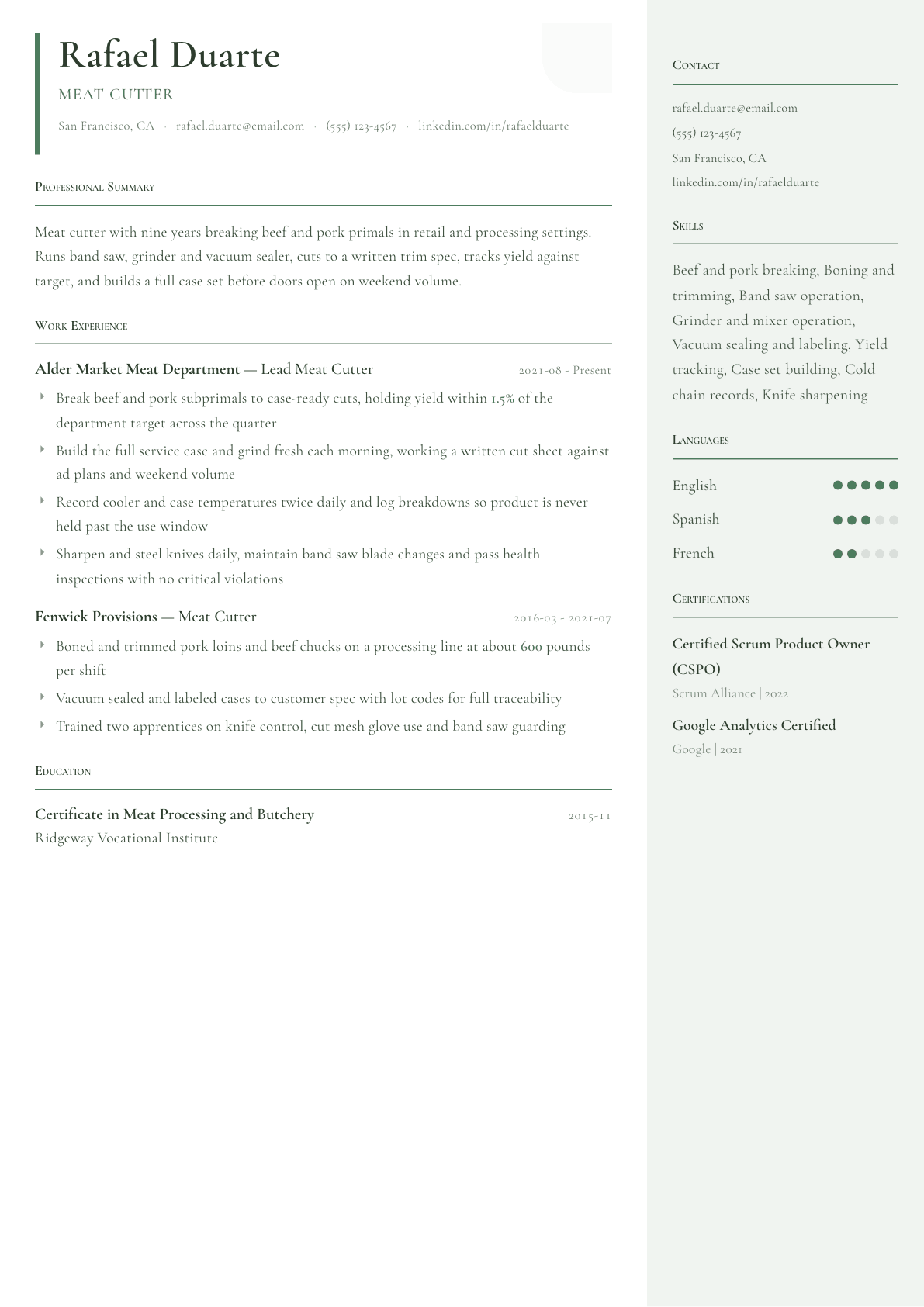
Example Meat Cutter summary
Meat cutter with nine years breaking beef and pork primals across retail service counters and a processing line. Cuts to a written trim spec, holds yield close to the department target, and runs band saw, grinder, patty former and vacuum sealer. Builds a full service case before doors open and writes the cut sheet against the ad plan. Logs cooler temperatures twice daily and has closed inspections with no critical violations.
Skills to list on a Meat Cutter resume
- Beef primal and subprimal breaking
- Pork fabrication
- Boning and seam butchery
- Trim specification cutting
- Band saw operation and guarding
- Grinder and mixer operation
- Patty forming
- Vacuum sealing and case labeling
- Yield and shrink tracking
- Service case merchandising
- Cut sheet planning
- Cold chain temperature logging
- Knife sharpening and steeling
- Cut resistant glove and mesh use
- Sanitation and equipment breakdown cleaning
What actually gets this resume read
- Say which species you break: beef, pork, lamb and poultry are separate hands and separate hiring lines.
- Give your yield against the target you were held to, because that number decides the department margin.
- Name the equipment you run: band saw, grinder, mixer, tenderizer, vacuum sealer and patty machine.
- Show whether you build the case and write the cut sheet, or cut to someone else's plan.
- Put temperature logging and inspection results on the page, since a critical violation ends a job quickly.
- Mention retail service counter work separately from processing line work, because the pace differs entirely.
How to write a meat cutter resume
A meat manager hiring a cutter is buying yield, speed and safety in that order. She knows what a case of subprimals costs, she knows what her department margin is supposed to be, and she knows a cutter with poor knife control turns that margin into trim. Your resume needs to speak to those numbers rather than to a general love of the trade.
The resumes that get set aside describe cutting meat and serving customers. The ones that get called name the species, the primals, the equipment and the yield. A cutter who can break a beef chuck to spec, run a band saw safely and build a full service case before doors open is a specific and scarce hire, and the page should say so.
This guide sets out the layout a meat department or processing plant expects, what belongs in the summary, how to write experience so it shows yield and pace, before and after bullets, the food safety records that keep a department open, and the questions cutters ask when they move between retail and processing.
Format: species and equipment before anything else
One page, reverse chronological, with a species and cuts block under your name. Beef, pork, lamb, veal and poultry are separate hands. So are whole animal breaking, subprimal fabrication and case-ready cutting. Name what you have done and at what level, because a manager will not assume breadth from a job title.
Follow it with the equipment line: band saw, grinder, mixer, tenderizer, patty former, slicer, vacuum sealer and tumbler. Then the setting for each job, retail service counter, back room case-ready, or a processing plant line, since the pace and the paperwork differ sharply between them.
- Species and cuts block naming what you break, fabricate and merchandise.
- Equipment line covering saw, grinder, mixer, sealer, slicer and any patty or portioning machine.
- Setting labeled per job: retail counter, supermarket back room, wholesale or processing plant.
- Records and inspection outcomes: cooler logs, sanitation, health inspection results, audit findings.
Summary: species, yield, pace and case ownership
Four lines at most. Years cutting, species and primals, the yield you held against target, and whether you own the case and the cut sheet or work to someone else's plan. Yield is the number a meat manager thinks about all day, and a cutter who volunteers it is speaking her language immediately.
Add pace if you have it. Pounds broken per shift, cases fabricated per hour or the weekend volume you cut for tells a manager whether you can hold a holiday week. Vague claims about working hard say nothing, while a volume figure with the day it applied to says everything.
Experience: cut sheets, yield and the service case
Start each job with the setting, the volume and the species mix. Then write bullets around four things. Breaking and fabrication first: which primals and subprimals, cut to what trim spec, at what pace, and whether you worked from a written cut sheet or wrote it.
Yield and shrink second. Give the yield against target, and if you improved it say how: better seam work, tighter trim to spec, less bone loss on the saw, or a grind plan that used trim instead of dumping it. Managers rarely see this on a resume and it separates a cutter from a trimmer.
Merchandising third, for retail roles: building the case, rotating stock, using the ad plan to set the cut mix, marking down before shrink rather than after, and cutting to customer request at the counter. Safety and sanitation fourth: knife sharpening routine, cut resistant glove and mesh use, saw guarding, cooler temperature logs and equipment breakdown cleaning.
Food safety and inspection outcomes
A meat department can be shut down in an afternoon, so hiring managers read the safety part of your resume properly. Give your temperature logging routine, product rotation and use window discipline, sanitizer concentration checks, and equipment breakdown and reassembly at close.
Then give outcomes. Health inspections passed without critical violations, third party audits worked through, or a customer complaint investigation you supported with lot records. If you work in a plant under federal inspection, say how you handled inspector requests and hold and release decisions, because that experience does not exist in every retail background.
Words a meat posting screens for
Meat postings repeat a small set of terms: primal, subprimal, break, bone, seam, trim spec, case-ready, cut sheet, grind, band saw, yield, shrink, cold chain and sanitation. Use them where the work was real. A manager scanning quickly is looking for exactly these words in the right relationship to each other.
Add the customer facing side if you have it, since retail cutters serve at a counter as well as cutting. Special orders, portioning to a weight request, recommending a cut for a cooking method and holiday order handling all belong on a retail meat cutter resume and none of them belong on a plant line resume.
Meat Cutter resume summary examples
Apprentice cutter
Meat processing certificate holder with 10 months as an apprentice cutting pork loins and beef rounds under a lead cutter. Trained on band saw guarding, grinder breakdown, cut resistant equipment and cooler temperature logging. Seeking a full time meat cutter position in a retail department.
Six years in
Meat cutter with 6 years breaking beef and pork subprimals to case-ready cuts in a supermarket back room. Holds yield within 1.5% of department target, builds the full service case daily from the ad plan, and has passed every health inspection with no critical violations.
Lead cutter
Lead meat cutter with 14 years across retail counters and a wholesale processing line. Writes the weekly cut sheet against ad plans and forecast, trains apprentices on seam work and saw safety, and holds shrink below the target the department has carried for 3 years.
Work experience bullets: before and after
Before: Cut meat and prepared it for sale.
After: Broke beef and pork subprimals into case-ready cuts to a written trim spec, working about 700 pounds a shift across steaks, roasts and grind.
Species, cut level, spec and volume give a meat manager a real production picture.
Before: Kept waste down in the department.
After: Held yield within 1.5% of department target by tightening seam work on chucks and routing usable trim into fresh grind rather than the waste barrel.
A yield figure with the technique behind it is the strongest line a cutter can write.
Before: Stocked the meat case each day.
After: Built the full service case before opening from a cut sheet set against the weekly ad, rotating stock by pack date and marking down ahead of the use window rather than after it.
Case ownership and markdown timing show merchandising judgment, not just stocking.
Before: Used the band saw and grinder.
After: Ran band saw, grinder, mixer and patty former daily, changed saw blades on schedule, and completed full equipment breakdown and sanitation at close with no lost time injuries in 6 years.
Equipment named with maintenance and a safety record reads as a trained operator.
Before: Made sure everything was clean and at the right temperature.
After: Logged cooler and case temperatures twice daily, checked sanitizer concentration at each breakdown, and closed 4 health inspections with no critical violations.
Logging frequency plus an inspection outcome is verifiable where a cleanliness claim is not.
Hard skills
- Beef primal and subprimal breaking
- Pork and lamb fabrication
- Seam butchery and boning
- Cutting to written trim specification
- Band saw operation and blade changes
- Grinder and mixer operation
- Patty forming and portion control
- Slicing and vacuum sealing
- Case-ready packaging and labeling
- Yield and shrink tracking
- Cut sheet planning against ad plans
- Service case merchandising and rotation
- Cold chain temperature logging
- Knife sharpening and steeling
- Equipment breakdown and sanitation
Soft skills
- Holding knife control at the end of a long weekend shift
- Reading a customer request and suggesting the right cut
- Teaching an apprentice without slowing the block
- Judging when a case needs rebuilding rather than topping up
- Keeping a cool head during holiday order volume
Certifications worth listing
- ServSafe Food Handler (National Restaurant Association)
- Accredited HACCP Training Certificate (International HACCP Alliance)
Mistakes that cost meat cutter candidates the interview
- Writing cut meat without naming species, primals or the trim spec you worked to.
- Omitting yield, which is the one number a meat department manager is measured on herself.
- Listing equipment without the maintenance and guarding habits that make a saw operator safe.
- Treating retail counter work and processing line work as the same job on the same resume.
- Forgetting temperature logs and inspection outcomes, the records that keep a department trading.
- Never mentioning the cut sheet, so the reader assumes you cut whatever somebody hands you.
Meat Cutter resume questions
How do I show yield if my store never shared the numbers?
Use what you saw: trim discipline, how you used usable trim in grind, bone loss control on the saw, and any feedback the manager gave on your blocks. Describe the practice honestly rather than attaching a figure you cannot support in an interview.
Is a meat cutter resume different for a plant than for a supermarket?
Yes. A plant wants pace, spec adherence, line position coverage and inspection experience. A supermarket wants case building, customer service, ad plan cutting and markdown judgment. Reorder your bullets so the first three match whichever one you are applying to.
Should I list knife skills as a skill?
Not as the words knife skills, which every applicant writes. Show them instead through seam work, boning, portion accuracy to a weight request and a sharpening routine. Those specifics prove hands that a general phrase can only claim.
What do I put down if I trained on the job with no certificate?
Put the training where the education section would be: who trained you, over how long, on which species and cuts, and what you were signed off to do alone. On the job training is the normal route in this trade and managers respect it when it is described precisely.
How important is safety history on this resume?
It matters more here than in most production roles because saws, grinders and sharp blades produce serious injuries. State your lost time record, cut resistant equipment use and guarding habits plainly, since a manager reading two similar resumes will take the one with the safety evidence.
Related resume examples
- Butcher Resume example
- Food Production Worker Resume example
- Line Cook Resume example
- Food Safety Inspector Resume example
- Forestry Worker Resume example
- Packaging Operator Resume example