Starbucks Interview Questions and Answers: 6 Full Samples
By Mustafa Tarabya, founder of CVBooster · Published · Updated
9 min read
Starbucks interview questions are mostly behavioral: tell me about a time you helped a customer, worked with a team or stayed calm when it got busy, plus why Starbucks and when you can work. The constraint is that the interviewer wants a real moment from your life, not a promise about how you would behave. Starbucks says so on its own hiring process page, which tells applicants to "Familiarize yourself with behavioral-based interviewing and prepare examples reflecting competencies of the role". Below are the questions you will hear for barista and shift supervisor roles, six complete sample answers and a short preparation plan. Written by Mustafa Tarabya, who hired for his own company, read every application himself and now writes CVBooster's guides.
You will be interviewed in a coffeehouse, at a small table, while a milk steamer screams behind you and someone orders a drink with seven modifications. Nobody will mention it. Answer anyway.
Starbucks interview questions: what they ask
The questions fall into five areas. Expect one or two from each:
- Motivation: Why Starbucks? What is your favorite drink?
- Customer connection: Tell me about a time you made a customer's day. Tell me about a time a customer was unhappy.
- Teamwork: Tell me about a time you helped a coworker. How do you handle a teammate who is not pulling their weight?
- Pace and pressure: Tell me about a time you had several things to do at once. How do you stay accurate in a rush?
- Availability: What hours can you work? Tell me about a time you were late, and what you did.
Harvard's career office explains why so many of these ask about a past moment in its interviewing guide: "The principle behind this type of interview is that past behavior is a good predictor of future behavior." It does not have to come from a café: school, sport, babysitting and volunteering all count.
Why do you want to work at Starbucks?
This is the usual opener. Name something specific about the job, connect it to something you have done, and stay under a minute. Starbucks publishes its values on its mission page, including "We actively listen and connect with warmth and transparency". You can use that language, but only if you back it with a real moment.
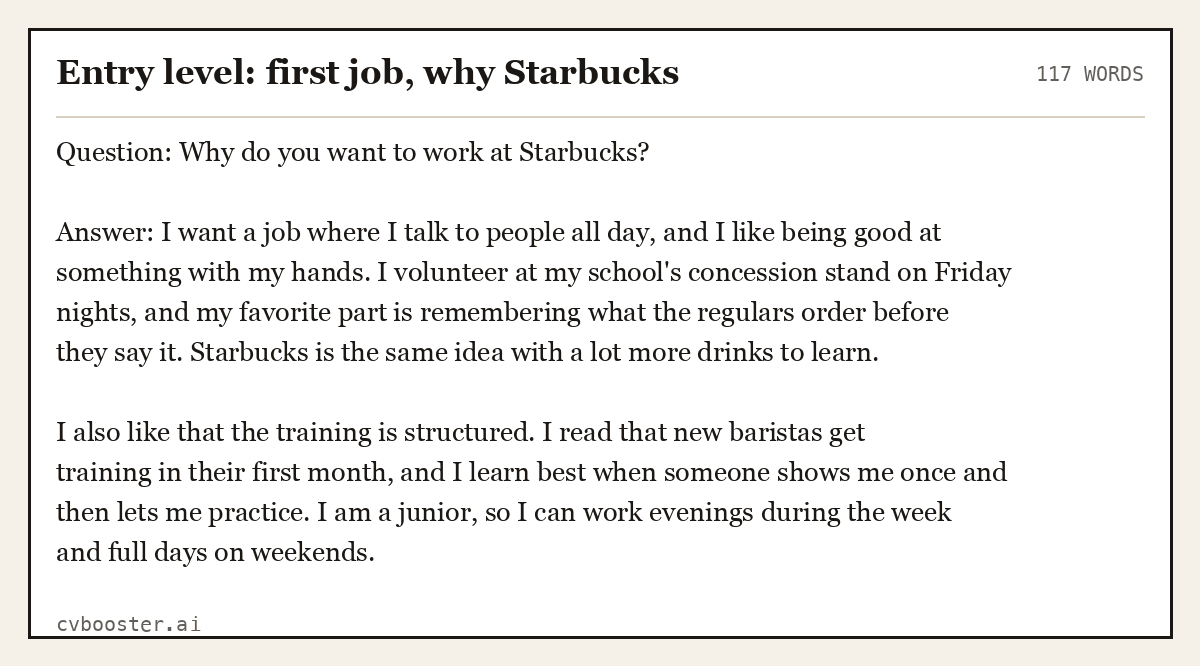
Entry level: first job, why Starbucks (117 words)
Question: Why do you want to work at Starbucks?
Answer: I want a job where I talk to people all day, and I like being good at something with my hands. I volunteer at my school's concession stand on Friday nights, and my favorite part is remembering what the regulars order before they say it. Starbucks is the same idea with a lot more drinks to learn.
I also like that the training is structured. I read that new baristas get training in their first month, and I learn best when someone shows me once and then lets me practice. I am a junior, so I can work evenings during the week and full days on weekends.
Customer service questions
These are the heart of the barista interview. The interviewer wants to see that you stay warm when something goes wrong and that you fix the problem rather than defend yourself. Use a short STAR shape: the situation, what you had to do, what you did, how it ended.
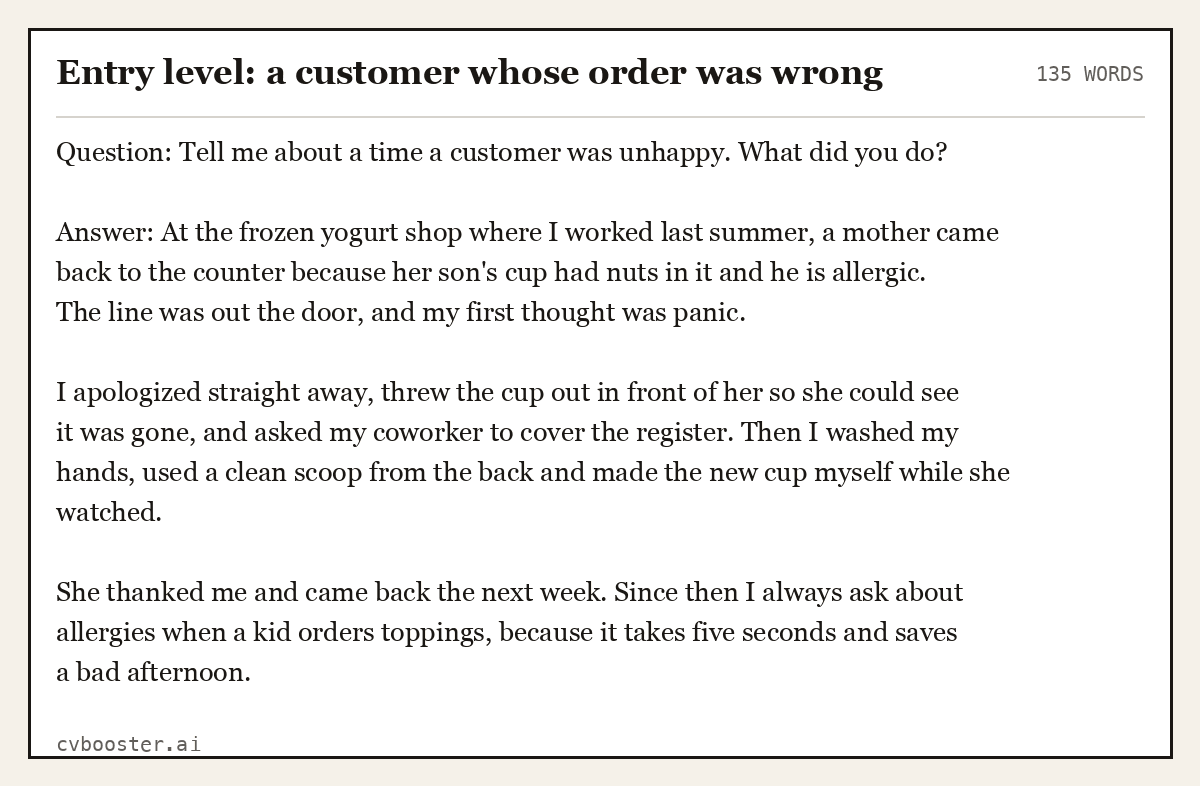
Entry level: a customer whose order was wrong (135 words)
Question: Tell me about a time a customer was unhappy. What did you do?
Answer: At the frozen yogurt shop where I worked last summer, a mother came back to the counter because her son's cup had nuts in it and he is allergic. The line was out the door, and my first thought was panic.
I apologized straight away, threw the cup out in front of her so she could see it was gone, and asked my coworker to cover the register. Then I washed my hands, used a clean scoop from the back and made the new cup myself while she watched.
She thanked me and came back the next week. Since then I always ask about allergies when a kid orders toppings, because it takes five seconds and saves a bad afternoon.
If you have no work history, a school or family example works. What matters is that the story has a problem, a real action from you and an outcome.
Teamwork and pace questions
A coffeehouse at 7:45 on a weekday morning is a team sport played at speed. These questions check whether you communicate, help without being asked, and keep quality when the line gets long.
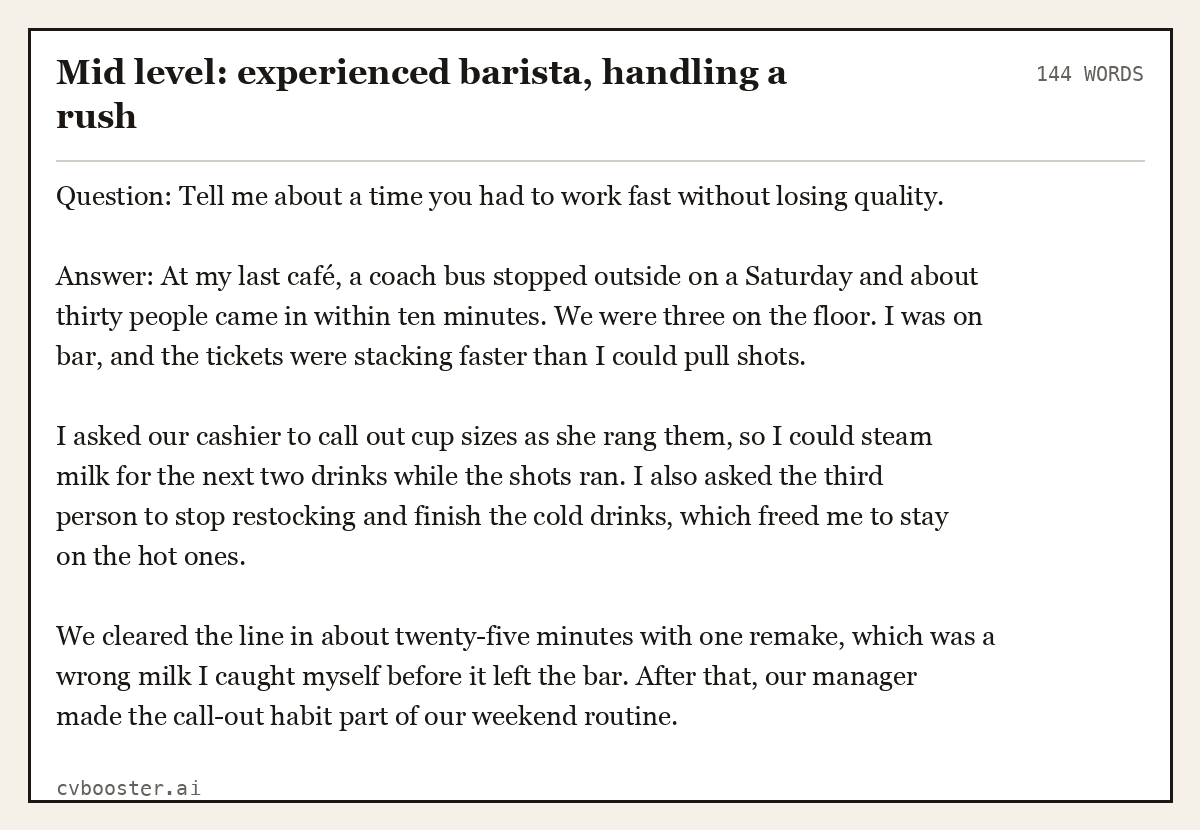
Mid level: experienced barista, handling a rush (144 words)
Question: Tell me about a time you had to work fast without losing quality.
Answer: At my last café, a coach bus stopped outside on a Saturday and about thirty people came in within ten minutes. We were three on the floor. I was on bar, and the tickets were stacking faster than I could pull shots.
I asked our cashier to call out cup sizes as she rang them, so I could steam milk for the next two drinks while the shots ran. I also asked the third person to stop restocking and finish the cold drinks, which freed me to stay on the hot ones.
We cleared the line in about twenty-five minutes with one remake, which was a wrong milk I caught myself before it left the bar. After that, our manager made the call-out habit part of our weekend routine.
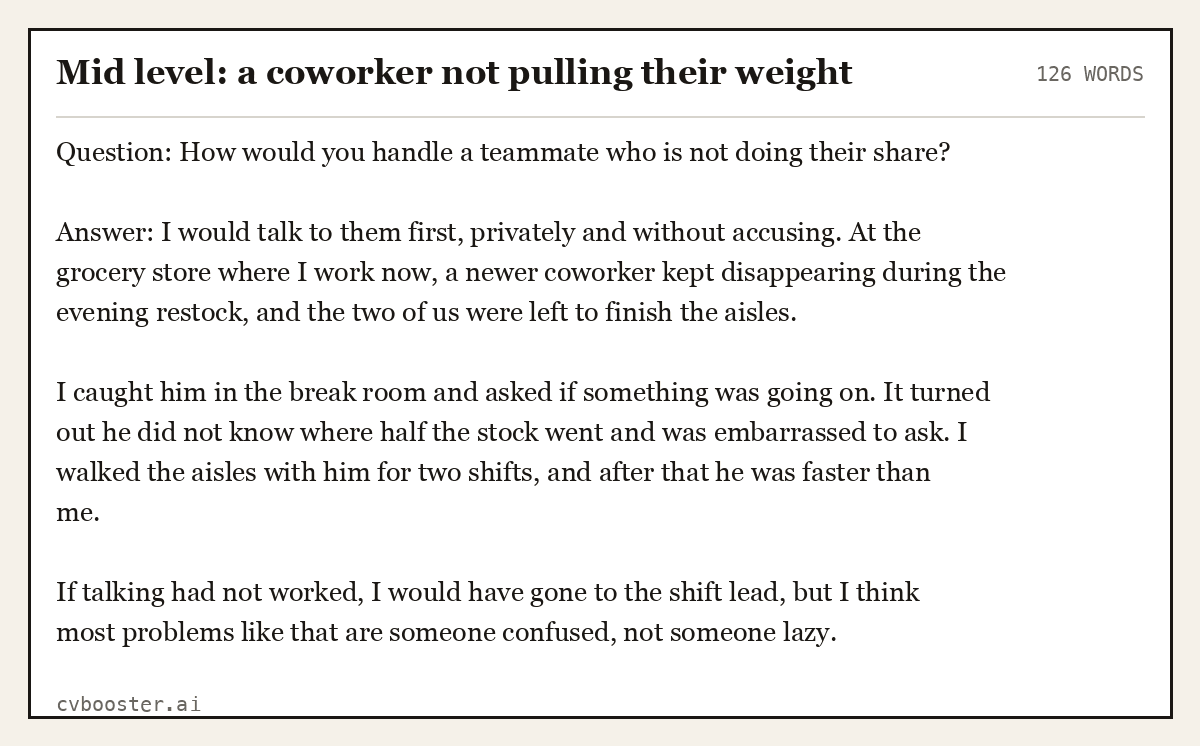
Mid level: a coworker not pulling their weight (126 words)
Question: How would you handle a teammate who is not doing their share?
Answer: I would talk to them first, privately and without accusing. At the grocery store where I work now, a newer coworker kept disappearing during the evening restock, and the two of us were left to finish the aisles.
I caught him in the break room and asked if something was going on. It turned out he did not know where half the stock went and was embarrassed to ask. I walked the aisles with him for two shifts, and after that he was faster than me.
If talking had not worked, I would have gone to the shift lead, but I think most problems like that are someone confused, not someone lazy.
Starbucks shift supervisor interview questions
A shift supervisor runs the floor: deployment, breaks, cash, and the call when something goes wrong. Starbucks describes the role on its coffeehouse careers page as one where "you'll run shifts, lead the coffeehouse team and make decisions that impact operations." Expect questions about leading peers, handling a call-out and coaching.
Senior level: shift supervisor, a call-out before the morning peak (148 words)
Question: Tell me about a time you were short-staffed. How did you handle it?
Answer: As a shift lead at a bakery café, I got a text at 5:40 one morning that our second barista was sick, and we open at 6:00. I had two people instead of three for the busiest two hours.
I called the one person on the backup list who lived close, and she could come in at 7:30. Until then, I put myself on bar, kept our strongest person on the register and drive-through, and paused the pastry restock until the backup arrived. I told the team the plan in one sentence, so nobody wondered who was doing what.
We had longer waits than usual between 6:30 and 7:30, but no remakes and no complaints. Afterward I asked my manager to keep a short backup list for every opening shift, which she did.
Other questions for this level include how you would coach a barista who keeps making the same drink wrong, how you would handle a cash drawer that is short, and how you would give feedback to someone who used to be your peer.
How to prepare for a Starbucks interview
Starbucks gives its own checklist on its hiring process page, and it is short enough to follow in an evening. It asks applicants to "Prepare 3-5 thoughtful questions for the interviewer" and to "Send a thank you note within 48 hours to the hiring manager or, if needed, to the recruiter to pass along." Our thank you letter guide has short notes you can adapt. Here is a plan that covers that list:
- Read the job posting twice. Underline every skill it names and match each one to a story from your life.
- Write four short stories. A happy customer, an unhappy customer, a time you helped a teammate, a time you were busy. Each one under a minute out loud.
- Know your availability. Write the exact hours you can work. A coffeehouse builds its schedule around those hours, so vague availability makes you hard to place.
- Know the menu a little. You do not need recipes, but know your own order and one drink you would like to learn.
- Prepare three questions. For example: what does training look like in the first month, and what does a great barista on this team do that others do not.
CareerOneStop, run by the US Department of Labor, adds a practical rule in its interview tips: "Plan your schedule so you arrive 10 to 15 minutes early." At a coffeehouse, use those minutes to watch the floor. You will often get asked what you noticed.
A Starbucks interview answer for a career changer
Plenty of people apply to Starbucks after another career, for the flexible hours, the benefits or a fresh start. The question you will get is some version of why this, why now. Answer it head on.
Career changer: office administrator moving to a barista role (127 words)
Question: You have worked in offices for eight years. Why do you want to be a barista?
Answer: I want work where I can see the result of my day. In my last job as an office administrator, the part I liked most was the front desk: greeting visitors, sorting out problems on the spot, remembering who needed what. The part I liked least was the spreadsheets.
I also need hours that fit my kids' school schedule, and the coffeehouse schedule gives me that.
What I bring is calm. I have handled a lobby full of angry visitors when the elevator broke, and a line of people waiting for coffee does not scare me. I am ready to learn the drinks from the start like anyone else.
If you also need the application itself, the barista resume guide shows how to list café and customer service work, and the barista cover letter covers the letter some stores still ask for. For the question bank behind most of these answers, see the STAR interview questions guide, and for another counter-service interview, the Wendy's interview questions cover crew and shift manager answers.
Frequently asked questions
What questions do they ask at a Starbucks interview?
Most questions are behavioral: tell me about a time you made a customer happy, handled an unhappy customer, helped a teammate or worked under pressure. You will also be asked why you want to work at Starbucks, what hours you can work and, for supervisor roles, how you would lead a shift. Prepare one short true story for each.
Is a Starbucks interview hard?
The questions are not technical, and the drinks are taught on the job: Starbucks says new employees get training in their first month. What makes it hard is that every answer needs a real example. Candidates who struggle usually say how they would act instead of what they did. Four prepared stories from school, sport or past jobs cover most of the questions.
What should I wear to a Starbucks interview?
Wear something clean and neat, a step above what baristas wear on shift: dark trousers or jeans without rips and a plain top. Starbucks says its coffeehouse dress code "highlights our iconic green apron", so muted colors fit. Avoid strong perfume, because you will be standing in a room built around smell.
What happens after the Starbucks interview?
Starbucks advises sending a thank you note within 48 hours to the hiring manager. Some roles also ask applicants to complete Applicant Insights, an online questionnaire, which Starbucks describes on its careers FAQ as "not pass/fail". If you hear nothing after a week, a short polite follow-up to the store is fine.
How do I answer "what is your favorite drink" at Starbucks?
Name a drink you actually order and say one specific thing about it, for example why you like it iced or how you customize it. The interviewer is checking whether you enjoy the product and can talk about it warmly with a customer. One sentence on the drink and one on why is enough.
Related articles
- Accountancy CV Example: 6 UK Accounts CVs by Career Level
- Accounting Interview Questions and Answers: 7 Full Examples
- Activity Resume Example: 6 Samples for College Applications
- Administration CV Example: 6 Admin CVs from Entry to Senior
More articles
- Starbucks Resume Examples: 6 Samples From Barista to Manager
- Statement of Suitability Civil Service Example: EO and HEO
- Strength Based Interviewing: Questions and 7 Sample Answers
Looking for a worked example for your job title? Browse the resume examples by job title.