Material Handler Resume Examples: the lines they read
Write a Material Handler Resume That Shows Real Throughput
By Mustafa Tarabya, founder of CVBooster · Published · Updated
Material handler resume example with forklift, pick rate and safety keywords, plus a writing guide for warehouse, plant and distribution applications.
Sample resumes for a material handler
The same material handler content laid out in three CVBooster templates, so you can see what the finished document looks like before you write a word.
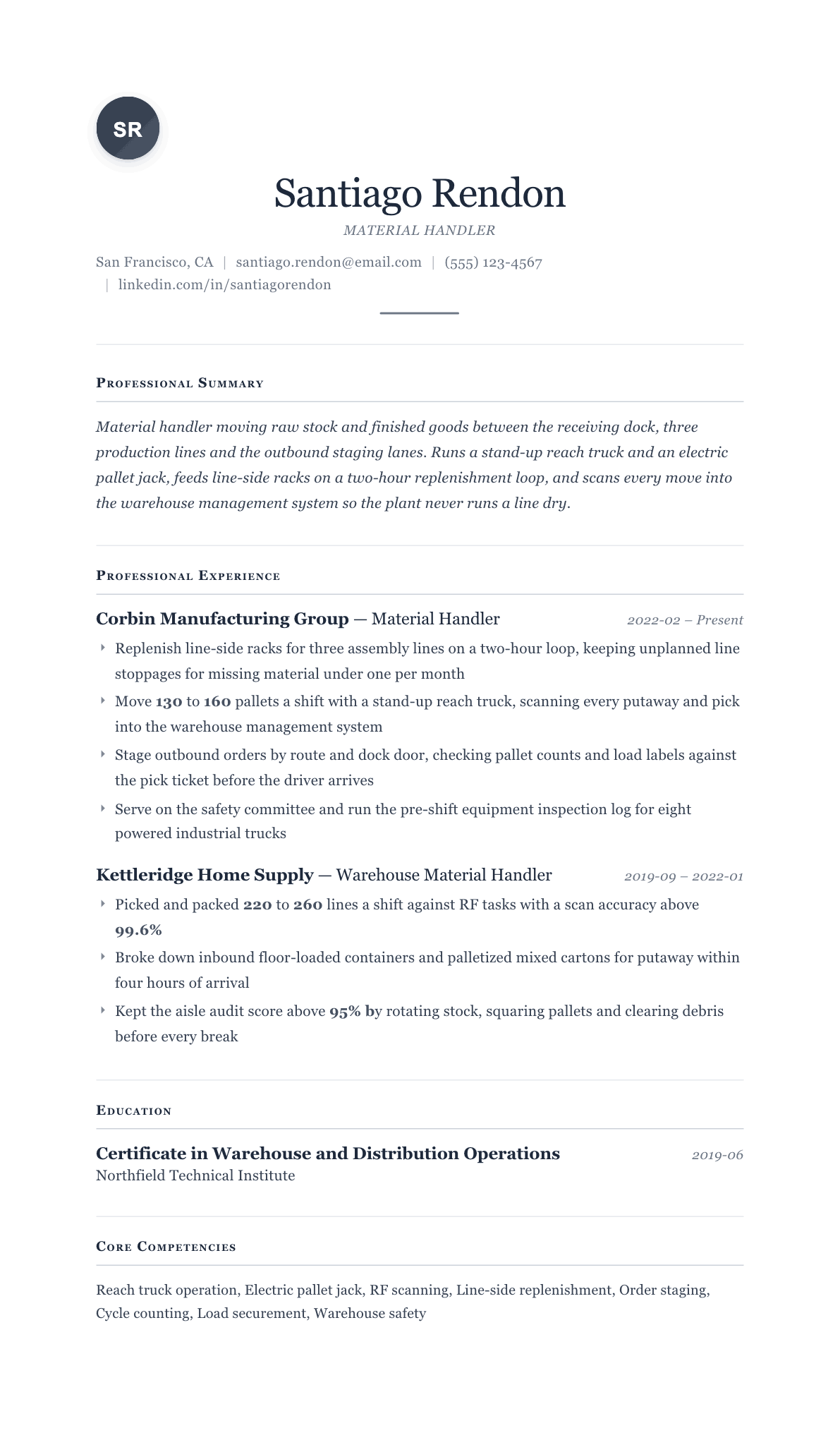
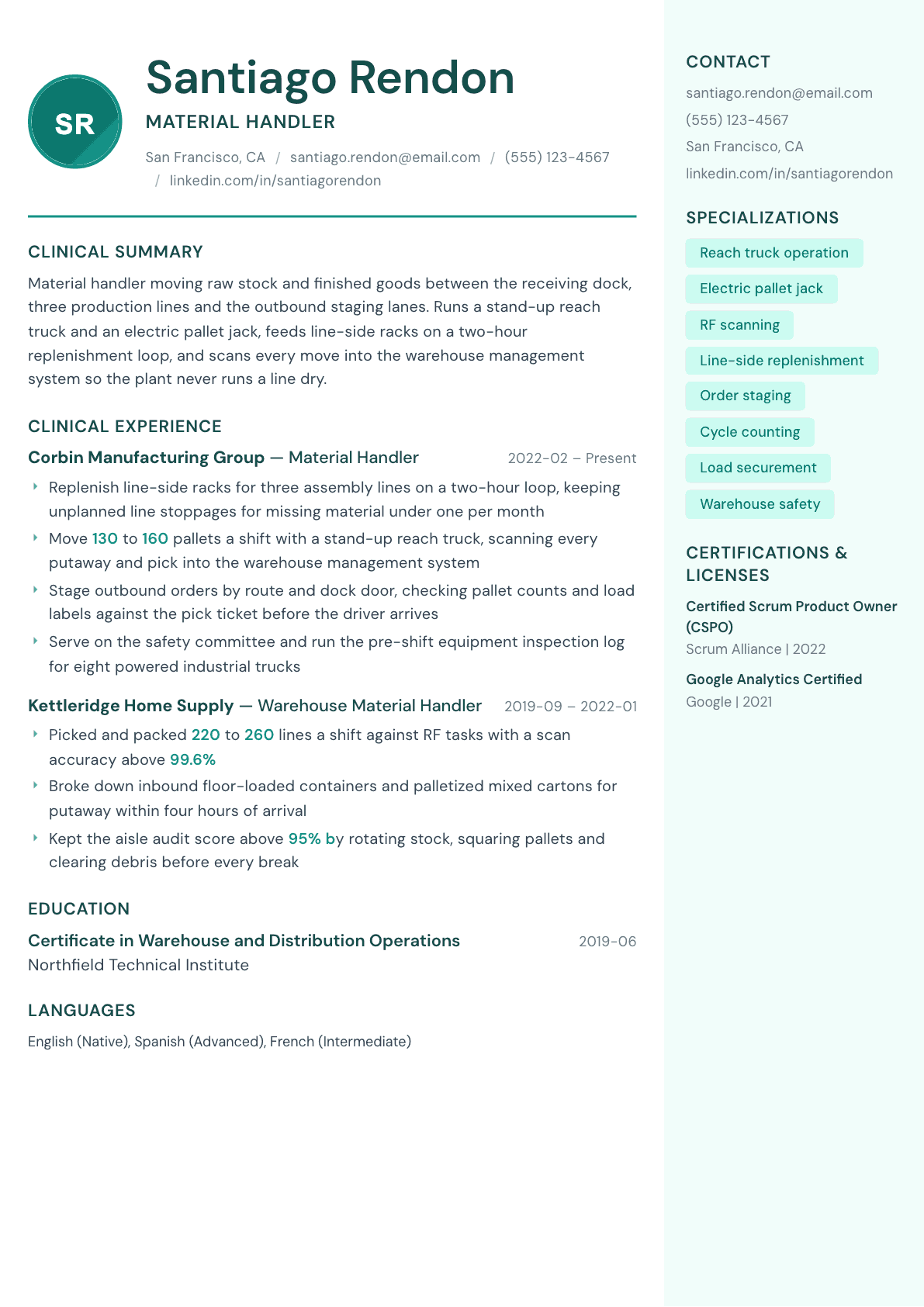
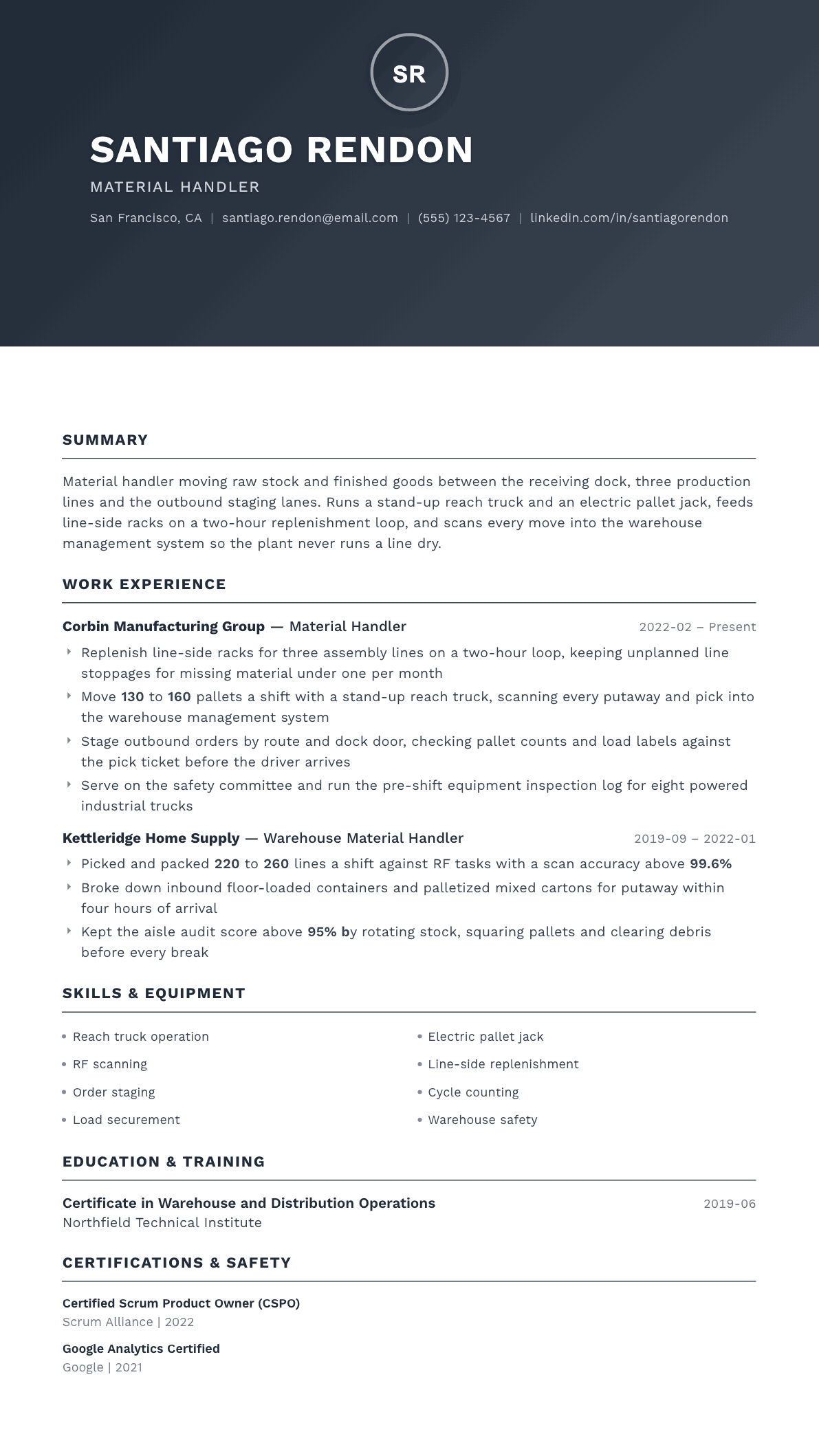
Example Material Handler summary
Material handler with four years in manufacturing and retail distribution, certified on stand-up reach truck, sit-down counterbalance and electric pallet jack. Moves 130 to 160 pallets a shift, keeps three assembly lines fed on a timed replenishment loop, and scans every transaction so inventory stays clean. Two years with no recordable injury and a seat on the plant safety committee.
Skills to list on a Material Handler resume
- Forklift operation
- Reach truck
- Order picker
- Electric pallet jack
- RF scanning
- Picking and packing
- Line-side replenishment
- Putaway
- Cycle counting
- Load securement
- Pallet building
- Lockout tagout awareness
- Warehouse safety
- Inventory transactions
What actually gets this resume read
- State the equipment you are certified on by name, because reach truck, order picker and sit-down forklift are three different hires.
- Put a throughput number on every job: pallets moved, lines picked, or cases handled in a shift.
- Name the environment, since cold storage, a food plant and a parcel hub each screen for different habits and tolerances.
- Show scan accuracy or pick accuracy if you have it, because that number is the one a warehouse manager can verify quickly.
- Mention safety work such as pre-shift inspections, near-miss reporting or a safety committee seat, since injury cost drives hiring.
- Keep it to one page, use plain section headings, and skip graphics that a warehouse applicant tracking system cannot read.
How to write a material handler resume
Material handler is one job title covering four different jobs. In a plant it means feeding production lines on a timed loop. In a distribution center it means picking, putaway and staging. In a parcel hub it means sorting volume against a clock. In a hospital or lab it means moving controlled stock with chain of custody. The resume that gets a callback tells the reader within two lines which of those you have done.
The second thing a warehouse manager wants is proof you can run the equipment he actually has on the floor. Forklift is not one qualification. Sit-down counterbalance, stand-up reach, order picker, walkie rider and clamp truck are different machines with different risk profiles, and a manager staffing a narrow aisle building needs the reach truck line spelled out.
Below is how to size your experience, which numbers a floor manager trusts, three summaries covering a first warehouse job through a lead handler, before and after bullets, and the mistakes that keep good handlers stuck in temporary placements. The same advice applies to any material handling resume, whether the posting says material handler, warehouse associate, loader or materials coordinator.
Format: one page, dense with numbers, no design flourishes
One page, reverse chronological, single column. Warehouse hiring runs on volume, so your resume is read fast and often on a phone by a supervisor standing on the floor. Anything decorative costs you the space a throughput number should occupy.
Directly under your contact line, put an equipment and systems strip. Every machine you are cleared on, the scanning system you have used, and any safety training. That strip is the fastest answer to the only question that matters in the first ten seconds, which is whether you can be scheduled next week.
- Header: name, city and state, phone, email, shift availability.
- Equipment strip: each truck class, plus manual equipment such as pallet jacks and hand trucks.
- Sections: summary, experience, equipment and systems, certifications and training, education.
Summary: setting, equipment, throughput, and one habit
Say where you have handled material, what you drive, how much you move, and one habit that reduces a manager risk. A handler who writes dependable team player with a strong work ethic could be anyone standing in the parking lot. A handler who writes moves 130 to 160 pallets a shift on a stand-up reach truck and scans every transaction has already answered two interview questions.
If you are changing settings, name the shared ground. Moving from retail backroom work to a manufacturing plant means you already know receiving, stock rotation and count discipline. What you have to learn is line-side timing and the pace of a production schedule, and saying so honestly reads better than pretending the jobs are identical.
Experience: throughput, accuracy, and what you protected
Under each employer give the operation in one line: building size in doors or square footage, product type, temperature zone, and shift length. Then bullets that cover the three things a floor manager is measured on. Throughput is how much you moved. Accuracy is whether the system matched the floor after you moved it. Safety is whether anything got broken or anybody got hurt.
For a plant handler, the strongest bullet is about keeping a line running, because line downtime is the most expensive event on the site. For a distribution handler, the strongest bullet is a pick rate paired with a scan accuracy, because rate alone invites the suspicion that you are fast and sloppy.
Do not write handled materials in a warehouse environment. It describes nothing and it burns a line. Every bullet should carry a unit, a machine, a system or an outcome.
- Throughput: pallets, cases, lines or totes per shift.
- Accuracy: scan or pick accuracy, count variance, mislabel rate.
- Safety: injury free stretch, pre-shift inspections, near-miss reporting, safety committee.
- Ownership: line-side loops, staging lanes, returns, a zone you were trusted with alone.
Equipment and certifications: be specific and be honest
List each machine class separately and note when you were last evaluated. Powered industrial truck qualification is employer specific by rule, so a new site will evaluate you again, but a documented history of clean evaluations makes that a formality rather than a risk. If you have driven a clamp, slip sheet or man-up turret truck, those are worth their own line because fewer applicants hold them.
Do not claim a machine you have only watched. A supervisor will put you on it during the first week, and being sent back to the training room on day two undoes everything the resume earned. It is stronger to write trained on manual equipment and ready to certify on stand-up reach truck than to overstate and get caught.
Keywords warehouse postings use
Postings for a material handler repeat a narrow set of terms: putaway, replenishment, staging, RF scanner, pick rate, load securement, cycle count, pallet jack, kitting, line-side, and the specific truck classes. Mirror the exact terms from the posting inside your bullets rather than piling them into a keyword block. A supervisor reads the bullets, and a term that appears only in a list looks like a claim nobody has tested.
Material handling resume for other job titles
Material handling is a skill set that shows up under many titles, so your resume should name the duties the posting uses rather than your old title alone. A picker or packer posting wants pick rate and accuracy. A loader or dock posting wants trailers per shift and how you protect freight. A materials coordinator posting wants inventory counts, cycle counting and the warehouse management system you used.
Write an objective only if you are changing title or setting, and make it one specific sentence: material handler with four years on sit down and stand up forklifts in a food distribution center, seeking a reach truck role on second shift. That tells the reader the equipment, the setting and the shift in one line, which is everything a general warehouse objective leaves out.
Material Handler resume summary examples
First warehouse job
General laborer with eight months of warehouse work, picking and packing to RF tasks and breaking down floor loaded containers. Certified on walkie rider and manual pallet jack, comfortable on a scanner, and looking for a full time material handler role with reach truck training.
Three years in
Material handler in a food manufacturing plant, feeding three assembly lines on a two hour replenishment loop and moving 130 to 160 pallets a shift on a stand-up reach truck. Scans every transaction into the warehouse system and has served on the plant safety committee for two years.
Lead handler
Lead material handler over a nine person crew in a refrigerated distribution center, owning the staging lanes, the line-side loop and daily equipment inspections for eleven powered trucks. Trains new operators, and the zone has run 18 months without a recordable injury.
Work experience bullets: before and after
Before: Moved materials around the warehouse using a forklift.
After: Moved 130 to 160 pallets a shift on a stand-up reach truck between the receiving dock, reserve racking and outbound staging lanes.
A volume and a named machine let a manager map you onto his own building instead of guessing.
Before: Kept the production lines supplied with parts.
After: Replenished line-side racks for three assembly lines on a two hour loop, holding unplanned stoppages for missing material under one a month.
The loop timing and the downtime result show you understand what your work is protecting.
Before: Picked orders quickly and accurately.
After: Picked 220 to 260 lines a shift against RF tasks while holding scan accuracy above 99.6%, verified on the weekly audit report.
Rate and accuracy together, with the source of the number, answer the fast but sloppy suspicion.
Before: Followed all safety rules.
After: Ran the pre-shift inspection log for eight powered industrial trucks and reported four near misses that led to a change in the staging lane layout.
Safety only counts when the reader can see the specific practice and the change it caused.
Before: Trained new employees.
After: Trained eleven new hires on RF task flow, pallet labeling and reach truck handling in a narrow aisle, and covered lead duties on the off shift.
Headcount, subjects and the lead coverage turn a throwaway line into evidence of trust.
Hard skills
- Stand-up reach truck
- Sit-down counterbalance forklift
- Order picker
- Electric pallet jack
- RF scanning
- Putaway and replenishment
- Order staging
- Cycle counting
- Load securement
- Pallet building and wrapping
- Warehouse management system transactions
- Kitting and line-side supply
Soft skills
- Pace consistency
- Spatial awareness
- Radio communication
- Reliability across shifts
- Teamwork on a zone
- Hazard reporting
Certifications worth listing
- Powered Industrial Truck Operator Training (Employer program under OSHA powered industrial truck rules)
- OSHA 10-Hour General Industry (OSHA Outreach Training Program)
- Certified Production Technician (CPT) (Manufacturing Skill Standards Council)
- Certified Logistics Technician (CLT) (Manufacturing Skill Standards Council)
Mistakes that cost material handler candidates the interview
- Writing forklift experience without the truck class, which reads to a narrow aisle manager as no reach truck time at all.
- Giving a pick rate with no accuracy figure next to it, which raises the exact doubt the number was meant to remove.
- Describing the warehouse instead of your work in it, so three employers produce three identical paragraphs.
- Hiding safety experience because it feels minor, when injury cost is one of the few things a plant manager loses sleep over.
- Claiming equipment you have not been evaluated on, which falls apart during the first week on the floor.
- Listing six agency placements as six jobs, which makes a steady worker look like somebody who cannot hold a role.
Material Handler resume questions
What is the difference between a material handler and a warehouse associate?
The titles overlap heavily and vary by employer. Material handler usually implies powered equipment and moving stock between fixed points, often in a plant. Warehouse associate leans toward order fulfillment tasks. Read the posting duties rather than the title before deciding which one fits your history.
How do I show throughput if my employer never gave me the numbers?
Reconstruct an honest range from what you do know: pallets on a typical trailer, trailers per shift, or totes on a cart and carts per hour. Write it as an approximate range rather than a precise figure, because a defensible estimate beats leaving the line blank.
Do I need a high school diploma for a material handler job?
Many postings ask for one and many do not enforce it, especially through staffing agencies. If you have one, list it in a short education line. If you do not, lead with equipment qualifications and safety training and let the experience section carry the resume.
Should I mention that I can lift heavy weight on my resume?
One short line is enough, matched to the posting language such as able to lift fifty pounds repeatedly. Do not build a section around it. Physical capability is assumed in this field, while equipment qualifications and accuracy are what actually differentiate candidates.
How do I move from temporary placements into a direct hire material handler role?
Group the assignments under the agency, name each site and its length, and show progression such as being kept past the original contract or asked to train others. Managers convert temporary workers who show reliability and equipment range, so make both visible on the page.
Related resume examples
- Warehouse Worker Resume example
- Truck Driver Resume example
- Forklift Operator Resume example
- Warehouse Associate Resume example
- Order Picker Resume example
- Packer Resume example