Freight Coordinator Resume Examples: what gets the call
Write a Freight Coordinator Resume Brokers and Shippers Trust
By Mustafa Tarabya, founder of CVBooster · Published · Updated
A freight coordinator resume that shows carrier sourcing, TMS work, claims and cost per load, with a sample resume and a full writing guide.
Sample resumes for a freight coordinator
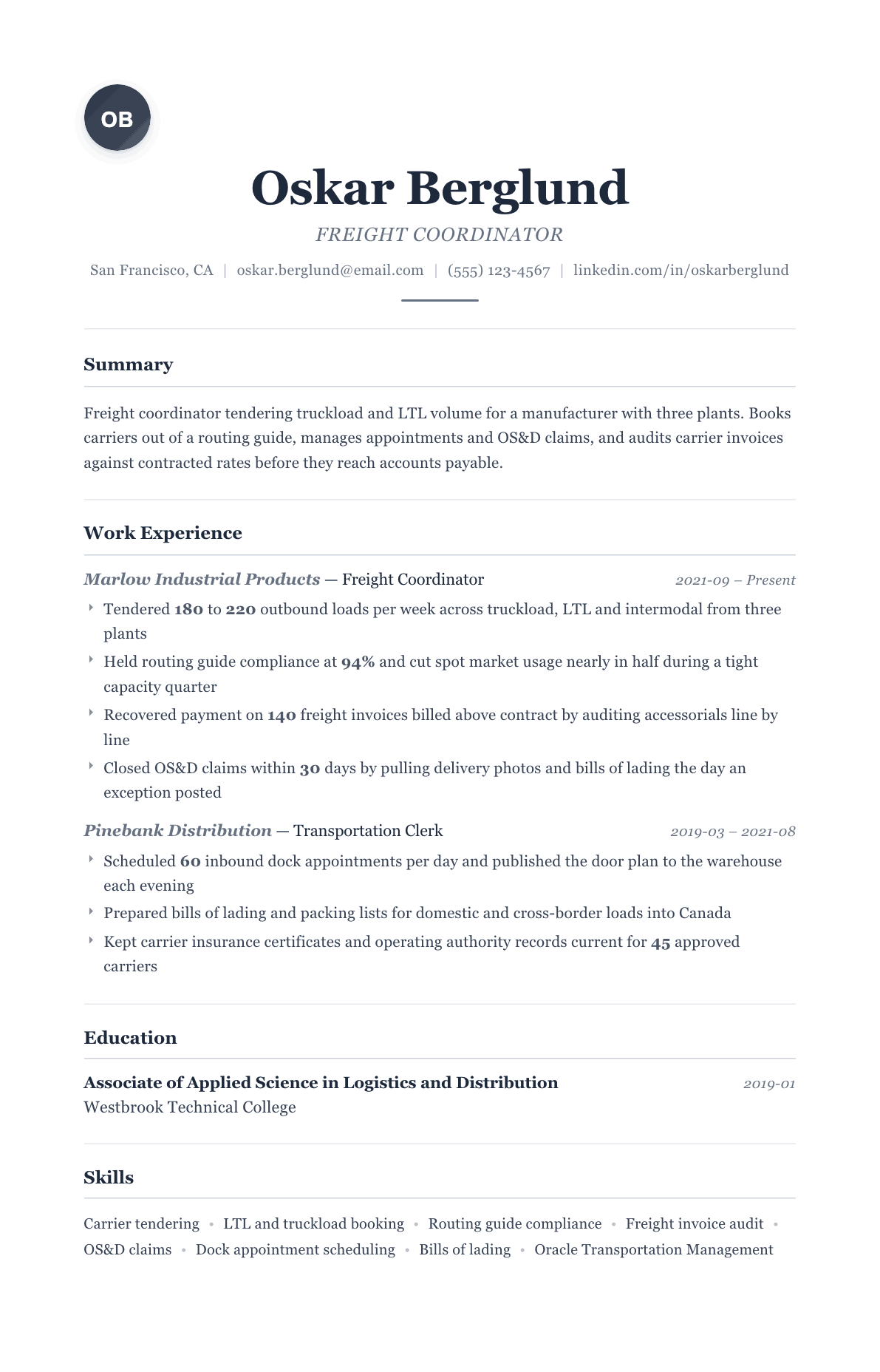
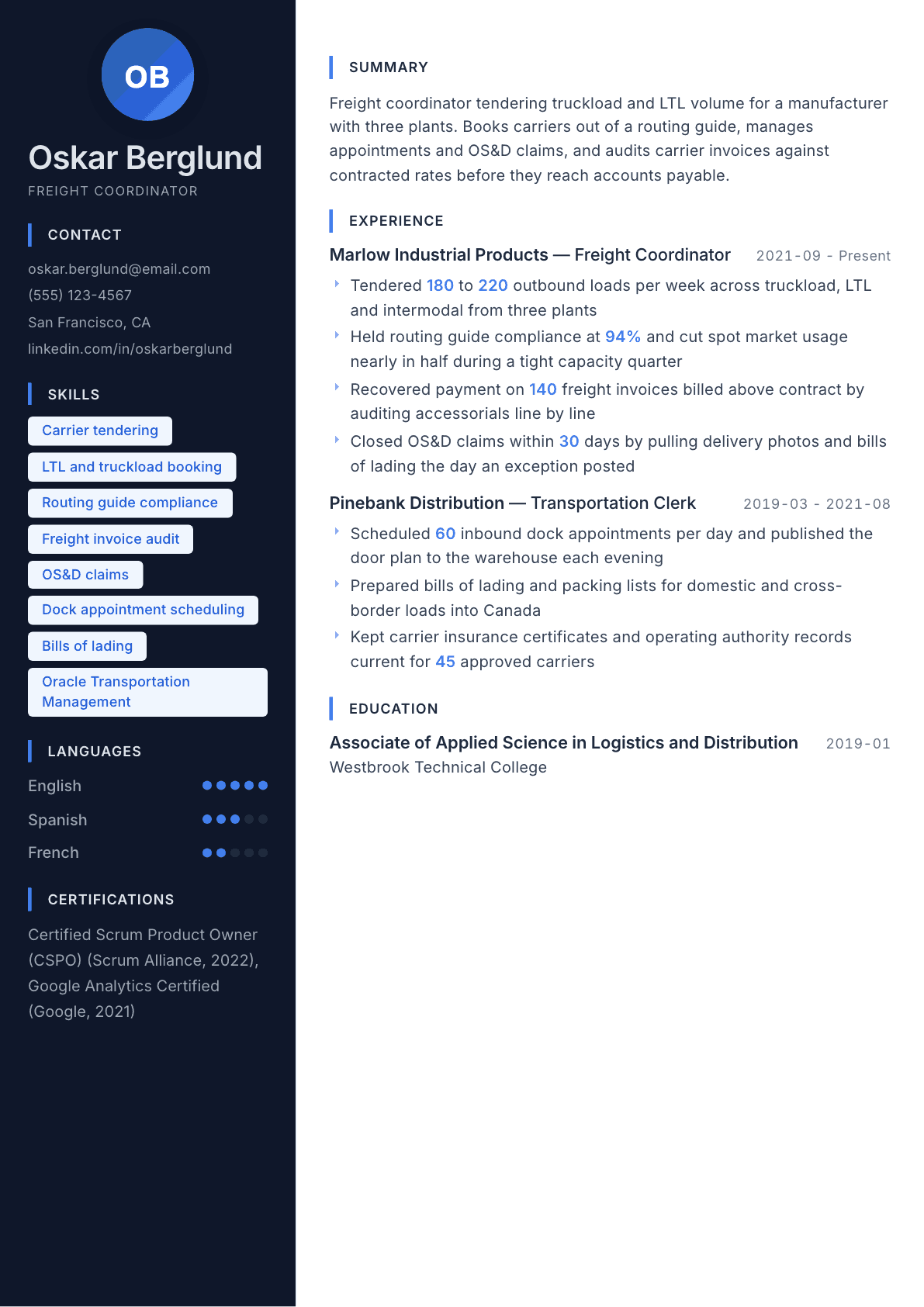
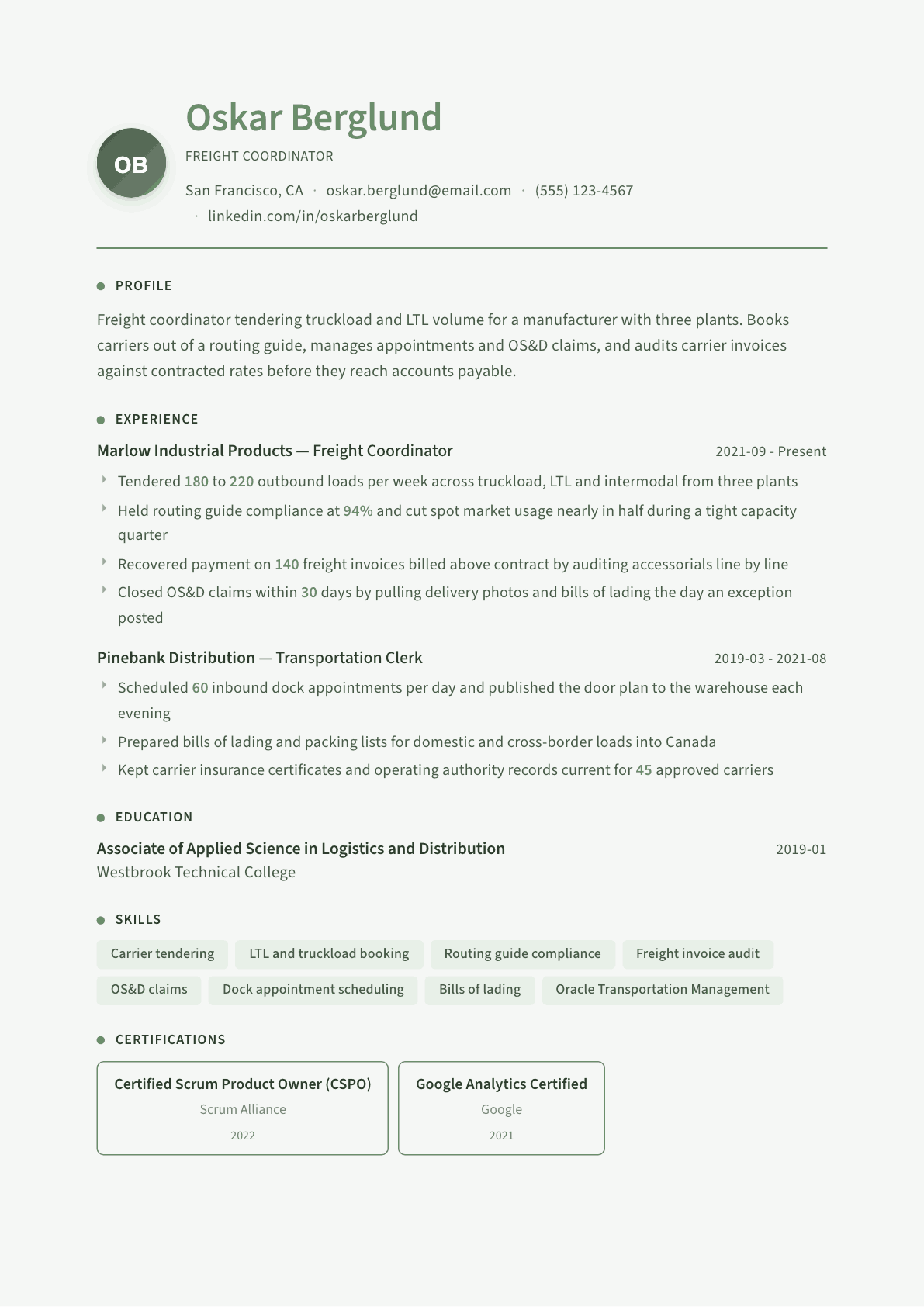
The same freight coordinator content laid out in three CVBooster templates, so you can see what the finished document looks like before you write a word.
Example Freight Coordinator summary
Freight coordinator with five years tendering truckload, LTL and intermodal volume for multi-plant manufacturers. Runs the routing guide, books and tracks 200 loads a week, audits carrier invoices against contract, and closes damage claims before they age. Held routing guide compliance in the mid nineties through a tight capacity market. Looking for a transportation role with carrier sourcing ownership.
Skills to list on a Freight Coordinator resume
- Carrier sourcing
- Load tendering
- LTL freight classification
- Truckload operations
- Intermodal coordination
- Routing guide management
- Freight audit and payment
- OS&D claims
- Dock scheduling
- Bill of lading preparation
- Oracle Transportation Management
- MercuryGate
- Carrier compliance vetting
- Rate benchmarking
What actually gets this resume read
- Say what modes you coordinate: truckload, LTL, intermodal, parcel, air or cross-border, because the desks differ.
- Give weekly load counts and lane coverage instead of writing that you handled a high volume of freight.
- Name your transportation management system, whether Oracle OTM, MercuryGate, Blue Yonder or a carrier portal.
- Show cost control: routing guide compliance, spot versus contract mix, accessorial recovery or cost per load.
- Include claims and exception work, since OS&D handling is a large part of the job that resumes usually skip.
- List the documents you own end to end, from bills of lading and packing lists to customs paperwork for border loads.
How to write a freight coordinator resume
A freight coordinator resume gets read by a transportation manager who needs to know whether you can move volume without letting cost drift. The page has to show modes, weekly load counts, the transportation management system you work in, how you handle exceptions, and what you did about invoices that came in above contract. That is the job in four lines.
Where these resumes go wrong is generality. Coordinating freight, working with carriers and tracking deliveries could describe a clerk at a small distributor or the person tendering hundreds of loads a week for three plants. Without volume, mode and system detail, a reader assumes the smaller version.
What follows is the section order a transportation manager uses, three summaries covering a first coordination job through a senior desk, five rewritten bullets pulled from patterns that repeat across applications, and the questions coordinators ask when they are trying to move from clerk work into real carrier management.
Format: one page, mode and volume before anything else
Reverse chronological, one page for most coordinators. Open each job with the operation: number of sites, modes handled, weekly load counts, and whether the freight was inbound, outbound or both. A transportation manager builds a mental picture from that line and reads the rest against it.
Put a systems block high on the page. Transportation management systems are the practical filter for this role, and a reader should see yours without scanning to the bottom of page one.
- Summary of three lines: modes, weekly volume, sites, system, one cost result.
- Experience with the operating profile first, results underneath.
- A systems line: TMS, ERP, carrier and broker portals, freight audit tool.
- A short line on claims and documentation ownership, which most candidates skip.
Summary: modes, volume, and the cost lever you pulled
Name the modes you actually coordinated. Truckload, less than truckload, intermodal, parcel, air, and cross-border each carry different documentation and different carrier relationships. A coordinator who has run LTL classification and NMFC disputes is a different hire from one who tenders full truckloads out of a routing guide.
Then give a cost lever. Routing guide compliance, spot versus contract mix, accessorial recovery, mode conversion savings, or cost per load. Freight is a cost center and the person hiring is under pressure on the number, so a summary that speaks to it gets read twice.
Experience: tendering, exceptions, and the money
Start with tendering. How many loads per week, across how many lanes, from what source: a routing guide, contracted carriers, a broker panel or the spot market. Then say how carriers were selected and who negotiated when the primary carrier rejected. Coverage under pressure is the daily test of this desk.
Exceptions come next, and they are where experienced coordinators separate themselves. Missed pickups, rejected loads, temperature excursions, over short and damaged claims, detention disputes and appointment failures. Give a claim volume and a closure time. A candidate who closes claims inside a month is protecting margin that would otherwise leak.
Then the money. Freight invoice audit against contracted rates and accessorials, dispute recovery, mode conversion, consolidation of LTL into truckload, and any lane you rebid. Coordinators often perform this work without a title that suggests it, so the page has to make it visible.
Documents, compliance and carrier vetting
List the documents you own end to end: bills of lading, packing lists, delivery receipts, proof of delivery retrieval, hazardous materials paperwork and cross-border documentation. Document errors create claims, so a reader treats document ownership as a proxy for care.
Carrier vetting belongs on the page too. Operating authority checks, insurance certificate tracking, safety rating review and onboarding into the TMS. Any company that has been burned by a fraudulent carrier reads that block closely.
- Modes and equipment types, including temperature controlled and flatbed if applicable.
- Documentation you prepared or audited, named specifically.
- Carrier onboarding and compliance checks you performed.
- Claims types you handled and how quickly you closed them.
Keywords a transportation team searches for
The recurring terms are load tendering, routing guide, carrier sourcing, LTL classification, truckload, intermodal, freight audit, accessorial, detention, over short and damaged, bill of lading, dock appointment, on-time in full, and the name of your TMS. Use the true ones where they carry a number.
If a posting names a system such as Oracle Transportation Management, MercuryGate or Blue Yonder, spell it out exactly rather than writing that you used a transportation platform.
Freight Coordinator resume summary examples
Moving up from transportation clerk
Transportation clerk with two years scheduling 60 inbound dock appointments a day and preparing bills of lading for domestic and cross-border loads. Maintains carrier insurance and authority records for 45 approved carriers and is moving into carrier tendering and freight audit work.
Three years coordinating
Freight coordinator tendering 180 to 220 outbound loads a week across truckload, LTL and intermodal from three manufacturing plants. Holds routing guide compliance at 94%, audits carrier invoices against contract before payment, and closes damage claims within 30 days.
Senior coordinator
Senior freight coordinator owning carrier sourcing and the routing guide for a distribution network of six sites. Runs annual lane bids, converts qualifying LTL volume into multi-stop truckloads, and manages a claims process that recovered payment on a substantial share of disputed accessorial charges.
Work experience bullets: before and after
Before: Booked carriers for outbound shipments.
After: Tendered 180 to 220 outbound loads per week across truckload, LTL and intermodal from three plants, escalating to backup carriers within two hours of a rejection.
Volume, mode mix and the rejection response show coverage discipline instead of order entry.
Before: Kept freight costs down.
After: Held routing guide compliance at 94% and cut spot market usage nearly in half during a tight capacity quarter by pre-booking recurring lanes.
A compliance figure and the tactic behind it give a cost claim something to stand on.
Before: Reviewed carrier invoices.
After: Audited carrier invoices line by line against contracted rates and accessorials and recovered payment on 140 bills that had been charged above agreement.
The audit method and the number of corrected invoices make the recovery credible.
Before: Handled freight claims.
After: Closed over short and damaged claims within 30 days by pulling delivery photos, bills of lading and dock notes the day an exception posted.
Naming the evidence gathered and the closure window shows a process rather than an inbox.
Before: Scheduled deliveries with the warehouse.
After: Scheduled 60 inbound dock appointments a day and published the next-day door plan each evening so receiving could staff to the volume.
The publishing habit ties the scheduling work to a downstream labor decision.
Hard skills
- Carrier sourcing and tendering
- Routing guide management
- LTL classification and NMFC
- Truckload operations
- Intermodal coordination
- Freight audit and payment
- Accessorial and detention disputes
- Over short and damaged claims
- Bill of lading preparation
- Dock appointment scheduling
- Oracle Transportation Management
- Carrier authority and insurance vetting
Soft skills
- Carrier negotiation
- Escalation judgment
- Cross-team coordination with plants and warehouses
- Written follow-through on disputes
- Working through capacity pressure
- Customer communication on exceptions
Certifications worth listing
- Certified in Logistics, Transportation and Distribution (CLTD) (Association for Supply Chain Management)
- Certified Transportation Broker (CTB) (Transportation Intermediaries Association)
- Hazardous Materials Employee Training (Pipeline and Hazardous Materials Safety Administration)
Mistakes that cost freight coordinator candidates the interview
- Writing that you coordinated freight without ever naming the modes or the weekly load count.
- Skipping the claims and exception work, which is where a coordinator protects real money.
- Listing a transportation platform generically instead of naming the product a recruiter searches.
- Ignoring freight audit work you performed, which reads as pure clerical support without it.
- Leaving carrier vetting off the page at a time when companies are cautious about who they onboard.
- Using warehouse language for a transportation role, which makes the resume surface for the wrong postings.
- Giving cost claims with no compliance rate, recovery amount or mode conversion behind them.
Freight Coordinator resume questions
What is the difference between a freight coordinator and a logistics coordinator?
Freight coordination centers on moving loads: carrier selection, tendering, tracking, claims and freight cost. Logistics coordination usually stretches wider into inventory, warehousing and order flow. Match your title language to the posting you are answering rather than to your internal job title.
How do I show freight cost savings without exact figures?
Use the ratios you can defend. Routing guide compliance, spot versus contract mix, accessorial dispute win rate, or the number of loads converted from LTL to truckload. These prove cost discipline without inventing a savings number you cannot support.
Do I need TMS experience to get a freight coordinator job?
It helps a lot, but coordinators are regularly hired from carrier portals, spreadsheets and ERP transportation modules. Name whatever system you worked in, describe the transactions you performed there, and mention any implementation or migration you supported.
Should I list the lanes I have covered?
List regions rather than individual lanes: regional Midwest, transcontinental, cross-border into Mexico or Canada. Employers hire for lane familiarity because carrier relationships and transit expectations differ, and a region tells them enough to judge fit.
How much detail do freight claims deserve on a resume?
One or two bullets is right. Give the claim types, roughly how many you handled, the evidence you pulled and your typical closure time. That is enough for a manager to see a process without turning the resume into a claims procedure.
Related resume examples
- Freight Broker Resume example
- Logistics Coordinator Resume example
- Shipping Coordinator Resume example
- Truck Dispatcher Resume example
- Transportation Coordinator Resume example
- Logistics Specialist Resume example