Shipping Coordinator Resume Examples: what gets the call
Write a Freight Coordinator Resume That Proves Carrier Control
By Mustafa Tarabya, founder of CVBooster · Published · Updated
Resume example for a coordinator managing outbound freight, with carrier and rate keywords, systems to list, and a guide to writing each section.
Sample resumes for a shipping coordinator
The same shipping coordinator content laid out in three CVBooster templates, so you can see what the finished document looks like before you write a word.
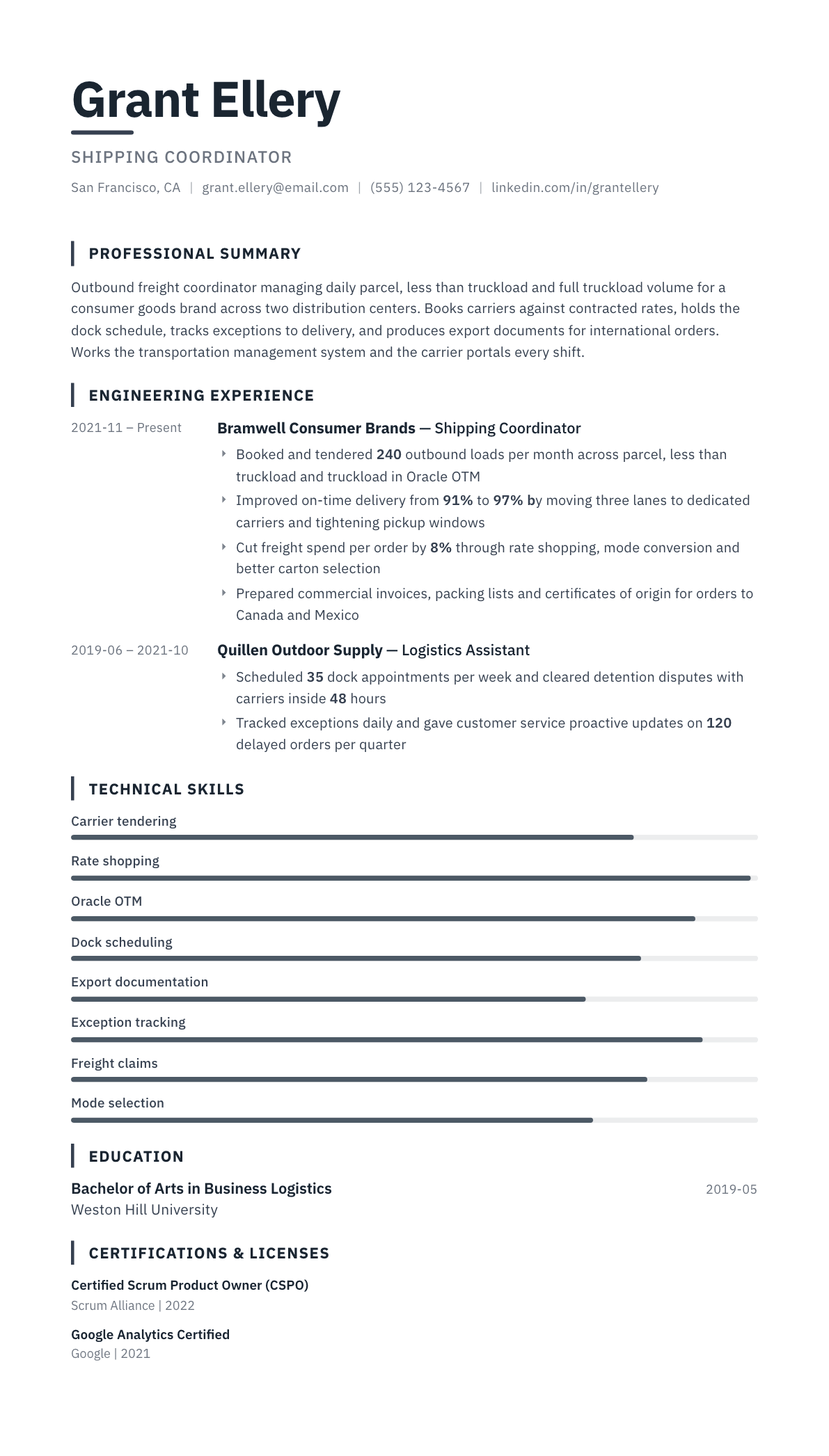
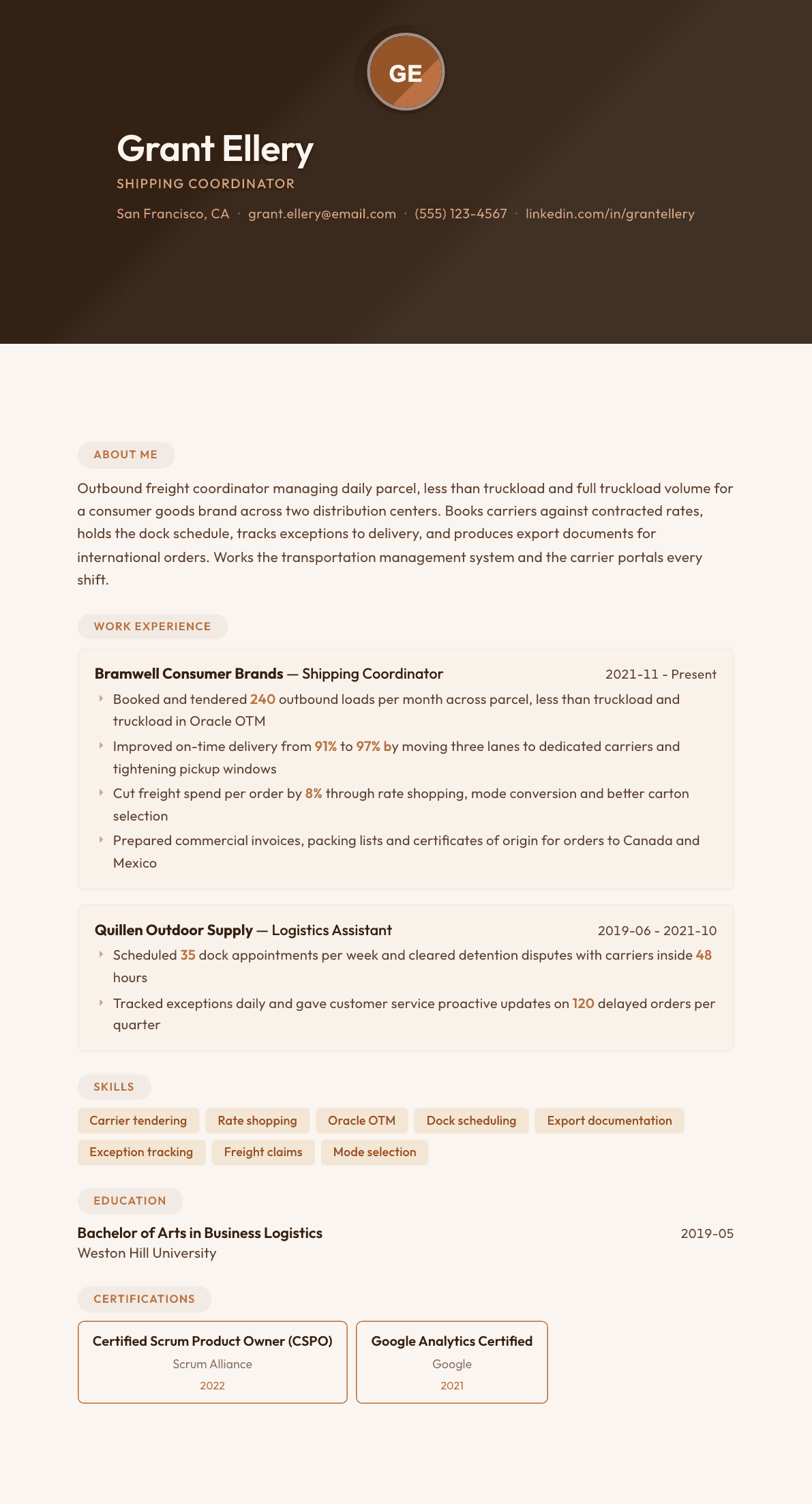
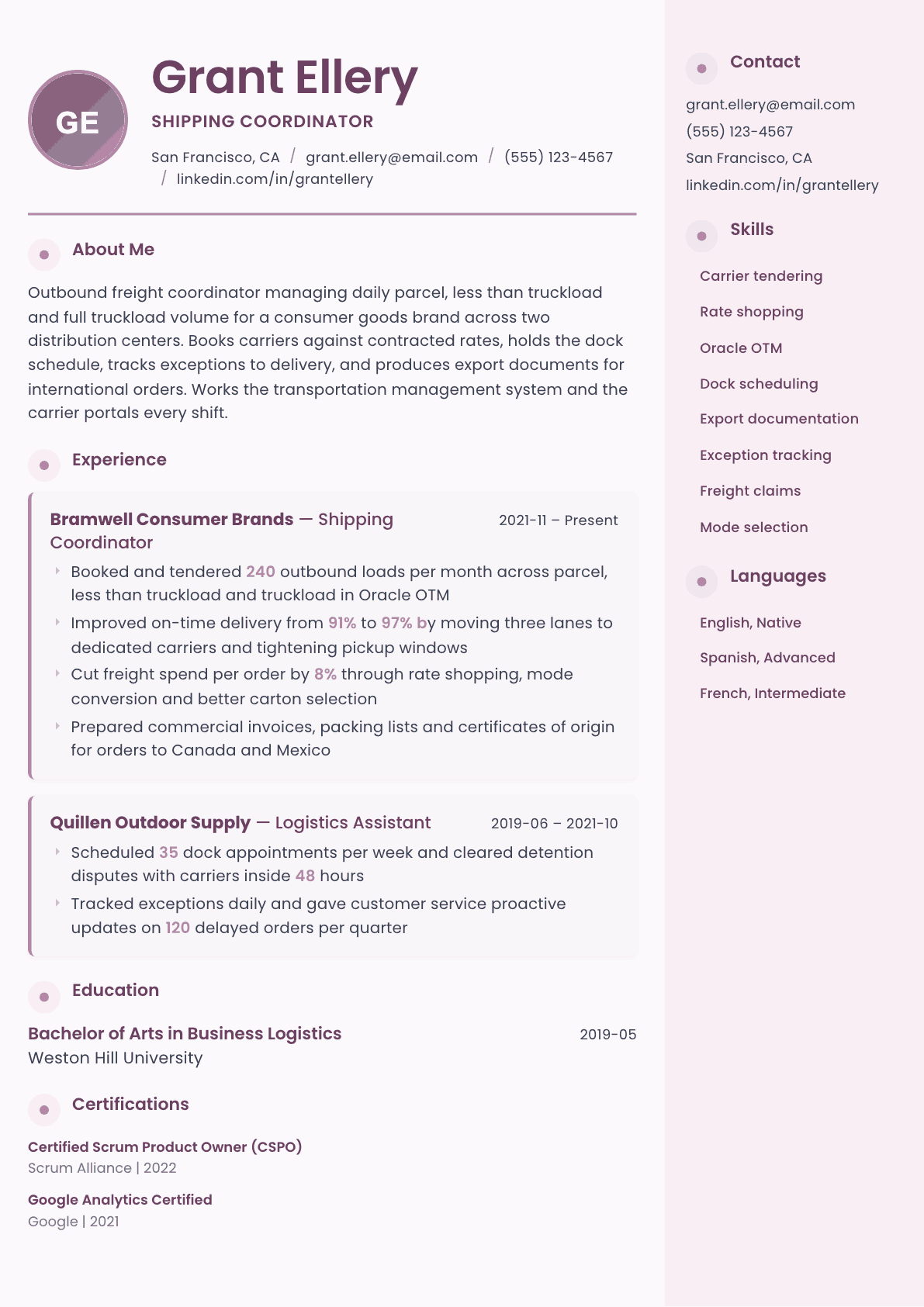
Example Shipping Coordinator summary
Outbound freight coordinator with five years moving parcel, less than truckload and truckload volume for a consumer goods brand across two distribution centers. Tenders 240 loads a month in Oracle OTM, lifted on-time delivery from 91% to 97% by converting three lanes to dedicated carriers, and reduced freight spend per order by 8%. Prepares export documents for North American trade. Seeking a transportation analyst role.
Skills to list on a Shipping Coordinator resume
- Carrier selection and tendering
- Rate shopping and mode conversion
- Transportation management systems
- Oracle OTM
- Dock appointment scheduling
- On-time delivery tracking
- Freight claims and disputes
- Accessorial and detention review
- Export documentation
- Commercial invoices and packing lists
- Certificates of origin
- Parcel manifesting
- Less than truckload consolidation
- Carrier scorecards
- Exception management
What actually gets this resume read
- Give load counts by mode, because parcel, less than truckload and truckload coordination are different jobs.
- Report on-time delivery and cost per order together, since a coordinator is judged on service and spend at once.
- Name the transportation management system and the carrier portals you work in every day by product name.
- Show one lane or mode change you drove, with the reason and the result, because that is coordinator level work.
- List export document types if you have prepared them, as international paperwork is a hard screening filter.
- Include detention, accessorial or claim disputes you resolved, because carrier negotiation is part of the role.
How to write a shipping coordinator resume
A shipping coordinator lives between two groups who both think they are right. Operations wants the dock cleared and the trailers gone. Customer service wants every order to arrive when it was promised. Finance wants the freight bill lower than last quarter. The coordinator decides, load by load, which carrier and which mode satisfies all three, and the resume has to show that decision being made well.
That is why a resume built on tasks fails here. Booked carriers and tracked shipments describes an inbox, not a shipping coordinator. The hiring transportation manager is reading for volume by mode, on-time performance, cost per order or per load, exception handling, and whether you have ever pushed back on a carrier over detention, accessorial charges or a claim. Those are the levers of the job.
This guide covers the structure a transportation manager expects, three summaries from a first coordination role to a senior coordinator running international freight, before and after bullets that turn booking into judgment, and the answers to the questions shipping coordinators ask when they try to prove savings they never formally reported.
Format: one page early, two once you carry cost accountability
One page until you own a freight budget or multiple sites, two after. Keep the layout plain, because manufacturers, brands and third party logistics providers all run applications through automated screening and this role is heavy with system and document keywords that a sidebar layout can scramble.
Under the header, add a scope line: loads per month by mode, the sites you support, and the transportation platform you work in. Mode mix is the fastest way for a manager to judge fit, since parcel heavy e-commerce freight and truckload heavy industrial freight are different working lives.
- Header: name, city, phone, email, and the transportation systems you work in daily.
- Scope line: monthly loads by mode, sites supported, domestic or international coverage.
- Sections: summary, experience, systems and documents, certifications, education.
Summary: mode mix, service, cost
Three lines. Open with the volume you move and how it splits across parcel, less than truckload, truckload and any intermodal or air. Then one service number, then one cost number. A shipping coordinator who can show on-time delivery rising and cost per order falling in the same summary has already made the strongest argument available in this field.
If you handle international freight, say it in the summary rather than burying it. Export documentation, customs coordination and Incoterms knowledge are hard screening filters, and many otherwise strong domestic candidates are removed at that line.
Experience: tender, schedule, track, dispute
Start with tendering. How many loads you booked, against contracted rates or a spot market, through a transportation management system or carrier portals, and how you chose. Rate shopping, mode conversion, consolidating orders into a single load, or moving a lane to a dedicated carrier are all decisions worth their own line, because they are where a coordinator produces value rather than processes it.
Then the dock schedule. Appointment scheduling, load sequencing against the carrier cut, and coordination with the warehouse supervisor on staging are the operational half of the job. A coordinator who never mentions the dock reads as someone who worked from a spreadsheet in another building.
Then exceptions, which is where customers form their opinion. Delayed loads, refused deliveries, a replacement sent for a short order, weather reroutes and appointment failures all have to be worked and communicated before the customer calls. Say how you tracked exceptions, who you told, and how quickly.
Finish with disputes. Detention charges, accessorial reviews, invoice audits and freight claims are the areas where a coordinator either defends the budget or quietly gives it away. Quantify what you recovered or avoided, and describe the evidence you used, because that is the skill a manager cannot teach in a quarter.
Systems and documents: the screening filter
Name the transportation management system by product, then the parcel manifesting system, then the enterprise platform where orders originate. Add the carrier portals you work in daily. Sites screen on their stack because a coordinator who already knows it is productive in the first week rather than the second month.
Document knowledge is the other filter. Bills of lading, packing lists, commercial invoices, certificates of origin, export declarations and dangerous goods declarations are named documents, so name them. Adding the trade lanes you have handled, such as movements into Canada and Mexico, makes the claim concrete and checkable.
Carrier relationships and the numbers a manager checks
Carrier management is a real part of this role even when procurement owns the contracts. Scorecards, quarterly performance reviews, tender acceptance rates and on-time pickup performance are all things a coordinator watches and escalates, and describing that work moves you from order taker to account owner in the reader's mind.
Keep the metrics honest and paired. On-time delivery, on-time pickup, tender acceptance, cost per order, freight as a share of order value, claims ratio and average transit days are the figures a transportation manager tracks. Give a baseline with every improvement, because an unanchored improvement invites the interviewer to assume the network changed and you did not.
Shipping Coordinator resume summary examples
First coordination role
Logistics assistant with two years scheduling dock appointments and tracking outbound orders for an outdoor goods distributor. Books parcel and less than truckload freight through carrier portals, resolves detention disputes inside two days, and gives customer service proactive updates on delayed orders.
Four years coordinating freight
Shipping coordinator moving 240 loads a month across parcel, less than truckload and truckload for a consumer goods brand. Lifted on-time delivery from 91% to 97% by converting three lanes to dedicated carriers, and cut freight cost per order by 8% through rate shopping and carton changes.
Senior coordinator, international
Senior shipping coordinator supporting three distribution centers with domestic and cross-border volume. Owns carrier scorecards, quarterly performance reviews and the invoice audit process, prepares commercial invoices and certificates of origin, and recovered a significant share of contested accessorial charges last year.
Work experience bullets: before and after
Before: Booked carriers for outgoing orders.
After: Tendered 240 loads a month across parcel, less than truckload and truckload in Oracle OTM, selecting against contracted rates and moving to spot only when transit time required it.
Volume by mode plus the selection rule shows a decision process rather than a booking queue.
Before: Improved delivery performance.
After: Raised on-time delivery from 91% to 97% over three quarters by moving three high volume lanes to dedicated carriers and tightening pickup windows with the warehouse supervisor.
A baseline, a result and two named mechanisms make the improvement attributable to you.
Before: Reduced freight costs.
After: Cut freight cost per order by 8% through rate shopping, converting eligible parcel volume to less than truckload consolidation, and changing carton sizes to lower dimensional weight.
Three specific levers explain how the saving was found, which is exactly what an interviewer probes.
Before: Handled problems with deliveries.
After: Tracked exceptions daily and notified customer service on 120 delayed orders a quarter before the customer called, including reroutes, refused deliveries and replacements sent for short orders.
Proactive notification with a volume attached is the difference between exception management and firefighting.
Before: Worked with carriers on billing issues.
After: Disputed detention and accessorial charges using gate times, dock logs and appointment records, closing carrier billing disputes within 48 hours and clearing the monthly invoice audit.
Naming the evidence and the closing window shows you can defend the freight budget with documentation.
Hard skills
- Carrier selection and tendering
- Rate shopping and mode conversion
- Transportation management systems
- Parcel manifesting
- Less than truckload consolidation
- Dock appointment scheduling
- On-time delivery tracking
- Freight invoice audit
- Detention and accessorial disputes
- Freight claims
- Export documentation and Incoterms
- Carrier scorecards and reviews
Soft skills
- Negotiation with carriers
- Proactive customer communication
- Prioritizing against a cut clock
- Cross-team coordination
- Persistence on open disputes
- Clear escalation
Certifications worth listing
- Certified in Logistics, Transportation and Distribution (CLTD) (Association for Supply Chain Management)
- Certified Supply Chain Professional (CSCP) (Association for Supply Chain Management)
- Dangerous Goods Regulations Training (International Air Transport Association)
- DOT Hazardous Materials Employee Training (U.S. Department of Transportation)
Mistakes that cost shipping coordinator candidates the interview
- Writing the resume as a list of bookings and tracking updates, which describes an inbox rather than a coordinator.
- Giving total volume without the mode split, so a manager cannot tell parcel work from truckload work.
- Reporting a cost saving with no baseline, which reads as a market rate change rather than a decision you made.
- Leaving out the transportation system by name when it is the first automated filter on most postings.
- Never mentioning detention, accessorial or claim disputes, which is where the budget is actually defended.
- Hiding international document experience in a skills list when it removes entire candidate pools from the running.
- Claiming carrier negotiation when you only booked against rates procurement had already agreed.
Shipping Coordinator resume questions
What is the difference between a shipping coordinator and a logistics analyst?
A shipping coordinator executes and troubleshoots daily freight, working loads, carriers and exceptions in real time. An analyst studies the same data to change the network. Many coordinators move into analysis, so show the reporting you already build.
How do I prove cost savings I never formally reported?
Reconstruct them defensibly. Compare the rate you booked against the alternative available that day, count the loads consolidated, or show carton changes that lowered dimensional weight. Present the method alongside the number so the figure survives an interview.
Do I need to know a transportation management system to get hired?
It helps a great deal, but coordinators are also hired from carrier portals and spreadsheet based operations. Name whatever you have used, describe the tendering and tracking you did in it, and say you learn platforms quickly with a concrete example.
How important is international freight experience?
It is decisive when a posting mentions exports, customs brokers or cross-border lanes, and irrelevant when the operation is purely domestic. If you have it, name the documents and trade lanes rather than writing international experience.
What metrics should I put on the resume?
On-time delivery and pickup, loads per month by mode, cost per order or per load, tender acceptance, claims ratio and average transit days. Pair every improvement with its starting point so the reader can size what changed.
Related resume examples
- Logistics Coordinator Resume example
- Freight Broker Resume example
- Freight Forwarder Resume example
- Transportation Coordinator Resume example
- Logistics Specialist Resume example
- Shipping and Receiving Clerk Resume example