Frontend Developer Resume Examples: the lines they read
Frontend Developer Resume and Front End Web Developer Resume Sample
By Mustafa Tarabya, founder of CVBooster · Published · Updated
A front end web developer resume sample and CV for front end developer roles, with performance, accessibility and portfolio bullets and keywords.
Sample resumes for a frontend developer
The same frontend developer content laid out in three CVBooster templates, so you can see what the finished document looks like before you write a word.
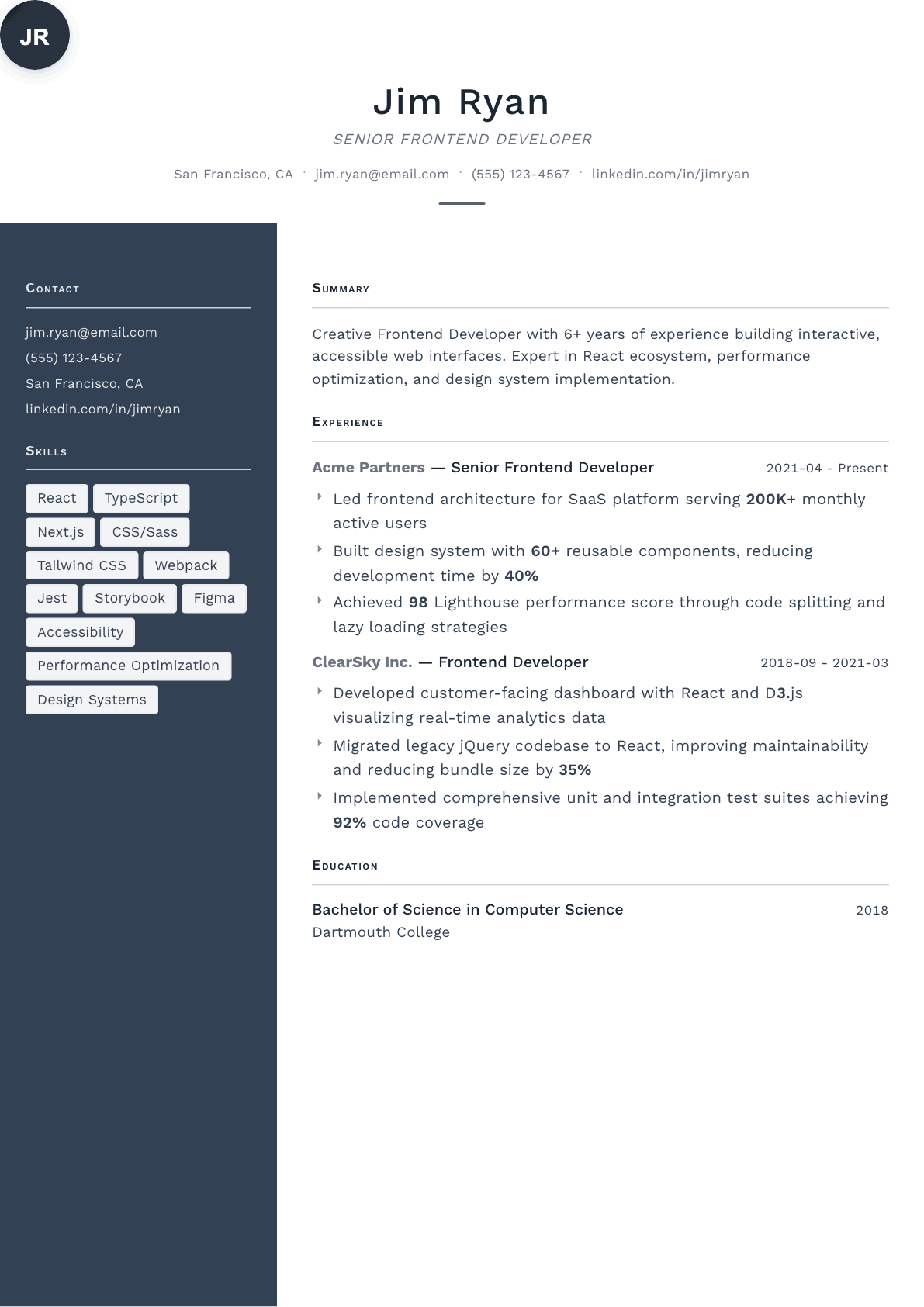
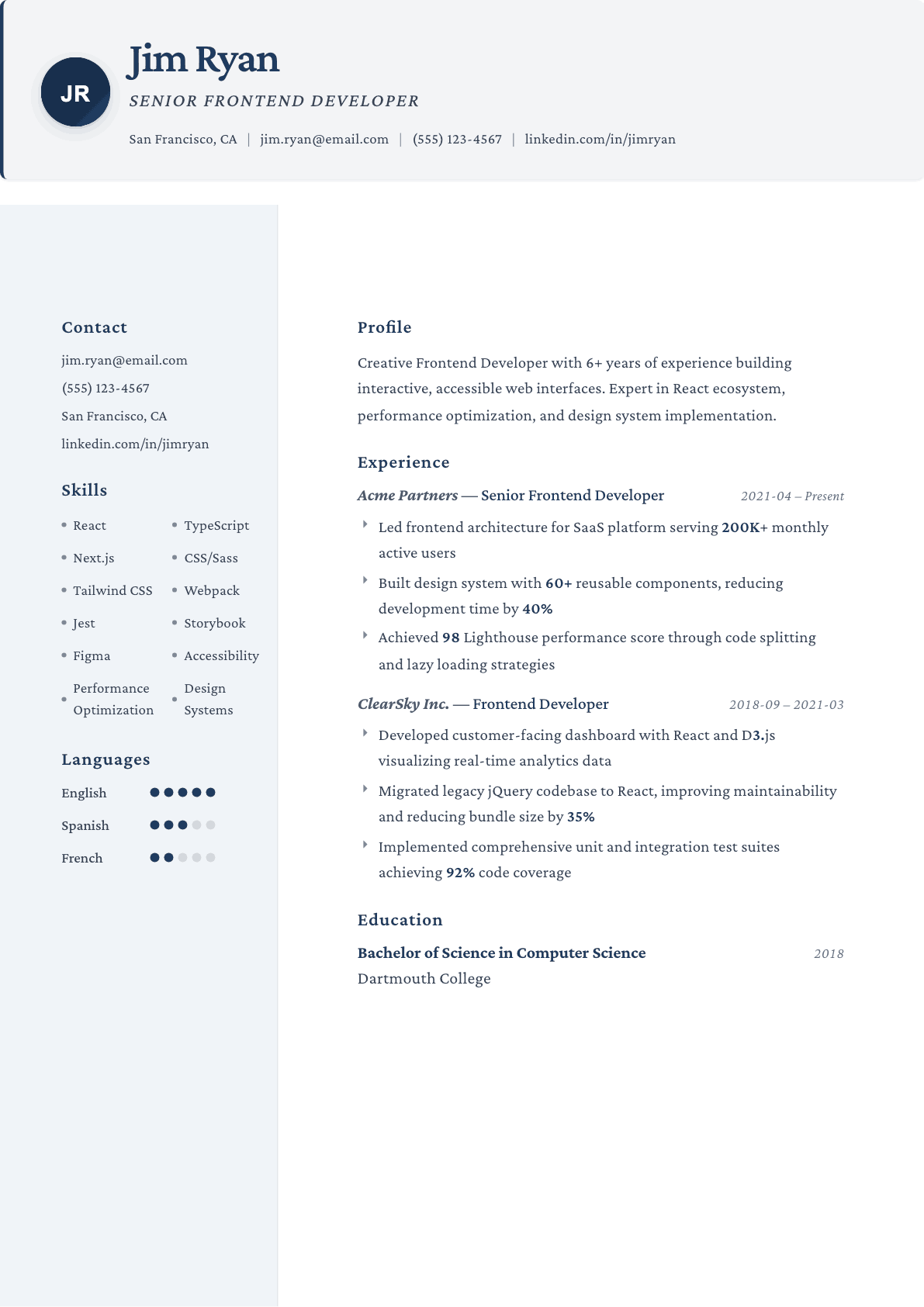
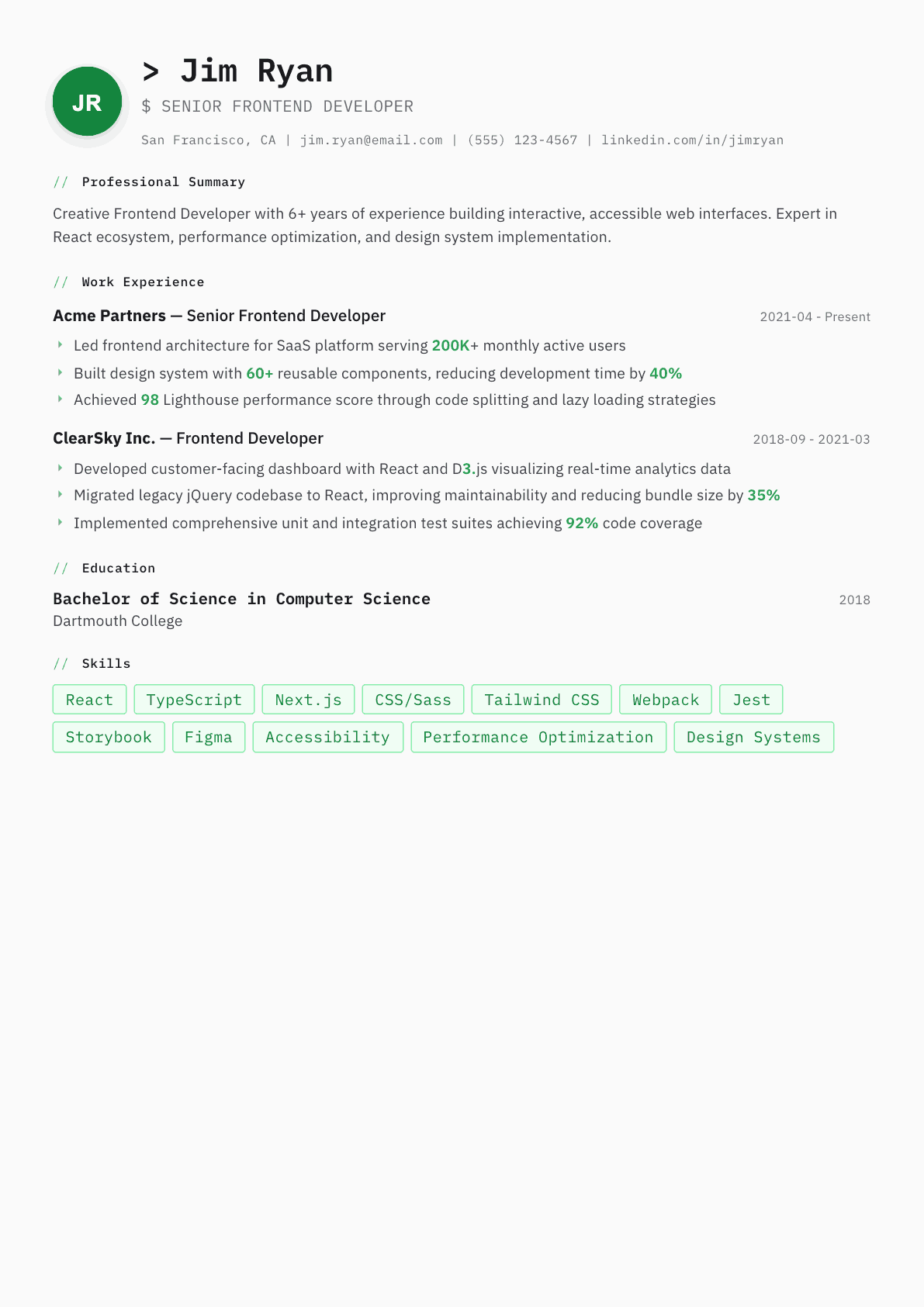
Example Frontend Developer summary
Frontend developer, 6 years in the React ecosystem, currently owning the front-end architecture of a SaaS platform with 200K monthly users. Built a 60-component design system that cut feature build time 40%, holds a 98 Lighthouse score through code splitting, and keeps test coverage above 90%.
Skills to list on a Frontend Developer resume
- React
- TypeScript
- Next.js
- CSS/Sass
- Tailwind CSS
- Webpack
- Jest
- Storybook
- Figma
- Accessibility
- Performance Optimization
- Design Systems
What actually gets this resume read
- Highlight measurable UI/UX improvements: load times, conversion lifts, accessibility scores.
- Show design tool proficiency (Figma, Sketch) to demonstrate designer-developer collaboration.
- Include open-source contributions or personal projects with live demos.
- Mention cross-browser compatibility and responsive design experience.
- List specific testing frameworks and code coverage achievements.
How to write a frontend developer resume
Frontend developer openings attract more applicants than almost any other engineering role, so the screening is brutal and fast. The engineer reading your resume is trying to answer one question in about twenty seconds: has this person owned real user-facing surfaces, or have they only assembled components someone else designed? Everything you write should push toward the first answer.
The resumes that fail all look alike. They list React, TypeScript, Tailwind and a testing library, then describe work as building responsive pages and collaborating with designers. That describes the whole applicant pool. The resumes that get a call name the surface, its traffic or its users, the performance and accessibility numbers before and after, and the architectural decision the candidate personally made.
This frontend web developer resume guide covers the layout a frontend hiring manager expects, how to write about performance and accessibility so an engineer believes you, three summaries for different career stages, before and after bullets, and the portfolio question that comes up in every frontend job hunt.
Resume format for a front end developer: one page, plain, with a live link
One page until you have roughly eight years of experience. Reverse chronological, single column, standard fonts. The irony of the frontend job hunt is that a heavily designed resume hurts you: it parses badly, and reviewers read the design as a substitute for the engineering underneath it.
Put two links in the header, a code repository and one live site or application you built, and make sure both load. A broken portfolio link is the most common self-inflicted rejection in this role. If the work is behind a login, link a short write-up of the project instead and say why the app itself is private.
The format, in order: name, city, email, GitHub and portfolio link on one line; a three line summary; a skills line grouped by language, framework, testing and tooling; experience with the surface named in each role; two projects with live links if you are early in your career; education last. Reverse chronological beats a skills based layout for frontend roles, because reviewers want to see what you built and when.
- Header: name, city, email, repository link, portfolio or live project link.
- Order: summary, skills grouped by kind, experience, projects, education.
- Career changers and bootcamp graduates put a projects section above experience with two deep projects, never six shallow ones.
- Title line: copy the posting. If the advert says Frontend Web Developer, put Frontend Web Developer under your name rather than Software Engineer, so the first thing the screener and the applicant tracking system read matches the job.
Summary: framework, surface, and the thing you are known for
Two or three lines. Name the framework you are strongest in, the kind of product you have built in it, and one specialism a team would hire you for: design systems, performance, accessibility, data-heavy interfaces, animation, or design and code hybrid work.
Skip adjectives about creativity and passion. A frontend lead has read them on every resume in the stack and they carry no information. If you are moving from another stack, say so directly and name what transfers, such as component architecture, state management or browser fundamentals.
Experience: the surface, the users, and the measurement
Start each role with what the product was and how many people used it. A checkout flow, an internal admin console and a marketing site are judged differently, and the reader cannot tell them apart from the word application.
Then write bullets that carry a measurement. Frontend work has unusually good metrics available and most candidates ignore them: Largest Contentful Paint, Interaction to Next Paint, Cumulative Layout Shift, bundle size in kilobytes, time to interactive, conversion or drop-off on a flow you changed, and the number of accessibility violations you closed. Give the before and after, not just the improvement.
Name the architectural decisions you owned. Choosing between server rendering and a client-only build, splitting a bundle by route, introducing a component library across teams, migrating a codebase to TypeScript, or replacing a state management approach are the bullets that separate a mid-level developer from a senior one.
Accessibility, testing and the parts teams cannot staff
Accessibility is the easiest way to look senior on a frontend resume because so few candidates write about it concretely. Say which standard you worked to, which assistive technology you actually tested with, and what you fixed: focus management in a modal, keyboard traps, color contrast, ARIA on a custom combobox, or announcements for live regions.
Testing deserves the same treatment. Unit tests with a component testing library, end-to-end coverage of the flows that generate revenue, visual regression on a design system, and a check that blocks a merge when the bundle grows all tell a reviewer that you think past the demo.
- Group skills so a scanner finds them fast: languages, frameworks, styling, testing, build and tooling, and design collaboration.
- Name the design tool you work in with designers, because handoff friction is a real cost teams hire against.
- Say whether you have worked on a component library used by other teams; internal customers are a seniority signal.
Keywords the frontend screener is scanning for
Frontend postings repeat a narrow vocabulary: React, TypeScript, Next.js, state management, responsive design, design system, component library, web performance, accessibility, cross-browser, REST and GraphQL, and continuous integration. Use the posting wording once in the skills group and once inside a bullet where it is attached to a shipped surface. A skills section that lists a framework never mentioned again in the experience reads as aspirational and interviewers probe it first.
Front end web developer resume sample, start to finish
Here is a complete front end developer resume sample for a front end web developer with four years on a consumer web product. The person and the companies are invented; the order is the part to copy. If you searched for an example front end developer resume for a web agency instead, keep the same order and swap the product metrics for client sites shipped and their results.
Profile: Nina Castillo, Front End Engineer. Four years building the checkout and account pages of a subscription meal kit site with about a million monthly visitors. Works in React and TypeScript, owns the design system components for the web team, and is the person the team asks about accessibility and page speed.
- Current role, Front End Engineer, Freshbox, three years: one of five engineers on the web team, owning checkout, account settings and the shared component library.
- Rebuilt the checkout flow in React and TypeScript, cutting the largest contentful paint on mobile from about 4 seconds to under 2 in field data.
- Built 30 shared components with the design team, documented in Storybook, now used on every page of the site.
- Fixed the keyboard and screen reader issues found in an outside accessibility audit, and added automated axe checks to the pull request pipeline.
- Wrote the end to end tests for the purchase path in Playwright, which caught two payment regressions before release.
- Previous role, Web Engineer, Brightpixel Agency, one year: built marketing sites for retail clients in Next.js and a headless CMS.
- Skills: React, TypeScript, Next.js, CSS and Tailwind, Storybook, Jest, Playwright, web performance, WCAG 2.2.
- Education and links: BS in Computer Science; portfolio and GitHub links in the header, each with one project that runs.
Frontend Developer resume summary examples
Junior frontend developer
Frontend developer with a year of React and TypeScript on a live customer portal, plus two projects built from an empty folder and deployed publicly. Comfortable with component testing, responsive layouts and reading a Figma file closely enough to catch the spacing the design system already defines.
Five years in
Frontend developer with five years in React and Next.js on a checkout and account experience used by roughly four hundred thousand monthly customers. Owns the performance budget, cut Largest Contentful Paint from 4.1 to 1.8 seconds, and maintains the shared component library three product teams build against.
Senior or lead
Senior frontend developer with nine years across consumer and enterprise products, leading a migration of a legacy single page application to server rendering and setting the accessibility standard the whole web organization now follows. Mentors four engineers and runs the design and engineering handoff review.
Work experience bullets: before and after
Before: Built responsive web pages using React and CSS.
After: Rebuilt the multi-step signup flow in React and TypeScript for a site with three hundred thousand monthly visitors, cutting drop-off between the address and payment steps by 18%.
Naming the flow, the traffic and the behavior change turns a task description into a business result the reader can weigh.
Before: Improved website performance.
After: Cut the main bundle from 1.4MB to 380KB by code splitting per route, deferring the analytics tag and replacing a date library, moving Largest Contentful Paint from 4.2 to 1.6 seconds on a mid-range Android phone.
Before and after numbers plus the actual techniques prove the work rather than asserting it.
Before: Made the site accessible.
After: Closed 60 accessibility issues across the booking funnel, rewriting focus handling in the modal, adding keyboard support to a custom date picker, and verifying each fix with VoiceOver and keyboard-only navigation.
A count, named components and the tools used make accessibility work verifiable instead of a claim.
Before: Worked with designers on the design system.
After: Built and documented 40 components in a shared library with Storybook and visual regression tests, adopted by four product teams and cutting new page build time from days to hours.
Component count, tooling and internal adoption show you served other engineers, which is what senior frontend work looks like.
Before: Wrote tests for frontend code.
After: Added end-to-end coverage of the six revenue-critical flows with Playwright and wired it into the pull request check, catching three checkout regressions before release in the first quarter.
Scoping tests to the flows that earn money, and naming what they caught, shows judgment about where testing pays.
Hard skills
- JavaScript and TypeScript
- React and hooks
- Next.js and server rendering
- HTML and semantic markup
- CSS, Sass and Tailwind
- State management
- REST and GraphQL clients
- Web performance and Core Web Vitals
- Accessibility to WCAG
- Jest and Testing Library
- Playwright or Cypress
- Storybook and design systems
- Vite and Webpack
- Git and continuous integration
Soft skills
- Design collaboration
- Code review
- Explaining tradeoffs to product
- Attention to visual detail
- Mentoring juniors
- Scoping under a release date
Mistakes that cost frontend developer candidates the interview
- Submitting a portfolio link that is broken, blank or still showing a starter template, which ends the review before the experience section.
- Listing every framework ever touched, so the interviewer picks Angular from the list and finds you last used it for a weekend tutorial.
- Describing frontend work with no measurement at all, when this is the one specialty where load time, layout shift and bundle size are available to anyone.
- Using a heavily designed two-column resume with icons, which parses badly and reads as decoration standing in for engineering depth.
- Claiming responsive design as a skill. It is assumed, and spending a bullet on it signals the candidate has nothing stronger to say.
- Never mentioning what happened after release. Monitoring, error tracking and the bug you found in production are what separate a builder from a maintainer.
Frontend Developer resume questions
What should a front end developer resume sample include?
A header with portfolio and GitHub links, a three line profile naming your framework and the product you work on, experience bullets that name the surface you owned and a measured result, then skills and education. One page up to about five years of experience. The sample on this page follows that order.
Do frontend developers need a portfolio site?
You need proof of live work, which a portfolio site is only one way to provide. A public repository with a deployed application and a clear readme works just as well, and reviewers often prefer it because they can read the code.
How many projects should a junior frontend developer show?
Two, built properly, with real data handling, error and loading states, tests and a deployment. Six tutorial clones are worse than two original applications because they show the same shallow depth repeated.
Is a CV for a front end developer different from a resume?
Outside academia, no. A curriculum vitae for a front end developer in the UK or Europe is the same document as a US resume, sometimes running to two pages. Keep the live portfolio link at the top, the surfaces you owned with their numbers, and only the frameworks you would be happy to be interviewed on today.
What is the best resume format for a front end developer?
Reverse chronological, one page for most candidates, single column, standard headings and plain text so the applicant tracking system parses it. Put the portfolio and GitHub links in the header, a grouped skills line under the summary, and keep visual flair for the portfolio itself. Two column templates with skill bars look polished but often scramble in the parser and tell the reviewer nothing. If you are moving toward full stack, add the API or database work inside the same role blocks.
Related resume examples
- Web Developer Resume example
- UX Designer Resume example
- Software Engineer Resume example
- UX Engineer Resume example
- React Developer Resume example
- Web Designer Resume example