Web Developer Resume Examples: free ATS score and gap list
Create a Web Developer Resume That Gets Callbacks
By Mustafa Tarabya, founder of CVBooster · Published · Updated
Web Developer resume examples with expert tips, ATS keywords, and professional templates. See exactly what a winning senior web developer resume looks like.
Sample resumes for a web developer
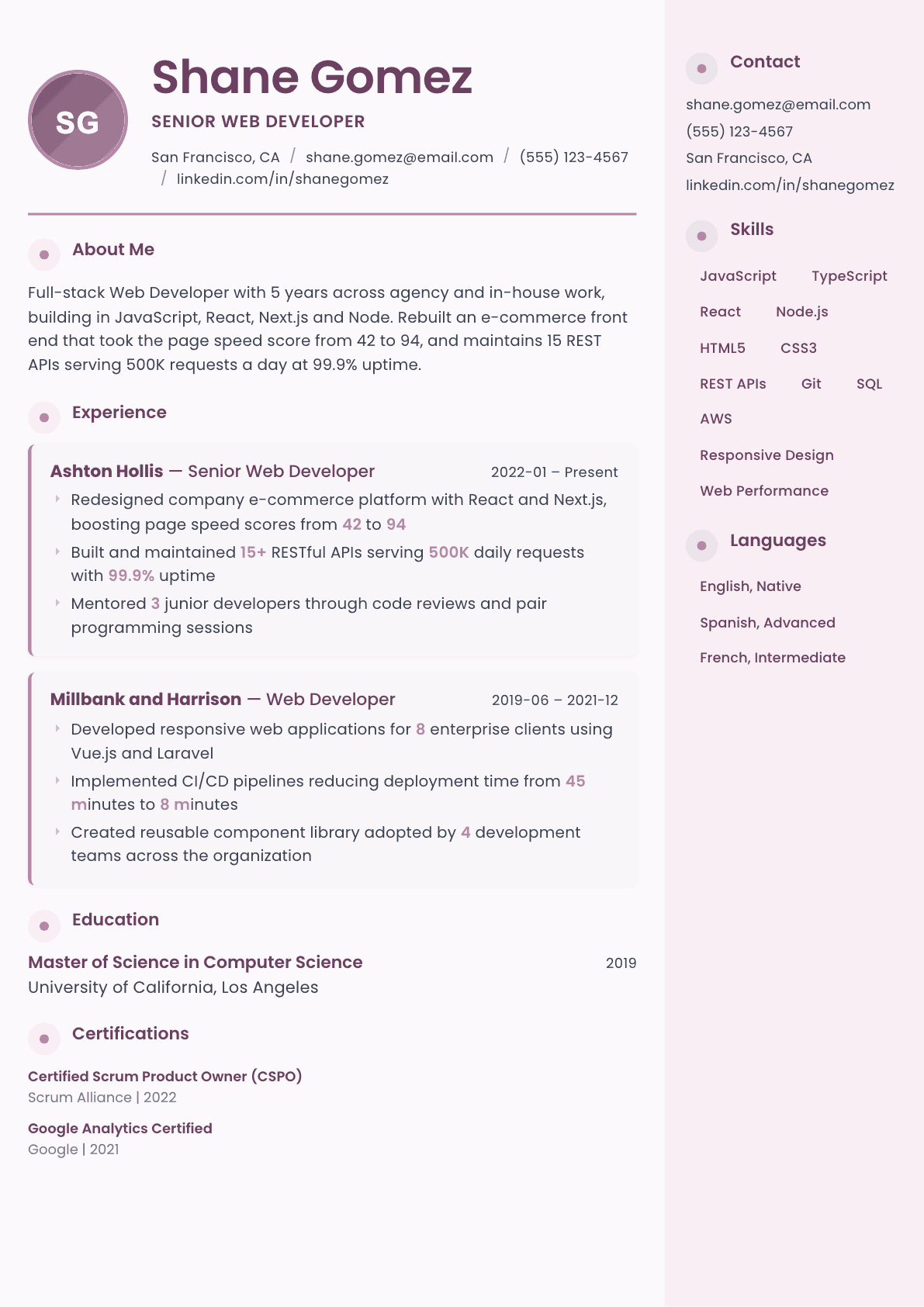
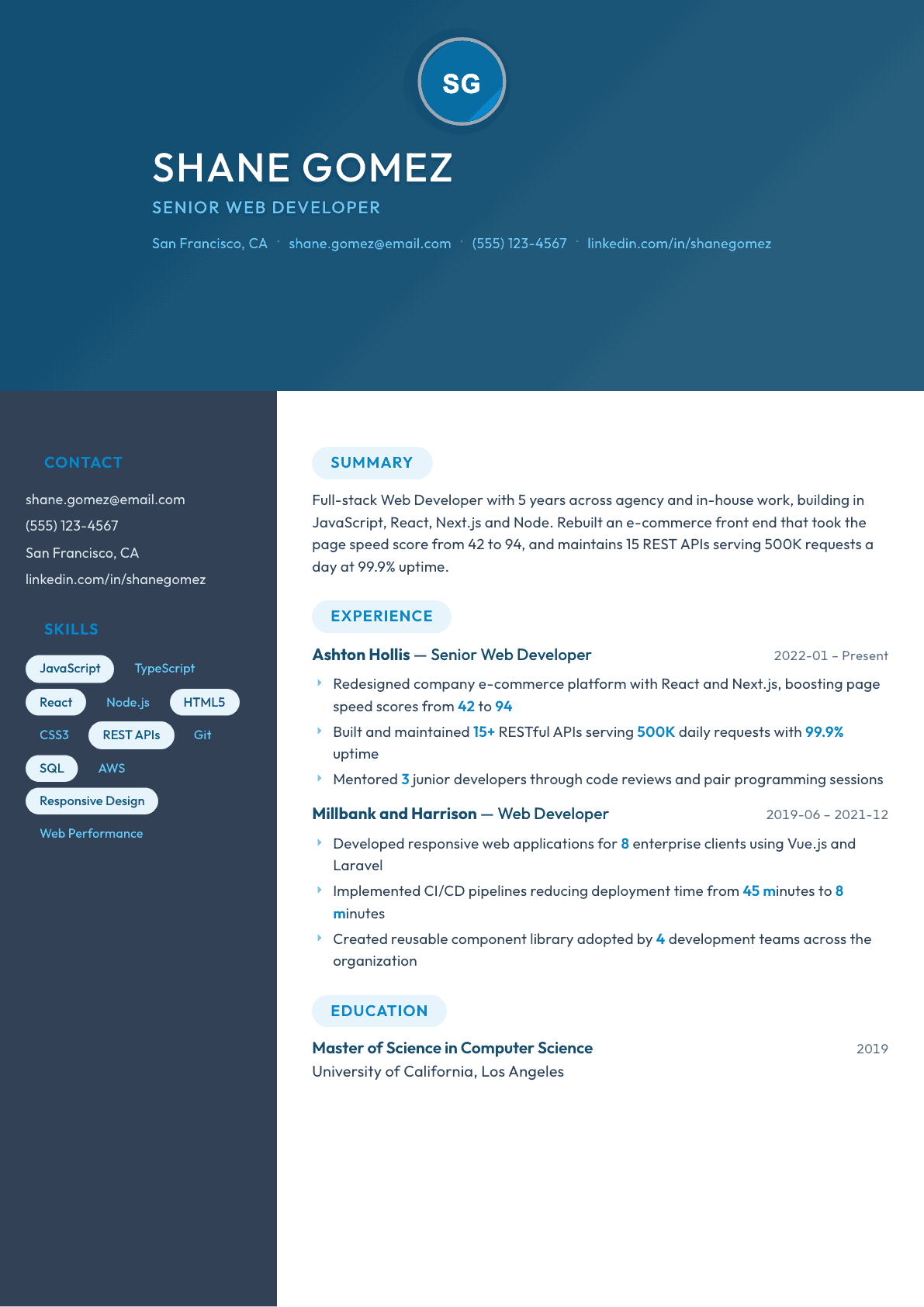
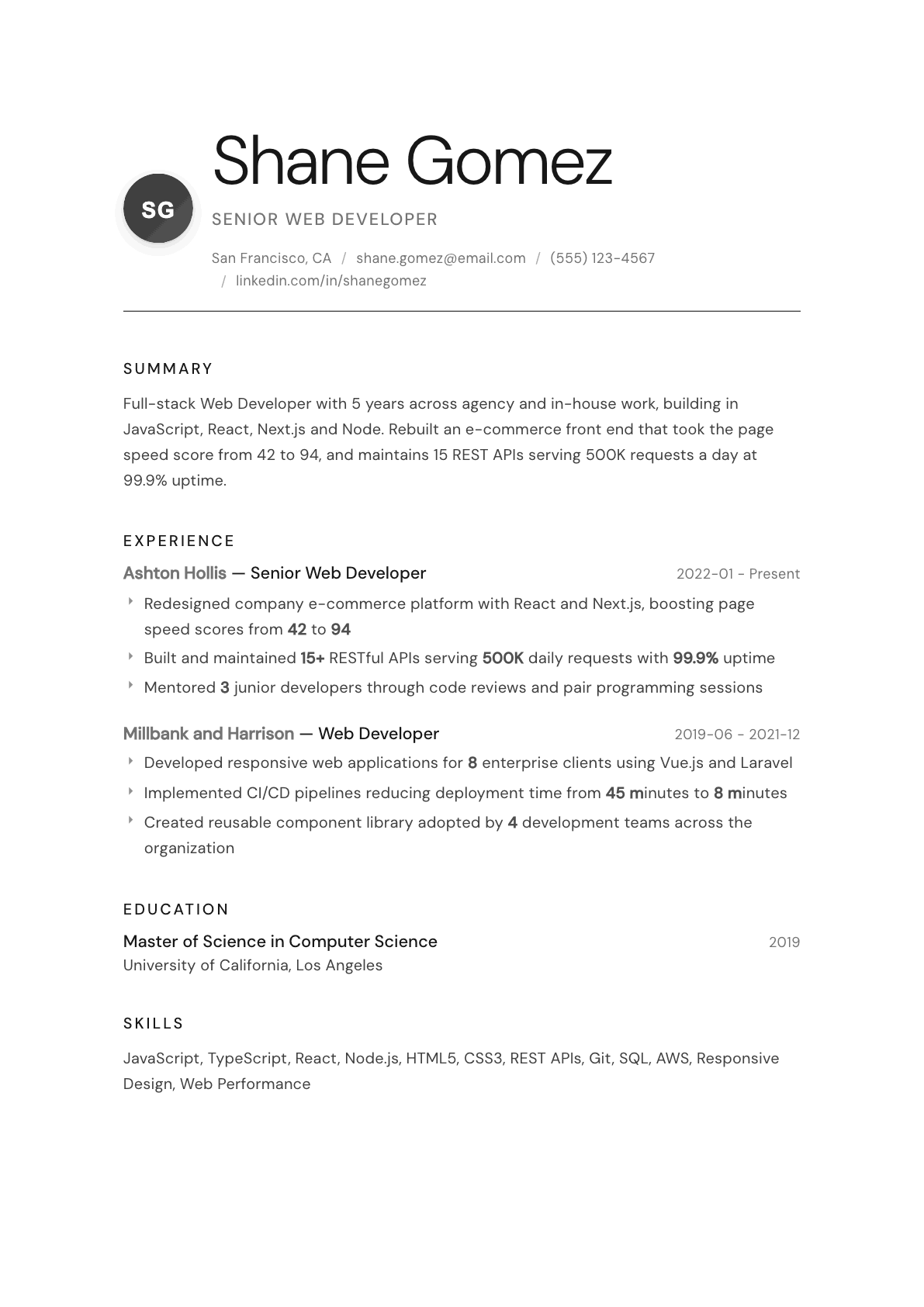
The same web developer content laid out in three CVBooster templates, so you can see what the finished document looks like before you write a word.
Example Web Developer summary
Web developer, 5 years, comfortable across React and Next.js on the front end and Node and SQL behind it. Took an e-commerce page speed score from 42 to 94, cut deploy time from 45 minutes to 8 with a new pipeline, and mentors three junior developers.
Skills to list on a Web Developer resume
- JavaScript
- TypeScript
- React
- Node.js
- HTML5
- CSS3
- REST APIs
- Git
- SQL
- AWS
- Responsive Design
- Web Performance
What actually gets this resume read
- Include links to your portfolio website and GitHub profile prominently at the top.
- Quantify performance improvements: page load times, conversion rates, uptime percentages.
- List both frontend and backend technologies to show full-stack versatility.
- Mention specific frameworks and versions to match ATS keyword requirements.
- Include examples of accessibility (WCAG) compliance work if applicable.
How to write a web developer resume
Web developer is the widest title in software hiring. It covers the person building marketing sites for an agency, the person maintaining a company's customer portal, and the person writing full-stack application code for a product team. Those three jobs are screened by different people against different criteria, so the first decision when writing this resume is which one you are applying for.
Whatever the flavor, a web developer is judged on things a reviewer can see. Live sites, page performance, responsive behavior, browser compatibility, accessibility, and how quickly a page loads on a phone. This is a rare field where the interviewer can inspect your work in a browser before you speak, which makes a link list in the header more valuable than an extra paragraph of self-description.
This guide covers the layout that works for web development applications, how to write about sites and applications you built, three summaries across career stages, before-and-after bullets, and the questions developers ask when their applications stop getting responses.
Format: links first, then a grouped stack
One page for most web developers, two only after eight or more years with substantial application work. Put a portfolio and a code link in the header, and if you have shipped public sites, list two or three of them by name inside the relevant job rather than in a separate section a reviewer might never reach.
Group the technical stack rather than listing it alphabetically. Frontend, backend, data, hosting and tooling as separate lines lets a reviewer confirm a match in seconds. Agencies in particular filter hard on the specific content management system or framework in their brief, and a buried keyword is a missed screen.
- Header: name, title, location, email, portfolio, code profile.
- Order: summary, technical stack by category, experience with named sites, projects, education.
- Say whether you work frontend, backend or full stack in the first line, since the title does not.
Experience: what you built, who used it, how fast it was
Each role needs a context line: the type of employer, the kind of work, and the volume. An agency developer might carry six client projects at a time on tight timelines. An in-house developer might own two applications used daily by a support team. A product developer might own features inside one large codebase. These are different jobs and the reader needs to know which yours was.
Then write bullets that name a real deliverable and a measurable property of it. Load time, Core Web Vitals, conversion on a redesigned page, form completion rate, browser and device coverage, uptime, and the size of the traffic the site carried are all things web work is genuinely measured on. Where you cannot measure outcomes, measure scope: pages, templates, integrations, locales.
Show the full path from build to running site. Hosting, deployment, caching strategy, image optimization, third-party script management and analytics instrumentation are all normal web developer work, and mentioning them separates a developer who ships live sites from one who only works locally.
Frontend, backend or both: pick a lane per application
Claiming full stack without evidence on both sides is the most common credibility problem on these resumes. If you write full stack, at least two bullets must be clearly backend: an API you designed, a database schema you modeled, an authentication flow you implemented, a queue or scheduled job you built, a data migration you ran.
If your strength is genuinely one side, say so plainly and go deeper instead. A frontend-focused web developer with strong performance, accessibility and CSS architecture work is a much easier hire than a candidate who lists nine technologies and can be interviewed on two.
- Frontend evidence: layout systems, responsive behavior, performance budgets, accessibility fixes.
- Backend evidence: API endpoints, data models, authentication, background jobs, integrations.
- Full stack evidence: at least one feature described end to end, from database to interface.
The portfolio decides more than the resume does
Reviewers open the links. That means every site you list should still be live, still look like your work, and still load quickly. A portfolio page listing sites that have since been rebuilt by someone else does you no favors, so note the year of the build or describe your contribution clearly when a client has moved on.
Three well-explained pieces beat a wall of thumbnails. For each, say what the client or product needed, what you built, what constraint made it interesting, and one number. If your paid work is under a confidentiality agreement, build one substantial personal site with real users and treat it the same way.
Keywords web development postings reuse
The recurring vocabulary includes responsive design, cross-browser compatibility, JavaScript, the named framework, REST APIs, content management systems, version control, accessibility standards, web performance, and search engine fundamentals. Use the posting wording once in the stack block and once inside a bullet that shows the work.
Agency and in-house postings diverge here. Agency briefs mention client communication, multiple concurrent projects, content management systems and turnaround times. Product briefs mention application architecture, testing and code review. Lead with the half that matches, and keep the other half visible further down.
Web Developer resume summary examples
First developer job
Web developer with a year of freelance and bootcamp project work, including three live client sites built with JavaScript, React and a headless content management system. Comfortable with responsive layouts, basic accessibility testing and deploying through Git. Portfolio includes a booking tool with 200 monthly users.
Five years in
Full-stack web developer with five years in agency and in-house roles, building marketing sites and customer portals with React and Node. Carried six concurrent client projects, cut average largest contentful paint from 3.4s to 1.6s across a client portfolio, and owns two production APIs.
Lead web developer
Lead web developer with nine years across e-commerce and publishing platforms. Owns the frontend architecture for a site serving 4 million monthly sessions, led a replatform onto a headless stack across 12 locales, and reviews the work of three developers and one contractor.
Work experience bullets: before and after
Before: Built and maintained websites for clients.
After: Built 14 client sites on a headless content management system with shared component templates, cutting average project build time from five weeks to three.
Project count plus a reusable approach shows an agency developer who improved the process, not just delivered tickets.
Before: Improved site speed and performance.
After: Reduced largest contentful paint from 3.4s to 1.6s by serving responsive images in modern formats, deferring three third-party scripts and inlining critical CSS.
Named techniques and a measured before and after make the improvement reproducible and believable.
Before: Made the site work on mobile devices.
After: Rebuilt the product listing templates with a fluid grid and container queries, fixing layout breakage on small viewports that affected 38% of sessions.
The technique and the share of affected traffic show the problem was real and the fix was deliberate.
Before: Worked on the backend of the customer portal.
After: Designed and built eight REST endpoints and the Postgres schema behind a customer portal handling 9,000 monthly logins, including session handling and rate limiting.
It proves the backend half of a full-stack claim with a schema, endpoints and an authentication concern.
Before: Followed accessibility best practices.
After: Audited five client sites against WCAG 2.1 AA, corrected 120 contrast, labeling and focus issues, and added an automated check to the deployment pipeline.
A standard, a count and a prevention step turn a claim of best practice into a documented process.
Hard skills
- JavaScript and TypeScript
- React
- HTML and semantic markup
- Modern CSS layout
- Node.js
- REST API development
- SQL and data modeling
- Content management systems
- Web performance and Core Web Vitals
- Accessibility standards
- Responsive and cross-browser development
- Git and deployment pipelines
- Hosting, caching and CDNs
- Analytics instrumentation
Soft skills
- Client communication
- Estimating build time
- Juggling concurrent projects
- Translating design files into build
- Debugging in unfamiliar codebases
- Handover and documentation
Certifications worth listing
- AWS Certified Developer, Associate (Amazon Web Services)
- Microsoft Certified: Azure Developer Associate (Microsoft)
- Google Analytics Certification (Google)
- Certified Professional in Accessibility Core Competencies (CPACC) (International Association of Accessibility Professionals)
Mistakes that cost web developer candidates the interview
- Listing dead portfolio links, or sites that have since been rebuilt by someone else without any note.
- Claiming full stack while every bullet describes interface work, which collapses in the first technical question.
- Describing sites without a single measurable property such as load time, traffic or conversion.
- Using one long alphabetical technology list instead of grouping the stack so a reviewer can match it fast.
- Omitting deployment and hosting, which suggests a developer who has never taken a site live alone.
- Applying to agency and product roles with the same top third when the two read for different signals.
- Padding the page with bootcamp exercises once real client or production work exists to write about.
Web Developer resume questions
What should a web developer portfolio include?
Three live pieces you can explain, each with the brief, your specific contribution, the technical constraint and one number. Include at least one site with real users. Check every link before you apply, because reviewers open them first.
Should I call myself a full-stack web developer?
Only if two or more bullets show backend work you designed: endpoints, data models, authentication, jobs or integrations. Otherwise say frontend web developer and go deeper. A narrow honest claim interviews far better than a broad thin one.
How do I write a web developer resume with no professional experience?
Put a projects section directly under the summary and treat each project as a job: what it does, who uses it, the stack, the hard part, and one measurement. Freelance work for a local business counts as professional experience and should be listed as such.
Does a web developer need to know search engine optimization?
The technical side, yes, and it is often in the posting. Semantic markup, metadata, structured data, page speed, crawlability and correct redirects during a migration are developer responsibilities. Keyword strategy and content planning are not.
How is an agency web developer resume different from an in-house one?
An agency resume shows concurrent projects, client contact, turnaround times and breadth across content management systems. An in-house resume shows depth in one codebase, ownership of specific applications and collaboration with internal teams. Lead with the one that matches.
Related resume examples
- Software Engineer Resume example
- Frontend Developer Resume example
- UX Designer Resume example
- Salesforce Developer Resume example
- JavaScript Developer Resume example
- Shopify Developer Resume example