React Developer Resume Examples: the lines they read
Shape a React Developer Resume Around Product Impact
By Mustafa Tarabya, founder of CVBooster · Published · Updated
A React developer resume with hooks and state management examples, component library keywords, sample bullets and a complete writing guide.
Sample resumes for a react developer
The same react developer content laid out in three CVBooster templates, so you can see what the finished document looks like before you write a word.
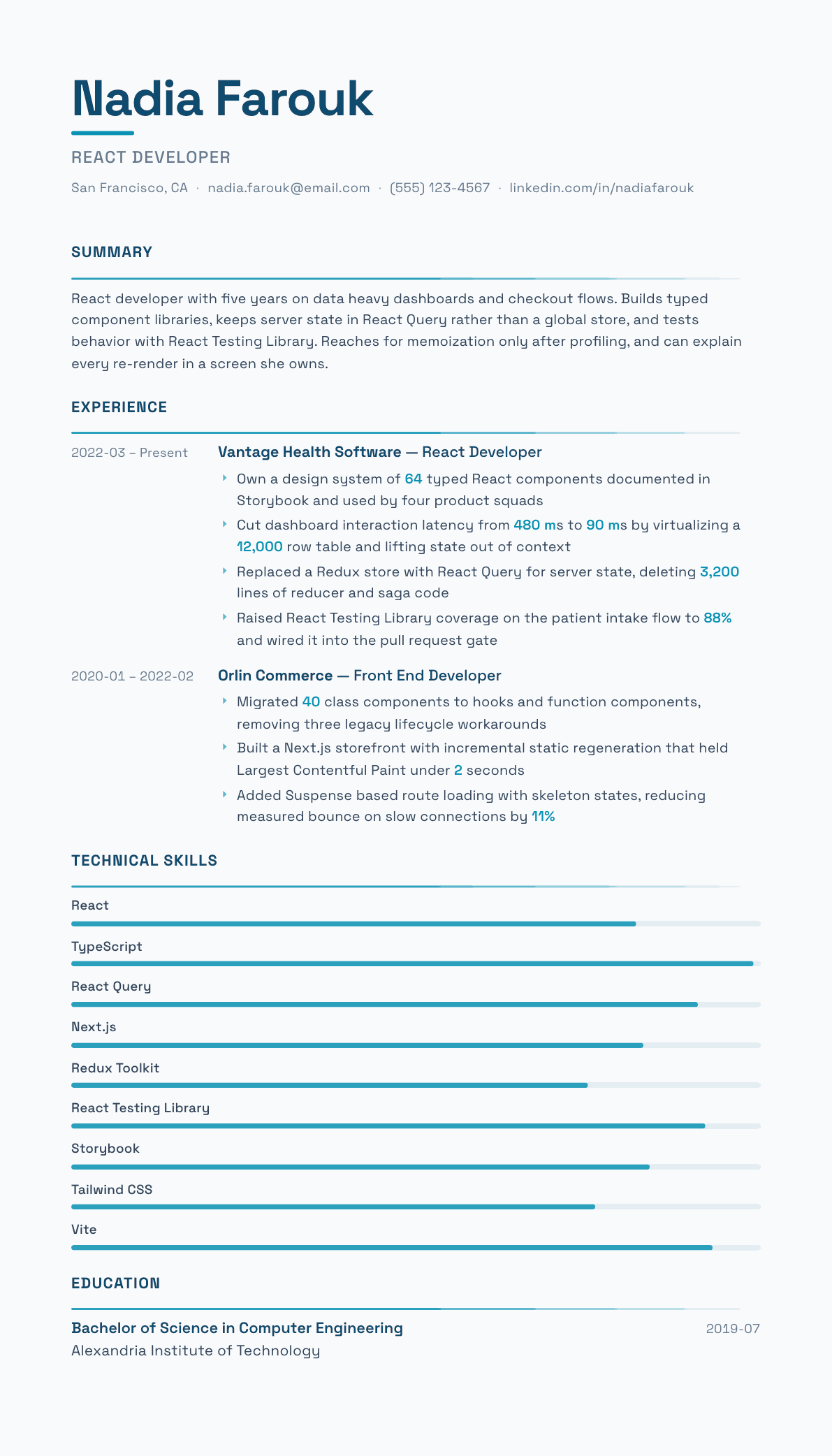
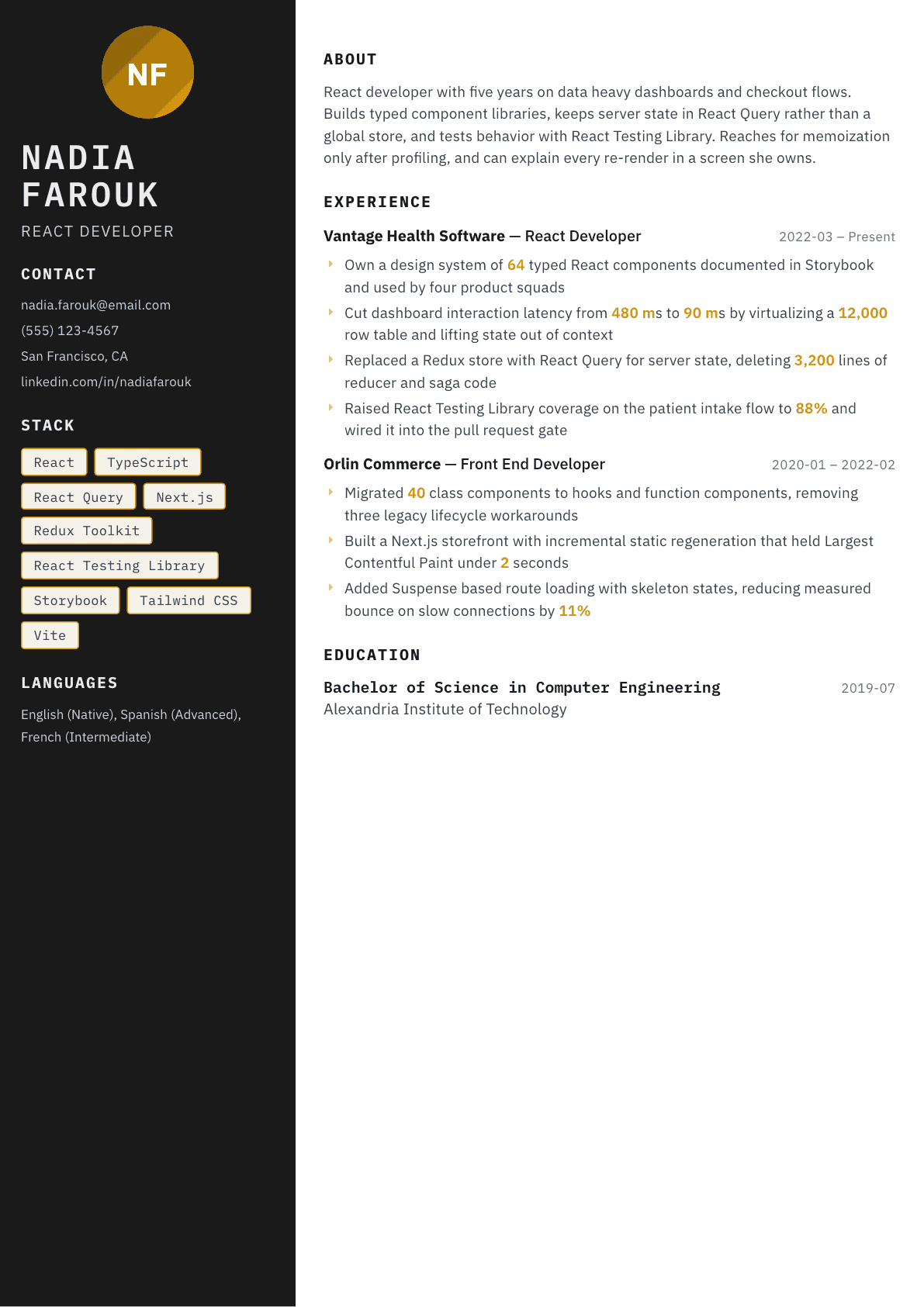
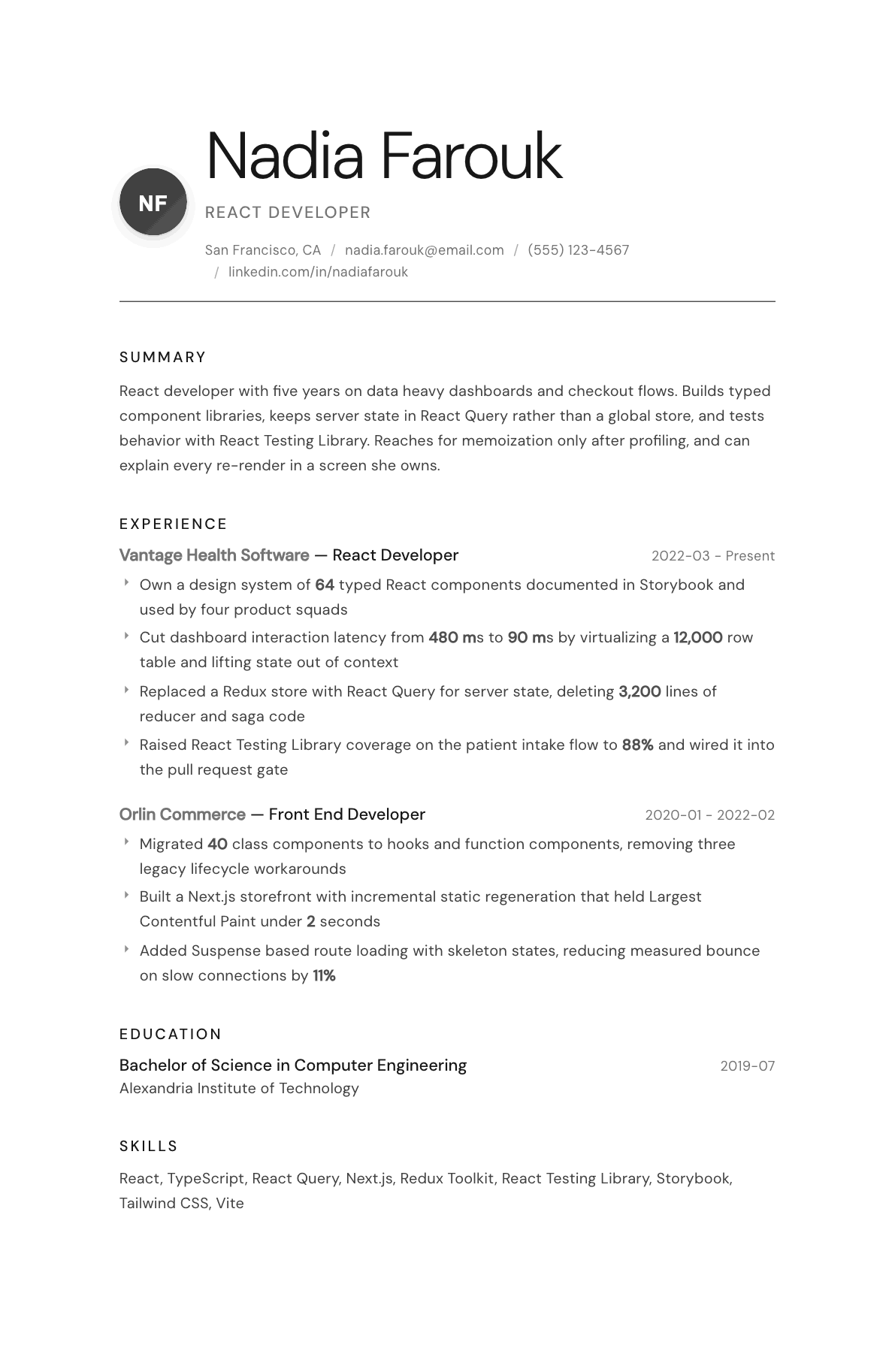
Example React Developer summary
React developer with five years building component libraries and dashboards for healthcare and commerce products. Works in TypeScript by default, keeps server state in React Query, and documents every shared component in Storybook so other squads stop rebuilding the same table. Reduced an interaction delay from half a second to under a tenth by virtualizing rows and moving state out of context. Open to a senior front end role.
Skills to list on a React Developer resume
- React
- TypeScript
- React Hooks
- Next.js
- Redux Toolkit
- React Query
- Context API
- React Testing Library
- Cypress
- Storybook
- Tailwind CSS
- Vite
- REST and GraphQL
- Web accessibility
- Component architecture
What actually gets this resume read
- Say whether your React work is client rendered, server rendered or static, because those pipelines hire differently.
- Name your state approach: local state, context, Redux Toolkit, Zustand or React Query, and why the project needed it.
- Quantify component work by count and reuse: how many components, how many teams consumed them, how they were documented.
- Show one render performance fix with the measurement before and after, since that separates senior React work from routine work.
- List React Testing Library or Cypress rather than writing tested, because screens filter on the tool name itself.
- Mention TypeScript early if you use it, as most React postings now treat it as the default rather than a bonus.
How to write a react developer resume
React roles attract more applicants than almost any other front end title, so the screen is brutal and fast. Nearly every resume in the pile says React, hooks, Redux and REST. The ones that get calls say what kind of React work it was: a design system consumed by other teams, a data heavy dashboard where render cost is the whole problem, or a server rendered storefront where the first paint decides revenue.
The second thing a reviewer looks for is state discipline. React interviews circle around the same question in different clothes: do you understand when a component re-renders, and do you know which state belongs on the server. A resume that names React Query for server state and explains why the Redux store went away answers that question before the interview starts.
Below is the section by section approach that works for React applications, three summaries pitched at different career stages, five rewritten bullets, the mistakes that get strong candidates filtered out, and the questions React developers ask when they sit down to write.
Format: one column, TypeScript visible, rendering model stated
Keep the layout simple and the skills block near the top. State your rendering model in the first job line: client rendered application, Next.js with server components, or static generation. Teams hire for these differently, and a reviewer should not have to infer it from the tool list.
One page under six years. If you have a component library or an open source contribution worth reading, link it once in the header rather than describing it three times in the body.
- Header: name, React developer or front end engineer, city, phone, email, code profile.
- Order: summary, technical skills, experience, projects if early career, education.
- Each role opens with product, audience and rendering model before the bullets.
Summary: product type, state approach, one measurable result
Three lines. Years, the kind of product, TypeScript if you use it, your state approach, and a single number that shows you measure your work. An interaction latency figure or a component count with the teams consuming it both do this job well.
Skip adjectives about being detail oriented. The detail you are oriented toward should appear as a fact instead: sixty four typed components documented in Storybook, or a table of twelve thousand rows that scrolls without dropping frames.
Experience: components, state, and render cost
The most convincing React bullets fall into three families. First, component architecture: how many components, whether they were typed, whether other teams used them, and where they were documented. Second, state: what lived locally, what lived in a store, what moved to a server state library, and what that change deleted.
Third, render performance. This is where senior React work shows. Virtualizing a long list, splitting a context that was re-rendering half the tree, memoizing after profiling rather than by habit, or moving a computation out of render entirely. Give the before and after in milliseconds if you have them.
Add one bullet on how the work reached users: Suspense boundaries and loading states, error boundaries, feature flags, or an incremental rollout. Product teams care whether your components behave when the network does not.
Skills: React specific, then the ecosystem around it
Split React itself from the ecosystem. Under React, list hooks you use deliberately, context, Suspense, error boundaries and server components if you have shipped them. Under ecosystem, list routing, state, forms, styling and testing choices by name.
Testing choices carry weight here. React Testing Library says you test behavior. Enzyme era snapshot testing says something else. Name the tool and, if you can, the coverage gate it sits behind in the pipeline.
- React: hooks, context, Suspense, error boundaries, server components.
- State: Redux Toolkit, Zustand, Jotai, React Query or SWR for server state.
- Routing and rendering: React Router, Next.js, static and incremental generation.
- Testing and docs: React Testing Library, Cypress or Playwright, Storybook.
Keywords and tailoring: match the stack in the posting
React postings are written by engineers, so the vocabulary is precise. If the posting says React Query, do not write data fetching library. If it says Next.js App Router, name it. Mirror the exact terms once in the skills block and once in a bullet where the work supports it.
When the stack in the posting differs from yours, say what you used and what the equivalent responsibility was. Moving from Redux Toolkit to Zustand is a week, and hiring managers know it. Pretending you already use Zustand costs you the offer when the technical round arrives.
React Developer resume summary examples
First React role
Front end developer with a year of internship and freelance React work in TypeScript, building forms, tables and authenticated routes against REST APIs. Comfortable with hooks, React Router and React Testing Library, and has published a small component package used by two client projects.
Five years in
React developer with five years on healthcare dashboards and commerce storefronts. Owns a typed design system of 64 components documented in Storybook and used by four squads, and cut dashboard interaction latency from 480 ms to 90 ms by virtualizing a large table and restructuring context.
Senior front end engineer
Senior React engineer with nine years building product front ends, currently technical lead for a team of six. Migrated a client rendered application to Next.js server components without a feature freeze, set the performance budget enforced in continuous integration, and mentors three mid level developers.
Work experience bullets: before and after
Before: Built reusable React components.
After: Own a design system of 64 typed React components documented in Storybook and consumed by four product squads, with visual regression tests on every pull request.
Count, typing, documentation and consumers turn reusable into something a reader can verify.
Before: Improved dashboard performance.
After: Cut dashboard interaction latency from 480 ms to 90 ms by virtualizing a twelve thousand row table and lifting frequently changing state out of a shared context.
The two techniques explain the number, which is what a senior interviewer will probe.
Before: Used Redux for state management.
After: Replaced a Redux store with React Query for server state and local state for the rest, deleting 3,200 lines of reducer and saga code while cutting stale data bugs.
Showing what the change removed proves a judgment call rather than a tool preference.
Before: Converted class components to hooks.
After: Migrated 40 class components to function components with hooks, removing three lifecycle workarounds and standardizing data fetching across the checkout flow.
The count and the workarounds removed give the migration a measurable end state.
Before: Worked on a Next.js site.
After: Built a Next.js storefront using incremental static regeneration for category pages, holding Largest Contentful Paint under 2 seconds on mid range mobile devices.
Naming the rendering strategy and the device class shows you understand where the cost falls.
Hard skills
- React and hooks
- TypeScript
- Next.js and server components
- React Query or SWR
- Redux Toolkit and Zustand
- React Router
- React Testing Library
- Cypress or Playwright
- Storybook and component documentation
- Tailwind CSS and CSS modules
- REST and GraphQL integration
- React profiling and render optimization
Soft skills
- Turning designs into component boundaries
- Writing pull requests reviewers can follow
- Pushing back on scope with a reason
- Onboarding other teams onto shared components
- Pairing with designers on interaction detail
Certifications worth listing
- Meta Front-End Developer Professional Certificate (Meta)
- JSA Certified Associate JavaScript Programmer (JS Institute)
Mistakes that cost react developer candidates the interview
- Writing React, Redux, hooks and nothing else, which makes your resume identical to the two hundred others in the queue.
- Failing to say whether the work was client rendered or server rendered, when those are different hiring tracks.
- Claiming a design system when the work was a folder of components nobody outside the team ever imported.
- Listing memoization as a skill without any evidence that profiling came before it.
- Leaving TypeScript implicit, so an automated screen filtering on it never sees a match.
- Describing a Next.js project without naming the routing model, which is the first thing an interviewer will ask about.
React Developer resume questions
How much does state management choice matter on a React resume?
A great deal, because it is the clearest signal of how you think about data. Name what you used, what you replaced, and why. A candidate who can explain moving server state out of Redux is treated as more senior than one who lists both.
Should I include Next.js experience if the role is plain React?
Yes, but keep it proportionate. Mention it in the skills block and in one bullet. A team hiring for a client rendered application still values the routing, data loading and rendering knowledge that Next.js work builds.
Do React developers need a portfolio?
A small number of well built demos help early career candidates more than a long list of tutorials. Once you have production experience, the experience section carries the weight and the portfolio only needs to prove that your work loads quickly.
How do I show React performance work without hard numbers?
Describe the symptom, the diagnosis and the change: a list that stuttered while typing, a profiler trace showing the whole tree re-rendering, and the context split that fixed it. The method is convincing even when you never captured a metric.
Is React Native experience worth adding?
Add it in one line under skills or as a single bullet. It signals range and helps at companies with a mobile product, but leading with it on a web React application can make a reviewer question which role you actually want.
Related resume examples
- Frontend Developer Resume example
- Full-Stack Developer Resume example
- JavaScript Developer Resume example
- Angular Developer Resume example
- Web Developer Resume example
- WordPress Developer Resume example