Furniture Designer Resume Examples: the lines they read
Write a Furniture Designer Resume Manufacturers Take Seriously
By Mustafa Tarabya, founder of CVBooster · Published · Updated
A furniture designer resume guide with CAD and joinery keywords, a sample from concept sketch to production drawing, and hiring manager tips.
Sample resumes for a furniture designer
The same furniture designer content laid out in three CVBooster templates, so you can see what the finished document looks like before you write a word.
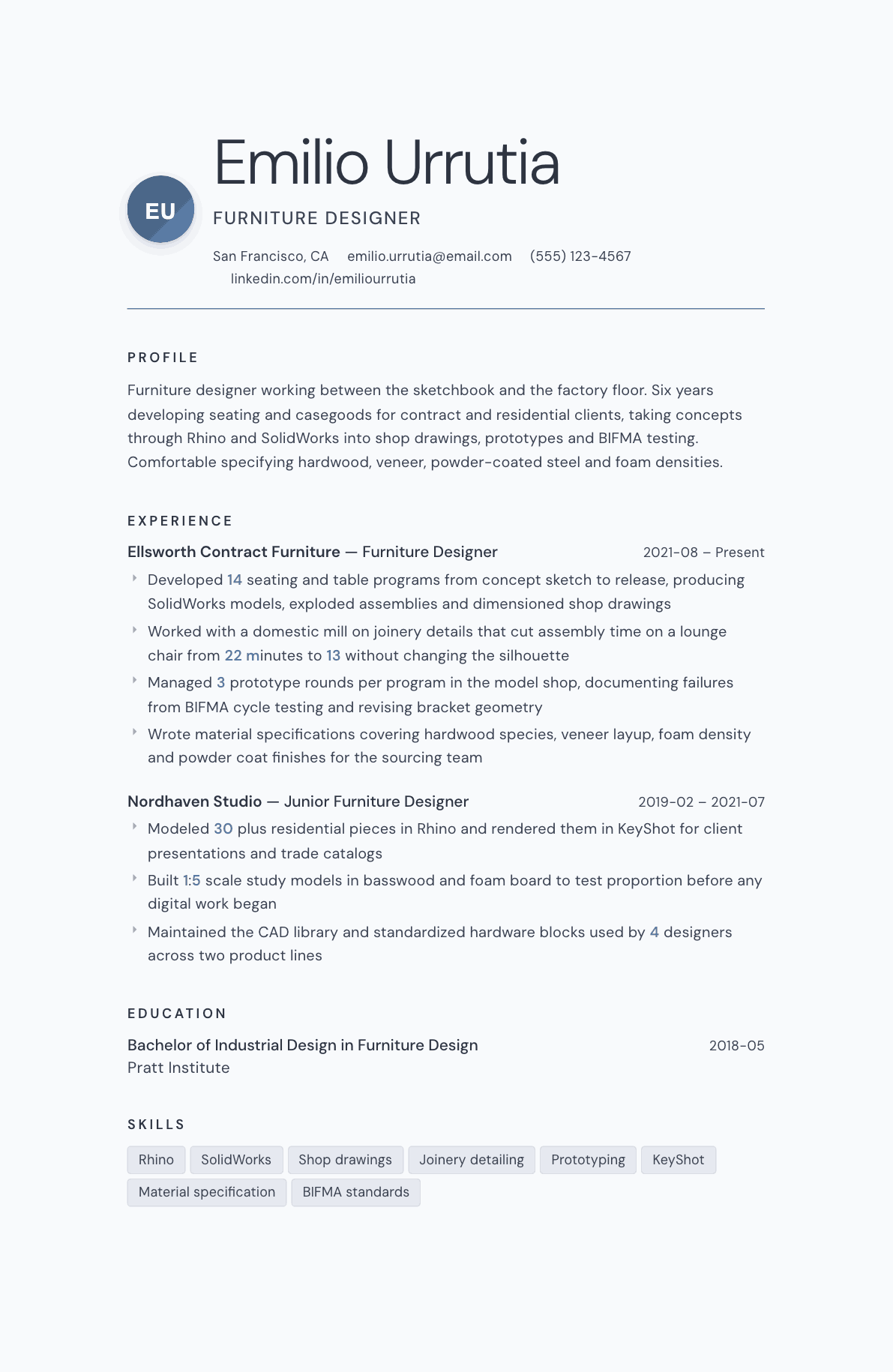
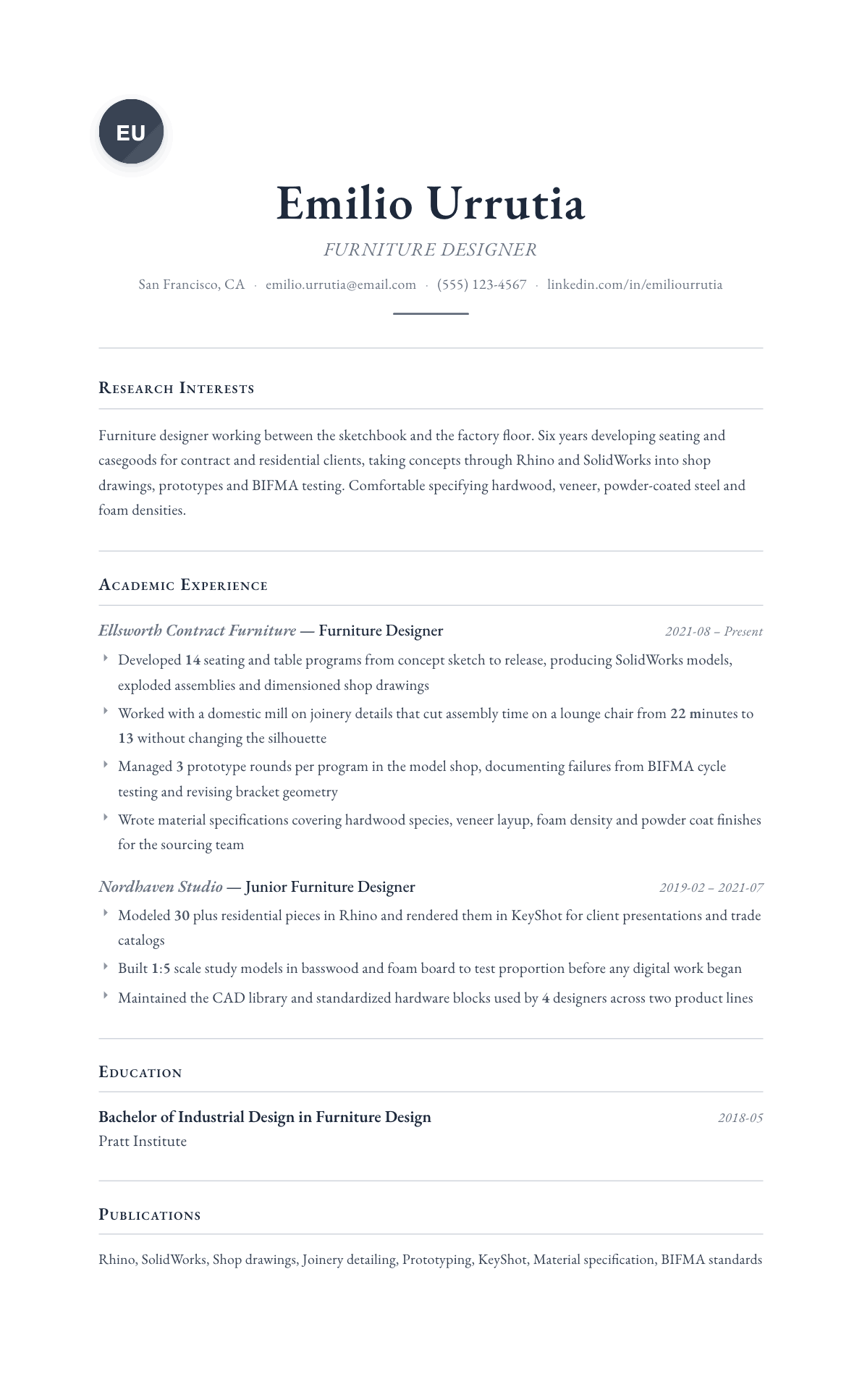
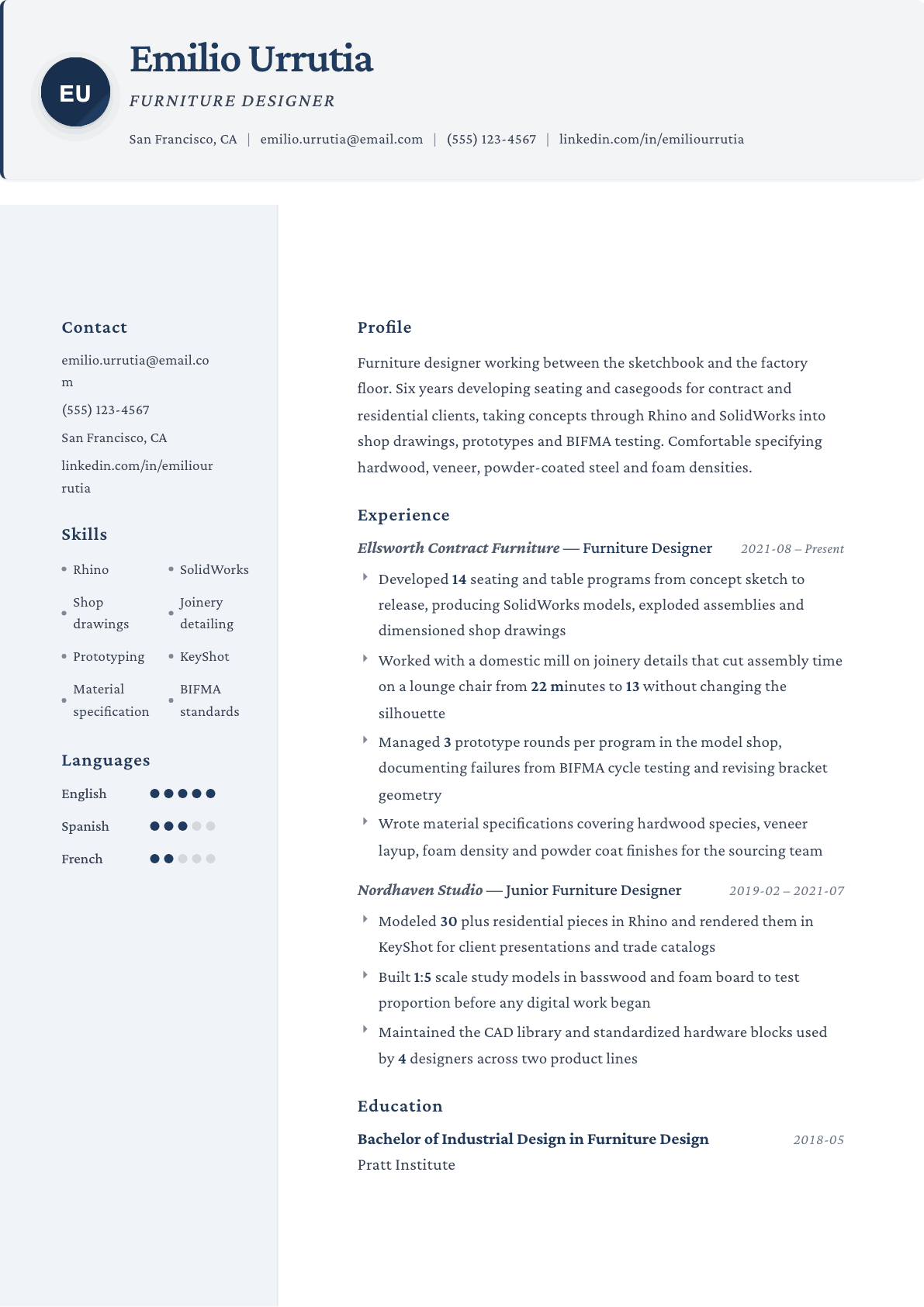
Example Furniture Designer summary
Furniture designer with six years developing seating and casegoods for contract interiors. Moves a concept from sketch and scale model through Rhino and SolidWorks to dimensioned shop drawings, prototype rounds and BIFMA cycle testing. Specifies hardwood, veneer, tubular steel and foam density with sourcing teams, and has released 14 programs into production with domestic and overseas manufacturers.
Skills to list on a Furniture Designer resume
- Rhino
- SolidWorks
- Fusion 360
- AutoCAD
- Shop drawings
- Joinery
- Prototyping
- KeyShot rendering
- Materials and finishes
- Upholstery construction
- CNC fabrication
- Bill of materials
- BIFMA testing
- Sketching
- Scale modeling
What actually gets this resume read
- Say whether you design for contract, residential or hospitality, because the testing standards and price points differ sharply.
- Name your CAD stack, and separate the surface modeler you sketch in from the parametric tool you release drawings from.
- Include one bullet showing a piece you took to production, with the manufacturing method and the material.
- Mention scale models and mockups, since studios want proof you understand proportion away from a screen.
- List the standards you have designed against, such as BIFMA cycle testing or flammability requirements for public seating.
- Link a portfolio that shows drawings and prototypes, not only finished renders, so the reader sees your process.
How to write a furniture designer resume
A furniture designer resume is judged by someone who has to release drawings to a factory. The design director wants to see taste, but the engineering and sourcing side of the same studio wants proof that your files leave the office without a phone call: dimensioned shop drawings, an exploded assembly, a bill of materials, and finish callouts a mill can quote from.
The split that decides most furniture hires is contract versus residential. Contract seating carries cycle testing, flammability requirements and a specification sheet the dealer sells from. Residential work lives closer to styling, price point and retail photography. Say which one you come from in the first line, because a studio filling a contract seating role will not guess.
This guide sets out the section order furniture studios expect, three summaries for different career stages, before and after bullets from concept through prototype, and answers to the questions designers ask when they move between residential, contract and hospitality work.
Format: one page, portfolio link in the header, drawings included
Keep it to one page until you have released several programs, then two. Put the portfolio link beside your email. The link should open on process, not only on styled photography: a studio wants to see a sketch page, a scale model, a Rhino model, and the dimensioned drawing that came out of the same project.
Use a single column in the experience section. Furniture studios are small and often read resumes as attachments inside an email thread, so a layout that depends on sidebars or icons tends to arrive broken. Reverse chronological order throughout.
- Header: name, city, phone, email, portfolio link, and a note if the site is password protected.
- Order: summary, experience, education, software and technical skills, exhibitions or awards.
- Recent graduates move education up and add a workshop skills line covering machines they are checked out on.
Summary: market, years, and where you sit between sketch and factory
Two or three lines. Name the market segment, the product families you have developed, the modeling stack, and the point in the process where you take over. A designer who models but never releases drawings is a different hire from one who runs prototype rounds with a mill, and the summary is where that gets settled.
If you are moving from another design discipline, name the transferable half plainly. An industrial designer entering furniture should point at parametric modeling, tolerancing and vendor communication rather than hoping the reader translates consumer electronics work into casegoods.
Experience: the program, the method, the material, the outcome
Every job needs the company, the segment it serves, and the kind of product you developed: seating, casegoods, tables, storage, or upholstered soft seating. Then three to five bullets per role. Lead with a program you took from concept sketch to release, and name the manufacturing method inside the bullet: five axis machining, bent plywood lamination, tube bending, welded steel frames, foam pour, cut and sew upholstery.
At least one bullet should describe a problem you solved in the factory rather than on the screen. Assembly time, part count, a joint that failed cycle testing, a veneer layup that telegraphed through the face: these are the details that convince a director you have stood next to a prototype and argued about it.
Avoid bullets that describe the job title back to the reader. Every furniture designer designs furniture. What separates candidates is which materials they can specify without help and which vendors they have already worked through.
- Name the CAD file you delivered: surface model, parametric assembly, or a released drawing package.
- Give prototype rounds as a count and say what changed between them.
- Include the standards you designed against, such as BIFMA cycle testing for contract seating.
Software and shop skills: two separate lines
Split the sketch and surface tools from the release tools. Rhino, Blender and hand sketching sit on one line; SolidWorks, Fusion 360 and AutoCAD sit on another, because a studio hiring for drawing release screens on the second line. Add rendering separately, since KeyShot and V-Ray work reads as presentation rather than engineering.
Then a shop line. Studios with an in-house model shop want to know what you can build yourself: table saw, band saw, CNC router, vacuum press, welding, upholstery mock-ups, foam carving. A designer who can cut a mock-up at one to five scale by Friday is worth more to a small studio than one who only sends files out.
Keywords a furniture posting is built from
Furniture job descriptions reuse a small vocabulary: shop drawings, bill of materials, tolerance, joinery, casegoods, soft seating, finish schedule, sample approval, vendor communication, prototype review, value engineering. Mirror the exact terms once in your skills block and once inside a bullet where the term is doing real work.
Add the material language too. Hardwood species, veneer layup, laminate, powder coat, plated steel, foam density and yield, and textile grades all appear in specification documents, and a resume that never names a material reads like a rendering with no weight behind it.
Furniture Designer resume summary examples
Recent graduate
Industrial design graduate focused on furniture, with a senior thesis chair built at full scale in bent plywood and steel. Models in Rhino and SolidWorks, renders in KeyShot, and checked out on the CNC router, vacuum press and MIG welder in the school shop. Seeking a junior furniture design role.
Six years in
Furniture designer with six years across contract seating and casegoods. Takes programs from sketch and scale model through SolidWorks release drawings, prototype rounds and BIFMA cycle testing. Specifies hardwood, veneer, tubular steel and foam density with sourcing, and has released 14 programs with domestic and overseas manufacturers.
Senior or lead designer
Senior furniture designer leading a three person studio team across hospitality and contract programs. Owns the design language, the drawing standard and the vendor relationships, runs sample and finish approvals, and has brought 40 products to market. Comfortable presenting to dealers and defending cost decisions with the sourcing team.
Work experience bullets: before and after
Before: Designed chairs and tables for the product line.
After: Developed 14 seating and table programs from concept sketch to release, producing SolidWorks assemblies, exploded views and dimensioned shop drawings for a domestic mill.
The volume, the deliverables and the receiving vendor turn a job description into evidence of released work.
Before: Worked with the factory to improve production.
After: Reworked the leg to seat joint on a lounge chair with the mill, cutting assembly time from 22 minutes to 13 without changing the silhouette.
A named part, a measured result and the constraint you protected show factory judgment rather than general cooperation.
Before: Built prototypes and tested them.
After: Ran three prototype rounds per program in the model shop, logging failures from BIFMA cycle testing and revising bracket geometry and weld placement between rounds.
Naming the test standard and what you changed proves you can close a loop, not just make a sample.
Before: Made renderings for presentations.
After: Modeled 30 residential pieces in Rhino and rendered them in KeyShot for client pitches and the dealer catalog, matching studio lighting and material setups across the range.
Consistency across a range is the real rendering skill, and the sentence now says who used the images.
Before: Wrote material specifications.
After: Wrote material specifications covering hardwood species, veneer layup, foam density and powder coat finish codes, and reviewed vendor quotes with sourcing before release.
The specific fields make the claim checkable and place you inside the costing conversation.
Hard skills
- Rhino
- SolidWorks
- Fusion 360
- AutoCAD
- Shop drawings
- Joinery detailing
- Bill of materials
- Prototyping and model making
- KeyShot rendering
- Materials and finishes
- Upholstery construction
- CNC fabrication
- BIFMA testing
- Hand sketching
Soft skills
- Vendor communication
- Design critique
- Cost trade-off judgment
- Presentation to clients
- Cross-team coordination
- Note taking under review
Certifications worth listing
- SolidWorks Certified Professional (CSWP) (Dassault Systemes)
- SolidWorks Certified Associate (CSWA) (Dassault Systemes)
- Autodesk Certified Professional: Fusion 360 for Design and Manufacturing (Autodesk)
- LEED Green Associate (U.S. Green Building Council)
Mistakes that cost furniture designer candidates the interview
- Sending a portfolio of renders with no drawings, which reads as styling and leaves the studio unsure you can release a file.
- Leaving out the market segment, so a contract studio cannot tell whether you have ever met a cycle test.
- Listing every CAD package in one line, which hides whether you actually release from a parametric tool.
- Describing programs without naming a material or a manufacturing method, the two things a sourcing manager reads for.
- Claiming full ownership of a group project. Studios are small and directors ask the same vendors about you.
- Dropping model making off the resume because it feels old fashioned, when small studios hire for it directly.
Furniture Designer resume questions
How long should a furniture designer resume be?
One page while your work fits on it, and two once you have several released programs, patents or teaching to list. The portfolio carries the images, so the resume should stay a dense factual record of what you developed and with whom.
Do I need SolidWorks, or is Rhino enough?
Rhino alone is enough at studios that outsource engineering, but most manufacturers release from a parametric tool. List both and be honest about which one you draw production files in, because an interview test will find out within an hour.
How do I show furniture work if I have only made one-off pieces?
Treat your own shop as an employer. Give the piece count, the materials, the joinery, and anything you sold, exhibited or built to a client brief. Craft work reads well as long as you also show you understand repeatable manufacture.
Should a furniture resume include exhibitions and awards?
Yes, in a short section after education. Trade fair showings, design competitions and gallery presentations tell a director you have put work in front of an audience and can hold a deadline that does not move.
How do I move from residential to contract furniture design?
Say the move in the summary and lead your bullets with anything that resembles contract discipline: durability testing, specification writing, tolerance work, dealer or architect communication, and repeat manufacturing rather than short custom runs.