Industrial Designer Resume Examples: what gets the call
Build an Industrial Designer Resume That Gets Interviews
By Mustafa Tarabya, founder of CVBooster · Published · Updated
Create a compelling industrial designer resume highlighting your product development, CAD skills, and manufacturing knowledge with modern templates.
Sample resumes for a industrial designer
The same industrial designer content laid out in three CVBooster templates, so you can see what the finished document looks like before you write a word.
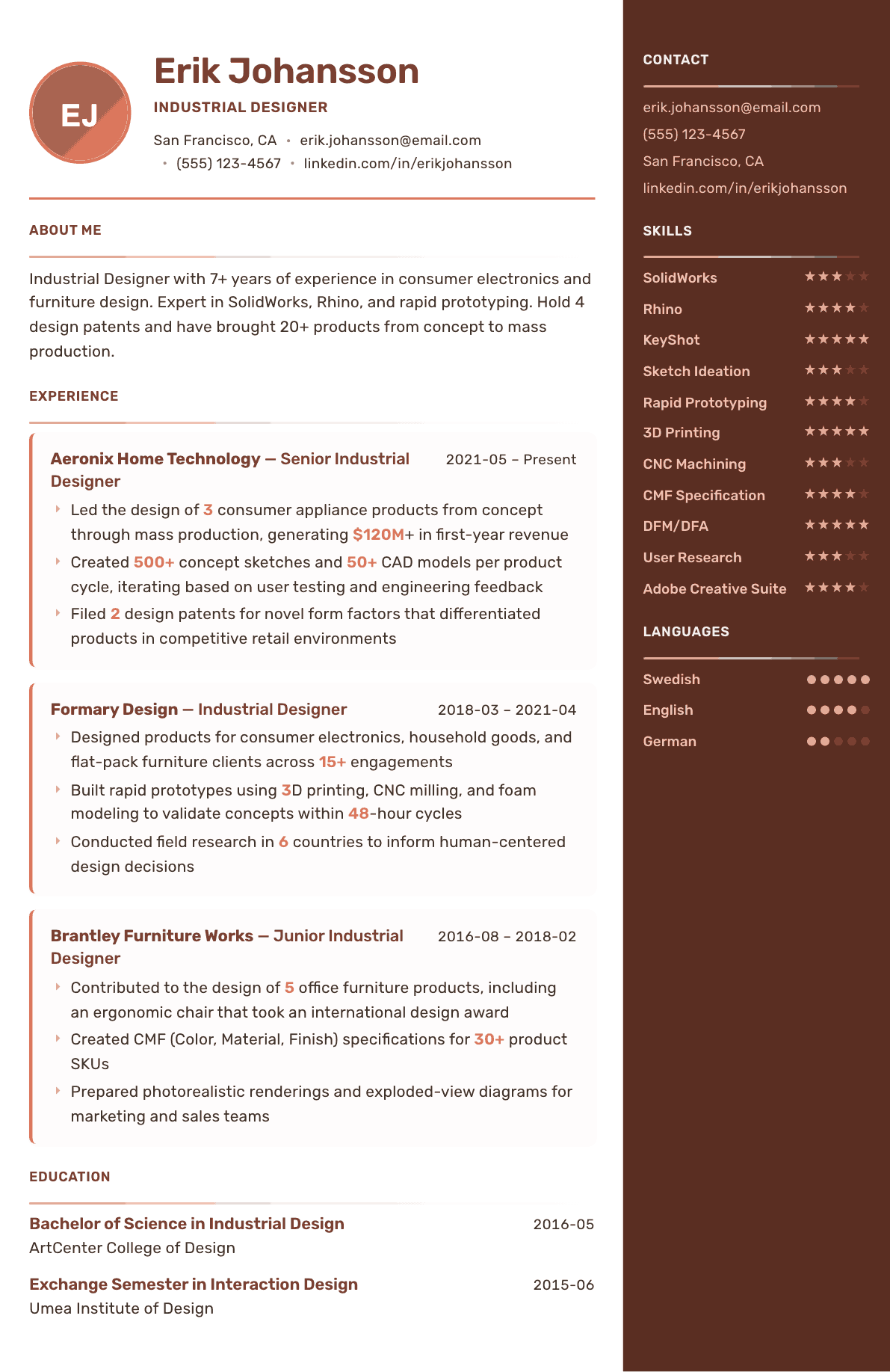
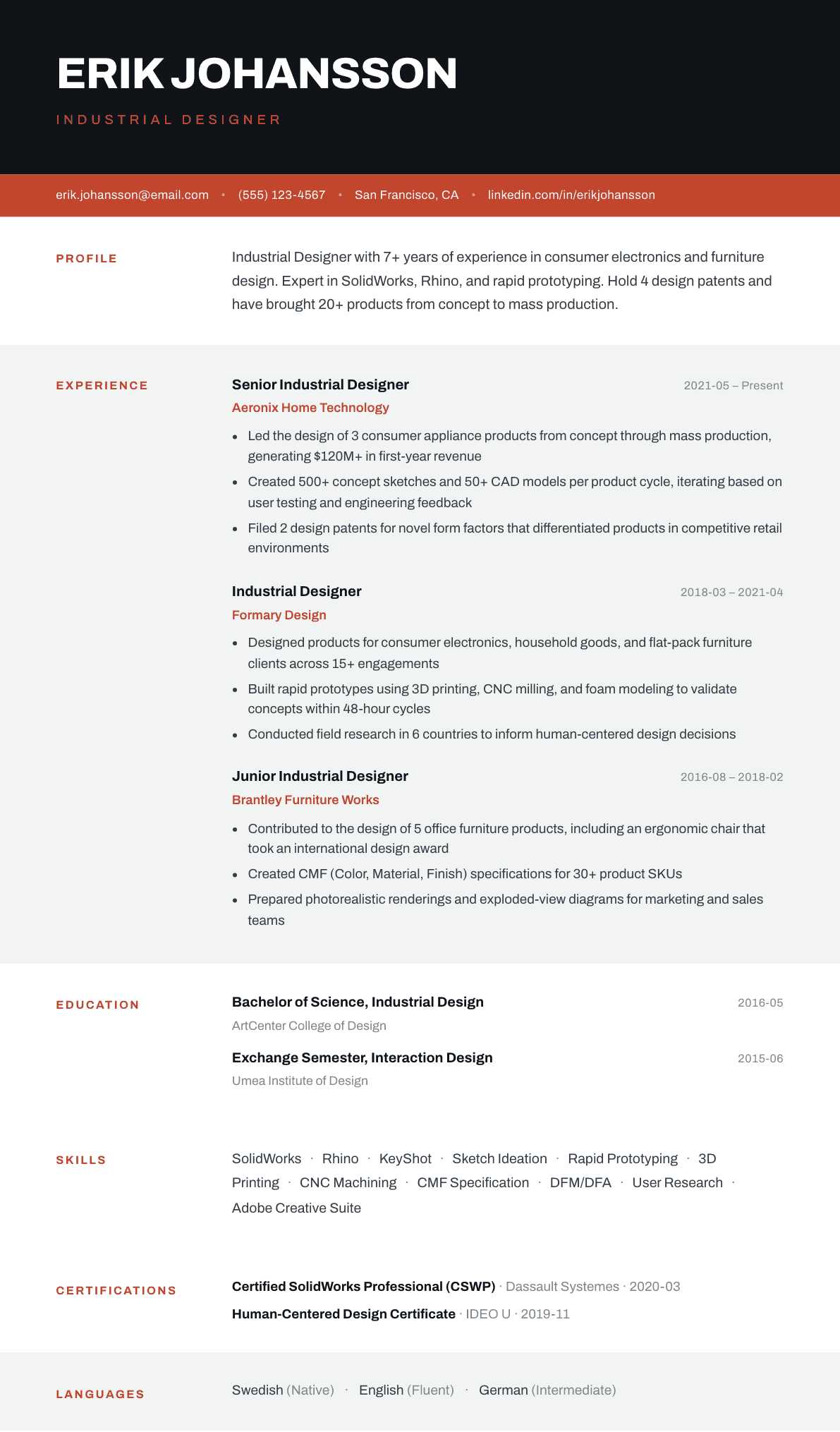
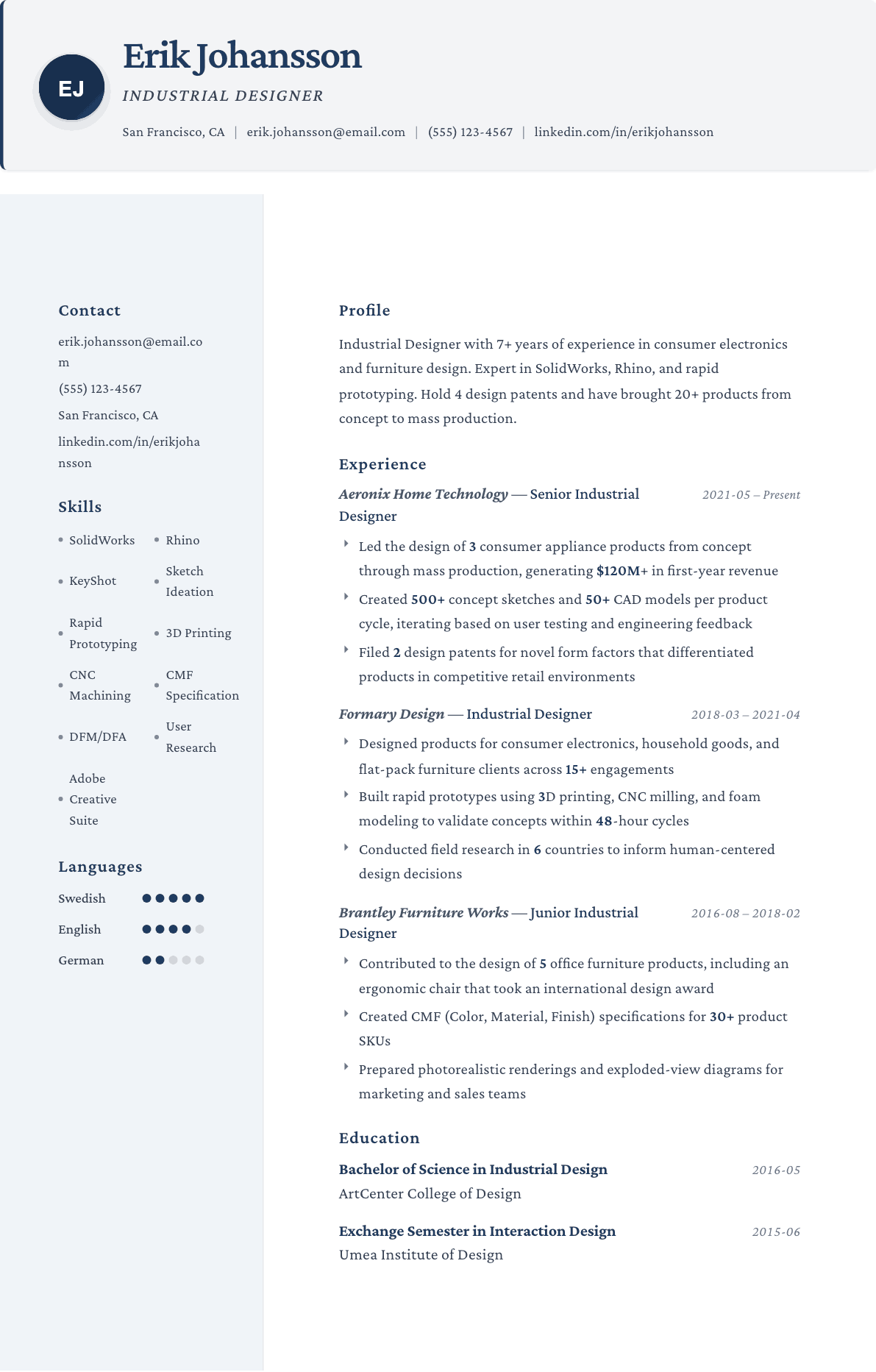
Example Industrial Designer summary
Industrial Designer with 7 years taking consumer electronics and furniture from sketch to mass production, with 4 design patents and 20+ products in market. Works in SolidWorks, Rhino, and KeyShot, prototypes in-house on 3D printing and CNC, and led 3 appliance programs worth $120M in first-year revenue.
Skills to list on a Industrial Designer resume
- SolidWorks
- Rhino
- Fusion 360
- KeyShot
- Sketch Ideation
- Rapid Prototyping
- 3D Printing
- CNC Machining
- DFM / DFA
- CMF Specification
- User Research
- Adobe Creative Suite
- Design Patents
- Manufacturing Knowledge
What actually gets this resume read
- Showcase shipped products with photos, renderings, or links to retail pages in your portfolio.
- List design patents and awards (Red Dot, iF, IDEA) prominently -- they carry enormous weight.
- Specify your CAD and prototyping tools: SolidWorks, Rhino, Fusion 360, KeyShot, 3D printing technologies.
- Quantify impact: revenue generated, units sold, cost reductions from DFM optimization.
- Mention manufacturing knowledge: injection molding, CNC, sheet metal, die casting.
- Show your process: research, sketching, CAD, prototyping, user testing, production.
How to write a industrial designer resume
Industrial design hiring turns on one question: has this person put a product into production. Sketching, rendering and form development are the visible half of the job, and every applicant shows them. The half that decides the hire is manufacturing: whether you have drawn parts that a tool can actually mold, held a tolerance stack, specified a finish that survives a factory, sat through a first article inspection, and shipped a product that people bought.
The reader is usually a design manager or the head of a small studio. She wants to see the categories you have designed in, the software you model in, the processes you have designed for, and the products that exist in the world with your work inside them. Design patents and recognized awards carry weight because they are external verification in a field where portfolios are easy to embellish.
This guide covers the format hiring managers expect, how to describe a product program so its complexity is visible, three summaries from graduate to senior, before and after bullets that turn design activity into manufacturing evidence, and the questions designers ask when moving between consumer electronics, furniture, medical devices and soft goods.
Format: one or two pages with the portfolio link in the header
One page while you are early, two once you have multiple product programs. Keep the layout plain and let the portfolio carry the visual argument, because a design manager reads the resume to decide whether to open the portfolio at all, often on a phone between meetings.
Put the portfolio link in the header with the password if the site is gated, and make sure the portfolio opens on a phone. A slow, heavy site full of unlabeled renders is a common way strong candidates lose a first round.
- Header: name, discipline line such as "Industrial Designer, Consumer Hardware", city, email, portfolio link.
- Order: summary, experience, technical skills, patents and awards, education.
- Graduates put education first and add a projects section with a full design process for each.
- Say which product categories you have worked in directly under your name.
Summary: category, process ownership, and something that shipped
Name the product categories, the years, the part of the process you own, and at least one product that reached the market. Consumer electronics, housewares, furniture, medical devices, power tools, toys, footwear and packaging hardware all bring different constraints, and a manager hires for the constraint set she has.
If you have not yet had a product reach production, be direct and lead with what you have taken furthest: a working prototype, a design for manufacture review, a tooling handoff on a student or internship project. Overstating a concept as a launched product is the fastest way to lose the room in a portfolio review.
Experience: the program, the constraints and the manufacturing outcome
For each role, give the team shape and the program scale: how many designers, whether engineering sat in house or at the factory, how many products or variants you carried, and the price point. A designer on a two-person studio doing everything from sketch to vendor management has a different profile from one of twelve on a hardware team, and both are hirable for different jobs.
Then bullets that follow the real arc: user research and benchmarking, ideation and sketching, form development in foam and print, computer aided design surfacing, design for manufacture and assembly reviews with engineering, color material and finish specification, tooling reviews, and production support through the first builds.
Name the manufacturing processes you designed for. Injection molding, die casting, sheet metal, extrusion, thermoforming, rotational molding, textile and sewn goods construction, and machining each carry their own rules on wall thickness, draft, radii and part splits. A designer who names them is telling a manager that engineering will not have to redraw the work.
Technical skills: modeling, visualization, prototyping, documentation
Group the software by what it is for. Surface and solid modeling in SolidWorks, Rhino, Fusion 360 or Creo; visualization in KeyShot, Blender or V-Ray; sketching and layout in the Adobe suite or Procreate; and any product lifecycle system you have released data into. State which one you model production geometry in rather than listing them all as equals.
Then the workshop side: foam and paper models, three dimensional printing across resin and filament processes, computer numerical control machining, vacuum forming, and hand finishing and painting of appearance models. Prototyping ability is what lets a designer answer a form question in a day instead of a week, and studios hire for it explicitly.
- Modeling: SolidWorks, Rhino with Grasshopper, Fusion 360, surfacing and part splits.
- Visualization: KeyShot, Blender, studio lighting, appearance renders for review.
- Prototyping: resin and filament printing, foam models, machining, appearance model finishing.
- Documentation: engineering drawings, tolerance callouts, color material and finish specifications.
Patents, awards and product credits: outside verification
Design patents and utility patents belong in a short section with the number and the status, listed as granted or pending. They are checkable, they show that a legal team took your work seriously, and they survive any dispute about who did what on a team.
Recognized design awards belong in the same section with the awarding body named. So do launched products a reader can look up. Naming a product that is on sale is a stronger claim than any adjective, because a manager can go and hold it.
Industrial Designer resume summary examples
Recent graduate
Industrial design graduate with a housewares thesis project taken from user research through appearance model and a tooling-ready computer aided design file. Models in SolidWorks and Rhino, renders in KeyShot, and built every prototype in the school workshop using resin printing, machining and hand finishing.
Five years in
Industrial designer with five years in consumer electronics accessories, with four products currently on sale. Owns form development, computer aided design surfacing and color material and finish specification, works directly with tooling vendors in Asia, and has run design for manufacture reviews through first article inspection.
Senior or lead designer
Senior industrial designer with twelve years across power tools and medical devices, three granted design patents and a portfolio of eleven launched products. Leads a team of three, sets the design language across a product family, and owns the relationship with mechanical engineering and the tooling supply base.
Work experience bullets: before and after
Before: Designed consumer products from concept to production.
After: Designed a two-piece injection molded speaker housing from sketch through Class A surfacing, holding a uniform 2.2 millimeter wall and a one-degree draft so the part released cleanly from the tool.
Wall thickness, draft and the tooling outcome prove design for manufacture rather than claiming it.
Before: Made prototypes and models.
After: Built weekly form studies in urethane foam and resin prints, then finished two appearance models for a leadership review, matching the intended paint and texture callouts.
The cadence, the materials and the review purpose show prototyping as a decision tool, not a craft hobby.
Before: Worked with engineers and factories.
After: Ran design for manufacture and assembly reviews with mechanical engineering and the tooling vendor, resolving 30 part-split and tolerance issues before tool cutting and avoiding a steel change during the build.
Catching issues before tool cutting is the specific saving a hardware manager is paying for.
Before: Chose colors and materials for the product.
After: Specified the color, material and finish palette across a six-product family, qualifying two textures against a factory sample plaque and writing the finish standard used for incoming inspection.
It shows finish specification as a documented standard rather than a taste preference.
Before: Did user research before designing.
After: Ran contextual interviews with 14 users and benchmarked nine competing products on grip, weight and one-handed operation, and used the findings to set the handle geometry brief.
Naming the method, the sample and how the research changed the design closes the loop.
Hard skills
- Concept sketching and ideation
- SolidWorks part and assembly modeling
- Rhino surfacing
- Fusion 360
- KeyShot rendering
- Design for manufacture and assembly
- Injection molding design rules
- Sheet metal and die casting design
- Color, material and finish specification
- Rapid prototyping and additive processes
- Appearance model making and finishing
- Engineering drawings and tolerancing
- User research and benchmarking
- Design language and product family systems
Soft skills
- Presenting concepts to leadership
- Working alongside mechanical engineering
- Vendor and factory communication
- Iterating fast without ego
- Written design rationale
- Prioritizing under a tooling deadline
Certifications worth listing
- Certified SolidWorks Associate (CSWA) (Dassault Systemes)
- Certified SolidWorks Professional (CSWP) (Dassault Systemes)
- Autodesk Certified Professional, Fusion 360 (Autodesk)
Mistakes that cost industrial designer candidates the interview
- Filling the portfolio with renders of concepts that were never made, which reads as an inability to reach production.
- Leaving out the manufacturing processes you designed for, the single clearest signal of whether engineering can build your work.
- Presenting a team product as a solo effort, which falls apart during a detailed portfolio walkthrough.
- Listing every modeling package as equal instead of saying which one you build production geometry in.
- Skipping design patents and awards, the only externally verifiable credentials this field offers.
- Describing research as a phase that happened without saying what it changed about the design.
- Hosting a portfolio that is slow, heavy and unlabeled, so a manager never reaches the strong project three scrolls down.
Industrial Designer resume questions
What should an industrial design portfolio show?
Three or four projects in depth, each carrying the brief, research, sketch exploration, physical models, computer aided design work and the manufacturing detail. Show at least one project all the way to production if you have one, including the parts that went wrong.
Do I need engineering knowledge as an industrial designer?
You need enough to design parts that can be made: wall thickness, draft, part splits, fastening methods, tolerance basics and the limits of the process you are designing for. You do not need to run the structural analysis, but you do need to speak the language.
Should I list design patents on my resume?
Yes. Give a short section with the patent number, the title and whether it is granted or pending. Patents are checkable and they establish your contribution to a product in a way no portfolio image can.
How do I get an industrial design job with no launched products?
Take one project as far as a product goes: real material selection, real process, engineering drawings, a working prototype and a costed bill of materials. One deeply resolved project beats six concepts that stop at the rendering stage.
How do I switch product categories as an industrial designer?
Lead with process ownership and the manufacturing knowledge that transfers, then learn the category-specific constraints and show one project against them. Medical devices bring regulatory documentation, furniture brings structural and material rules, and soft goods bring pattern and sewn construction.