General Counsel Resume Examples: the lines they read
Write a General Counsel Resume for the Board and the CEO
By Mustafa Tarabya, founder of CVBooster · Published · Updated
General counsel resume example with governance, risk and legal department leadership keywords, plus a guide to writing for a CEO and a board audience.
Sample resumes for a general counsel
The same general counsel content laid out in three CVBooster templates, so you can see what the finished document looks like before you write a word.
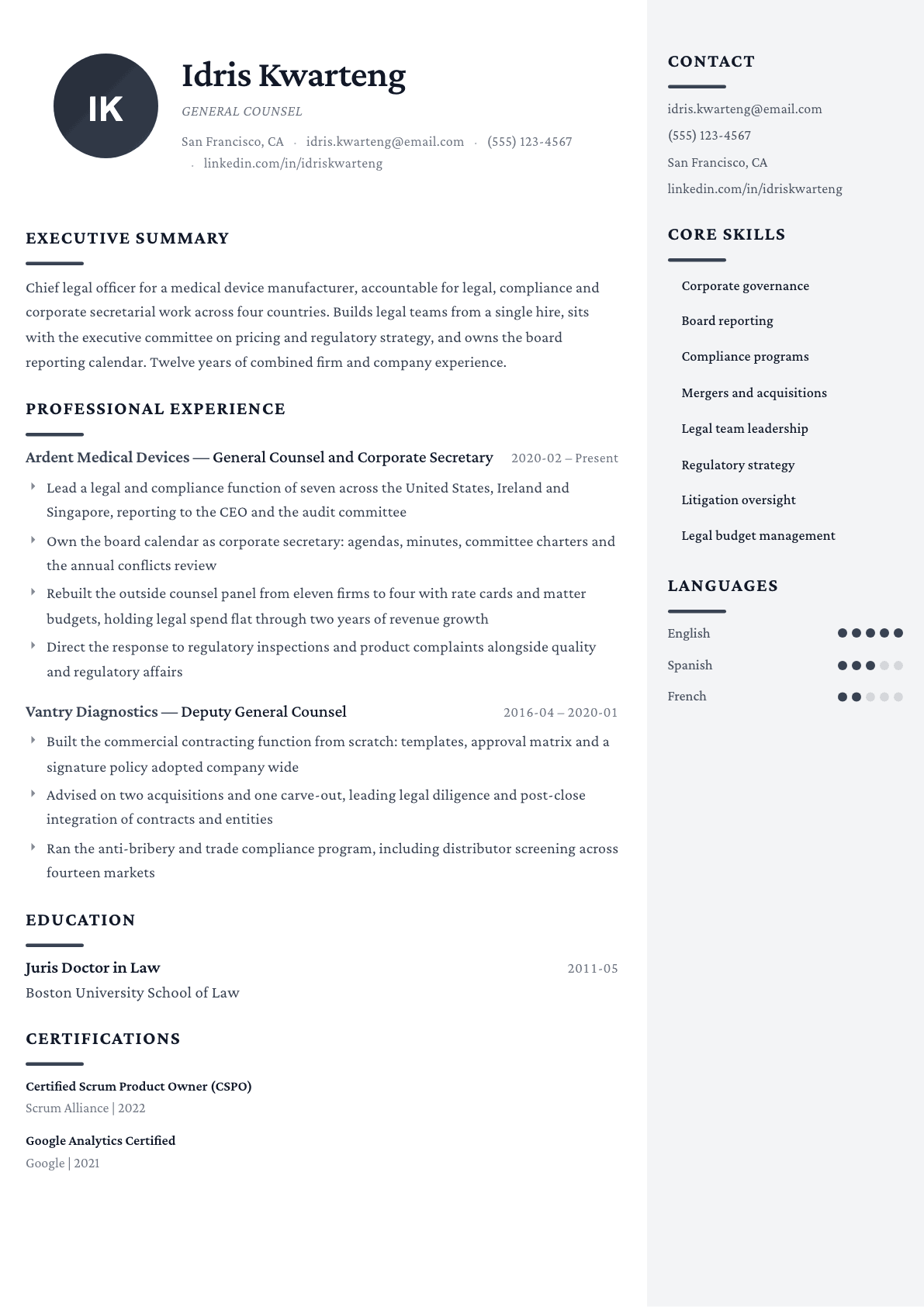
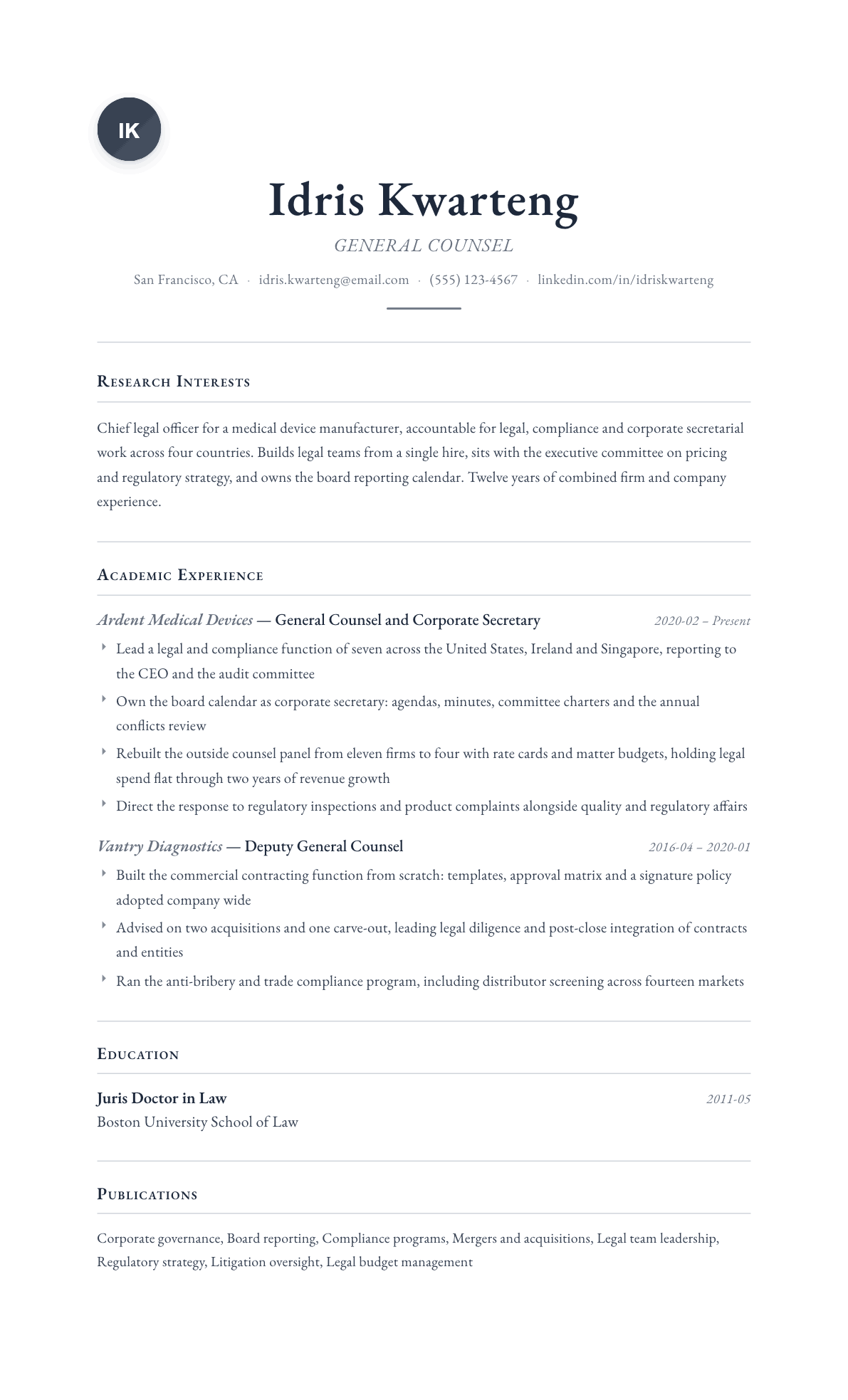
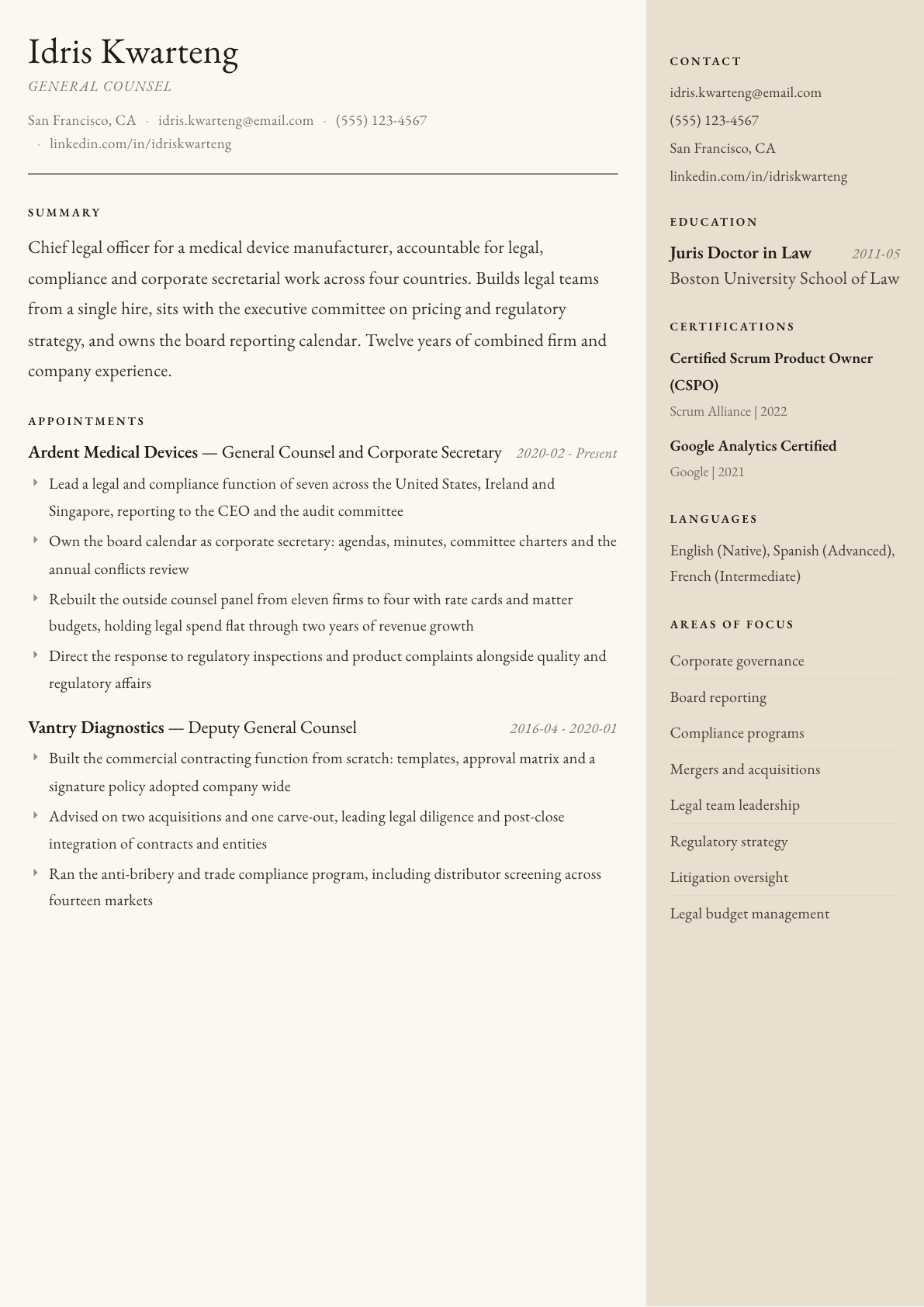
Example General Counsel summary
General counsel and corporate secretary for a regulated manufacturer, leading a team of seven across three countries and reporting to the CEO and audit committee. Rebuilt the outside counsel panel, held legal spend flat through two years of growth, and advised the executive committee on pricing and regulatory strategy. Seeking a chief legal officer role in a growth stage healthcare business.
Skills to list on a General Counsel resume
- Legal department leadership
- Corporate governance
- Board and committee reporting
- Corporate secretarial practice
- Enterprise risk management
- Compliance program design
- Mergers and acquisitions
- Commercial contracting strategy
- Litigation and dispute oversight
- Regulatory affairs liaison
- Anti-bribery and trade compliance
- Outside counsel panel management
- Legal budget and matter management
- Employment and labor advice
- Crisis and incident response
What actually gets this resume read
- Open with scope: reporting line, team size, countries covered and the committees you sit on or report to.
- Show the business decisions you influenced, not just the legal work, because the hiring committee is usually a CEO and a board chair.
- Quantify the legal function you ran: headcount, outside counsel panel, matter volume and how the budget moved.
- Give governance its own space, since corporate secretarial work is a large part of the job and is often invisible on a firm resume.
- Name the regulated environment you operated in, because a device company and a bank hire for very different instincts.
- Two pages is normal at this level, but the first half page has to carry scope, sector and the reporting line.
How to write a general counsel resume
A general counsel resume is read by people who are not lawyers. The CEO, the board chair, the audit committee and often an executive search consultant decide this hire, and they are assessing whether you can carry legal, governance and risk without needing supervision, and whether you will be useful in a room where the legal answer is only one input.
That audience changes what belongs on the page. Matter descriptions and doctrinal depth move to the background. Scope moves forward: who you reported to, the size and shape of the function you ran, the countries and entities covered, the regulators you dealt with, the committees you served, and the decisions you were trusted to make without checking upward.
This guide sets out the structure a chief legal officer resume needs, three summaries covering a first general counsel role, an established one and a multi-entity group role, before-and-after bullets from governance and risk work, and the questions senior lawyers ask when they write for a board audience for the first time.
Format: two pages, scope in the first six lines
Lead with a short scope block rather than a personal statement: company, sector, revenue stage, reporting line, team size, geographies, and the committees you attend. A search consultant screening a longlist is looking for exactly those variables, and a resume that buries them under narrative gets filtered on incomplete information.
Then reverse chronological experience with a line of company context under each employer. At this level the company is part of the credential: a regulated medical manufacturer, a private equity backed services group and a listed retailer make very different general counsel, and the reader will not assume the transfer.
- Scope block: reporting line, function headcount, entities and countries, committees, external panel size.
- Sections: scope, experience, board and committee roles, education, admissions, certifications.
- Keep any nonexecutive or advisory board seats in their own short section rather than folded into employment.
Governance: give corporate secretarial work real space
Governance is often the half of the job a firm lawyer has never done, so a board will look for it deliberately. Describe the machinery you owned: the board calendar, agendas and papers, minutes, committee charters, delegation of authority, subsidiary governance, conflicts and related party processes, and the director onboarding materials.
Say who you presented to and how often. A general counsel who has stood in front of an audit committee quarterly and answered questions on litigation exposure has a different profile from one who prepared papers for someone else to present, and the distinction is easy to state honestly.
Risk, compliance and regulators: name the environment
The board wants to know what kind of trouble you have handled. Name the regulatory bodies you dealt with, the inspections or investigations you led, the reporting obligations you owned, and the compliance program elements you built: code of conduct, training completion, speak-up channel, investigations protocol, third party screening.
Incidents are worth including when they are described with restraint. A recall, a data incident, a whistleblower investigation or an unexpected enforcement contact tells a board more about your judgment than a list of policies, provided you write what you organized rather than what went wrong.
Running the function: people, panel and budget
A chief legal officer is a manager first. Describe the team you built, the roles you hired, the split between in-house work and outsourced work, and how you decided where the line sat. Panel consolidation, rate cards, matter budgets, alternative fee arrangements and e-billing are the concrete levers, and any board member has seen a legal budget presentation before.
Include the operating rhythm you set: intake, triage, service levels for contracts, self-service templates for the business, and the reporting you sent to the executive team. Legal operations maturity is a live topic in general counsel hiring and most candidates leave it off entirely.
Transactions and strategy: the seat at the table
Acquisitions, disposals, financings, joint ventures and market entries are where a general counsel is most visible to a chief executive. Give the deal type, your role in it, the workstreams you led and what happened after closing, because integration is where legal either delivers or disappears.
Strategy contributions belong on the page when they are specific. Pricing structures, channel models, licensing terms that unlocked a market, or a decision to exit a jurisdiction are all legal-adjacent business calls, and naming one or two shows the board you think past the legal answer.
General Counsel resume summary examples
First general counsel appointment
Senior commercial lawyer stepping into a first chief legal role, having built a contracting function from templates to approval matrix at a diagnostics company, advised on two acquisitions and one carve-out, and run an anti-bribery program across fourteen distributor markets. Reported to the general counsel and presented to the audit committee twice a year.
General counsel, single company
General counsel and corporate secretary of a medical device manufacturer, leading a legal and compliance team of seven across three countries, reporting to the CEO and the audit committee. Rebuilt the outside counsel panel from eleven firms to four, held legal spend flat through two years of growth, and led the response to two regulatory inspections.
Group chief legal officer
Group chief legal officer for a private equity backed services platform of nine operating companies, accountable for legal, compliance, risk and insurance. Ran eleven bolt-on acquisitions and the legal workstream of a refinancing, standardized governance across all entities, and sat on the executive committee and the disclosure committee.
Work experience bullets: before and after
Before: Responsible for all legal matters at the company.
After: Led legal, compliance and corporate secretarial work for a device manufacturer selling in 18 countries, with a team of seven and a direct line to the CEO and the audit committee.
Scope becomes concrete once the reader sees the function, the footprint, the headcount and the reporting line.
Before: Handled board matters and corporate governance.
After: Ran the board calendar as corporate secretary: agendas and papers for eight meetings a year, minutes, three committee charters, the delegation of authority matrix and the annual conflicts review.
Listing the instruments and the meeting rhythm proves you operated the governance machine rather than attended it.
Before: Reduced outside counsel spend.
After: Consolidated the outside counsel panel from eleven firms to four on negotiated rate cards, introduced matter budgets with quarterly variance reporting, and held legal spend flat across two years of revenue growth.
The method behind the saving is what a board tests, and flat spend against growth is a cleaner claim than a raw reduction.
Before: Managed compliance training and policies.
After: Rebuilt the compliance program around a revised code of conduct, annual training with 97% completion, a speak-up line and a written investigations protocol used in nine internal inquiries.
Naming the program elements and the number of inquiries shows a working program rather than a shelf of documents.
Before: Supported acquisitions for the business.
After: Led the legal workstream on eleven bolt-on acquisitions, from diligence scope and disclosure schedules to post-close integration of contracts, entity filings and employee transfers.
Deal counts matter less than showing you carried the work through integration, which is where general counsel are judged.
Hard skills
- Legal function leadership
- Corporate secretarial practice
- Board and committee reporting
- Enterprise risk management
- Compliance program design and investigations
- Mergers, acquisitions and integration
- Commercial contracting strategy
- Dispute and litigation oversight
- Regulatory engagement and inspections
- Anti-bribery and trade controls
- Outside counsel panel and budget management
- Insurance and indemnity programs
- Employment and labor advice
Soft skills
- Executive communication
- Board presence
- Decision ownership
- Team building and hiring
- Crisis composure
- Commercial trade-off judgment
Certifications worth listing
- Certified Compliance and Ethics Professional (CCEP) (Compliance Certification Board)
- Certified Information Privacy Manager (CIPM) (International Association of Privacy Professionals)
- NACD Directorship Certification (National Association of Corporate Directors)
Mistakes that cost general counsel candidates the interview
- Writing for a lawyer audience when the decision makers are a chief executive, a board chair and a search consultant.
- Leaving out headcount, entities, geographies and reporting line, which are the variables a longlist is filtered on.
- Treating corporate secretarial work as administrative and cutting it, when many boards weigh it as heavily as advisory skill.
- Describing policies without a single investigation, inspection or incident that shows the program was exercised.
- Listing deals by name and value without saying what you personally led or what happened after closing.
- Running to four pages of matter history instead of two pages of scope, decisions and outcomes.
General Counsel resume questions
What does a board actually look for in a general counsel resume?
Scope and independence. The reader wants to see the size of the function you ran, the entities and regulators you covered, the committees you served, and evidence that you made consequential calls without a partner behind you. Doctrinal depth is assumed by this stage.
How do I write a resume for my first general counsel role?
Show that you have already done pieces of the job. Point to a function you built, a board or committee you presented to, a compliance program element you owned, and a deal you led end to end. Then state the gap you are stepping into rather than pretending it is not there.
Should I list corporate secretary duties separately from legal work?
Yes when you held the corporate secretary title, because it is a distinct accountability with its own calendar, records and statutory filings. Give it a short cluster of bullets under the role so a board can see the machinery you operated without reading past it.
How much detail should I give about litigation and investigations?
Enough to show the exposure and your role, without confidential facts. Describe the type of matter, whether you led or supervised, the budget or reserve process you ran, and how the outcome was reported internally. Restraint on detail reads as good judgment at this level.
Do certifications matter for a chief legal officer?
They are secondary to scope, but compliance, privacy and director education credentials help when the company is regulated or preparing for a transaction. List two or three, keep them current, and make sure each is backed by work described in the experience section.