Genetic Counselor Resume Examples: the lines they read
Build a Genetic Counselor Resume for Clinical and Industry Roles
By Mustafa Tarabya, founder of CVBooster · Published · Updated
Genetic counselor resume example with specialty caseloads, ABGC certification details, variant interpretation keywords and a section-by-section guide.
Sample resumes for a genetic counselor
The same genetic counselor content laid out in three CVBooster templates, so you can see what the finished document looks like before you write a word.
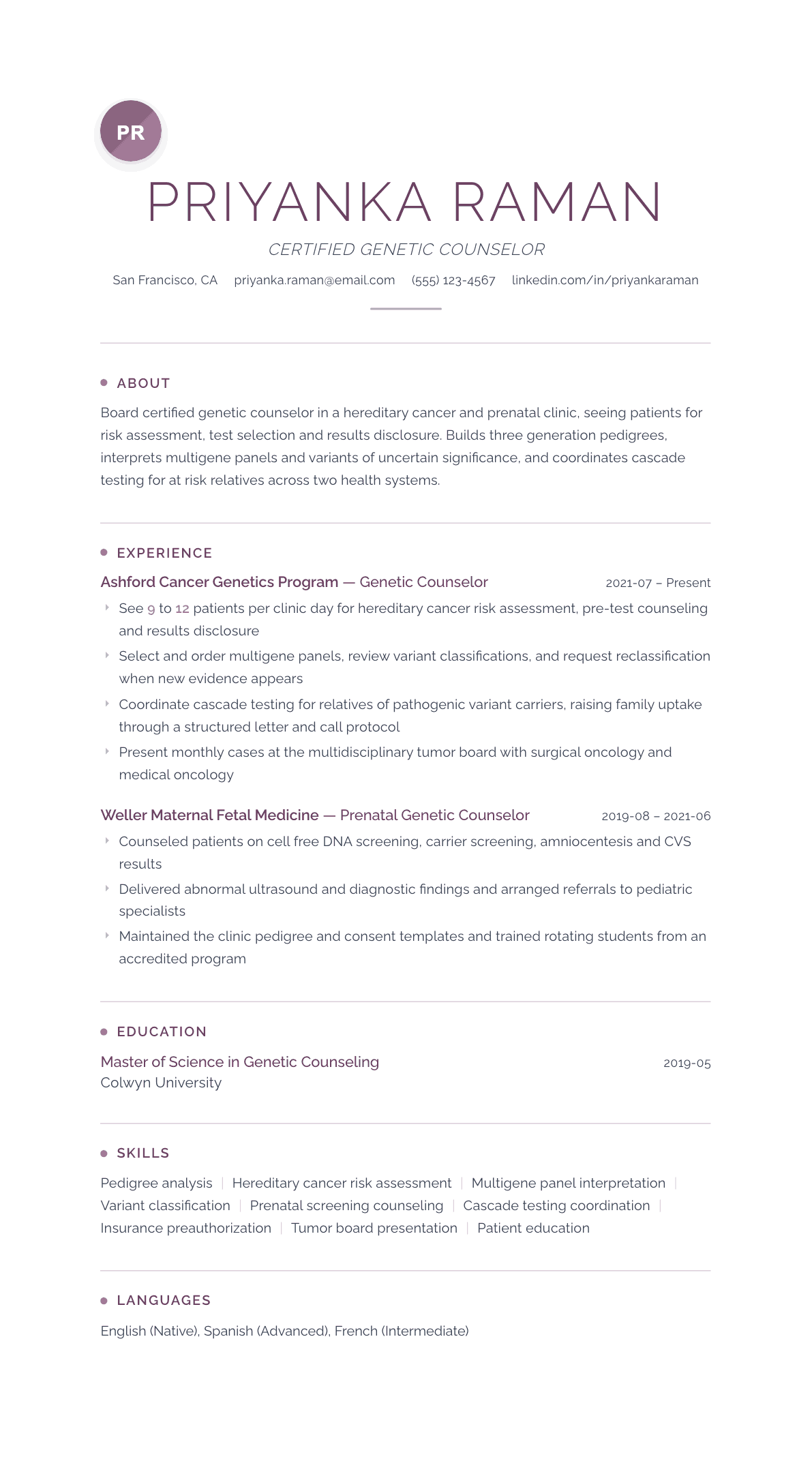
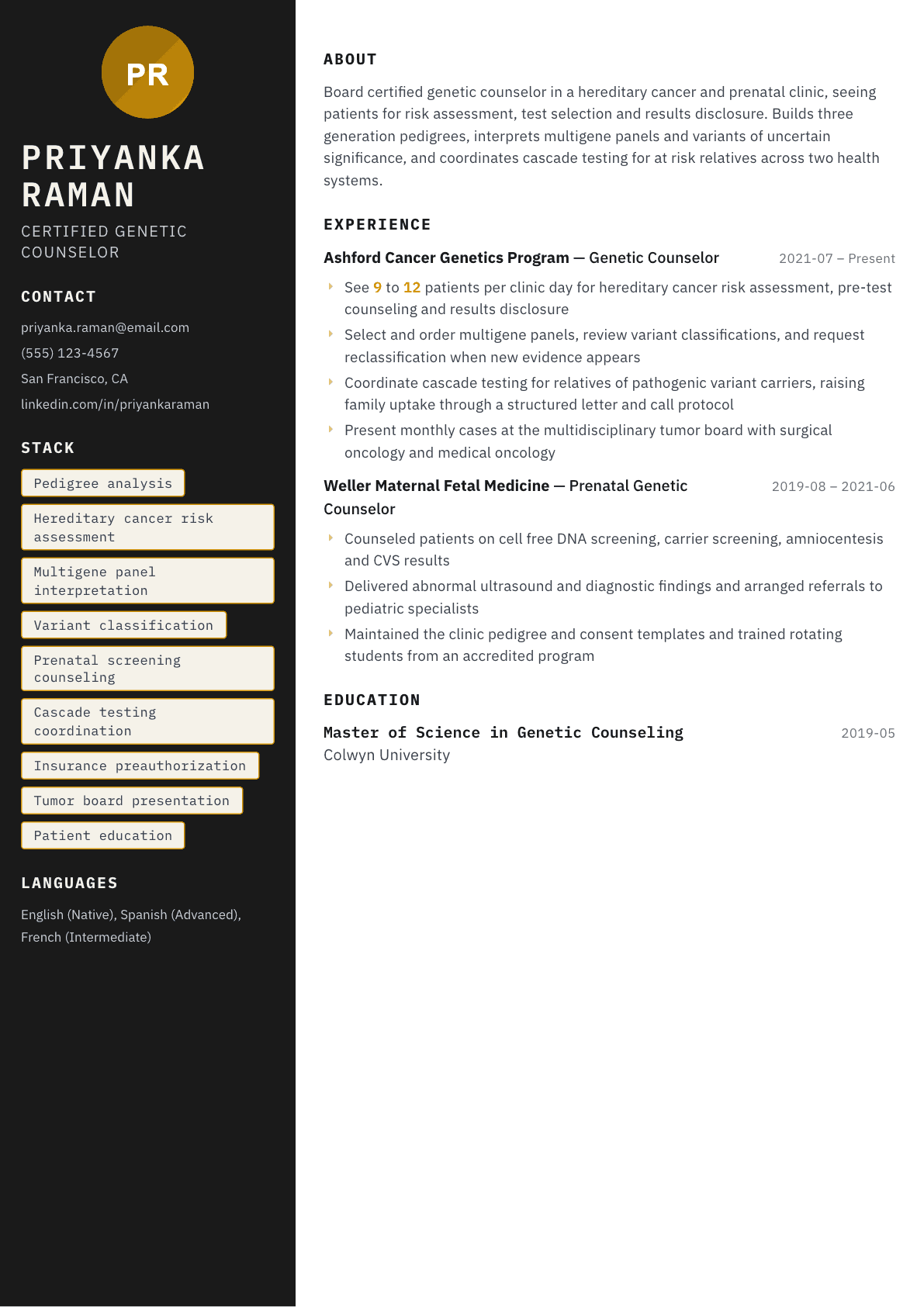
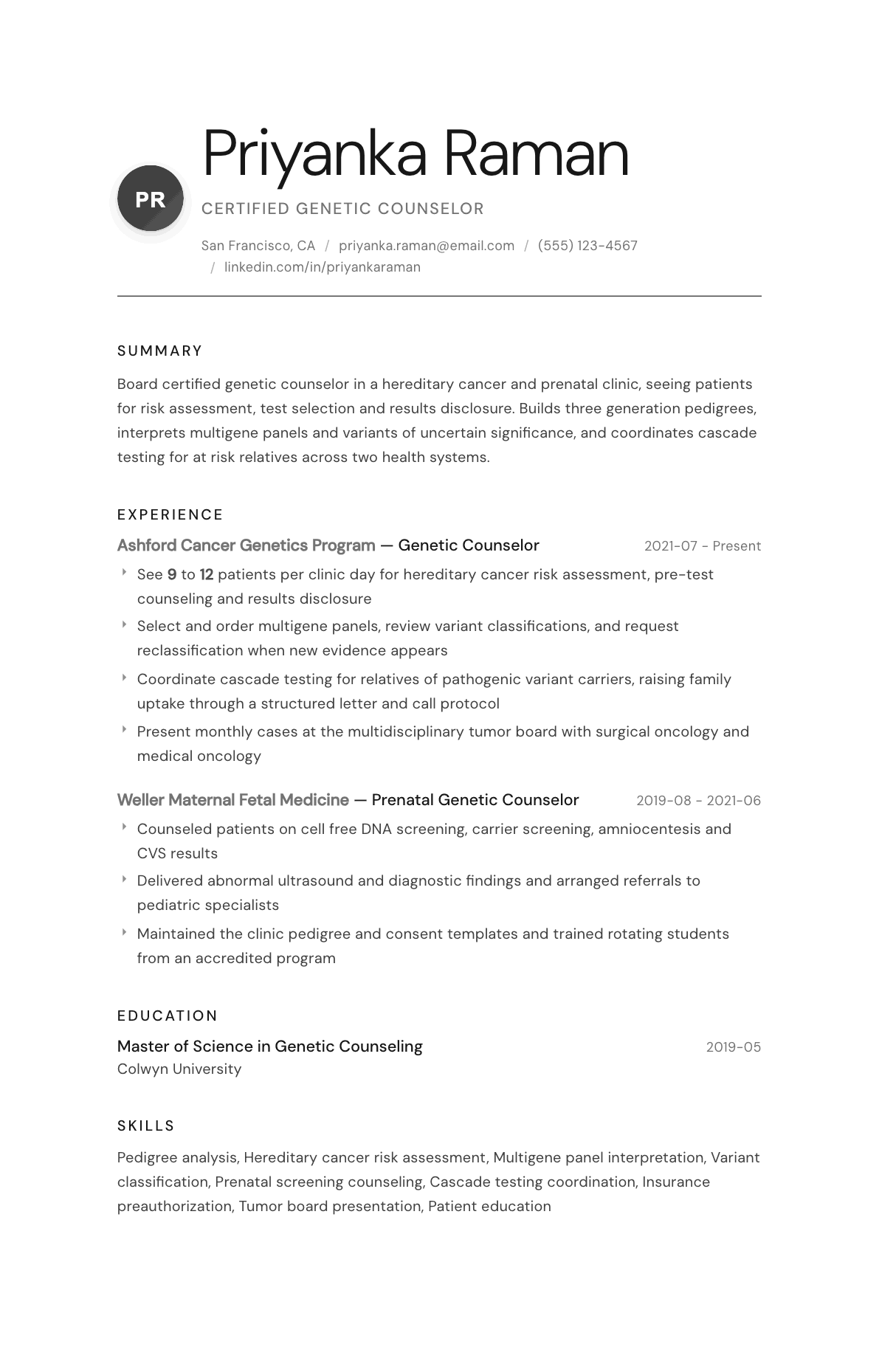
Example Genetic Counselor summary
Board certified genetic counselor with five years across hereditary cancer and prenatal clinics, seeing nine to twelve patients per clinic day for risk assessment, test selection and results disclosure. Interprets multigene panels and variants of uncertain significance, coordinates cascade testing for at risk relatives, and presents cases monthly at the multidisciplinary tumor board alongside surgical and medical oncology.
Skills to list on a Genetic Counselor resume
- Genetic risk assessment
- Pedigree construction
- Multigene panel selection
- Variant interpretation
- ClinVar and ClinGen review
- Prenatal screening
- Carrier screening
- Results disclosure
- Cascade testing
- Psychosocial counseling
- Informed consent
- Insurance authorization
- Case documentation
- Provider education
- Student supervision
What actually gets this resume read
- List your ABGC certification status and state licensure early, since most clinical postings will not advance a file without them.
- Split experience by specialty area: cancer, prenatal, pediatric, cardiovascular and laboratory work are judged as separate skill sets.
- Quantify clinic volume in patients per day or per week, because that is the workload signal a program director compares across candidates.
- Name the databases and resources you use for variant work, such as ClinVar, ClinGen and the laboratory reports you routinely interpret.
- For laboratory or industry roles, lead with variant curation, report writing, provider education and turnaround time rather than clinic volume.
- Include supervision of students, tumor board presentations and any protocol or template you authored for the clinic.
How to write a genetic counselor resume
Genetic counseling resumes are read by two very different audiences. A clinical program director wants specialty area, patient volume per clinic day, and whether you can hold a difficult results conversation without a supervisor in the room. A laboratory or industry hiring manager wants variant curation depth, report writing, provider education and turnaround time. The same file rarely serves both well.
What both readers share is impatience with vague counseling language. Everyone in the pile provides risk assessment and psychosocial support. What separates candidates is the specialty caseload, the test menus you actually order and interpret, the databases you work in, and what you do when a variant of uncertain significance lands on a family that has already lost someone.
This guide sets out how to structure the file for clinical and industry paths, what belongs in each specialty block, three summary examples from a new certified counselor through a program lead, bullet rewrites that show reasoning instead of duties, and the questions counselors ask when they move between settings.
Format: certification and licensure in the top third
One page for the first several years, two once you have publications, supervision and multiple specialties. Single column with clean dates. Academic medical centers use large applicant tracking systems, and a decorative layout puts your certification date in the wrong field.
Certification status and state licensure belong immediately under the header. Many states license genetic counselors and a hospital cannot credential you without it, so a screener will look for that line before reading a word of your experience.
- Header: name with credentials, city and state, phone, professional email.
- Credentials: board certification with status and date, every state license held.
- Sections: summary, credentials, clinical or laboratory experience, teaching and research, education, professional service.
Summary: specialty, setting, volume, one distinguishing strength
Name the specialty area first because it filters everything: hereditary cancer, prenatal, pediatric, cardiovascular, neurogenetics, laboratory or industry. Then the setting and volume, then one strength the posting asked for, such as cascade testing programs, telehealth delivery, variant reclassification or building a new service line.
A counselor changing specialty should name the transferable core: pedigree analysis, test selection logic, informed consent, insurance authorization and results disclosure carry across every area. The disease knowledge is learnable and directors know it.
Clinical experience: caseload, complexity, coordination
Lead each job with clinic days per week and patients per clinic day. A director comparing candidates needs that number because it predicts whether you can absorb their schedule. Then show the mix: new patient risk assessments, pre-test counseling, results disclosures, follow up and family cascade visits.
The strong bullets show decision making. Selecting a panel over single gene testing and saying why, requesting reclassification when a laboratory report ages, ordering parental studies to phase a variant, working an insurance denial through appeal, and coordinating testing for relatives across state lines. These are the moments a director will ask about at interview, so put them on paper first.
Include the interdisciplinary work. Tumor board presentations, maternal fetal medicine case review, cardiology clinic collaboration and pediatric subspecialty referrals show that you function inside a team rather than as an isolated consultant.
Laboratory and industry versions of the same career
If you are aiming at a laboratory, variant science moves to the front. Curation volume, classification framework applied, evidence review, report writing and sign-out support, case escalation to the medical director and turnaround time all belong in the first job block. Clinic volume becomes context rather than the headline.
For industry medical affairs or education roles, lead with provider education delivered, materials authored, territory covered, congress presentations and cross-functional work with sales and medical science teams. Keep clinical background as the credibility anchor beneath it.
- Laboratory: curation volume, classification framework, report authorship, sign-out support.
- Industry: provider education, materials, territory, congress activity.
- Both: turnaround expectations, quality review participation, escalation pathways.
Keywords the postings actually contain
Common phrases include risk assessment, pedigree analysis, pre-test and post-test counseling, informed consent, multigene panel, variant of uncertain significance, cascade testing, carrier screening, prenatal diagnosis, insurance preauthorization, telehealth counseling and interdisciplinary collaboration. Add the resources you genuinely use, such as ClinVar and ClinGen, and the electronic record you chart in.
Genetic Counselor resume summary examples
Newly certified
Genetic counselor recently certified after an accredited program with rotations in hereditary cancer, prenatal and pediatric genetics. Completed more than 50 supervised cases including panel selection, results disclosure and cascade family outreach. Comfortable building three generation pedigrees, reviewing variant classifications and handling insurance preauthorization.
Five years in
Board certified genetic counselor in a hereditary cancer program seeing nine to twelve patients per clinic day for risk assessment, panel selection and results disclosure. Coordinates cascade testing for carrier relatives, requests reclassification on aging reports, and presents monthly at the multidisciplinary tumor board with surgical and medical oncology.
Program lead
Lead genetic counselor for a health system cancer genetics service, supervising four counselors across three sites and a telehealth clinic. Built the referral triage criteria and the reclassification recall workflow, doubled annual visit capacity without new clinic space, and mentors students from an accredited training program each year.
Work experience bullets: before and after
Before: Provided genetic counseling to patients and families.
After: Saw 9 to 12 patients per clinic day for hereditary cancer risk assessment, pre-test counseling and results disclosure, including families with a known pathogenic variant.
Clinic volume and the counseling stages tell a director exactly what schedule you can carry.
Before: Ordered genetic tests for patients.
After: Selected multigene panels against personal and family history rather than defaulting to a single menu, documented the rationale, and switched to single gene testing where a known familial variant made a panel unnecessary.
Showing the choice and its rationale demonstrates test stewardship instead of order entry.
Before: Handled variants of uncertain significance.
After: Tracked variants of uncertain significance in a recall list, requested laboratory reclassification when new evidence appeared, and recontacted families whose result changed with a documented disclosure plan.
A tracking system and a recontact plan turn a common phrase into an operational process the clinic can keep.
Before: Encouraged family members to get tested.
After: Raised cascade testing uptake among first degree relatives of pathogenic variant carriers by adding a structured family letter, a follow up call at two weeks and a direct scheduling line for out of state relatives.
Three named interventions attached to an outcome make family outreach a program rather than a suggestion.
Before: Worked with insurance companies on approvals.
After: Prepared preauthorization documentation and appeal letters citing testing criteria, overturning denials for panels in high suspicion families and reducing the wait between consult and result.
Naming the documents and the effect on turnaround shows a skill clinics quietly depend on.
Hard skills
- Pedigree construction and analysis
- Hereditary cancer risk assessment
- Prenatal and carrier screening counseling
- Multigene panel selection
- Variant classification review
- ClinVar and ClinGen resource use
- Cascade testing coordination
- Informed consent documentation
- Insurance preauthorization and appeals
- Telehealth counseling delivery
- Tumor board case presentation
- Student clinical supervision
Soft skills
- Delivering difficult results
- Nondirective counseling
- Active listening
- Clear explanation of uncertainty
- Interdisciplinary collaboration
- Boundary setting with distressed families
Certifications worth listing
- Certified Genetic Counselor (CGC) (American Board of Genetic Counseling)
- Canadian Certified Genetic Counsellor (CCGC) (Canadian Association of Genetic Counsellors)
- Diplomate in Clinical Genetics and Genomics (American Board of Medical Genetics and Genomics)
Mistakes that cost genetic counselor candidates the interview
- Writing one general resume for clinical, laboratory and industry roles when each reader is looking for a different first paragraph.
- Omitting state licensure, which blocks credentialing and stops a hospital application before review.
- Describing counseling generically without naming the specialty, the test menus or the databases you work in.
- Leaving out clinic volume, the one number that predicts whether you can absorb a program schedule.
- Listing research and publications ahead of patient care for a clinical job that is hiring for clinic coverage.
- Failing to show what you do with uncertain results, which is the hardest part of the work and the part directors probe hardest.
Genetic Counselor resume questions
How do I move from clinical genetic counseling into a laboratory role?
Rebuild the top of your resume around variant work. Lead with classification framework experience, evidence review, report interpretation and any curation you have done, then position clinic volume as the source of your understanding of how reports are used by ordering providers.
Should I list every rotation from my training program?
Only while you are a new graduate, and only with substance. Give the site, the specialty, the case count and the level of independence you reached. Once you have a year of certified practice, replace the rotation block with your own caseload numbers.
How much detail about cases is appropriate?
Describe categories of complexity, never identifiable details. Say hereditary cancer families with a known pathogenic variant, prenatal diagnoses after abnormal ultrasound, or pediatric cases with negative exome results. That gives a reader the difficulty level without touching patient privacy.
Do publications and posters belong on the resume?
Yes, in a short section near the end for clinical roles and higher up for academic or industry positions. List them in a consistent citation style, and keep the list to work you can discuss in depth rather than everything you have ever coauthored.
What if I have mostly telehealth experience?
Present it as a strength with specifics: platform used, states you were licensed to see patients in, visit volume, how you obtained consent remotely and how you handled results disclosure at a distance. Many programs are expanding remote clinics and want someone who has already solved those problems.