Medical Science Liaison Resume Examples: free ATS score
Write a Medical Science Liaison Resume Built for Field Medical Hiring
By Mustafa Tarabya, founder of CVBooster · Published · Updated
A medical science liaison resume example with KOL engagement, territory and scientific exchange detail, plus the guide field medical directors expect.
Sample resumes for a medical science liaison
The same medical science liaison content laid out in three CVBooster templates, so you can see what the finished document looks like before you write a word.
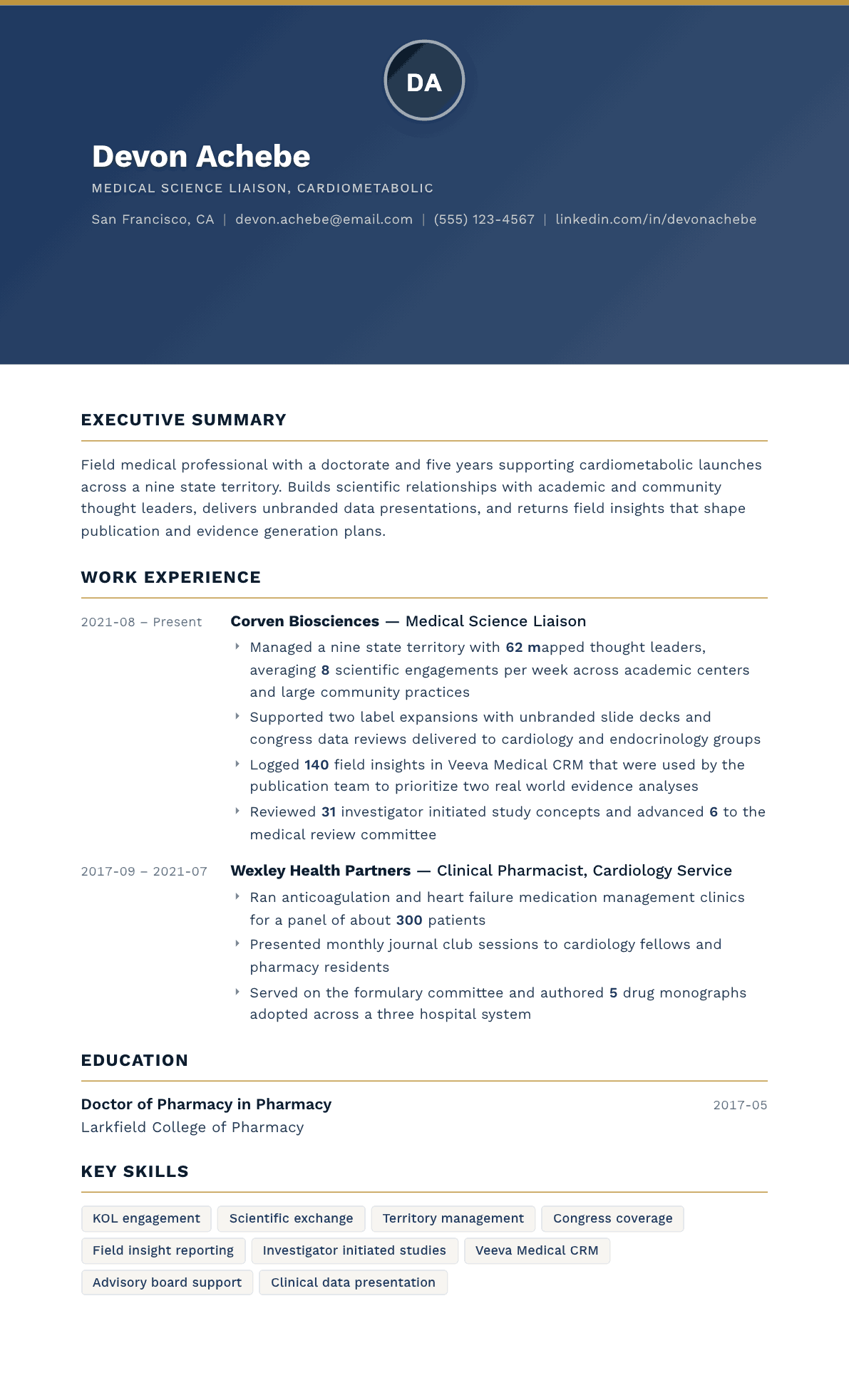
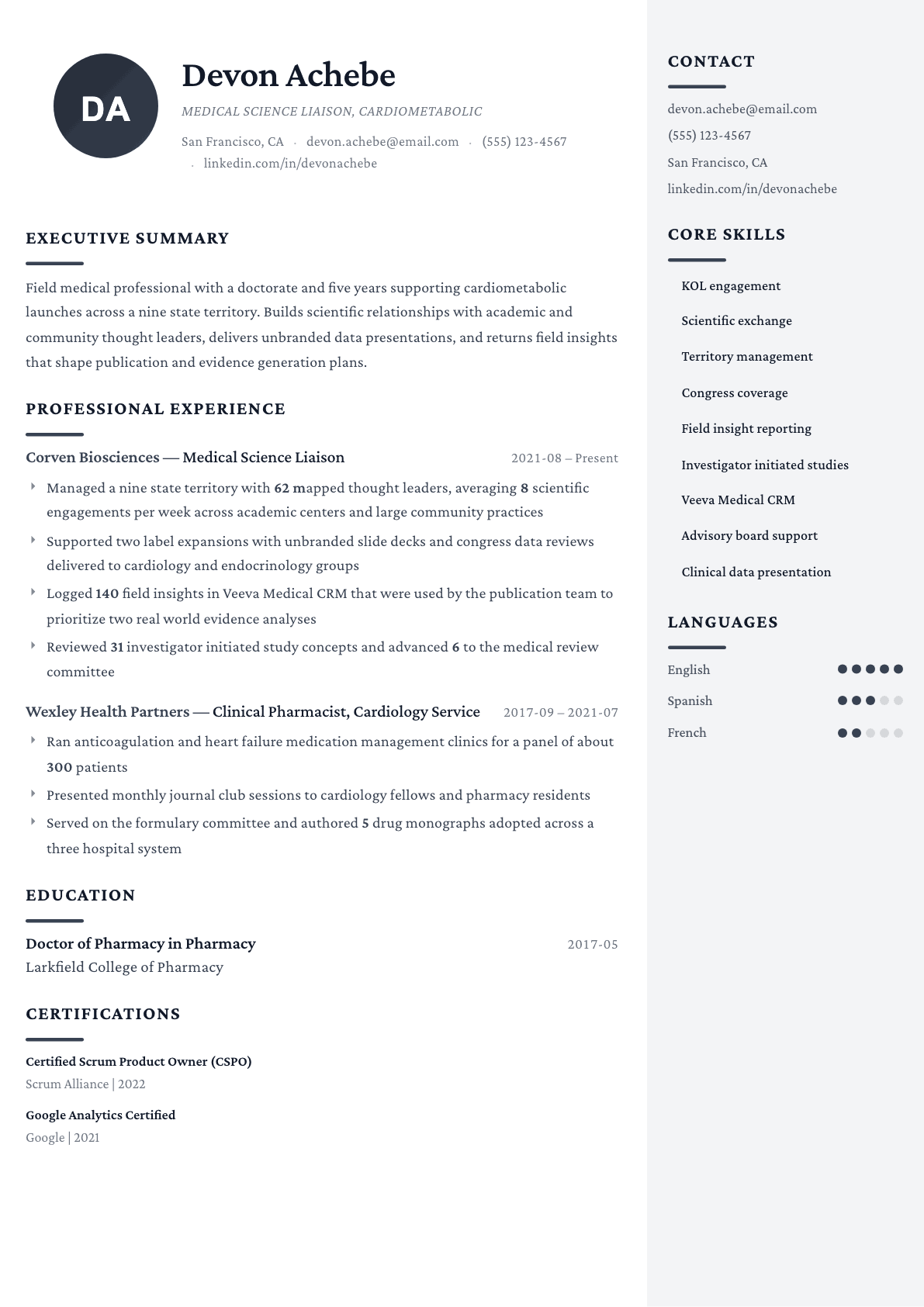
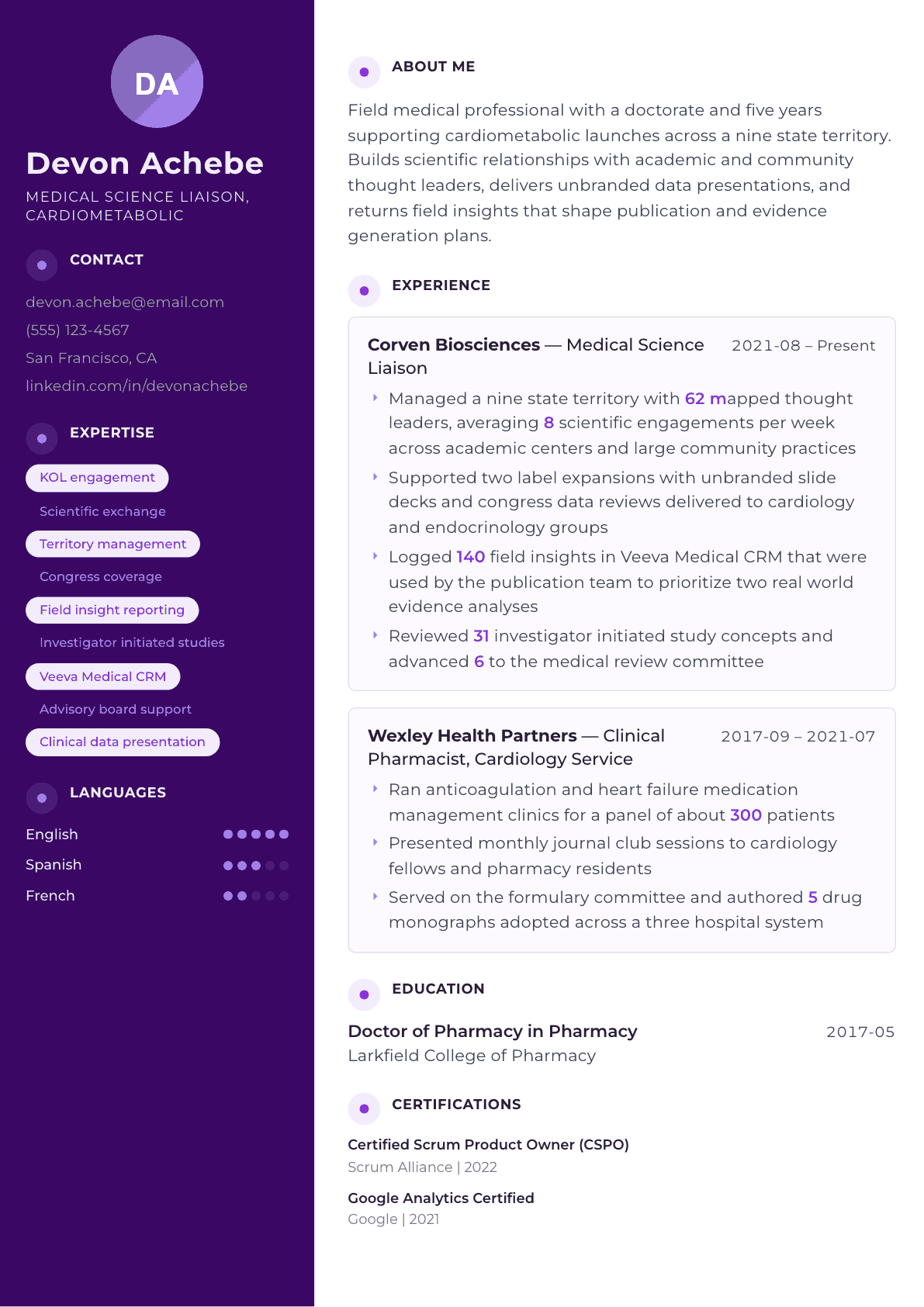
Example Medical Science Liaison summary
Medical science liaison with a PharmD and five years in cardiometabolic field medical. Covers a multistate territory of academic and community thought leaders, delivers unbranded data reviews, supports investigator initiated study concepts, and reports field insights that shape evidence generation. Known for pairing deep trial knowledge with disciplined compliance judgment during launch periods and congress season.
Skills to list on a Medical Science Liaison resume
- Scientific exchange
- Thought leader mapping
- Territory planning
- Unbranded medical presentations
- Field insight capture
- Investigator initiated study support
- Advisory board planning
- Congress data review
- Medical information response
- Veeva Medical CRM
- Publication plan input
- Clinical trial site support
- Compliance and promotional boundaries
- Real world evidence
What actually gets this resume read
- Open with your terminal degree, because most field medical postings screen for a PharmD, MD or PhD before anything else.
- Quantify the territory: states or regions covered, number of mapped thought leaders, and typical engagements per week.
- Separate scientific exchange from promotional activity in your wording, since compliance boundaries are read closely here.
- Describe what happened to your field insights, naming the publication, evidence or advisory outputs they fed into.
- List the therapeutic area and the specific data sets you can discuss, from pivotal trials to real world evidence.
- Mention congress work by role, such as booth coverage, data station staffing or post congress internal summaries.
How to write a medical science liaison resume
The medical science liaison resume is read by a field medical director who has to answer two questions quickly. Can this person hold a peer level scientific conversation with a busy academic investigator, and can they do it inside compliance boundaries without a manager in the room. Everything on the page either supports those two answers or wastes space.
The screen itself is brutal and mechanical. Terminal degree first, therapeutic area second, territory and engagement evidence third. A resume that opens with a soft paragraph about relationship building gets filtered before a human sees the therapeutic area at all.
What follows is the section order field medical teams expect, summaries for someone crossing over from clinical practice, a working liaison and a field lead, before and after bullets drawn from real territory work, and the questions candidates ask most when they leave the clinic for industry.
Format: credential line first, territory block second
Put the terminal degree beside your name. PharmD, MD, DO, PhD or DNP belongs in the header because many postings list it as a hard requirement and the recruiter checks it before reading anything else. Add board certification or clinical specialty underneath if you carry one.
Directly under the summary, add a short territory and coverage block: the geography, the number of mapped thought leaders, the institution types, and the therapeutic area. Field medical leaders build headcount plans on exactly these numbers, so putting them in one visible block makes you easy to place.
- Header: name with terminal degree, city and state, phone, email, and the airport you are based near if you are open to relocation.
- Order: summary, therapeutic areas, territory and coverage, professional experience, education and training, presentations, systems.
- Clinicians crossing over add a short clinical highlights block so the reader sees depth without wading through hospital duties.
Summary: therapeutic area, territory scale, and the evidence you carry
Name the therapeutic area and the disease states inside it, then the territory scale, then what you actually deliver in the field. A cardiometabolic liaison covering nine states with sixty mapped thought leaders reads very differently from a rare disease liaison with twelve treating centers, and both are legitimate. State which one you are.
Close with the data you can discuss unaided. Pivotal trial results, real world evidence analyses, health economics dossiers and safety data are different bodies of knowledge, and a director hiring during a launch wants to know which ones you already carry.
Experience: engagements, insights, and what the insights changed
Give engagement volume in the units the function uses: scientific engagements per week or per quarter, split between academic centers, community practices and payer or population health contacts. Then name what those engagements produced. Field insights that sat in a database changed nothing. Field insights that redirected a publication plan, seeded a real world evidence question or reshaped an advisory board agenda are the ones worth a bullet.
Show your investigator initiated study workflow. How many concepts you reviewed, how many advanced to committee, and how you supported investigators through the submission. This is one of the few liaison activities with a clean numeric trail, so use it.
Congress work belongs here too, described by task. Data station coverage, competitive readouts, internal post congress summaries and thought leader meetings during the meeting are concrete. Attended congresses is not.
Compliance language a reviewer is checking
Word your bullets so the boundary is visible. Scientific exchange, unbranded presentation, response to unsolicited request, and medical information referral are the accepted terms. Avoid any phrasing that reads as promotional support, sales assistance or account growth, because a hiring manager in medical affairs reads that as a compliance risk in a candidate.
If you have supported a launch, describe the medical side of it: unbranded disease state education, investigator training, publication support and advisory input. Leave the commercial outcomes to the commercial team.
- Say scientific exchange rather than detailing, and unbranded rather than promotional.
- Describe advisory boards by your role in content development and follow up, not by attendance.
- Log systems matter: name the medical customer relationship management platform you used for insights and engagement tracking.
Education, training and the presentation record
Include residency or fellowship if you have one, since clinical training is the credibility a liaison trades on. Add a presentations section listing invited talks, journal clubs, grand rounds and poster presentations, because it is direct proof you can stand in front of specialists and hold a room.
List languages, and list the states you are licensed in if you keep an active clinical license. Some teams value a maintained license, and it also signals you can speak to prescribing realities rather than trial abstractions.
Medical Science Liaison resume summary examples
Clinician crossing into field medical
PharmD and board certified cardiology pharmacist with six years of direct patient care, seeking a first field medical role. Presented 30 journal clubs and grand rounds to cardiology fellows, authored 5 formulary monographs, and served on a health system pharmacy and therapeutics committee.
Four years in the field
Medical science liaison covering a nine state cardiometabolic territory with 62 mapped thought leaders and about 8 scientific engagements a week. Supported two label expansions with unbranded data reviews, logged 140 field insights that shaped two real world evidence analyses, and advanced 6 investigator initiated concepts to committee.
Field medical lead
Field medical lead in oncology with eleven years of liaison and management experience. Built and coached a team of seven liaisons across two regions, designed the insight taxonomy the medical affairs group still uses, and led scientific readiness training for a first in class launch across four tumor types.
Work experience bullets: before and after
Before: Built relationships with key opinion leaders in my territory.
After: Mapped and maintained 62 thought leaders across academic centers and large community practices in a nine state territory, averaging 8 scientific engagements a week.
A named count, institution mix and cadence let a director judge coverage instead of taking relationship building on faith.
Before: Collected insights from physicians and shared them internally.
After: Logged 140 field insights in the medical customer relationship management platform, and presented quarterly themes that led the publication team to prioritize two real world evidence analyses.
The strong bullet follows the insight to a decision, which is the only reason the function collects them.
Before: Supported investigator initiated studies.
After: Reviewed 31 investigator initiated study concepts for scientific merit and area of interest fit, advanced 6 to the medical review committee, and supported two investigators through full protocol submission.
Concept volume, conversion and the level of support given are the only measurable part of investigator initiated work.
Before: Presented clinical data to healthcare professionals.
After: Delivered unbranded slide decks on pivotal trial and real world evidence data to cardiology and endocrinology groups, including 12 institutional presentations during a label expansion period.
Naming the unbranded format and the audience specialty shows both scientific range and compliance discipline.
Before: Attended national and regional conferences.
After: Covered three national congresses per year: staffed the medical data station, ran competitive readouts on session abstracts, and produced internal summaries within a week of each meeting.
Congress attendance is passive; congress coverage with a deliverable and a turnaround is work.
Hard skills
- Scientific exchange
- Thought leader mapping and engagement planning
- Territory coverage planning
- Unbranded medical presentations
- Field insight capture and reporting
- Investigator initiated study support
- Advisory board content development
- Congress and data station coverage
- Medical information responses
- Clinical trial site identification
- Real world evidence familiarity
- Medical customer relationship management platforms
Soft skills
- Peer level scientific conversation
- Compliance judgment without supervision
- Independent territory planning
- Listening for unspoken clinical concerns
- Cross functional coordination with commercial partners
- Sustained travel discipline
Certifications worth listing
- Board Certified Medical Affairs Specialist (BCMAS) (Accreditation Council for Medical Affairs)
- MSL-BC Board Certification (Medical Science Liaison Society)
- Certified Medical Publication Professional (CMPP) (International Society for Medical Publication Professionals)
Mistakes that cost medical science liaison candidates the interview
- Burying the terminal degree at the bottom of the resume when it is the first hard filter the posting applies.
- Using commercial vocabulary such as accounts, targets or growth, which reads as a compliance concern in a medical affairs candidate.
- Describing a territory only by state names without the thought leader count or the institution mix inside it.
- Listing insights collected without ever saying what a single insight changed downstream.
- Claiming a therapeutic area based on one rotation, which fails the moment an interviewer asks about a trial endpoint.
- Omitting the presentation record, which is the clearest evidence that you can hold a room full of specialists.
Medical Science Liaison resume questions
Can I become a medical science liaison without industry experience?
Yes, and many liaisons come straight from clinical practice or a research fellowship. Lead with your terminal degree, your specialty depth, your presentation record and any committee or formulary work, because those map directly onto what the field role actually requires.
How much detail should I give about my territory?
Give the geography, the number of mapped thought leaders, the institution mix and the typical engagement cadence. That is enough for a director to compare you against their own coverage model without disclosing anything confidential about specific customers.
Should a liaison resume include a publications section?
Include one if you have peer reviewed publications, posters or invited talks. Field medical teams read the publication and presentation record as evidence that you can hold a scientific exchange with an investigator who publishes in the same space.
How do I show compliance awareness on a resume?
Use the vocabulary the function uses: scientific exchange, unbranded materials, unsolicited requests and medical information referral. Describe launch work as disease state education and investigator support rather than as anything that helped sell a product.
How long should a medical science liaison resume be?
Two pages is normal because the education, training and presentation sections are substantial. Keep the credential line, therapeutic areas and territory block on the first page, since that is where the screening decision usually happens.