Clinical Pharmacist Resume Examples: what gets the call
Write a Clinical Pharmacist Resume for Hospital Roles
By Mustafa Tarabya, founder of CVBooster · Published · Updated
Clinical pharmacist resume examples covering rounding, antimicrobial stewardship and anticoagulation, with board certification placement and a writing guide.
Sample resumes for a clinical pharmacist
The same clinical pharmacist content laid out in three CVBooster templates, so you can see what the finished document looks like before you write a word.
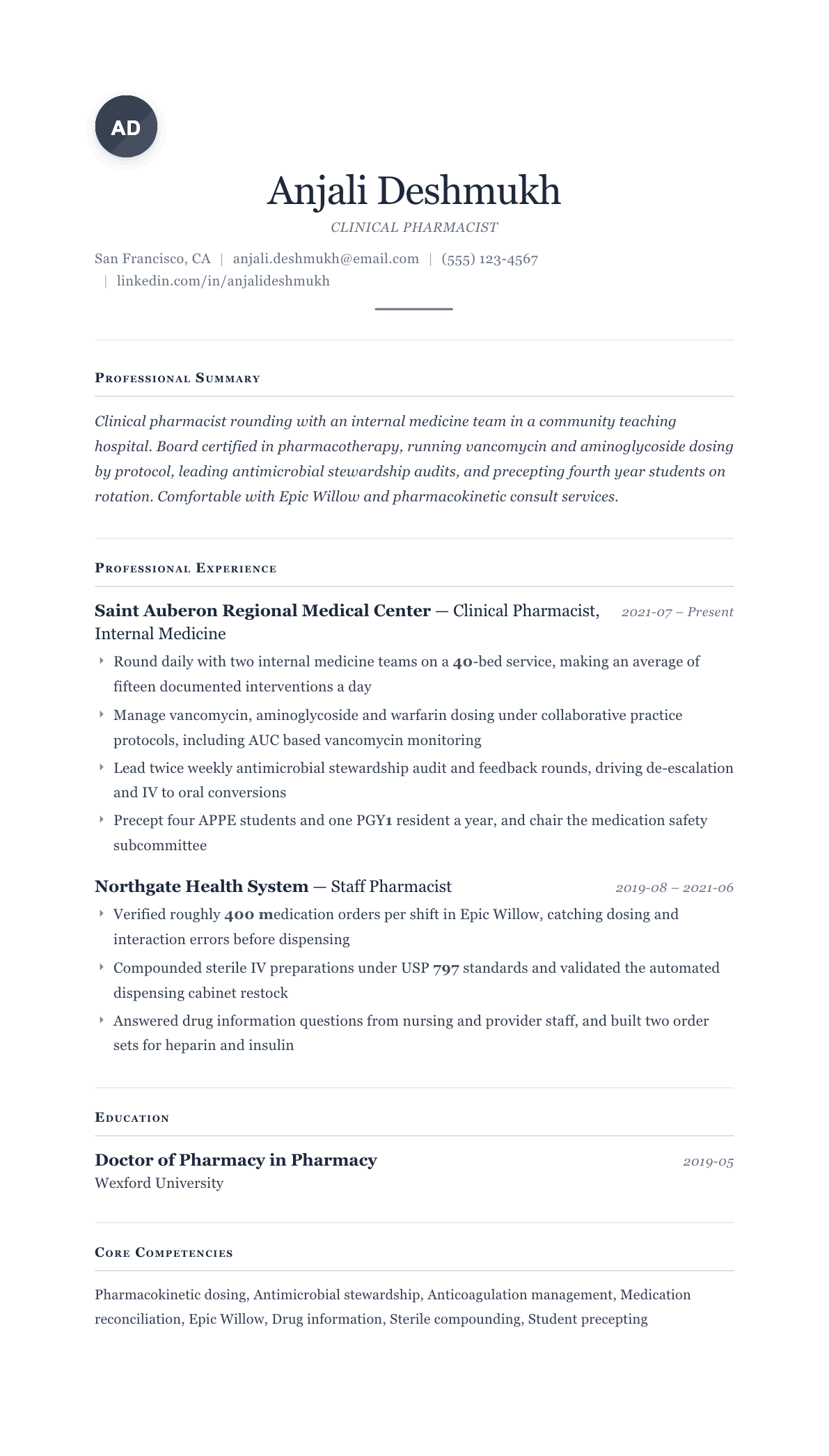
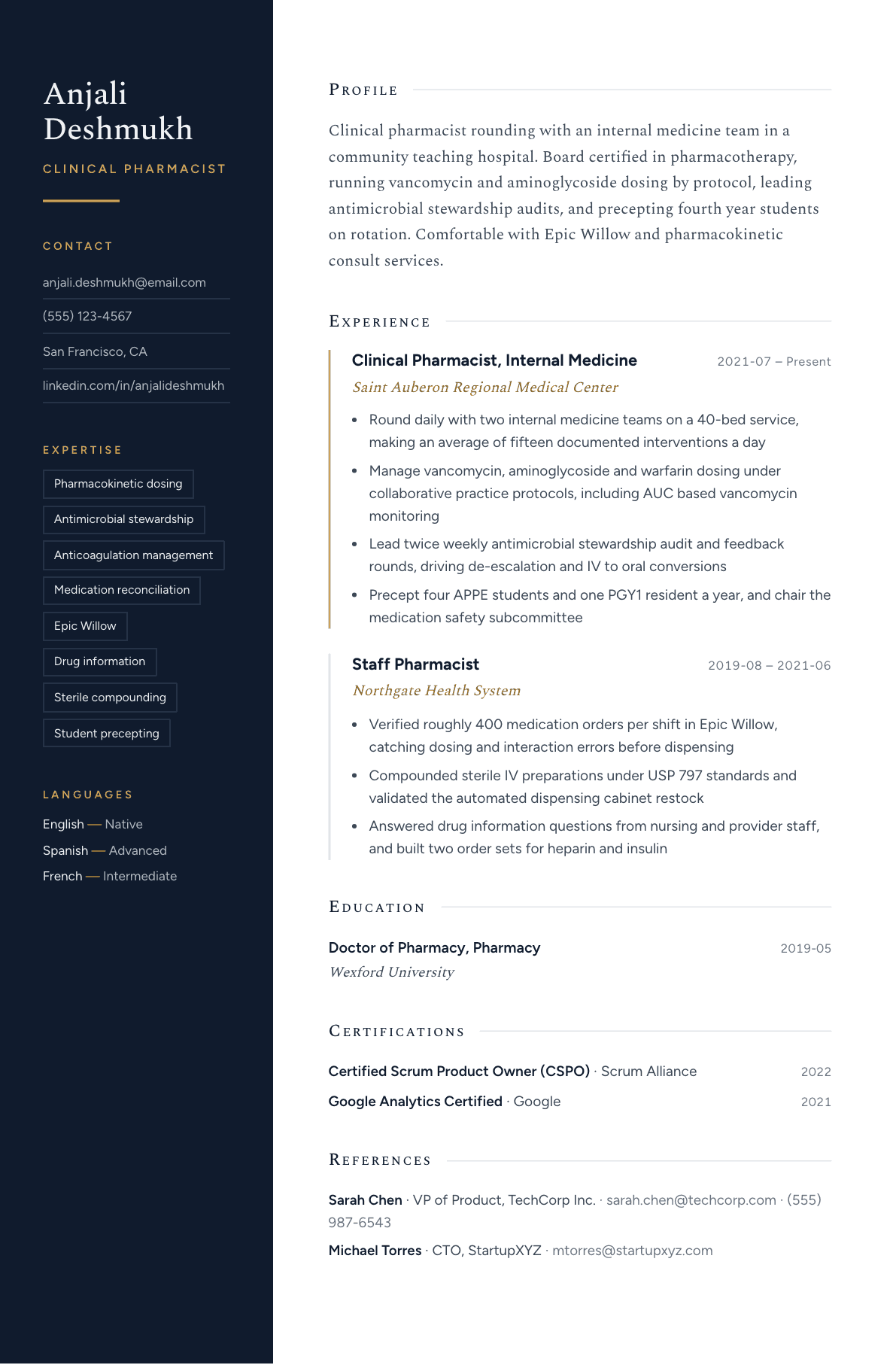
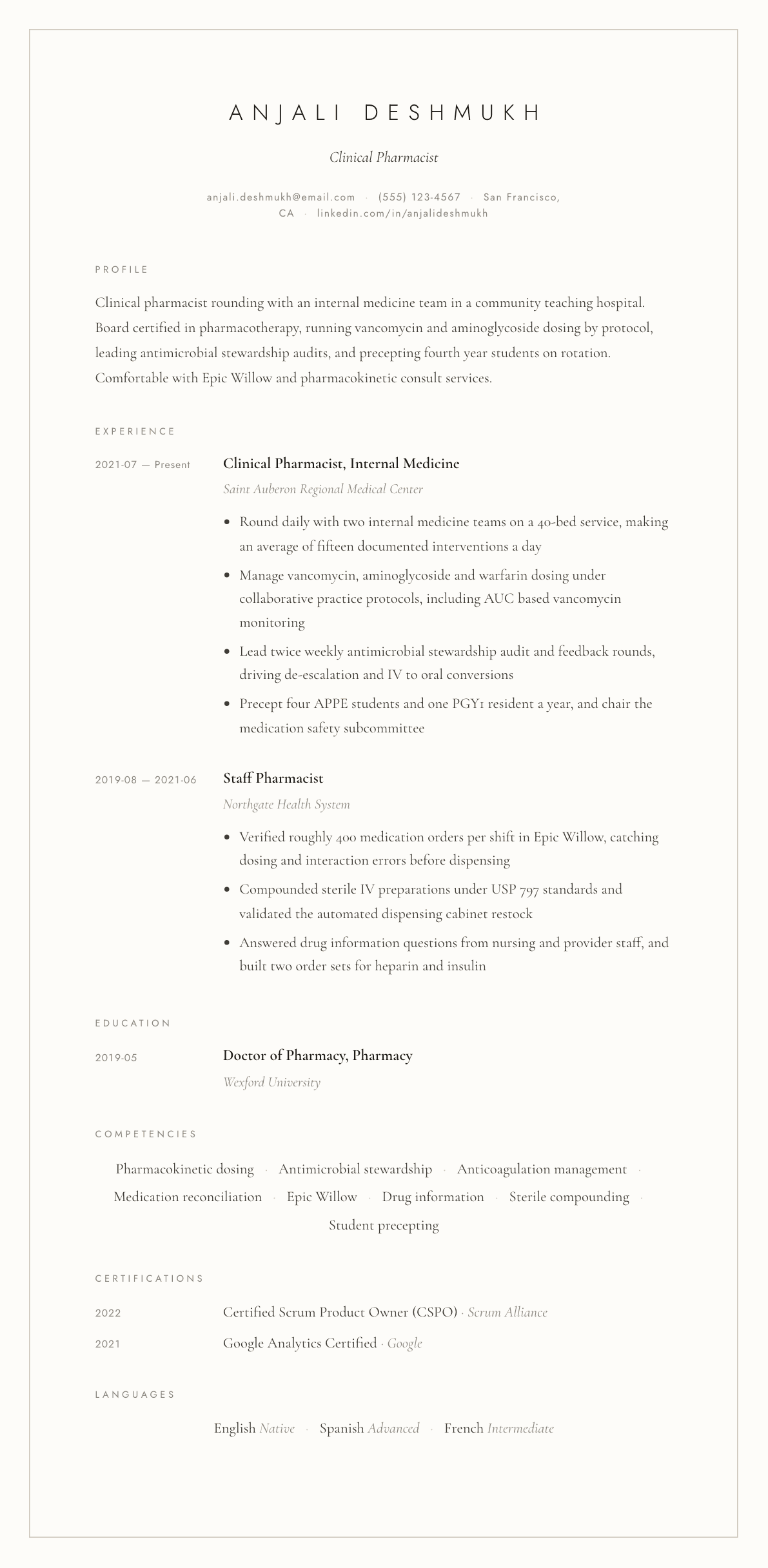
Example Clinical Pharmacist summary
Board certified clinical pharmacist with six years in acute care, rounding with internal medicine and stepping into critical care coverage. Manages vancomycin, aminoglycoside and anticoagulation dosing under collaborative practice, leads stewardship audit and feedback, and documents interventions that support the pharmacy staffing case. Precepts students and residents, and builds order sets that nursing actually follows.
Skills to list on a Clinical Pharmacist resume
- Pharmacotherapy consults
- Pharmacokinetic dosing
- AUC based vancomycin monitoring
- Antimicrobial stewardship
- Anticoagulation management
- Medication reconciliation
- Total parenteral nutrition
- Order set development
- Medication use evaluation
- Sterile compounding and USP 797
- Drug information response
- Epic Willow
- Formulary management
- Adverse drug event reporting
- Student and resident precepting
What actually gets this resume read
- Put your license state, PharmD and board certification in the header, because credentialing screens the resume before a pharmacist does.
- Name your service line for each role: internal medicine, critical care, oncology, infectious disease, emergency or ambulatory care.
- Quantify interventions per day or per month and say how they were documented, since that number drives staffing justification.
- List the protocols you manage under collaborative practice, such as vancomycin dosing, warfarin adjustment or renal dose adjustment.
- Include residency training with the site, the year and the postgraduate level, and list your research or MUE project.
- Show teaching and committee work, because most hospital clinical roles expect precepting and a quality committee seat.
How to write a clinical pharmacist resume
A clinical pharmacist resume passes through two filters. Credentialing checks the license state, the PharmD, board certification and residency training, and will stall the file if any of them are ambiguous. The pharmacy director then reads for service line fit: an infectious disease pharmacist and an ambulatory care pharmacist do different work, and a resume that says only "provided pharmaceutical care" tells her which one you are.
The strongest clinical pharmacist resumes read like a record of decisions. Interventions documented, protocols managed under collaborative practice, stewardship recommendations accepted, order sets written and adopted, students precepted. Those are the outputs a director uses to justify pharmacist staffing to a chief financial officer, so they are the outputs that get you hired.
This guide covers the section order hospital pharmacy expects, how to write residency and rotation experience without padding, three summaries from new practitioner to clinical coordinator, five rewritten bullets, and the questions pharmacists ask when moving between practice settings.
Format: credentials first, two pages is normal
Two pages is standard for a clinical pharmacist and expected once you have residency training, committee work and presentations. Use reverse-chronological order and keep the layout single column, because health system applicant tracking systems parse it more reliably.
Write credentials after your name in the conventional order: "Anjali Deshmukh, PharmD, BCPS". Then a licensure block naming each state and its status, followed by board certification with the certifying body and residency training with the site and postgraduate year.
- Header: name, credentials, city and state, phone, email.
- Order: summary, licensure and certification, residency training, clinical experience, teaching, committees and presentations, education.
- New practitioners put residency and rotations above staff experience.
Summary: setting, service line, protocols, certification
Four lines at most. Name the setting, whether academic medical center, community hospital, ambulatory clinic, long-term care or managed care. Name the service line you round with. Name the protocols you manage under collaborative practice. Close with board certification and teaching role.
If you are changing service lines, say it and name the bridge. A staff pharmacist moving into critical care should point at code coverage, vasoactive drip management and the ICU rotations completed during residency rather than hoping the reader infers it.
Experience: interventions, protocols, and the team you round with
Open each entry with the practice profile: bed count, service line, team structure and whether the site is teaching. "Rounds with two internal medicine teams on a 40-bed service in a community teaching hospital" gives a director everything she needs to place you.
Then write bullets that show clinical decisions. Documented interventions per shift and how they are captured. Pharmacokinetic dosing services including AUC based vancomycin monitoring and aminoglycoside dosing. Anticoagulation management with the transition protocols you follow. Renal dose adjustment, total parenteral nutrition, and antimicrobial de-escalation with IV to oral conversion.
Stewardship work deserves its own bullet if you do it. Prospective audit and feedback, restricted antimicrobial approval, culture follow-up on discharged patients, and the antibiogram review cycle are all specific and all recognizable to the reader.
Operational work still belongs on the page, especially early. Order verification volume, sterile compounding under the relevant USP standards, automated dispensing cabinet oversight and drug shortage management show that you can run the department when the clinical day ends.
Teaching, committees and scholarship
Precepting is a hiring requirement in most hospital clinical roles, so list it explicitly: the number of APPE students and residents per year, the rotation you run, and whether you serve as a residency program coordinator or preceptor of record.
Then committees and outputs: pharmacy and therapeutics, medication safety, antimicrobial stewardship, code committee. Add medication use evaluations, order sets and protocols you authored, plus published work or presentations with the venue named. These are the items that separate a clinical pharmacist from a staff pharmacist on paper.
Skills and systems: name the electronic health record
List the electronic health record and pharmacy module by name, since Epic Willow, Cerner and Meditech appear directly in postings. Add the clinical surveillance platform, the automated dispensing system and any dosing calculator or pharmacokinetic software you use.
Keep the clinical skills list to services rather than adjectives: pharmacokinetic consults, anticoagulation, stewardship, nutrition support, medication reconciliation, drug information response and formulary review.
Clinical Pharmacist resume summary examples
New practitioner after residency
PharmD and PGY1 pharmacy practice residency graduate with rotations in internal medicine, critical care, infectious disease and ambulatory care. Managed vancomycin and warfarin dosing under protocol, completed a medication use evaluation on perioperative antibiotics, and precepted introductory students during the residency year.
Five years in acute care
Board certified pharmacotherapy specialist with five years rounding on internal medicine in a community teaching hospital. Runs AUC based vancomycin monitoring, anticoagulation transitions and stewardship audit and feedback twice weekly. Precepts four advanced students a year and chairs the medication safety subcommittee.
Clinical coordinator
Clinical pharmacy coordinator overseeing eight clinical pharmacists across critical care, internal medicine and emergency services. Owns collaborative practice protocols, the residency program as coordinator, formulary review preparation for pharmacy and therapeutics, and the annual antibiogram driven stewardship plan.
Work experience bullets: before and after
Before: Provided clinical pharmacy services to inpatients.
After: Rounded daily with two internal medicine teams on a 40-bed service, documenting an average of fifteen interventions a day in the electronic health record.
The team structure, bed count and documented intervention rate give the director a number she can compare to her own staffing model.
Before: Dosed antibiotics and monitored levels.
After: Managed vancomycin under an AUC based monitoring protocol and adjusted aminoglycoside dosing by measured pharmacokinetics under a collaborative practice agreement.
Naming the monitoring method and the practice agreement shows independent dosing authority rather than a suggestion to a physician.
Before: Participated in antimicrobial stewardship.
After: Led twice weekly prospective audit and feedback rounds, driving de-escalation and IV to oral conversion, and presented quarterly results to the stewardship committee.
The cadence, the specific interventions and the reporting line show ownership of a program rather than attendance at meetings.
Before: Verified medication orders.
After: Verified roughly 400 orders per shift in Epic Willow, intercepting dosing, renal adjustment and interaction errors before dispensing.
Volume and the error categories turn a routine duty into a measurable safety contribution.
Before: Taught pharmacy students.
After: Precepted four advanced pharmacy practice students and one resident each year on an internal medicine rotation, with a structured topic discussion calendar and midpoint evaluations.
The counts and the rotation structure prove a real teaching load, which most clinical postings require.
Hard skills
- Pharmacotherapy consults and rounding
- AUC based vancomycin monitoring
- Aminoglycoside pharmacokinetic dosing
- Anticoagulation management and transitions
- Antimicrobial stewardship audit and feedback
- Medication reconciliation
- Total parenteral nutrition management
- Renal and hepatic dose adjustment
- Order set and protocol authoring
- Medication use evaluation
- Sterile compounding standards
- Epic Willow and Cerner pharmacy modules
Soft skills
- Persuading prescribers with evidence
- Bedside communication with patients
- Teaching at the level of the learner
- Committee facilitation
- Prioritizing consults under load
Certifications worth listing
- Board Certified Pharmacotherapy Specialist (BCPS) (Board of Pharmacy Specialties)
- Board Certified Infectious Diseases Pharmacist (BCIDP) (Board of Pharmacy Specialties)
- Board Certified Critical Care Pharmacist (BCCCP) (Board of Pharmacy Specialties)
- Board Certified Ambulatory Care Pharmacist (BCACP) (Board of Pharmacy Specialties)
- Board Certified Oncology Pharmacist (BCOP) (Board of Pharmacy Specialties)
- Advanced Cardiovascular Life Support (ACLS) (American Heart Association)
Mistakes that cost clinical pharmacist candidates the interview
- Listing service duties that any pharmacist performs while leaving out the protocols you manage under collaborative practice.
- Hiding residency training at the bottom under education, when it is the first thing a hospital director looks for.
- Omitting documented intervention volume, which is the metric pharmacy leadership uses to defend clinical positions.
- Naming a service line in the summary and then writing bullets that never mention that population again.
- Skipping the electronic health record, when postings name Epic or Cerner explicitly.
- Writing a single resume for acute care, ambulatory care and managed care roles, which reward completely different evidence.
Clinical Pharmacist resume questions
Do I need a residency to be hired as a clinical pharmacist?
Most hospital clinical roles expect a PGY1, and specialty roles often expect a PGY2. Experienced staff pharmacists are still hired without one, so lead with protocol management, documented interventions and board certification when residency is not on your record.
Where do board certifications go on a pharmacist resume?
After your name in the header and again in a licensure and certification block near the top, with the certifying body written out. Credentialing staff verify each one, so give the exact certification name rather than an abbreviation alone.
How do I quantify clinical pharmacy work?
Use documented interventions per day or per month, consults managed per service, orders verified per shift, students and residents precepted per year, and stewardship acceptance of your recommendations. These numbers are already tracked in most departments.
How long should a clinical pharmacist resume be?
Two pages for most practitioners. Academic and coordinator roles often run to three once presentations, publications and committee service are included, and that is acceptable as long as the first page carries the credentials and current practice.
How do I move from retail pharmacy into a hospital clinical role?
Highlight immunization authority, medication therapy management, anticoagulation clinics and any collaborative practice work you already do, then close the gap with per diem hospital shifts or a residency application. Say plainly in the summary that acute care is your target.