Housing Authority Specialist Resume Examples: free score
Write a Housing Authority Specialist Resume That Survives File Review
By Mustafa Tarabya, founder of CVBooster · Published · Updated
Housing authority specialist resume example with HUD program keywords, caseload and recertification tips, and a guide to voucher and occupancy work.
Sample resumes for a housing authority specialist
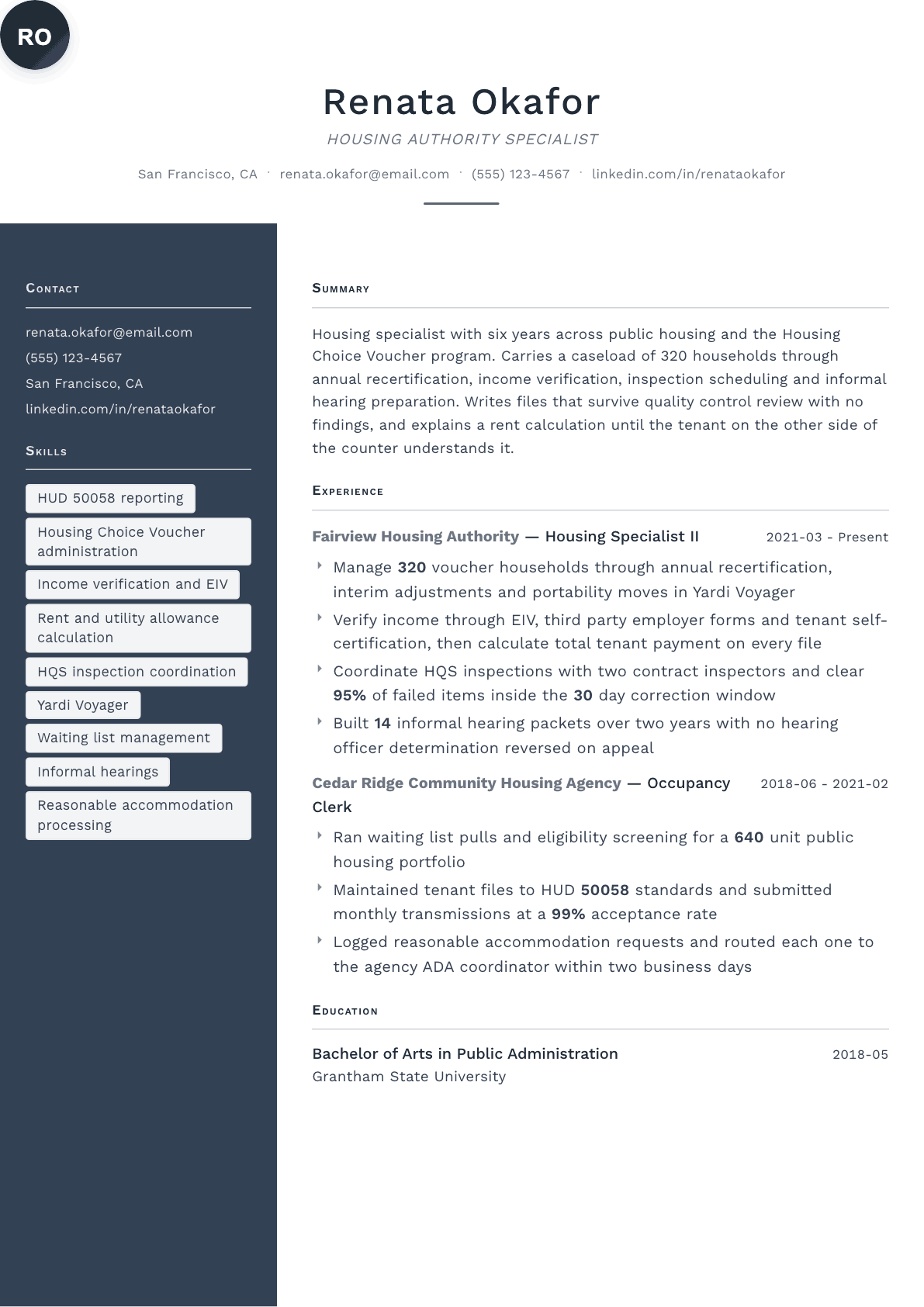
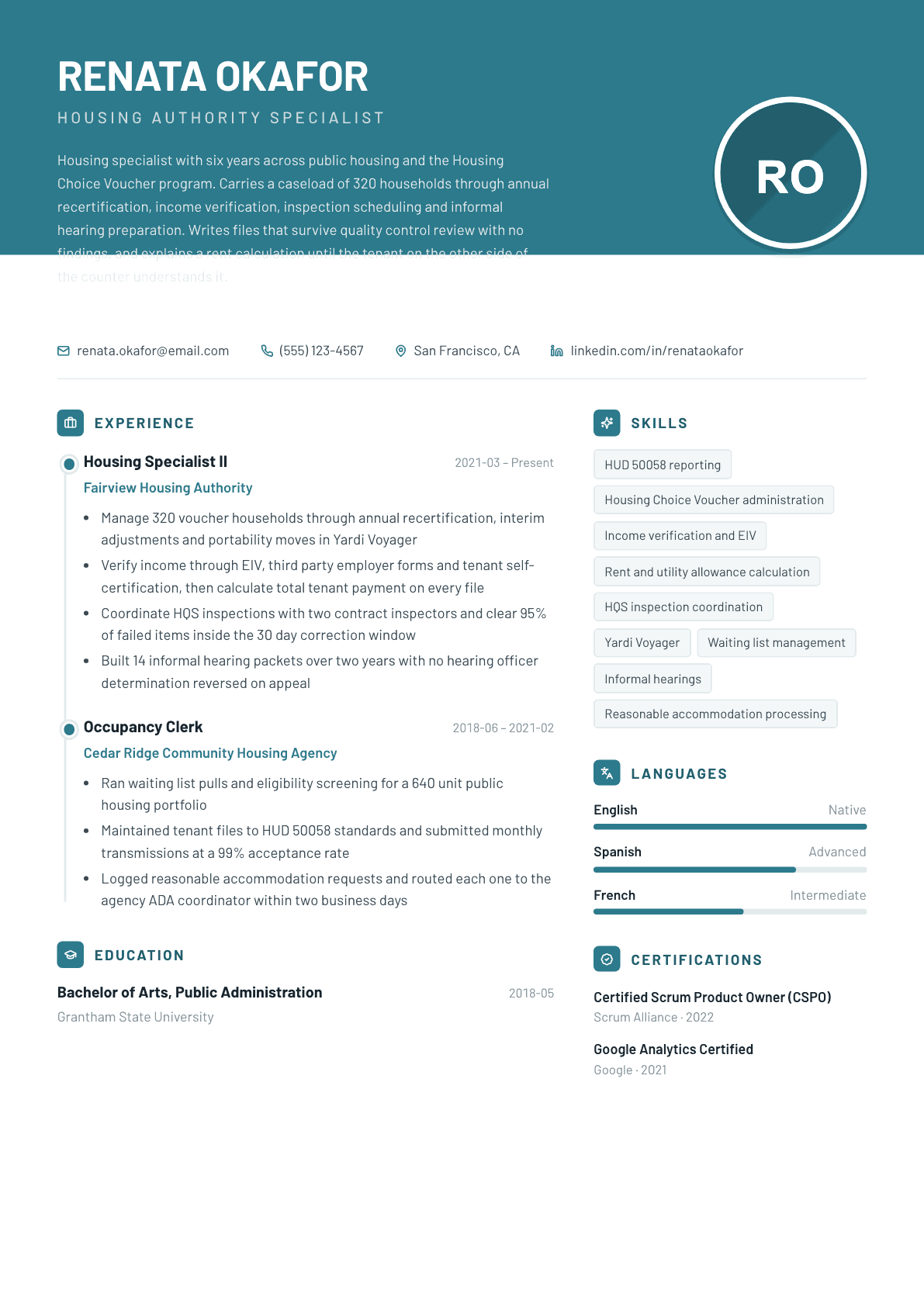
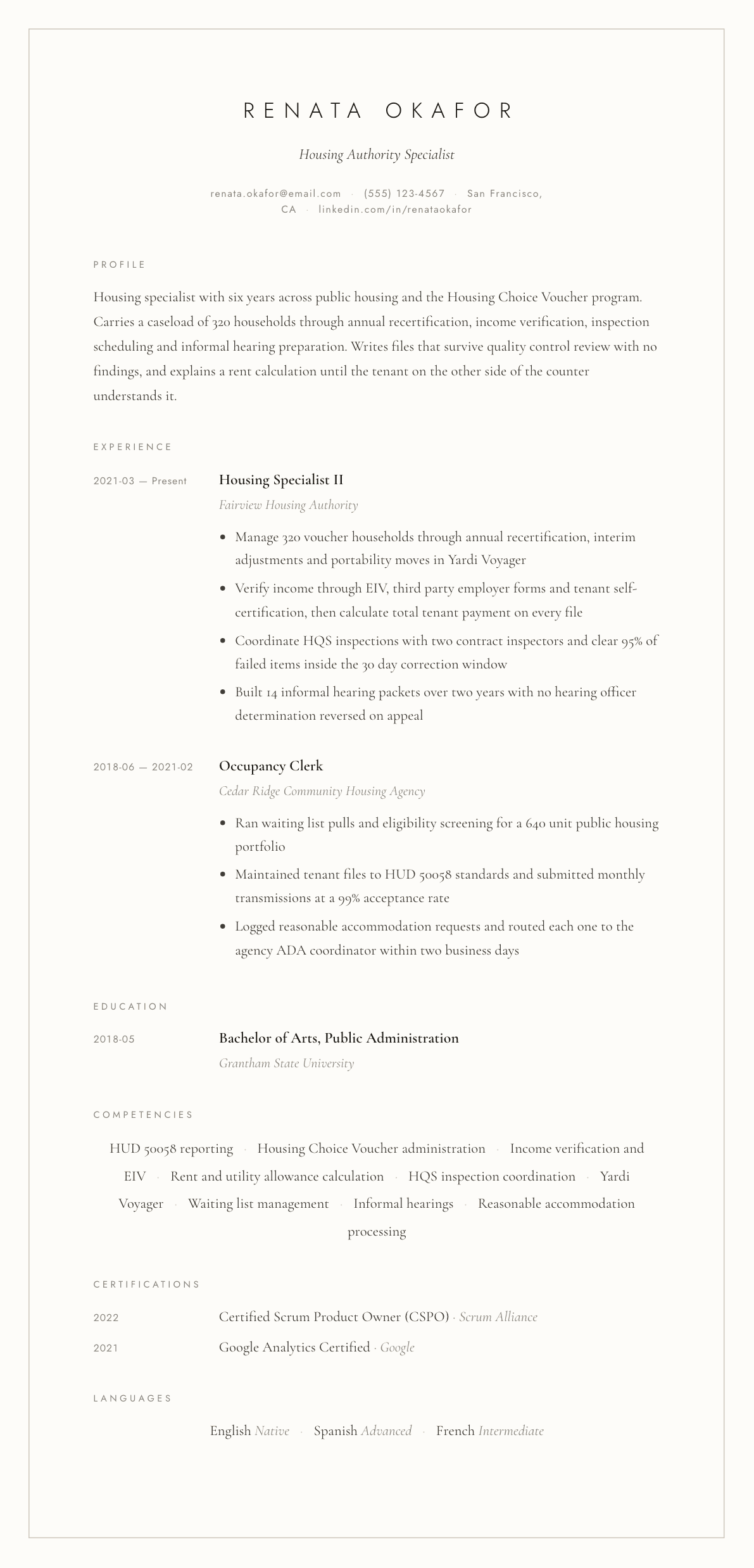
The same housing authority specialist content laid out in three CVBooster templates, so you can see what the finished document looks like before you write a word.
Example Housing Authority Specialist summary
Housing authority specialist with six years across public housing and the voucher program, carrying more than 300 households through annual recertification, interim changes and portability. Verifies income through EIV and third party sources, calculates total tenant payment, coordinates inspections with contract inspectors, and prepares informal hearing packets. Files pass quality control review without findings, and landlords stay in the program because payments and inspections run on schedule.
Skills to list on a Housing Authority Specialist resume
- Housing Choice Voucher administration
- Public housing occupancy
- HUD 50058 submission
- EIV income verification
- Adjusted income and rent calculation
- Utility allowance schedules
- HQS inspection scheduling
- Waiting list and preference administration
- Eligibility determination
- Informal hearings and appeals
- Reasonable accommodation requests
- Fair housing compliance
- Yardi Voyager
- Case file documentation
- Landlord relations
What actually gets this resume read
- Name every program you have administered: public housing, Housing Choice Voucher, project based vouchers or tax credit units.
- Give your caseload in households and the number of recertifications you close in a year rather than calling it large.
- Show that you calculate rent yourself, including adjusted income, utility allowance and total tenant payment, not just that you collect forms.
- List the housing software by name, because Yardi, Emphasys and an in house legacy system are not interchangeable to a supervisor.
- Put your quality control and audit outcomes on the page, since a clean file review is the strongest proof a specialist can offer.
- Describe how you prepare informal hearings and termination notices, which is where a housing authority carries its real legal exposure.
- Add a second language if you use it at the intake counter, and say plainly that you use it there.
How to write a housing authority specialist resume
The person hiring a housing authority specialist is handing over a caseload, not a job description. She has households waiting on annual recertification, a stack of interim change reports, inspections that have to be scheduled against a correction clock, and a quality control sample that a state or federal monitor will pull from her files. The only question she is really asking is whether your files will hold up when someone else reads them.
That is why the resumes that get shortlisted read like an operations page and not a mission statement. Anyone can write that they assisted low income families with housing needs. Far fewer write that they carry 320 voucher households, verify income through EIV and third party employer forms, calculate total tenant payment themselves, and have never had a hearing determination reversed. The second version tells a supervisor exactly which of her open desks you could sit at on Monday.
This guide covers the section order a housing agency reads, how to write caseload and recertification volume, what to say about rent calculation and inspections, the compliance work nobody puts in the advert, and the questions specialists ask when they move between agencies or from a private property management office into public housing.
Format: programs first, caseload second, systems third
Reverse chronological, one page for under about eight years of agency work and two once you have covered several programs. Put a short program line directly under your title so the reader sees the alphabet soup before anything else: public housing, Housing Choice Voucher, project based vouchers, tax credit units, moderate rehabilitation, or whichever mix you have run. Agencies hire against a specific opening, and a specialist who has only done voucher work is a different hire from one who has run occupancy on a public housing portfolio.
The second block is caseload and volume. The third is the case management system. Everything else, including the degree, sits below those three, because a supervisor with a vacancy is deciding how much training you will need before you can close a file on your own.
- Program line under the title: every program you have administered, and the ones you have only assisted on kept separate.
- Caseload in households, plus recertifications closed in a year and any interim volume you handle on top.
- System named exactly: Yardi Voyager, Emphasys Elite, MRI or the in house platform your agency built.
- A compliance line: quality control sample results, monitoring reviews, or the last audit your files went through.
- Certificates grouped in one block where a supervisor can check them against the position description.
Summary: what you administer, how much of it, and how clean it is
Three lines, four facts. The programs, the caseload, the parts of the process you own end to end, and the state of your files. A specialist who writes that she carries a mixed caseload of voucher and public housing households, runs annual and interim recertifications from intake through rent calculation, and closed the last monitoring review with no findings has answered the entire first screen in one paragraph.
Skip anything about being passionate about affordable housing. The supervisor assumes it, because nobody stays in this work for the pay, and the sentence uses space that a caseload number would have earned.
Experience: recertifications, rent calculation and the paper behind them
Each job needs the agency size and the portfolio it manages, then the caseload you personally carried. A specialist at an agency with four hundred vouchers works differently from one at an agency with four thousand, and the reader cannot tell unless you say so. Give the unit count or voucher allocation next to the employer name.
Then write the process work in the order the file moves: eligibility screening and waiting list pulls, intake and briefing, income verification through EIV and third party sources, deductions and adjusted income, utility allowance, total tenant payment, the housing assistance payment contract, inspection scheduling, and the annual that starts the loop again. Name the steps you do yourself. Many applicants write that they processed recertifications when what they mean is that they collected the forms and someone else calculated the rent, and that gap surfaces in the first week.
Add the exceptions, because the exceptions are where a specialist earns the job: zero income households and the follow up interval you use, self employment income and how you document it, family composition changes, portability in and out, repayment agreements after an overpayment, and the households whose paperwork never arrives on time.
Inspections, hearings and the compliance work nobody advertises
Inspection coordination belongs on the page even when the inspectors are contractors. Say how many units you schedule in a month, how you track failed items against the correction window, and what you do when an owner stops answering. An agency that has abated payments on a stubborn landlord knows precisely how much labor sits behind that one sentence.
Hearings and terminations are the highest risk work a specialist touches. Write the volume, your role in it, and the outcome: how many informal hearing packets you have built, whether you present the agency position, and how many determinations were upheld. Do the same for reasonable accommodation requests, because fair housing exposure is the thing an executive director loses sleep over. Describe how requests reach you, how fast you route them, and how you document the interactive process without editorializing about the tenant.
- Inspection volume a month, failed item tracking, abatement and the correction clock.
- Informal hearing packets built, hearings attended, determinations upheld.
- Termination notices prepared and the review step before they go out.
- Reasonable accommodation intake, routing time and documentation trail.
- Repayment agreements negotiated after unreported income, with the recovery outcome.
Skills, keywords and the language the position description uses
Agency postings recycle a narrow vocabulary and human resources screens against it literally: 50058, EIV, adjusted income, utility allowance, total tenant payment, housing assistance payment, HQS or the newer inspection standard your agency has adopted, portability, absorption, waiting list preference, fair housing, and Violence Against Women Act protections. Use the exact terms the position description uses, once in the skills block and once inside a bullet where the work is visible.
Language is a hard skill in this job, not a nice extra. If you conduct briefings or intake interviews in a second language, say which language and where you use it, since a housing agency counting its language access obligations reads that line as a staffing solution.
Housing Authority Specialist resume summary examples
First agency role
Public administration graduate with 18 months in a property management office handling tax credit recertifications and waiting list screening. Trained on income verification, deductions and file documentation standards, and completed occupancy certification coursework. Seeking a voucher or public housing specialist seat where the whole file, not just intake, belongs to me.
Five years in
Housing specialist carrying 320 voucher households through annual and interim recertification, income verification through EIV, rent calculation and inspection scheduling. Cleared 95% of failed inspection items inside the correction window last year and closed the most recent quality control sample with no findings. Certified Occupancy Specialist working daily in Yardi Voyager.
Senior specialist and team lead
Senior housing specialist with 11 years across public housing occupancy and the voucher program, leading four specialists and owning the agency hearing calendar. Rewrote the interim change workflow, cutting average processing from 21 days to 9, and prepared the agency for its last two federal monitoring reviews without a repeat finding.
Work experience bullets: before and after
Before: Assisted families with housing applications and paperwork.
After: Screened 40 waiting list applicants a month for eligibility, ran the intake briefing, and issued vouchers to 22 households with a complete file at issuance.
Volume, the step you own and the completeness standard turn helping into a measurable workload.
Before: Processed annual recertifications for tenants.
After: Closed 320 annual recertifications a year end to end, from EIV and third party income verification through deductions, utility allowance and total tenant payment calculation.
Naming the calculation steps proves you own the rent, not just the paperwork around it.
Before: Worked with inspectors to make sure units were inspected.
After: Scheduled about 60 inspections a month with two contract inspectors and tracked failed items to correction, abating payment on 4 units where owners missed the window twice.
Abatement is the part that requires judgment, and it separates a coordinator from a clerk.
Before: Handled tenant complaints and disputes professionally.
After: Prepared 14 informal hearing packets over two years, presented the agency position at each hearing, and had every determination upheld by the hearing officer.
A hearing count with an outcome is verifiable where professionalism is an adjective.
Before: Kept accurate records in the housing software.
After: Maintained 50058 records in Yardi Voyager at a 99% first submission acceptance rate and corrected the fatal error queue within two business days of each transmission.
Acceptance rate and error turnaround are the two numbers a monitor actually looks at.
Hard skills
- Housing Choice Voucher administration
- Public housing occupancy and continued occupancy policy
- HUD 50058 submission and error correction
- EIV and third party income verification
- Adjusted income, deductions and rent calculation
- Utility allowance schedules
- Housing quality inspection scheduling and abatement
- Waiting list and local preference administration
- Portability in and out
- Informal hearings and termination notices
- Reasonable accommodation and fair housing compliance
- Repayment agreement negotiation
- Yardi Voyager and Emphasys Elite
- Landlord recruitment and retention
Soft skills
- Explaining a rent calculation to someone it just went badly for
- Holding a deadline when the household misses theirs
- Neutral documentation under later scrutiny
- De-escalation at a public counter
- Discretion with income and medical information
Certifications worth listing
- Certified Occupancy Specialist (COS) (National Center for Housing Management)
- Tax Credit Specialist (TCS) (National Center for Housing Management)
- Public Housing Manager (PHM) (National Association of Housing and Redevelopment Officials)
Mistakes that cost housing authority specialist candidates the interview
- Writing that you helped families access affordable housing without a single caseload number anywhere on the page.
- Saying you processed recertifications when you collected documents and a supervisor calculated the rent.
- Leaving the case management system off, which forces the reader to assume retraining time you may not need.
- Listing every program the agency runs instead of the ones you personally administered.
- Skipping hearings, terminations and reasonable accommodations, which are the tasks a supervisor most fears assigning to an unknown hire.
- Quoting a monitoring result with no sample size or scope, so it reads as decoration rather than evidence.
- Describing tenants in a way that reveals income or medical detail, which signals poor file discipline before the interview starts.
Housing Authority Specialist resume questions
How do I move from private property management into a housing authority?
Lead with the compliance overlap. Tax credit recertification, income verification, file documentation and inspection readiness all transfer directly, so name them in agency language and add occupancy coursework to show you have learned the public side of the rules.
Should I put my caseload size on the resume?
Yes, and put it in households rather than a vague word like large. Supervisors staff by ratio, so a number tells them whether you can absorb the vacancy they are filling and whether your pace matches their office.
What do I write if my agency never had an audit finding to report?
Use the quality control sample instead. Say how many of your files were pulled for internal review in a year and what came back, or give your submission acceptance rate and how quickly you clear fatal errors after a transmission.
Do I need a degree to be hired as a housing specialist?
Many agencies accept a combination of experience and coursework in place of a degree, so put the experience first and the certifications right behind it. A Certified Occupancy Specialist credential often carries more weight in screening than an unrelated bachelor degree.
How much detail should I give about difficult tenant situations?
Enough to show judgment, never enough to identify anyone. Describe the category of problem, the action you took and the outcome, and keep names, unit numbers, medical facts and income details off the page entirely.
Related resume examples
- Housing Case Manager Resume example
- Eligibility Worker Resume example
- Public Administrator Resume example
- Case Manager Resume example
- Social Worker Resume example
- State Government Employee Resume example