Medical School Applicant Resume Examples: free ATS score
Medical School Applicant Resume That Holds Up Beside Your Application
By Mustafa Tarabya, founder of CVBooster · Published · Updated
Medical school applicant resume example with clinical hours, shadowing, research and service categories, plus a guide to the committee-ready format.
Sample resumes for a medical school applicant
The same medical school applicant content laid out in three CVBooster templates, so you can see what the finished document looks like before you write a word.
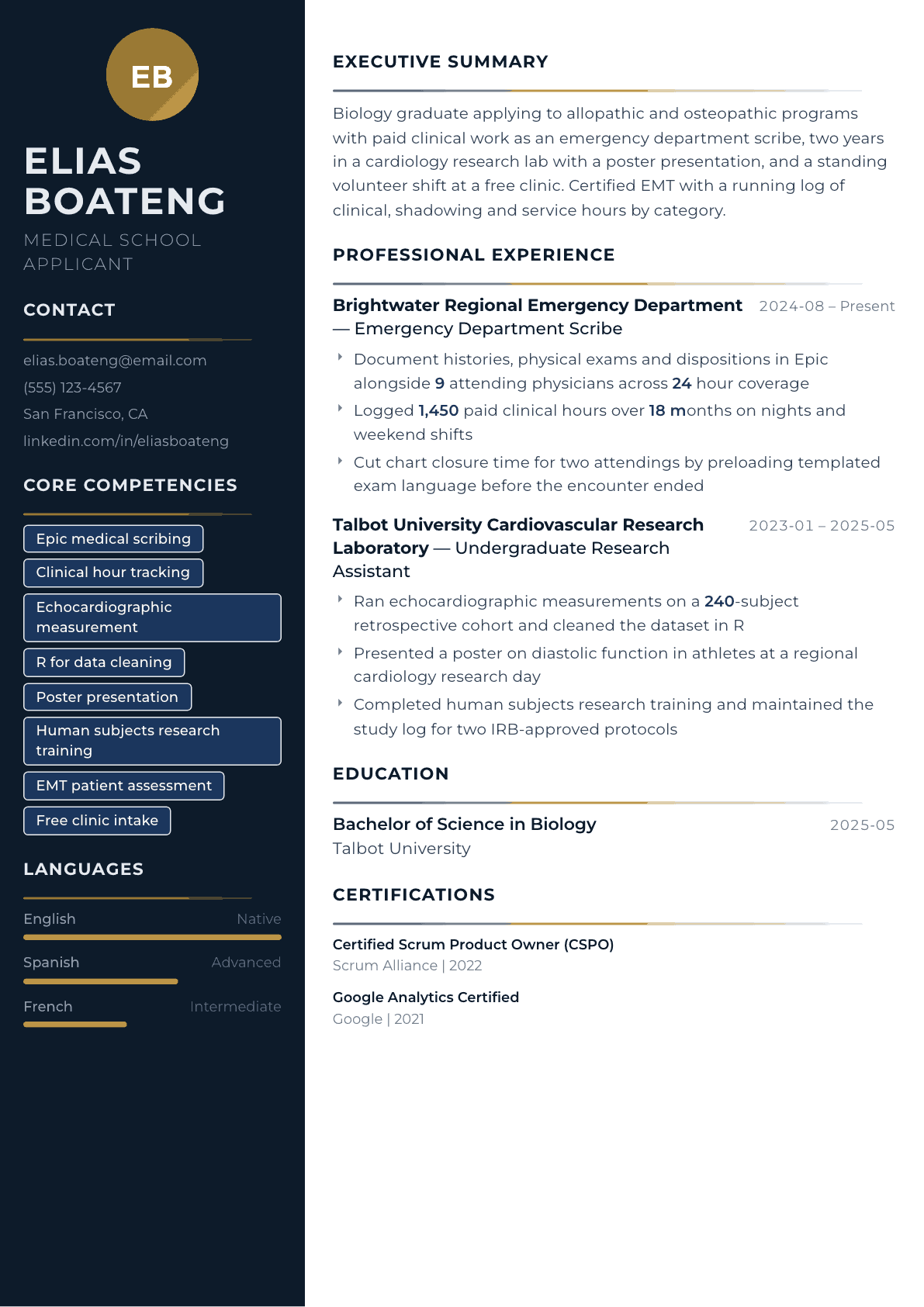
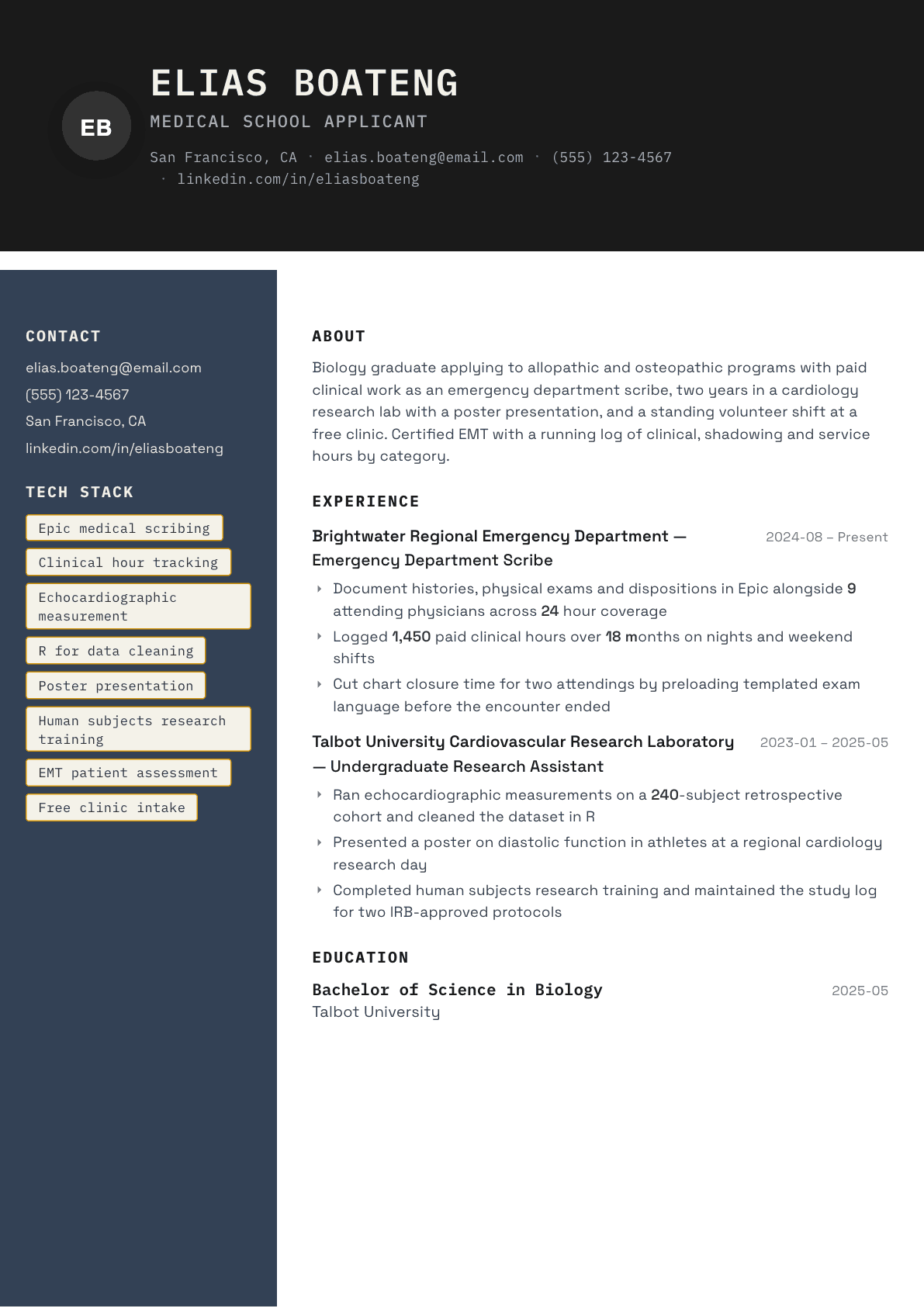
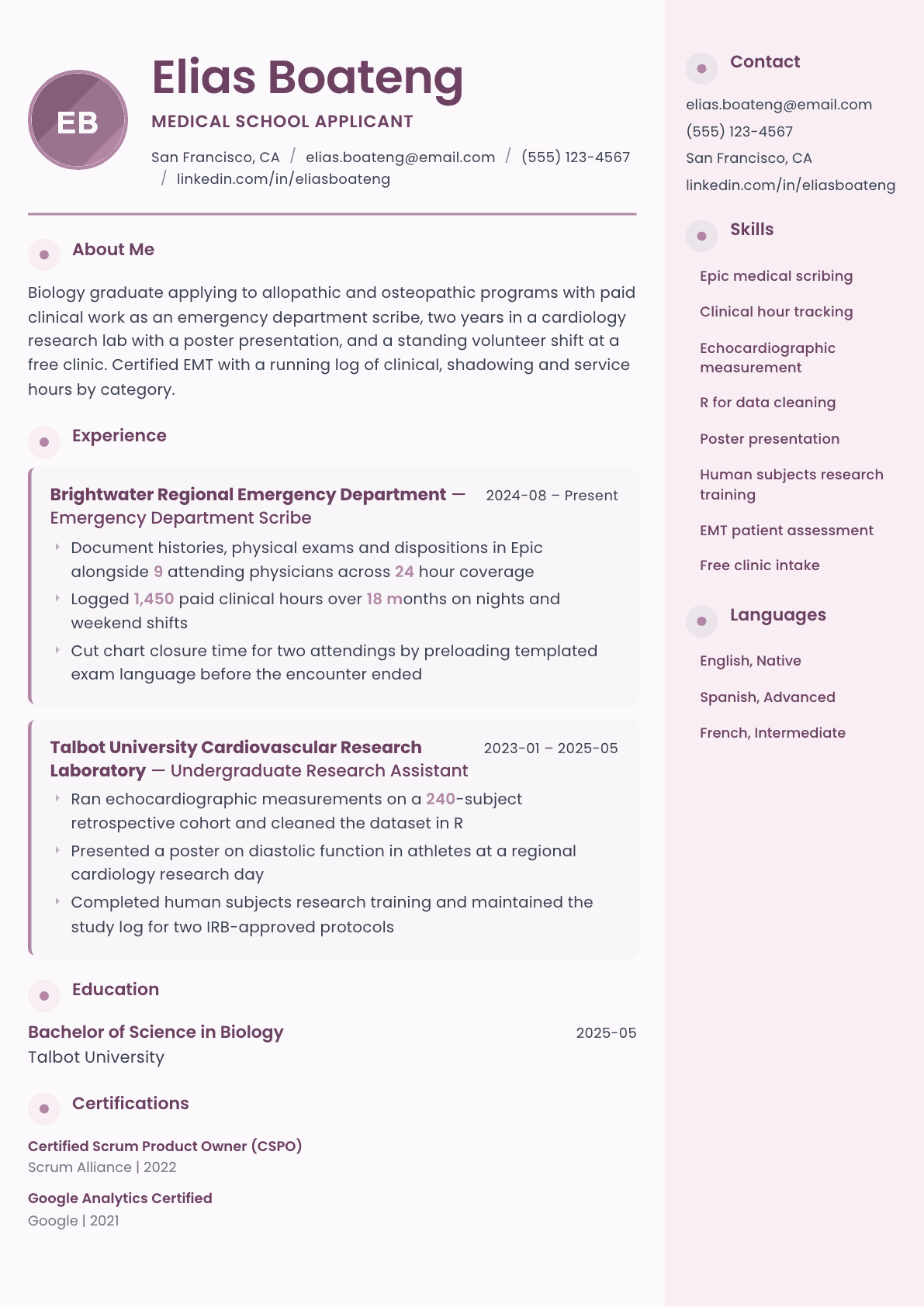
Example Medical School Applicant summary
Medical school applicant with a biology degree, an emergency department scribe role covering more than a thousand paid clinical hours, and two years in a cardiology research laboratory ending in a regional poster. Volunteers on a standing free clinic shift and holds current EMT certification. Tracks clinical, shadowing, research and service hours separately by category. Applying for entry in the coming cycle.
Skills to list on a Medical School Applicant resume
- Medical scribing in Epic
- Clinical documentation
- Patient intake and vitals
- Physician shadowing across specialties
- Basic life support
- EMT patient assessment
- Clinical research protocols
- Human subjects research compliance
- Data cleaning in R
- Statistical summary and figures
- Poster and abstract preparation
- Free clinic volunteering
- Peer health education
- Hour logging and record keeping
What actually gets this resume read
- Group your entries the way the application does: clinical, shadowing, research, service and leadership.
- Give hour totals per category with the date range, because committees compare hours against sustained commitment.
- Separate paid clinical work from volunteer clinical work, since the two are read as different evidence.
- Name the specialties you shadowed and the hours in each, rather than saying you shadowed several physicians.
- Describe research by your own role: the protocol, the measurement, the analysis, and any poster or abstract.
- Keep patient details out entirely, and describe encounters only at the level a public poster would use.
- List your certifications with the issuing body, since basic life support and EMT credentials are checked.
How to write a medical school applicant resume
Most medical school applicants need a resume for reasons the application itself never explains. A prehealth committee asks for one before writing the letter. A research mentor wants one attached to a recommendation request. A scribe agency, a clinical research coordinator or a gap year employer wants one for a job that will become the clinical hours on your file. The page has to serve all three without turning into a second personal statement.
What makes this resume unusual is that it is organized by evidence category rather than by employer. Admissions readers think in buckets: clinical exposure, shadowing, research, service to others, leadership, and the paid work that funded all of it. A page that mirrors those buckets is instantly legible to a committee member and, as a bonus, shows you exactly where your own file is thin while there is still time to fix it.
This guide covers the structure a prehealth committee expects, how to write hours honestly, how to describe patient contact without breaching anything, three summaries across a sophomore, a senior applying straight through and a gap year applicant, and the questions applicants ask about what belongs on the page.
Format: categories that match how a file is read
Group entries into clinical experience, shadowing, research, service, leadership and employment, and put the categories in the order that flatters your file. An applicant with a heavy research record leads with research. An applicant with two years of paid patient contact leads with clinical. Two pages is acceptable here in a way it is not in most fields, because a committee is checking breadth over years.
Inside each category, list entries in reverse chronological order with a date range, a role title, the setting, and hours. Hours are the currency. An entry without them forces a committee member to guess, and the guess is always low.
- Clinical experience split into paid and volunteer, since committees weigh sustained paid patient contact differently.
- Shadowing listed by specialty with hours per specialty, not as one lumped figure.
- Research entries with the laboratory, the principal investigator, your method, and any poster, abstract or manuscript.
- Service entries that show duration, because a standing weekly shift outperforms a one-day drive every time.
Clinical hours: paid, volunteer, and what actually counts
Clinical means close enough to a patient to smell the room. Scribing, medical assisting, emergency medical services, patient transport, phlebotomy, nursing assistance, hospice volunteering and clinic intake all count. Front desk scheduling and hospital gift shop volunteering do not, and a committee reader will silently recategorize them if you claim otherwise.
Write each clinical entry with the setting, the population, the tasks and the hours. An emergency department scribe entry that names the documentation system, the number of attending physicians worked alongside, and the shift pattern gives a reader a picture. A line saying you gained valuable clinical exposure gives them nothing to weigh.
If you are still building hours, put the running total and the projected total by application date, with the weekly commitment behind it. Committees respect a clear plan more than a padded number, and a prehealth advisor reading it can tell you immediately whether the plan is enough.
Research: your method, not the laboratory topic
Applicants routinely describe their laboratory instead of their work. A committee wants your role: the assay you ran, the cohort you cleaned, the instrument you were trained on, the analysis you did, whether you wrote any part of a manuscript. That is what a faculty interviewer will ask about, and the resume should set that question up rather than dodge it.
List presentations and publications in full citation form with author order intact, including work under review, labeled honestly. Include your human subjects research training with the issuing body, since a coordinator hiring you for a gap year job will check it before anything else on the page.
- Your technique: the measurement, the assay, the software, the protocol you ran without supervision.
- Scale: cohort size, sample count, sessions run, records reviewed.
- Output: poster, abstract, manuscript, internal report, or the pipeline the laboratory kept using.
- Training: human subjects research certification and any protocol-specific training with dates.
Service, leadership and the things committees quietly check
Service entries are read for duration and for who you served. A weekly shift at a free clinic held across two years outweighs six scattered events, and work with populations who face barriers to care is read closely. Say what you actually did: interpreting at intake, running a blood pressure table, coordinating volunteer schedules, driving patients to appointments.
Leadership does not have to be a club presidency. Training new scribes, running a shift, building a volunteer rota, organizing a research journal club: all of these are leadership with a concrete artifact behind them. Committees are wary of title collecting, so one substantial role with an outcome beats five listed positions.
Two things belong on the page and are almost always missing. The first is your language ability, stated at the level you can actually take a history in, because clinics schedule against it. The second is confidentiality practice: keep every entry at the level of category and count, never a story a reader could match to a person.
Keywords, certifications and the gap year job hunt
The same page has to win you the gap year job that produces the hours. Employers hiring scribes, medical assistants, research coordinators and emergency medical technicians search for concrete terms: electronic health record documentation, vital signs, phlebotomy, intake, chart preparation, protocol adherence, study enrollment, specimen handling. Use the ones you have earned in the entry where the work sits.
Certifications carry real weight in that hunt. Basic life support, an emergency medical technician registration, a certified nursing assistant credential or a phlebotomy certification with the issuing body listed will move you ahead of applicants with better transcripts and no credentials.
Medical School Applicant resume summary examples
Sophomore building a file
Second-year biology major with 180 hours of hospice volunteering across two semesters, a first year in a cardiovascular research laboratory, and an emergency medical technician course in progress. Building toward a sustained clinical role for the coming summer while continuing weekly service at a community free clinic.
Senior applying straight through
Senior biology major applying this cycle with 900 paid clinical hours as an emergency department scribe, 60 shadowing hours across three specialties, and two years in a cardiology laboratory ending in a first-author regional poster. Holds current basic life support certification and volunteers weekly at a free clinic.
Gap year applicant
Biology graduate in a second gap year working as a clinical research coordinator, managing enrollment for two protocols while continuing night scribe shifts. Carries more than two thousand paid clinical hours, a published abstract, and a standing interpreter role at a free clinic serving Spanish-speaking patients.
Work experience bullets: before and after
Before: Worked as a medical scribe in a hospital.
After: Documented histories, physical exams and dispositions in Epic alongside 9 attending physicians in a 30-bed emergency department, working nights and weekend shifts across 18 months.
The documentation system, physician count, department size and shift pattern let a reader picture the exposure.
Before: Volunteered at a free clinic.
After: Held a standing Saturday shift at a community free clinic for two years, running intake and vitals for 15 to 20 patients per session and interpreting for Spanish-speaking families at registration.
Duration, cadence, patient volume and the language role turn a service line into sustained commitment.
Before: Assisted with research in a cardiology lab.
After: Ran echocardiographic measurements on a 240-subject retrospective cohort, cleaned the dataset in R, and presented a first-author poster on diastolic function at a regional research day.
Your own method, the cohort scale and the output replace the laboratory description with your contribution.
Before: Shadowed doctors in several specialties.
After: Shadowed 60 hours across internal medicine, general surgery and family medicine, including 20 hours of clinic sessions and two full operating room days.
Hours split by specialty are exactly the breakdown an admissions reader is trying to reconstruct.
Before: Trained new scribes on the job.
After: Trained 6 new scribes through a three-shift onboarding sequence, wrote the department shorthand reference now given at orientation, and audited their first solo charts for accuracy.
A training sequence with a lasting artifact reads as leadership rather than as helping a colleague.
Hard skills
- Electronic health record documentation
- Patient intake and vital signs
- Medical terminology and charting shorthand
- Basic life support
- Emergency medical technician patient assessment
- Phlebotomy and specimen handling
- Clinical research protocol adherence
- Study enrollment and consent process
- Human subjects research compliance
- Data cleaning and analysis in R
- Poster and abstract preparation
- Medical Spanish interpreting at intake
Soft skills
- Staying quiet and useful in a room during a difficult conversation
- Keeping accurate notes while a physician moves quickly
- Holding patient information without discussing it anywhere
- Turning up for the same shift for two years
- Asking a supervising clinician a question at the right moment
Certifications worth listing
- Basic Life Support (BLS) Provider (American Heart Association)
- Emergency Medical Technician Certification (National Registry of Emergency Medical Technicians)
- Human Subjects Research Training (CITI Program)
Mistakes that cost medical school applicant candidates the interview
- Counting front desk or gift shop volunteering as clinical hours, which a committee reader will quietly recategorize.
- Lumping shadowing into one total instead of splitting hours by specialty the way the application asks.
- Describing the laboratory topic at length while never naming the technique you personally ran.
- Including a patient anecdote with enough detail that someone could recognize the encounter.
- Listing six leadership titles with no outcome, when one substantial role with an artifact is stronger.
- Leaving hours off entirely, forcing every reader to guess, and to guess low.
- Rewriting the personal statement into the resume summary instead of keeping the page factual.
Medical School Applicant resume questions
Do medical schools ask for a resume at all?
The central application does not, but prehealth committees, letter writers, secondary applications at some schools and every gap year employer do. Keep one maintained page so that a committee request in the spring does not become a week of reconstruction from memory.
How should I count clinical hours if the work was part clinical and part administrative?
Count only the hours with patient contact and say so in the entry. A scribe role that included two administrative hours a week should describe the split plainly. Committees read overstated hours as a judgment problem, which is worse than a smaller number.
Should a gap year applicant put the gap year job first?
Yes, if it is clinical or research, because it is the most recent and usually the strongest evidence in the file. Give it full detail, then keep the undergraduate entries shorter, since a reader has already assessed those in your transcript.
How do I present research that never produced a publication?
Describe the method, the scale and the outcome that did exist: a cleaned dataset, an internal report, a pipeline the laboratory still runs, a poster at a campus symposium. Unpublished work is normal and committees weigh method exposure over authorship for undergraduates.
Is it worth listing a non-healthcare job on this resume?
Yes, especially work you held to pay for school. Committees read sustained employment as maturity and time management, and it explains a lighter volunteer record more honestly than any explanatory paragraph you could write.