Grants Administrator Resume Examples: what gets the call
Craft a Grants Administrator Resume That Survives Audit Scrutiny
By Mustafa Tarabya, founder of CVBooster · Published · Updated
Grants administrator resume example covering budgets, compliance and reporting, keyword list, and a detailed writing guide.
Sample resumes for a grants administrator
The same grants administrator content laid out in three CVBooster templates, so you can see what the finished document looks like before you write a word.
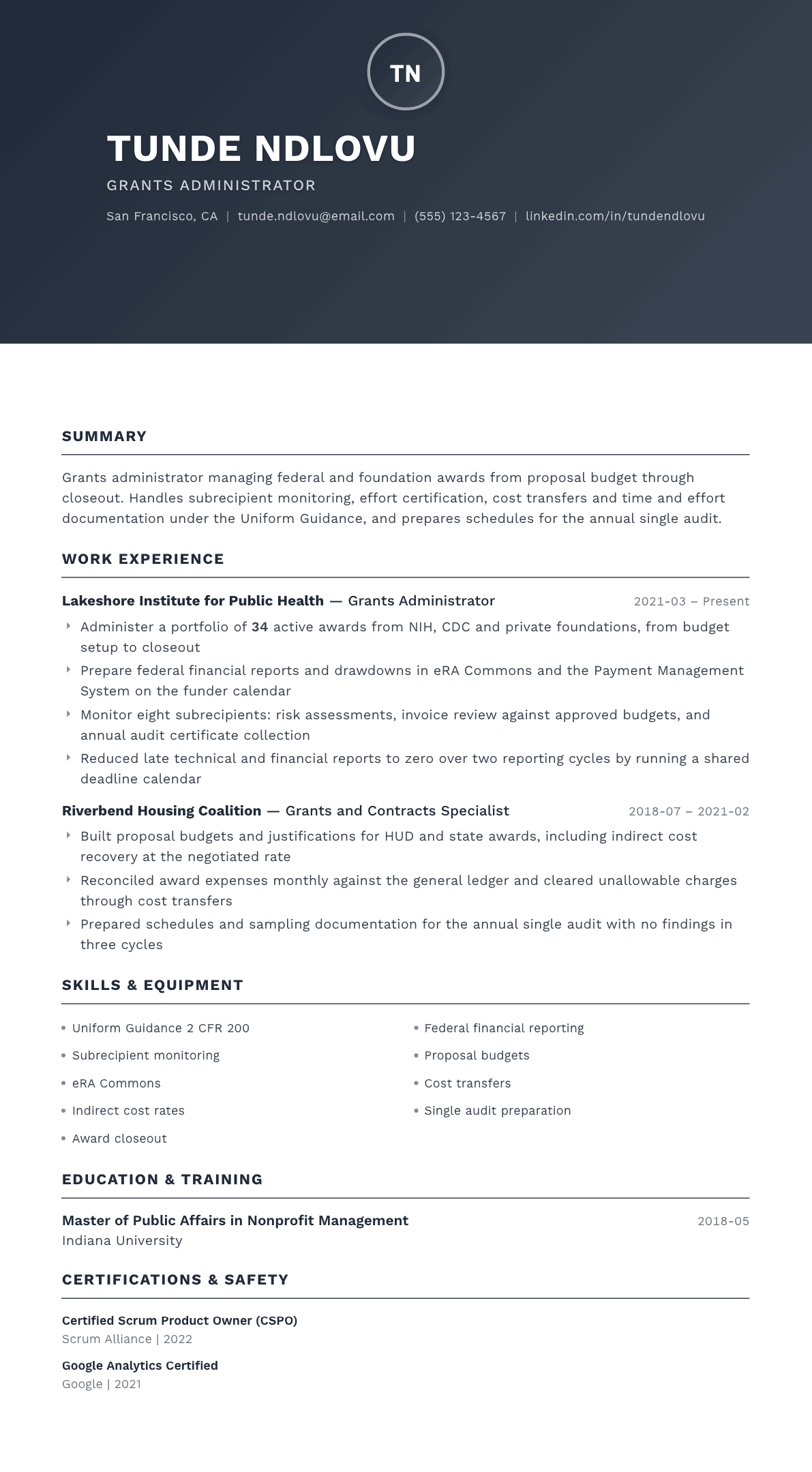
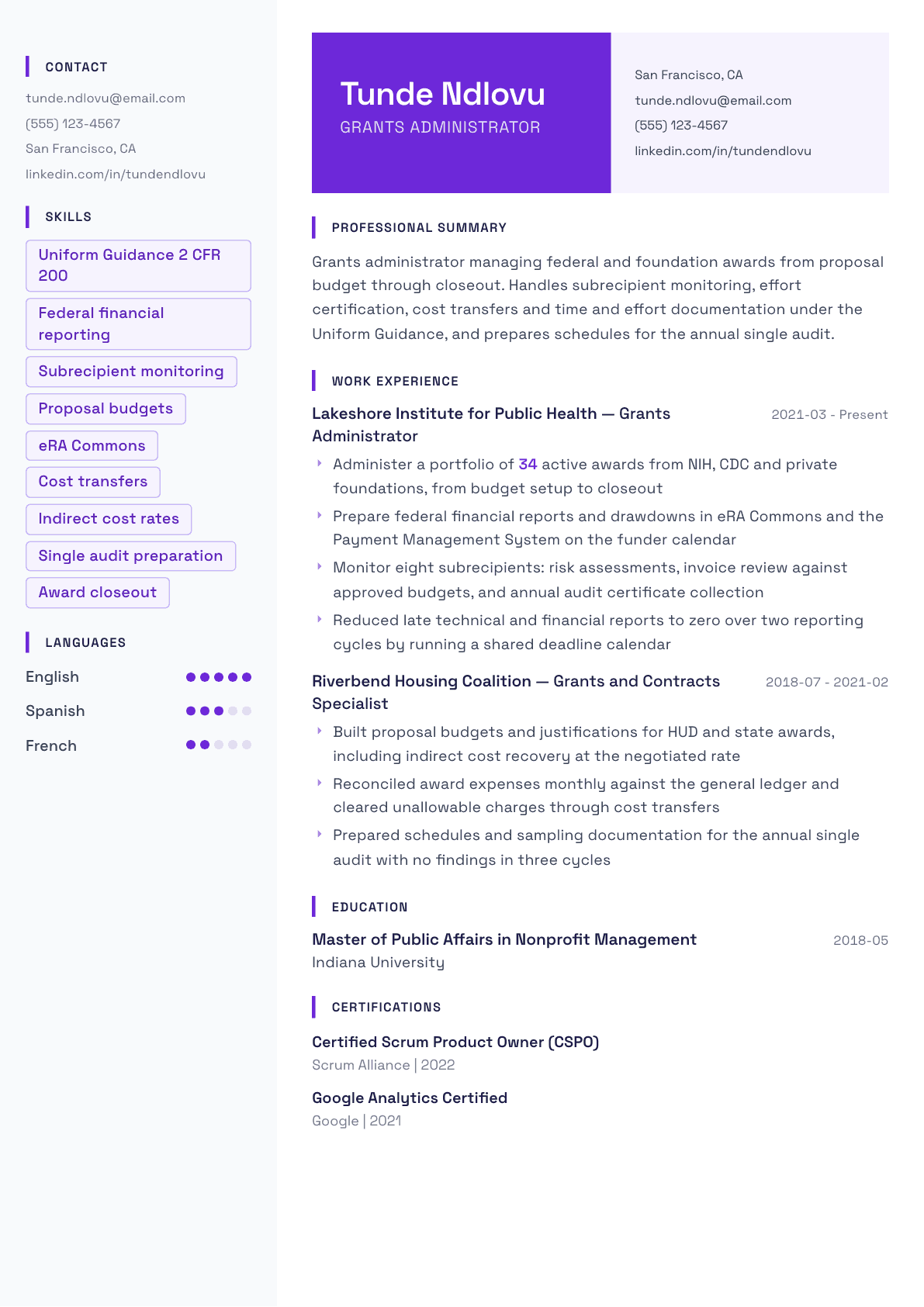
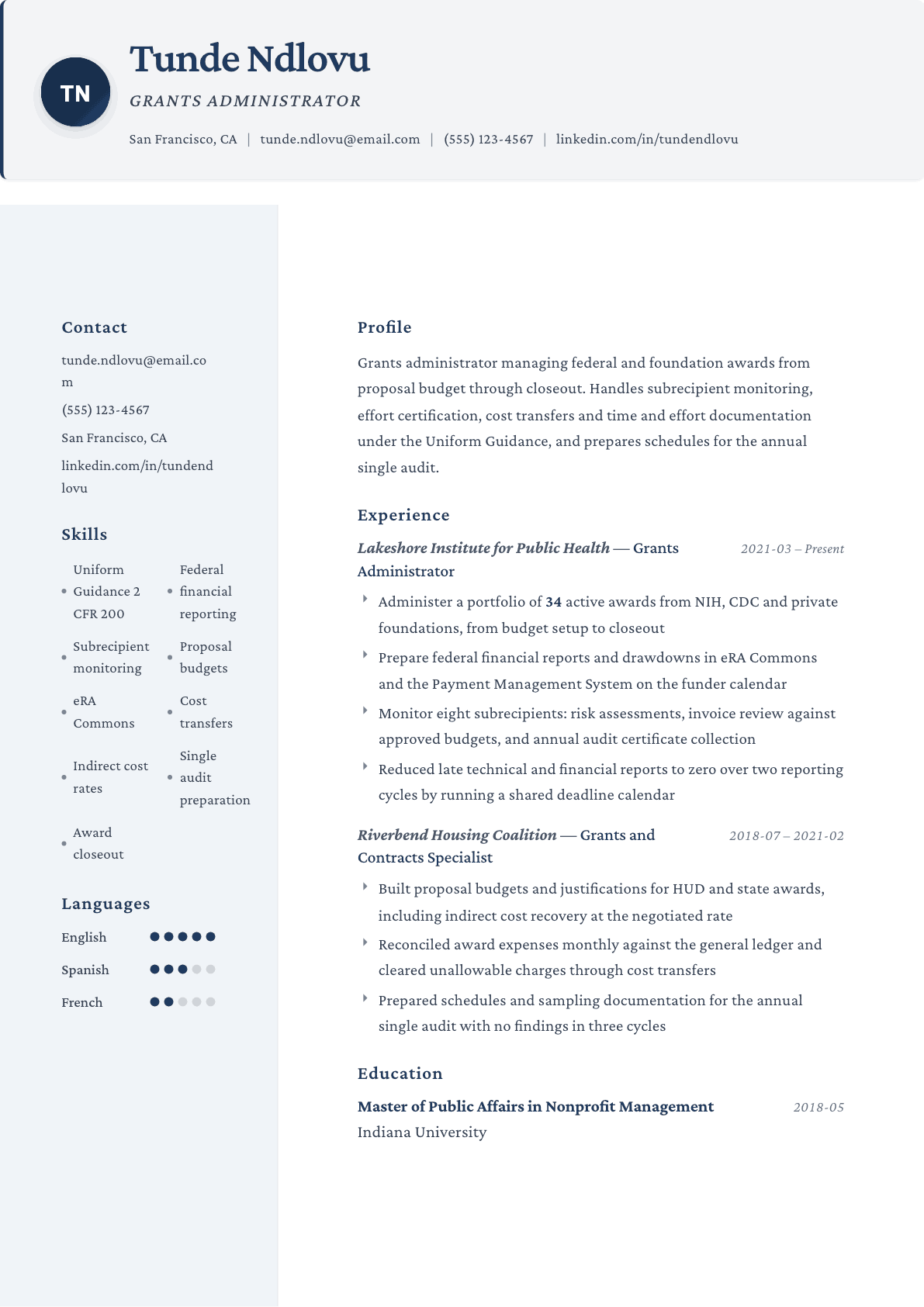
Example Grants Administrator summary
Grants administrator with seven years across federal and foundation awards. Carries a portfolio of 34 active grants from budget setup through closeout, files federal financial reports and drawdowns on the funder calendar, and monitors eight subrecipients under the Uniform Guidance. Prepares single audit schedules and cleared three cycles without a finding. Master degree in public affairs.
Skills to list on a Grants Administrator resume
- Pre-award budget development
- Post-award financial management
- Uniform Guidance compliance
- Subrecipient monitoring
- Federal financial reporting
- Drawdowns and cash management
- Cost transfers
- Effort certification
- Indirect cost recovery
- Award closeout
- eRA Commons
- Grants.gov and SAM.gov
- Single audit support
- General ledger reconciliation
- Proposal routing and approvals
What actually gets this resume read
- Name the funders you have administered, since NIH, NSF, HUD and state pass-through awards carry different rules.
- Say how many active awards you carried at once, because portfolio size is the fastest measure of capacity.
- Cite the Uniform Guidance by name and show one control you ran under it, such as subrecipient risk assessment.
- Include the reporting systems you used, for example eRA Commons, Grants.gov, SAM.gov or the Payment Management System.
- Give an audit result you contributed to, such as clean single audit cycles, without claiming credit for the whole opinion.
- Keep pre-award and post-award duties in separate groups so a reader can match you to how their office is split.
How to write a grants administrator resume
A grants administrator resume is read by a director of sponsored programs or a finance leader who has lived through an audit. Her screen is unusually technical for an administrative title: which funders you have administered, how many active awards you carried, whether you can cite the Uniform Guidance without hedging, and whether reports went out on the funder calendar rather than after a reminder.
The role also splits in ways that generic resumes ignore. Pre-award means proposal budgets, justifications, routing and submission. Post-award means setup, drawdowns, financial reporting, effort certification, cost transfers, subrecipient monitoring and closeout. Offices are organized around that split, so a resume that mixes both into one undifferentiated list forces the reader to guess which desk you can fill.
This guide covers the structure a sponsored programs office expects, how to write compliance work so it holds up in an interview, three summary examples across career stages, before and after bullets, and the questions grants staff ask when moving between university, hospital and nonprofit environments.
Format: two pages is acceptable, and the funder mix goes near the top
Reverse chronological, one page under five years, two pages after that. Grants work accumulates specific technical exposure, and a second page is fine when it is carrying funder names, systems and compliance areas rather than padding. What is not fine is a two page file whose second page repeats the first in different words.
Directly under your contact block, put a line naming the funder types you have administered and the systems you have filed in. Federal agencies, state pass-through awards and private foundations carry different rules, and a hiring manager filling a federal heavy portfolio needs to see federal agency names before she reads a single bullet.
- Header: name, city and state, phone, email, then a funders and systems strip.
- Section order: summary, funders and systems, experience split into pre-award and post-award, education, certifications.
- Each job opens with portfolio size and composition, for example 34 active awards across federal and foundation sponsors.
Summary: portfolio size, funder mix, compliance frame, audit record
Portfolio size is the fastest measure of capacity in this field, so lead with it. How many active awards you carried at once, from which sponsors, and across which phases of the award life. Then the compliance frame you work under and the systems you file in. Four lines is plenty and it lets a director place you against her own workload without reading further.
End the summary with an audit or reporting record you can defend. Single audit cycles you supported schedules for, or a stretch with no late financial or technical reports, are the outcomes a sponsored programs office measures itself on. State your contribution precisely, because claiming credit for an entire clean audit opinion is a claim the interview will unpick.
Experience: separate pre-award from post-award, then show the controls
Under pre-award, show budget construction with real components: personnel and fringe, subaward lines, participant support costs, indirect cost recovery at the negotiated rate, and the budget justification that had to survive sponsor review. Add routing and internal approvals, and the submission portals you filed through, because deadline discipline in submission is its own skill.
Under post-award, structure around the controls a monitor tests. Award setup and budget load, monthly reconciliation to the general ledger, allowability review and cost transfers with written justification, effort certification cycles, drawdowns and cash management, financial and technical report deadlines, and closeout including final reports and residual balance resolution.
Subrecipient monitoring deserves its own bullet because it is where most findings originate. Risk assessment at issuance, invoice review against the approved budget and period of performance, audit certificate or single audit report collection, and a documented follow up when something is missing. Say how many subrecipients you monitored, since that number sizes the work better than any adjective.
- Name sponsors specifically: National Institutes of Health, National Science Foundation, Centers for Disease Control and Prevention, Department of Housing and Urban Development, state agencies, private foundations.
- Name systems by product: eRA Commons, Grants.gov, SAM.gov, the Payment Management System, Research.gov, and your financial system.
- Give report cadence and on-time record rather than a claim of strong organizational ability.
Compliance language: cite the framework, then show the control
Cite the Uniform Guidance at 2 CFR 200 by name, and then immediately show one control you personally ran under it. A citation with no control behind it reads as vocabulary borrowed from a job posting. A control with no citation reads as clerical. Together they read as a grants professional.
The compliance areas worth naming, when true, are allowability and allocability review, cost transfer timing and documentation, effort and time and effort reporting, procurement standards on awards, program income treatment, period of performance limits, prior approval requirements, and record retention. Choose the ones you have actually applied. An interviewer in this field will ask a follow up question on whichever term you use, so do not decorate the page with terms you cannot unpack.
Education, credentials and keyword mirroring
A bachelor degree is standard and a master degree in public affairs, accounting, public health or a related field is common at the senior end. List the field, since finance heavy offices weight accounting coursework. Any research administration credential belongs in its own block with the issuing body, because those bodies are recognized instantly by hiring managers in this field.
Postings recycle a stable vocabulary: pre-award, post-award, sponsored programs, Uniform Guidance, subrecipient monitoring, federal financial report, drawdown, cost transfer, effort certification, indirect cost rate, closeout and single audit. Mirror what is true of you once in the skills block and once inside the bullet where the work happened, in your own sentence.
Grants Administrator resume summary examples
Grants assistant moving up
Grants assistant with two years supporting a sponsored programs office: proposal document assembly, budget worksheet preparation, routing for internal approvals and submission through Grants.gov. Reconciles award expense reports monthly and tracks report deadlines. Public affairs degree and seeking a full grants administrator role.
Seven years in
Grants administrator carrying 34 active federal and foundation awards from budget setup through closeout. Files federal financial reports and drawdowns on the funder calendar, monitors eight subrecipients under the Uniform Guidance, and prepares single audit schedules. Cleared three audit cycles without a finding in this portfolio.
Senior or lead administrator
Senior grants administrator with twelve years across university and public health awards, covering pre-award budgets and full post-award management for a portfolio above 50 sponsored projects. Rebuilt the subrecipient monitoring process, wrote the cost transfer justification standard, and trains department staff on allowability.
Work experience bullets: before and after
Before: Managed grants for the organization.
After: Administered a portfolio of 34 active awards from federal agencies and private foundations, from budget setup and account creation through final financial report and closeout.
Portfolio size, sponsor mix and the phases covered give a director an immediate read on capacity.
Before: Submitted required reports to funders.
After: Prepared federal financial reports and drawdowns in eRA Commons and the Payment Management System on the sponsor calendar, and took late technical and financial reports to zero across two reporting cycles.
Naming the systems and the on-time record converts a duty into a measurable compliance outcome.
Before: Worked with subrecipients on their invoices.
After: Monitored eight subrecipients under the Uniform Guidance: risk assessment at issuance, invoice review against the approved budget and period of performance, and annual audit certificate collection with documented follow up.
The control steps are exactly what a monitor tests, and they show you know where findings originate.
Before: Helped with the annual audit.
After: Prepared schedules and sampling documentation for the annual single audit, pulled expenditure support for selected transactions, and answered auditor questions on cost allocation for three cycles.
It shows the specific audit work performed instead of implying ownership of the opinion.
Before: Built budgets for grant proposals.
After: Built proposal budgets and justifications for federal and state applications, including personnel and fringe, subaward lines and indirect cost recovery at the negotiated rate, and routed them for internal approval ahead of the deadline.
The budget components and the routing step prove real pre-award competence rather than spreadsheet assistance.
Hard skills
- Pre-award budget development and justification
- Post-award financial management
- Uniform Guidance 2 CFR 200 compliance
- Subrecipient risk assessment and monitoring
- Federal financial reporting
- Drawdowns and cash management
- Cost transfers and allowability review
- Effort certification
- Indirect cost rate application
- Award closeout and residual balance resolution
- eRA Commons
- Grants.gov and SAM.gov
- Single audit schedule preparation
- General ledger reconciliation
Soft skills
- Deadline discipline across many calendars
- Explaining rules to program staff
- Saying no to an unallowable cost
- Documentation habits under audit
- Working between finance and research staff
- Written clarity in justifications
Certifications worth listing
- Certified Research Administrator (CRA) (Research Administrators Certification Council)
- Certified Pre-Award Research Administrator (CPRA) (Research Administrators Certification Council)
- Certified Financial Research Administrator (CFRA) (Research Administrators Certification Council)
- Grant Professional Certified (GPC) (Grant Professionals Certification Institute)
- Certified Public Accountant (CPA) (State board of accountancy)
Mistakes that cost grants administrator candidates the interview
- Merging pre-award and post-award work into one list, so the reader cannot match you to how her office is split.
- Naming the Uniform Guidance without showing a single control you ran under it, which reads as borrowed vocabulary.
- Leaving out portfolio size, the fastest capacity measure a sponsored programs director has.
- Claiming a clean audit as a personal achievement rather than describing the schedules and support you prepared.
- Omitting subrecipient monitoring, the area where audit findings most often originate.
- Listing funders generically as government grants instead of naming the agencies whose rules you actually applied.
Grants Administrator resume questions
Do I need a research administration certification to be competitive?
Not to enter the field, but it helps at the senior end and in university offices. A credential from a recognized certifying body signals tested knowledge of federal rules. Portfolio size, funder mix and audit support experience still carry the screen.
How do I describe grants work if my organization had only a few awards?
Depth substitutes for volume. Show the full award life you covered, the compliance decisions you made, the reports you filed and the monitoring you performed. An administrator who ran six awards end to end is often stronger than one who touched forty at one narrow step.
Should a grants administrator resume include dollar values of awards?
Portfolio value is commonly listed and is fine when you can source it. Many offices care more about award count, sponsor mix and complexity such as subawards, cost sharing and multi-year budgets. If the value adds nothing to the story, leave it out.
How do I move from nonprofit grants work into a university sponsored programs office?
Translate your vocabulary. Foundation reporting becomes sponsor reporting, program budgets become proposal budgets, and monitoring subgrantees becomes subrecipient monitoring. Then add the research specific pieces you can honestly claim, such as effort certification exposure or federal portal filing.
What single line most improves a grants administrator resume?
A defensible on-time reporting record. Filing every financial and technical report on the sponsor calendar over a stated stretch is the outcome a director loses sleep over, and almost no applicant states it directly, so it stands out immediately in a stack.
Related resume examples
- Grant Writer Resume example
- Compliance Officer Resume example
- Grants Manager Government Resume example
- Program Assistant Resume example
- Administrative Officer Resume example
- Travel Coordinator Resume example