Grants Manager Government Resume Examples: free score
Write a Government Grants Manager Resume That Clears the Audit
By Mustafa Tarabya, founder of CVBooster · Published · Updated
Government grants manager resume example with federal award keywords, monitoring tips and a guide to writing compliance and subrecipient work.
Sample resumes for a grants manager government
The same grants manager government content laid out in three CVBooster templates, so you can see what the finished document looks like before you write a word.
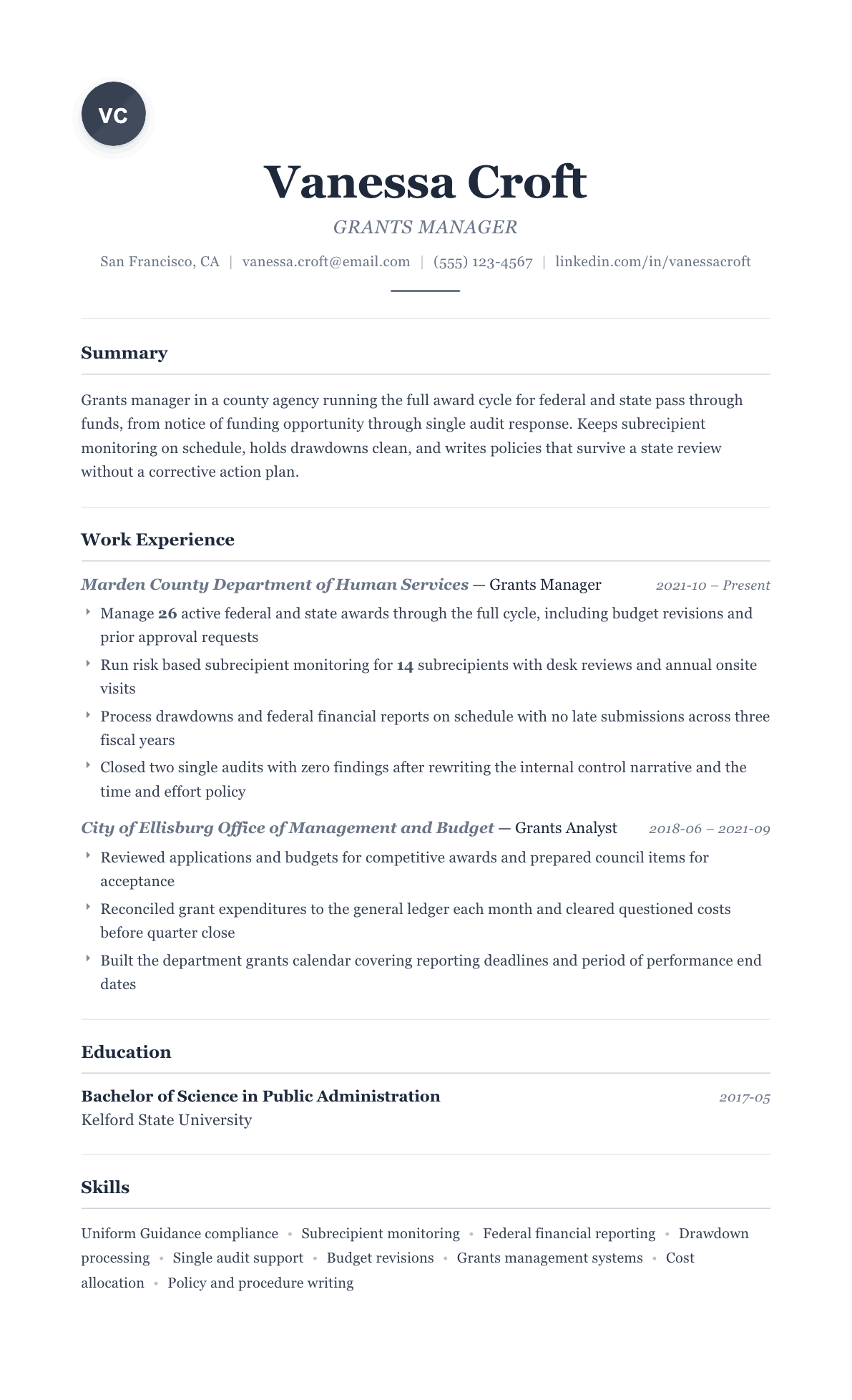
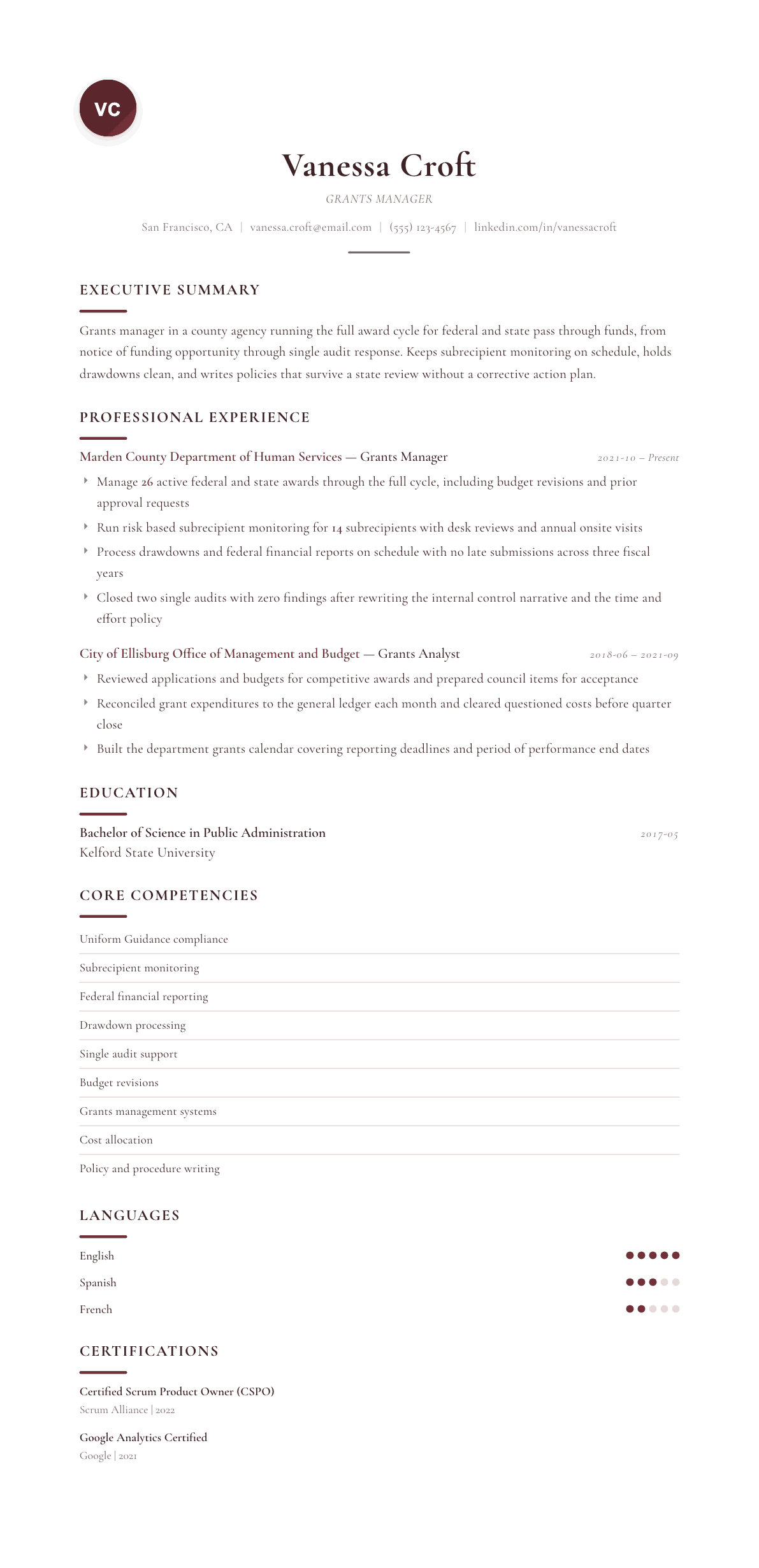
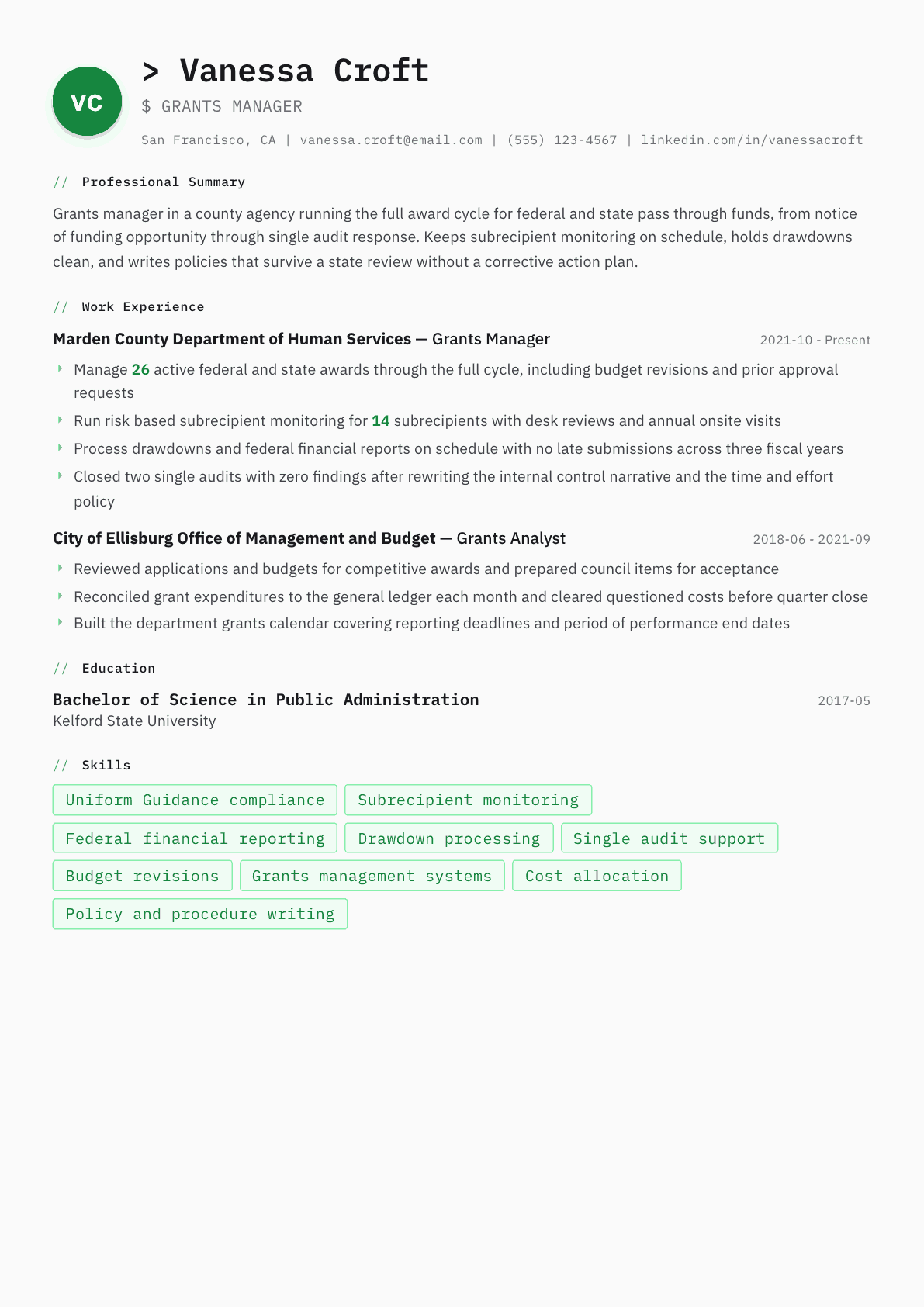
Example Grants Manager Government summary
Government grants manager running federal and state pass through awards through the full cycle in a county human services agency. Owns award setup, budget revisions, drawdowns and federal financial reports, and runs risk based subrecipient monitoring on a published schedule. Closed consecutive single audits with no findings after rewriting the internal control narrative and the time and effort policy.
Skills to list on a Grants Manager Government resume
- Uniform Guidance and cost principles
- Notice of funding opportunity review
- Award setup and period of performance tracking
- Subrecipient risk assessment
- Desk review and onsite monitoring
- Federal financial reporting
- Drawdown and cash management
- Single audit preparation
- Questioned cost resolution
- Indirect cost rate application
- Time and effort documentation
- Budget revision and prior approval
- Grants management systems
- Policy and internal control writing
What actually gets this resume read
- Name the federal cost principles and administrative requirements you apply, using the exact regulatory language.
- Give the number and type of awards you manage, separating direct federal awards from state pass through funds.
- Show audit outcomes plainly, including findings and how corrective actions were closed under your ownership.
- Describe subrecipient monitoring as a risk based process, naming desk reviews, onsite visits and the follow up loop.
- List the systems you draw down and report in, since a hiring manager wants an officer who can file without training.
- Put your reporting calendar discipline on the page, because late federal reports are the failure agencies fear most.
How to write a grants manager government resume
A government grants manager is hired to keep an agency out of trouble. The person reading your resume has usually lived through a late federal report, a questioned cost, or an audit finding that turned into a corrective action plan, and she is scanning for evidence that you will not create the next one. Warmth about public service is not what she is looking for.
The page therefore has to be technical. Which regulations you apply, how many awards you carry, whether the funds are direct federal or state pass through, how you monitor subrecipients, how you draw down, and what your audit history looks like. Those facts either appear or the resume goes into the maybe pile behind someone whose does.
This guide covers what an agency grants office checks, section by section, with summaries for an analyst, a manager running a full award portfolio and a grants director, before and after bullets on monitoring and audit work, and the questions grants staff ask when they move between city, county, state and federal roles.
Format: agency, funding streams and award counts up front
Reverse chronological, one to two pages, with a heavy front loading of technical detail. Each job header should name the agency, the department, the funding streams you administered and the number of active awards. A reader comparing three candidates uses those numbers before she reads a single bullet.
If you are applying for a federal position, follow the longer federal format the announcement requires, including hours per week and supervisor information, and keep a shorter version for state, county and city postings. Trying to make one document serve both usually satisfies neither.
- Job header: agency, department, funding streams administered, and count of active awards.
- A regulations block naming the requirements and cost principles you apply, plus any agency-specific rules.
- A systems block for the payment, reporting and grants management platforms you file in.
- An audit block giving your single audit and monitoring review history in plain terms.
Summary: portfolio, regulations, audit record
Three lines that answer the screening questions: what you administer, under which rules, with what audit history. A grants manager who can say she runs federal and state pass through awards under the uniform administrative requirements and has closed consecutive single audits with no findings has answered the interview before it starts.
Name the government level you have worked at. City, county, state, tribal, university and federal grants work share vocabulary but differ in approval routes, council or board processes and reporting expectations, and hiring managers weigh that fit heavily.
Experience: the full award cycle in agency terms
Cover the cycle from the funding announcement forward: reviewing the notice of funding opportunity, building the application budget, award acceptance through the council or board process, setting up the award in the financial system, tracking period of performance, processing budget revisions and prior approval requests, reporting, and closeout.
Subrecipient monitoring deserves the most detail because it is where agencies get findings. Describe your risk assessment method, how risk level determines monitoring intensity, what a desk review covers, what an onsite visit covers, and how findings are tracked to closure. An agency reading a resume with that level of specificity assumes you have actually done it.
Cash management is the other high-risk area. Say how you process drawdowns, how you keep the interval between drawdown and disbursement compliant, and how you reconcile grant expenditures to the general ledger. Nobody writes this down and everybody who hires for the job cares about it.
Audit, findings and the corrective work
Write your audit history plainly. Number of single audits your programs went through, findings received, and how each corrective action plan closed. A candidate who has cleaned up a finding is often more valuable than one who has never seen one, provided the story is told as a fix rather than as a defense.
Include the internal control work behind a clean audit: written policies and procedures, time and effort documentation, segregation of duties in the approval chain, equipment and inventory records, and the indirect cost rate you apply. These are the exact documents an auditor asks for on day one.
- State how many single audits your awards went through and the findings outcome for each.
- Describe the policies you wrote or rewrote and what problem each one closed.
- Name your time and effort method and how certifications are collected and reviewed.
- Say how questioned costs were resolved and who made the final determination.
Systems, calendars and keywords
Name the systems you actually file in: the federal payment and reporting platforms, the agency grants management system, and the financial system you reconcile against. Agencies value this because a manager who already knows the platform files on time in her first quarter rather than her third.
Reporting calendar discipline is worth its own line. Federal financial reports, performance reports, closeout packages and period of performance end dates all carry hard deadlines, and late submissions are the failure mode agencies fear most. If you have a record of on-time filing across several years, put the number of years on the page.
Terms that appear in these postings: uniform administrative requirements, cost principles, allowable costs, period of performance, subrecipient monitoring, risk assessment, desk review, federal financial report, drawdown, cash management, single audit, questioned costs, indirect cost rate, time and effort, and closeout.
Grants Manager Government resume summary examples
Grants analyst
Grants analyst reviewing applications and budgets for competitive awards, preparing council acceptance items and reconciling grant expenditures to the general ledger monthly. Built a department grants calendar in 2021 covering reporting deadlines and period of performance end dates. Moving toward full award portfolio ownership.
Grants manager
Grants manager running 26 active federal and state pass through awards through the full cycle, including budget revisions, prior approval requests and closeout. Runs risk based monitoring for 14 subrecipients and has filed every federal financial report on time across three fiscal years since 2022.
Grants director
Grants director leading a centralized office of six across a county government, setting policy, chairing the pre-award review committee and owning the relationship with external auditors. Closed two single audits with no findings after rewriting internal control documentation and the time and effort policy in 2023.
Work experience bullets: before and after
Before: Managed federal and state grants for the department.
After: Managed 26 active federal and state pass through awards through the full cycle, including award setup, budget revisions, prior approval requests, reporting and closeout.
The award count, the funding types and the named cycle stages describe a workload an agency can size.
Before: Monitored subrecipients.
After: Ran risk based subrecipient monitoring for 14 subrecipients, setting monitoring intensity from an annual risk assessment and completing desk reviews plus one onsite visit for every high risk partner.
Risk-driven monitoring with two review types is the method auditors look for, and naming it proves the practice.
Before: Submitted reports to the federal government on time.
After: Filed all federal financial and performance reports on schedule across three fiscal years with no late submissions and no post-submission corrections.
A multi-year record with no corrections is the strongest reliability claim a grants manager can make.
Before: Worked with auditors during the annual audit.
After: Prepared and closed two single audits with zero findings after rewriting the internal control narrative, the time and effort policy and the equipment inventory procedure.
Tying a clean result to the specific documents you fixed shows the work behind the outcome.
Before: Handled grant expenditures and payments.
After: Processed drawdowns on a schedule that kept cash on hand within the allowable window and reconciled grant expenditures to the general ledger monthly, clearing questioned costs before quarter close.
Cash management timing and monthly reconciliation are exactly where findings originate, so specifics matter.
Hard skills
- Uniform administrative requirements and cost principles
- Notice of funding opportunity review and application budgeting
- Award setup and period of performance tracking
- Subrecipient risk assessment
- Desk review and onsite monitoring
- Federal financial and performance reporting
- Drawdown processing and cash management
- Single audit preparation and response
- Questioned cost resolution
- Indirect cost rate application
- Time and effort documentation
- Budget revision and prior approval requests
- Grants management and payment systems
- Policy and internal control writing
Soft skills
- Telling a program director that a planned cost is not allowable
- Staying calm through an audit interview
- Explaining a federal rule to someone who has to follow it tomorrow
- Chasing a subrecipient report without souring the partnership
- Keeping a deadline calendar that nobody else has to think about
Certifications worth listing
- Grants Management Certificate (National Grants Management Association)
- Certified Grants Management Specialist (CGMS) (National Grants Management Association)
- Certified Government Financial Manager (CGFM) (Association of Government Accountants)
Mistakes that cost grants manager government candidates the interview
- Describing grants work generically without naming the administrative requirements and cost principles you apply.
- Giving no award count and no funding type, so a hiring manager cannot compare your workload to the vacancy.
- Treating subrecipient monitoring as one line when it is where most audit findings begin.
- Hiding an audit finding instead of describing the corrective action you owned and how it closed.
- Leaving out drawdown and cash management, which is the second most common source of trouble.
- Using a private sector resume format for a federal announcement that requires hours per week and supervisor detail.
Grants Manager Government resume questions
How is a government grants manager resume different from a nonprofit one?
A government resume leans much harder on regulation, audit exposure and pass through responsibility, because agencies both receive and award funds. A nonprofit resume leans toward fundraising, proposal writing and donor relationships, which agencies rarely ask about.
Should I mention an audit finding on my resume?
Yes, when you fixed it. Write what the finding was, what you changed, and that the corrective action closed. Managers who have lived through a finding trust a candidate who has, and the story shows you understand what auditors actually test.
What do I write if I only handle post-award work?
Say so and go deep. Post-award specialists own monitoring, drawdowns, reporting, amendments and closeout, and a candidate who is strong there is exactly what many agencies need. Note any pre-award exposure separately rather than blurring the two.
How important are the systems I have used?
More than most candidates think. Payment and reporting platforms differ enough that experience with the ones an agency uses cuts weeks off ramp-up. List each platform and what you did in it rather than putting them all in a single skills line.
Do I need a certification to be competitive?
It is not required, but a recognized grants management credential helps when you are moving between government levels or coming from a nonprofit, because it signals you know the federal framework rather than only one agency's local habits.
Related resume examples
- Grants Administrator Resume example
- Budget Analyst Resume example
- Compliance Officer Resume example
- Contract Specialist Government Resume example
- Government Accountant Resume example
- Tax Examiner Resume example