Program Assistant Resume Examples: the lines they read
Build a Program Assistant Resume for Nonprofit and Public Programs
By Mustafa Tarabya, founder of CVBooster · Published · Updated
Program assistant resume example with participant, grant and event detail, ATS keywords, and a full writing guide.
Sample resumes for a program assistant
The same program assistant content laid out in three CVBooster templates, so you can see what the finished document looks like before you write a word.
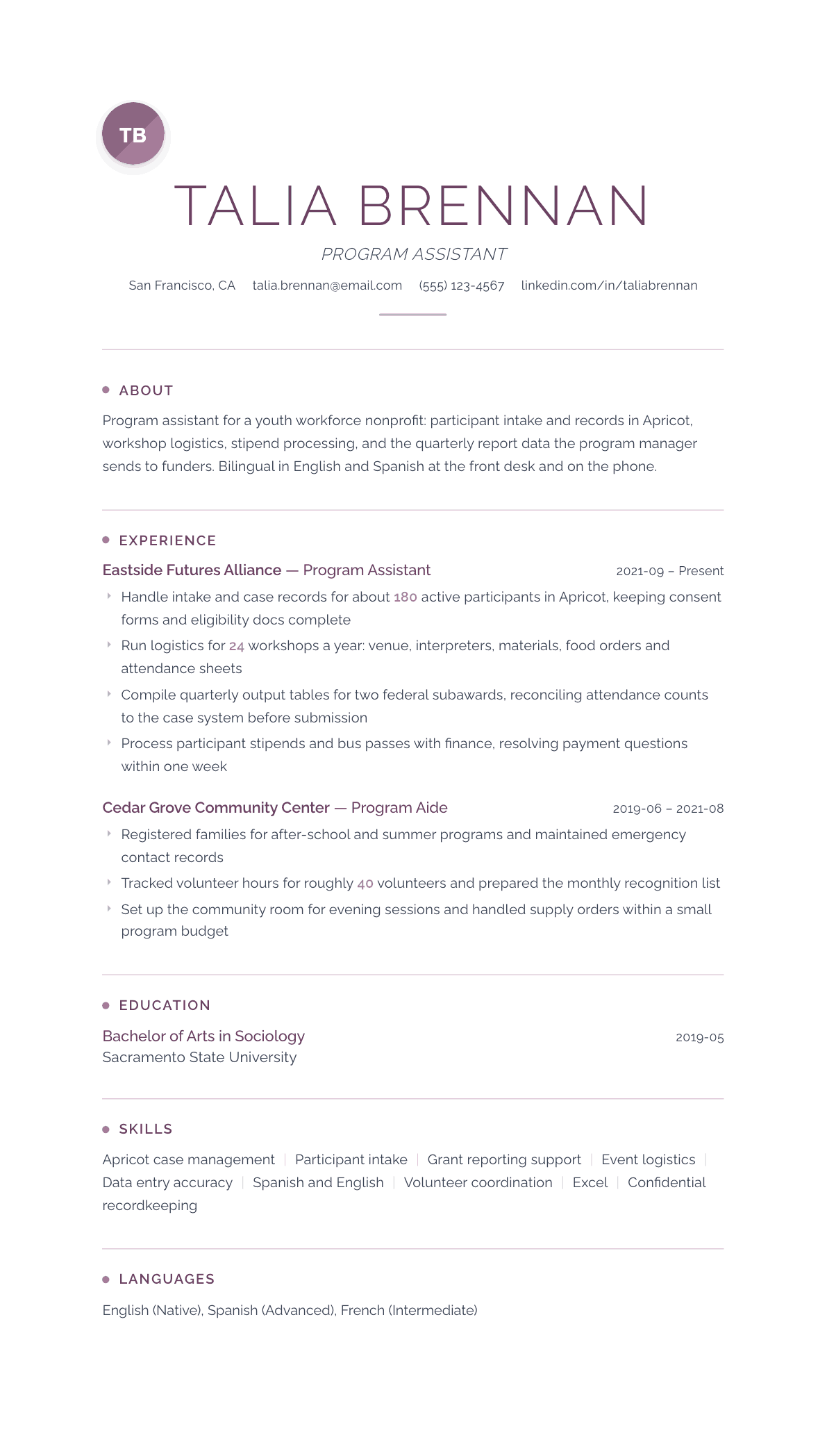
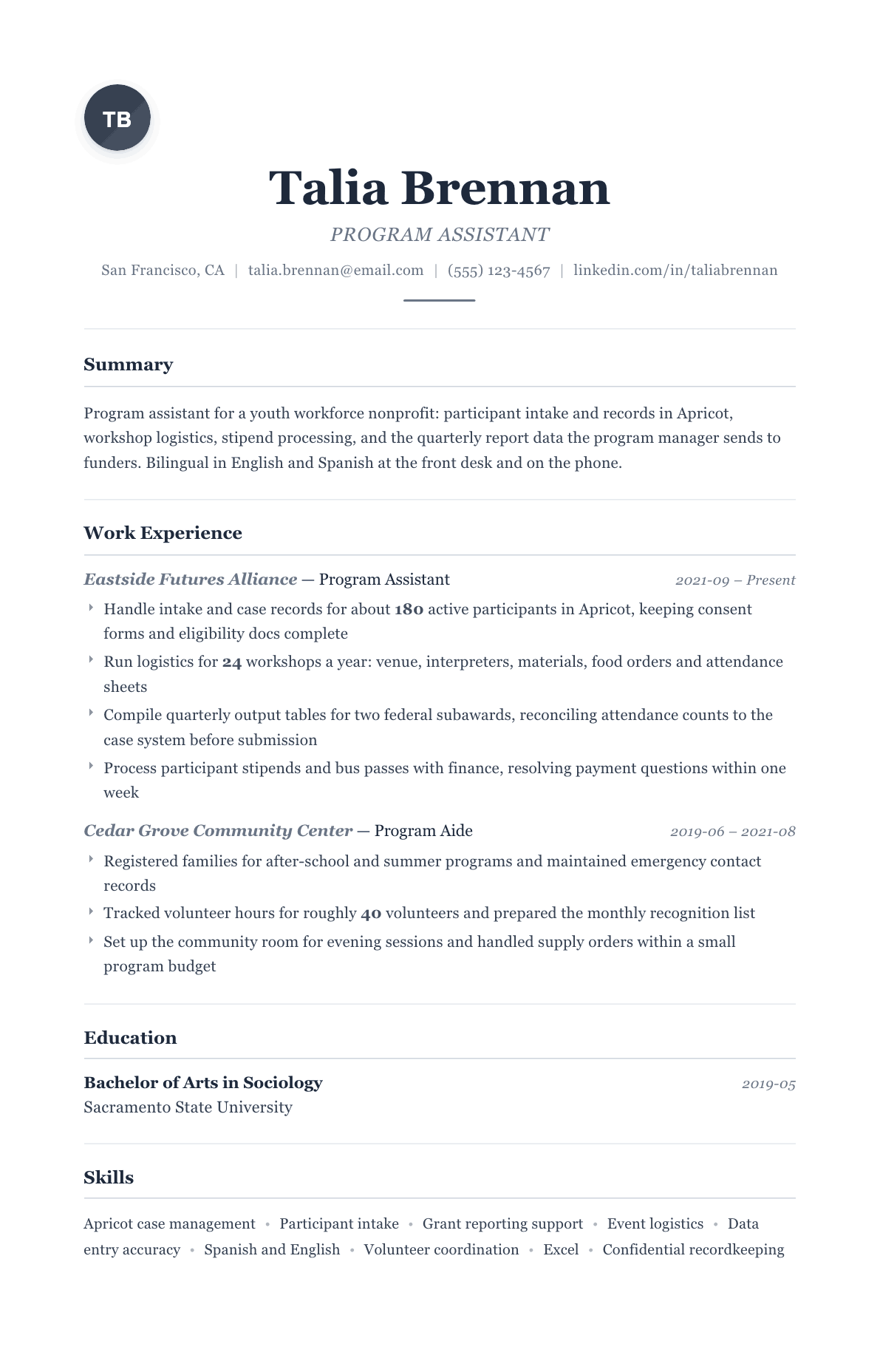
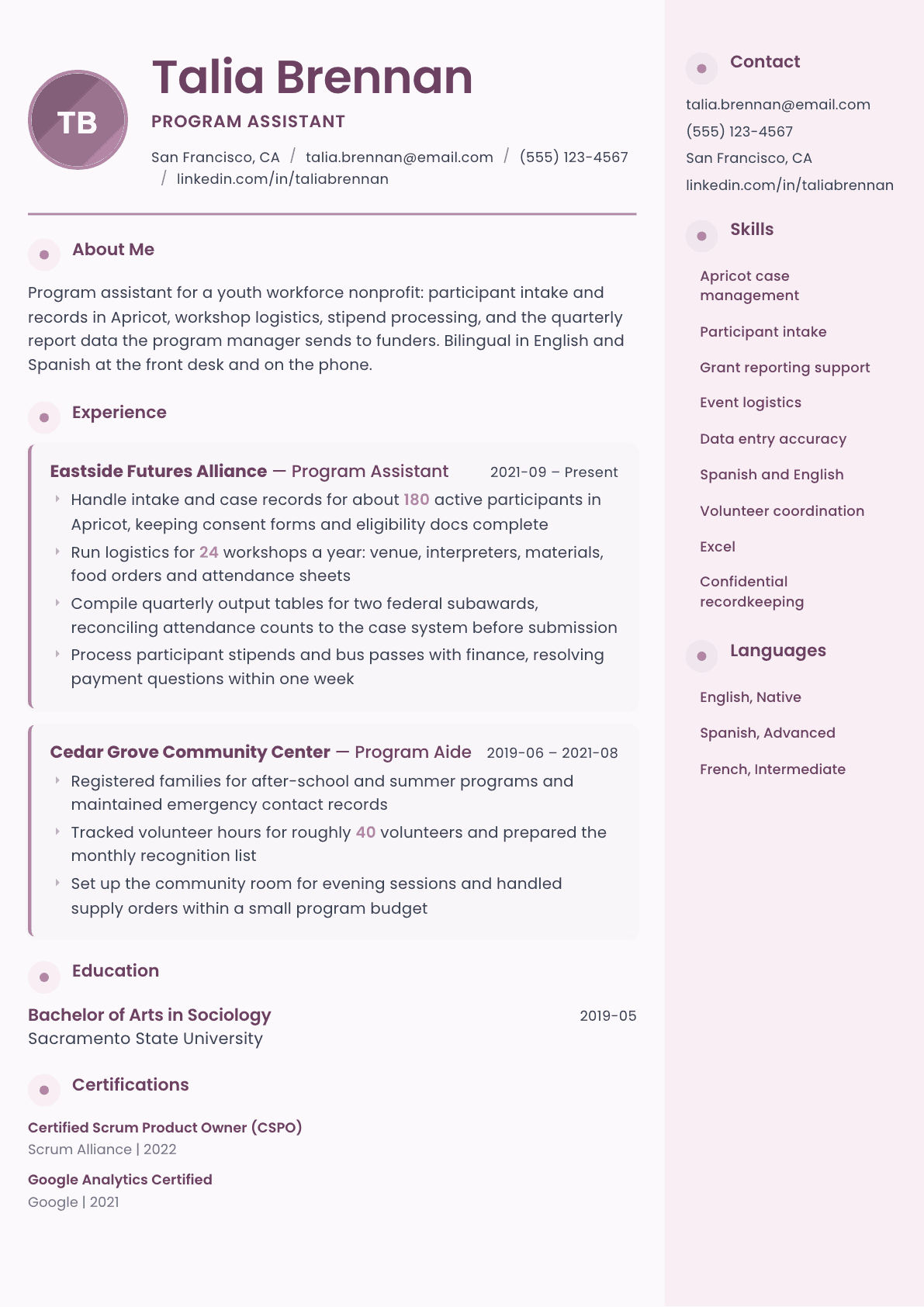
Example Program Assistant summary
Program assistant with five years in community and workforce programs. Manages intake and case records for about 180 participants in Apricot, runs logistics for two dozen workshops a year, and compiles quarterly output tables for federal subawards. Bilingual in English and Spanish, and trusted with confidential participant files. Bachelor degree in sociology.
Skills to list on a Program Assistant resume
- Participant intake
- Case record management
- Apricot
- Salesforce Nonprofit Cloud
- Grant reporting support
- Event and workshop logistics
- Attendance tracking
- Stipend processing
- Volunteer coordination
- Excel data tables
- Confidential recordkeeping
- Community outreach
- Bilingual communication
- Meeting scheduling
What actually gets this resume read
- Give participant numbers and program type, because a hiring manager sizes the role by caseload and setting.
- Name the case management or database system, such as Apricot, Salesforce, ETO or Penelope, in a skills line.
- Tie one bullet to funder reporting: which data you pulled, how often, and what it fed into.
- Show event logistics with specifics like interpreters, transport, materials and attendance sheets, not just support.
- List any language other than English, since community programs screen hard for bilingual staff at intake.
- Mention confidentiality practice for participant records, which program managers treat as a hiring requirement.
How to write a program assistant resume
A program assistant resume is read by a program manager at a nonprofit or public agency who is holding two pressures at once: a caseload that keeps growing and a funder report that has to reconcile to the case system. She is looking for someone who can keep participant records complete, run workshop logistics without drama, and pull clean numbers when the quarterly output tables are due.
That means the resume has to name the caseload, name the database, and show a link between the data you entered and the report it fed. Most applicants describe warmth and passion for the mission, which every applicant shares, and leave out the participant count, the consent form completeness and the attendance reconciliation, which is what actually protects a subaward.
This guide sets out the section order program managers read, how to write intake, eligibility, logistics and funder reporting work with the right specificity, three summary examples, before and after bullets, and the questions program staff ask when moving between nonprofit and public program settings.
Format: one page, program type and caseload visible fast
One page for under six years, reverse chronological, plain sections. Name the program type in a parenthetical after each employer, since youth workforce, housing, family services, senior services and health outreach have different intake rules and a manager reads that context before anything else.
Put a short systems line under your contact block naming the case management database and any reporting tools. Community programs filter for the database first because retraining on a case system is the slowest part of onboarding, and a screener who cannot find that word in ten seconds will assume it is not there.
- Header: name, city and state, phone, email, and languages spoken if you are bilingual.
- Section order: summary, systems and skills, program experience, education, training and certifications.
- Open each job with active participant count and program type, for example about 180 active youth participants.
Summary: caseload, setting, database, funder link
Give the number of active participants, the program setting, the case management system, and the reporting your data fed. Four facts and a manager knows whether you are sized for her program. A person supporting a hundred and eighty active participants in a workforce program is doing a different job from someone registering families for a summer camp, and both are legitimate, so say which one you are.
If you speak a second language used by the community you served, put it in the summary rather than in a list at the bottom. Community programs screen hard for bilingual front desk and intake staff, and burying that line at the end of page one costs interviews.
Experience: intake, records, logistics, reporting, participant support
Intake bullets should show the compliance side, not just the friendly side. Consent forms, eligibility documentation, release of information and complete demographic fields are what a monitor checks when a funder visits, and completeness is the outcome a program manager cares about. Write the caseload and write what a complete file looks like in your program.
Logistics bullets need real components. Venue, interpreters, transportation, materials, food orders and attendance sheets is a workshop; coordinated events is not. Give the number of sessions a year and the typical attendance, because that is how a manager judges whether you can carry the calendar she is trying to hand over.
The reporting bullet is the one that separates strong candidates. Say which data you compiled, on what cycle, and what it fed: quarterly output tables reconciled against the case system before submission to a funder is credible, checkable and directly relevant. Add participant support work such as stipend processing and transit passes, and give a resolution time so the reader sees follow through rather than intention.
- Name the case management system by product: Apricot, ETO, Penelope, Salesforce Nonprofit Cloud or the agency database.
- Show volunteer coordination separately with volunteer count and hour tracking if you did it.
- Include confidentiality practice with an example, not as an adjective in a soft skills list.
Data quality and confidentiality: the two quiet requirements
Program data has to survive a monitoring visit. Show that you reconcile: attendance sheets to case notes, enrollment counts to the report, service units to the file. One sentence describing a reconciliation you routinely ran tells a manager you understand why the fields matter, which is rare in applicants at this level and immediately valuable.
Confidentiality should appear as a practice with a shape. Keeping participant files locked, limiting record access to program staff, and separating sensitive documentation is concrete. Writing maintained confidentiality is not, because it is claimed universally and demonstrates nothing. Never name a participant, a case or an identifying circumstance anywhere on the resume.
Education, training and the words the posting will use
A degree in social work, sociology, human services, public health or education is common and worth listing with the field. Equally worth listing is program relevant training: mandated reporter training, trauma informed practice, mental health first aid, CPR, and any funder specific data system training you completed. Name the provider so the reader can place it.
Program postings recycle a narrow vocabulary: participant intake, eligibility determination support, case notes, attendance tracking, event logistics, grant reporting support, volunteer coordination, data entry accuracy and community outreach. Mirror the ones that are true in your own sentences, once in the skills block and once where the work happened.
Program Assistant resume summary examples
First program role
Sociology graduate with two years as a community center program aide: family registration, emergency contact records, volunteer hour tracking for about 40 volunteers, and evening session setup. Bilingual in English and Spanish. Seeking a program assistant seat where intake accuracy and workshop logistics are the core duties.
Five years in
Program assistant in a youth workforce nonprofit managing intake and case records for about 180 active participants in Apricot. Runs logistics for two dozen workshops a year including interpreters and transportation, compiles quarterly output tables for two federal subawards, and processes participant stipends with finance.
Ready for coordinator
Senior program assistant with eight years across community and workforce services, currently supporting two program managers and a caseload above 300 participants. Owns the data quality check before every funder submission, trains new staff on intake and consent documentation, and coordinates a volunteer pool of 60.
Work experience bullets: before and after
Before: Entered participant information into the database.
After: Maintained intake and case records for about 180 active participants in Apricot, keeping consent forms, eligibility documents and demographic fields complete ahead of funder monitoring visits.
Caseload, system and the definition of a complete file show data work that would survive an actual monitoring visit.
Before: Helped organize program events.
After: Ran logistics for 24 workshops a year: venue booking, interpreters, transportation passes, printed materials, food orders and attendance sheets returned to the case system the same week.
The component list and the attendance handoff make the logistics real and connect the event back to program data.
Before: Assisted with grant reports.
After: Compiled quarterly output tables for two federal subawards, reconciling attendance counts and service units against the case system before the program manager submitted them.
Naming the cycle, the awards and the reconciliation step proves you understand what makes funder numbers defensible.
Before: Answered questions from participants.
After: Served as first contact at intake in English and Spanish, explaining eligibility documents and program steps, and resolving stipend and transit pass questions with finance within one week.
Language, the subject matter and a resolution time turn a general duty into a service standard.
Before: Kept records confidential.
After: Kept participant files in locked storage with access limited to program staff, and separated sensitive documentation from general case records during a full file review.
A described practice is verifiable in an interview, while a claim of confidentiality is not.
Hard skills
- Participant intake and enrollment
- Case record and case note management
- Apricot case management
- Salesforce Nonprofit Cloud
- Eligibility documentation support
- Attendance and service unit tracking
- Grant and subaward reporting support
- Workshop and event logistics
- Stipend and transit pass processing
- Volunteer coordination and hour tracking
- Excel data tables
- Confidential recordkeeping
- Community outreach and referrals
- Bilingual intake and phone support
Soft skills
- Warmth without over promising
- Boundaries with participants
- Patience at a busy front desk
- Accuracy in repetitive data entry
- Cultural responsiveness
- Discretion with sensitive circumstances
Certifications worth listing
- Certified Nonprofit Professional (CNP) (Nonprofit Leadership Alliance)
- Mental Health First Aid (National Council for Mental Wellbeing)
- Adult and Pediatric First Aid and CPR (American Red Cross)
- Certified Community Health Worker (State health department certification program)
Mistakes that cost program assistant candidates the interview
- Leading with passion for the mission instead of caseload, database and reporting, which is what a program manager screens on.
- Omitting the case management system, the slowest thing to retrain and therefore the first thing filtered for.
- Describing events as coordinated without naming interpreters, transportation, materials or attendance capture.
- Never connecting your data entry to the funder report it fed, which is where the value of accurate records actually lands.
- Listing a second language at the very bottom when bilingual capacity is often the deciding factor at intake.
- Including any participant detail that could identify a person, which reads as a confidentiality failure rather than an example.
Program Assistant resume questions
Do I need a social work degree to be a program assistant?
Usually not. Most postings ask for an associate or bachelor degree in any field plus community, administrative or customer facing experience. What matters more is documented intake accuracy, database familiarity and evidence that you handled sensitive information carefully.
How do I describe grant reporting work if I did not write the report?
Describe your actual layer: the data you pulled, the reconciliation you ran, the tables you built and the deadline you met, then say the program manager or grants staff assembled and submitted the report. Precision about your layer builds trust rather than shrinking your contribution.
Should I list volunteer experience on a program assistant resume?
Yes if it involved real responsibility such as intake, tutoring, event coordination or record keeping. Format it like a job with dates, hours per week and outcomes. Community programs read volunteer service as legitimate experience, especially for a first paid program role.
How do I move from a program assistant role to program coordinator?
Show ownership rather than support: a workshop series you planned end to end, an intake process you rewrote, staff or volunteers you trained, and a data quality check you introduced. Add funder vocabulary such as service units and output measures so the reader hears a coordinator thinking.
Is it acceptable to give participant numbers on a resume?
Yes, aggregate counts are expected and carry no confidentiality risk. Active caseload, workshop attendance, volunteers coordinated and families registered are all fine. What is never acceptable is any detail that could identify an individual participant or their circumstances.
Related resume examples
- Program Coordinator Resume example
- Volunteer Coordinator Resume example
- Nonprofit Program Manager Resume example
- Grants Administrator Resume example
- Administrative Assistant Resume example
- Administrative Coordinator Resume example