Graphic Design Intern Resume Examples: read this first
Write a Graphic Design Intern Resume Studios Actually Shortlist
By Mustafa Tarabya, founder of CVBooster · Published · Updated
Graphic design intern resume example with coursework, portfolio link placement, Adobe skills, keywords and a full writing guide.
Sample resumes for a graphic design intern
The same graphic design intern content laid out in three CVBooster templates, so you can see what the finished document looks like before you write a word.
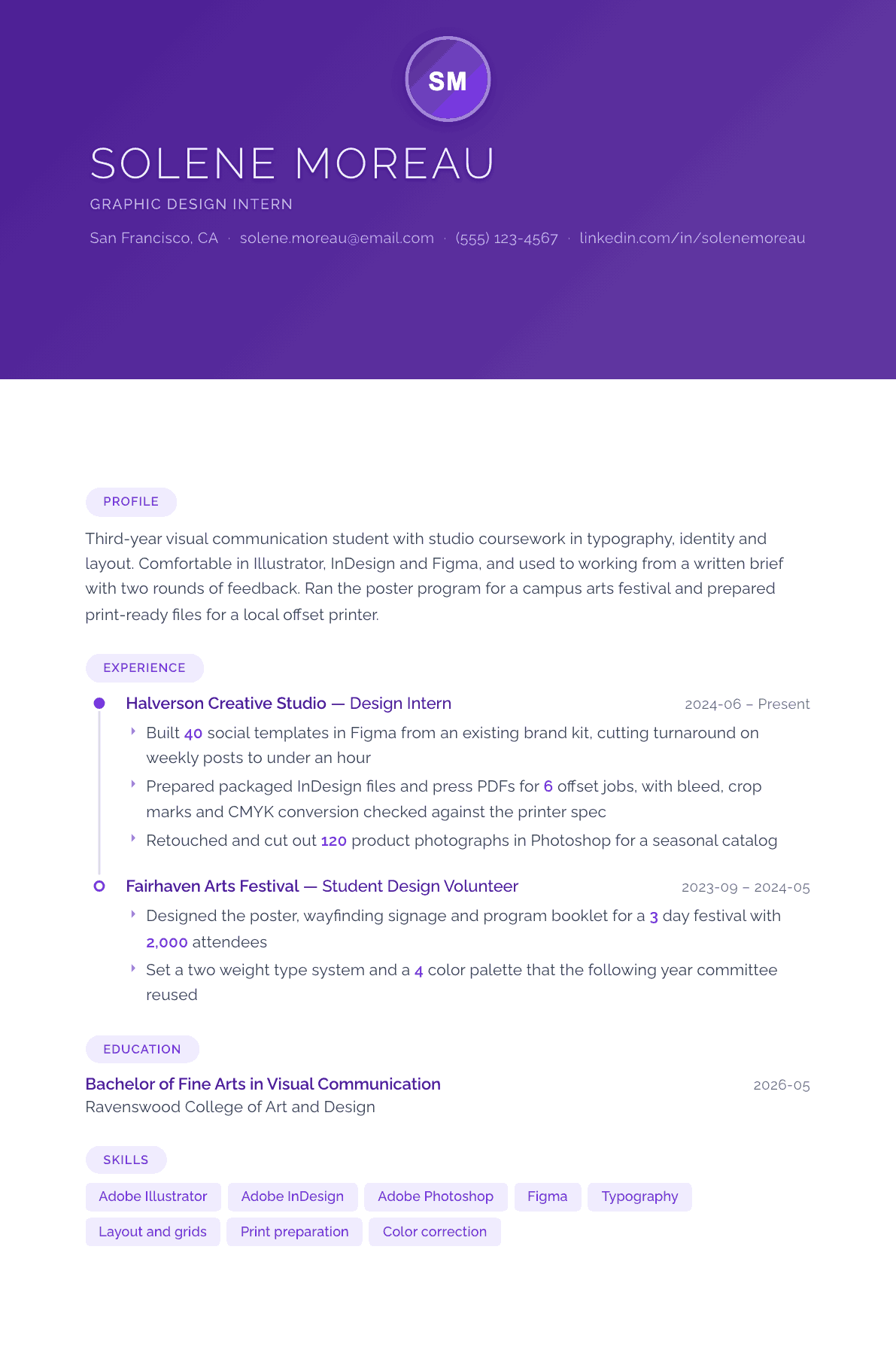
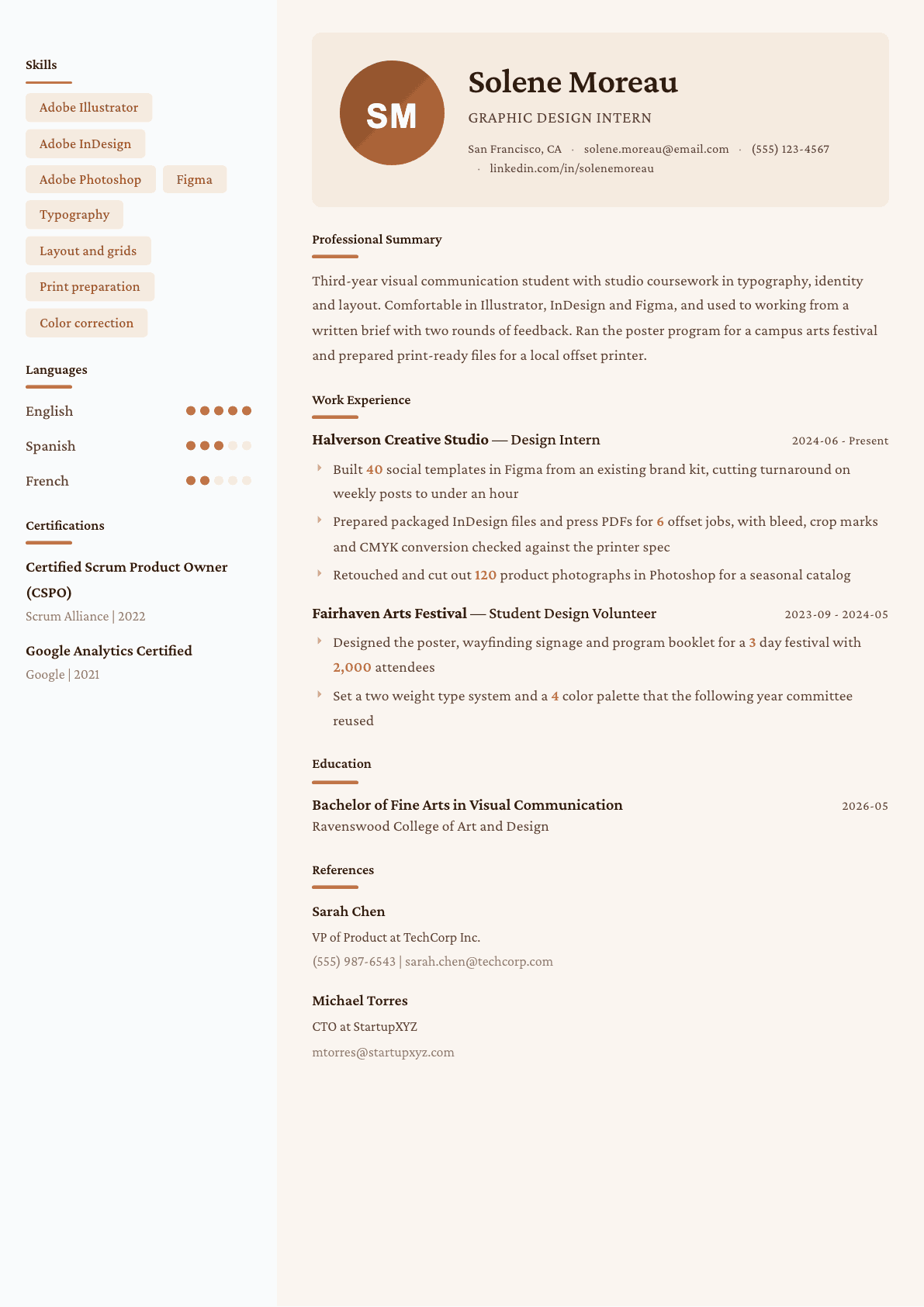
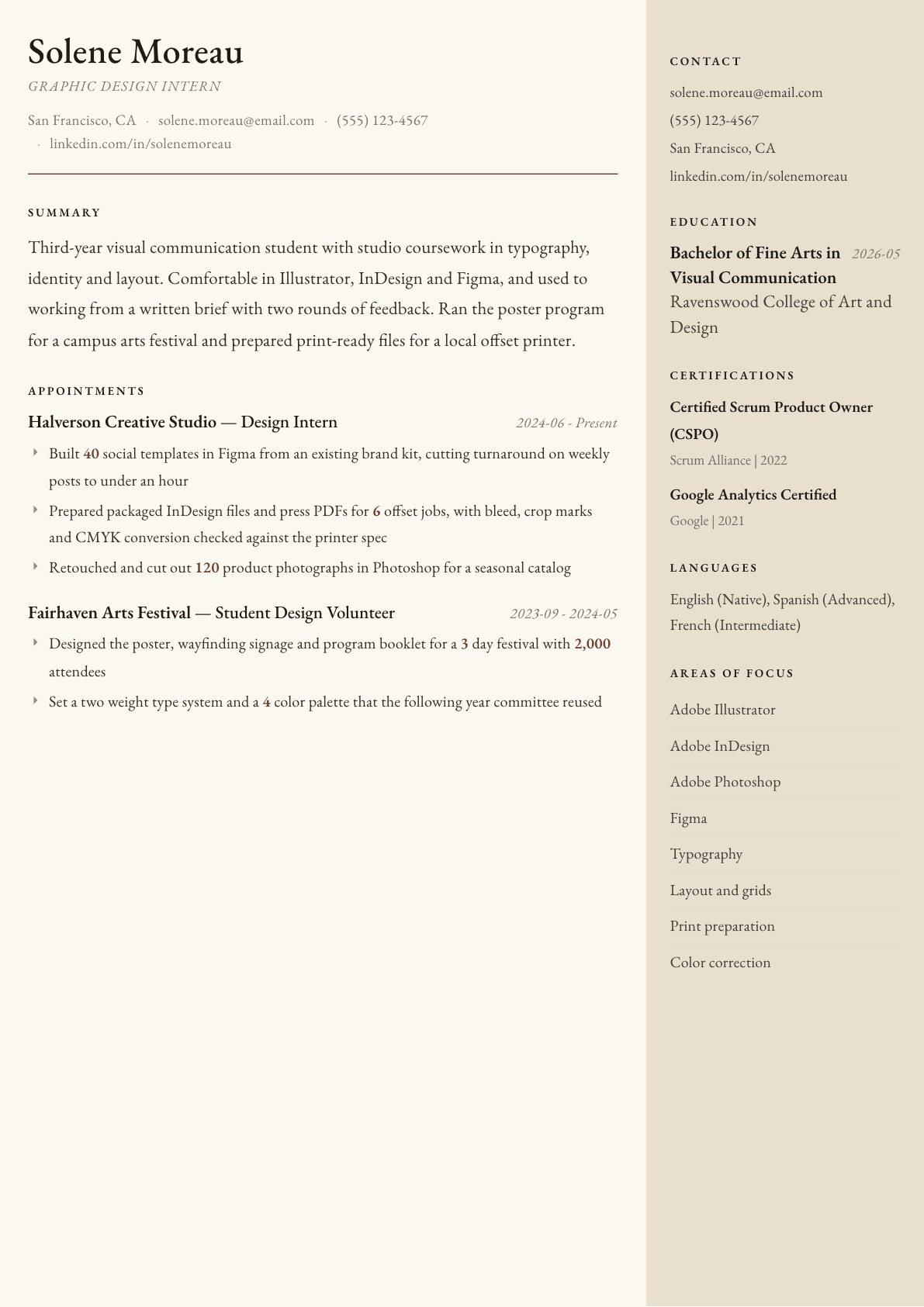
Example Graphic Design Intern summary
Visual communication student entering the final year of a BFA, with studio training in typography, identity systems and editorial layout. Fluent in Illustrator, InDesign, Photoshop and Figma. Delivered press ready files for six offset jobs during a studio internship and designed the full print package for a campus arts festival. Seeking a design internship where craft and feedback matter more than speed.
Skills to list on a Graphic Design Intern resume
- Adobe Illustrator
- Adobe InDesign
- Adobe Photoshop
- Figma
- Typography
- Grid systems
- Layout design
- Print production
- Color theory
- Image retouching
- Brand guidelines
- Mockup presentation
- File packaging
- Social media graphics
What actually gets this resume read
- Put the portfolio link in the header next to your email, and make sure the site opens without a password.
- Name the software version and the file type you delivered, because studios hire interns who can hand off clean artwork.
- Turn class projects into real experience entries with the brief, the constraint and what you produced.
- List the print specs you have handled: bleed, trim, CMYK conversion, spot color, packaged links.
- Keep the resume to one page and let the portfolio carry the images; never paste artwork into the document itself.
- Show one project where you took written feedback and revised, since that is what an internship is really testing.
How to write a graphic design intern resume
A graphic design intern resume is read for about twenty seconds, and most of that time is spent looking for a portfolio link that opens. The studio lead who screens the pile has an active project, an art director who needs help packaging files, and a stack of applications from students whose resumes all say the same six words about passion and creativity. The one that gets a call is the one that proves the applicant can take a written brief, work in Illustrator and InDesign without hand holding, and hand back artwork that a printer or a developer can use.
That means the document has one job the portfolio cannot do: it lists the software, the file formats, the print specifications and the process vocabulary that tell a studio you already speak the language. The images live on the portfolio site. The resume is the evidence that you know what happens after the design is approved.
This guide covers the page structure studios expect from a student, how to turn class projects into experience entries that read as real work, three summary examples for different stages of a design education, before and after bullets, and the questions design students ask when they sit down to write.
Format: one page, portfolio link in the header, no artwork inside
Keep the whole document to a single page and let the portfolio carry every image. Interns who paste thumbnails into the resume end up with a file that is heavy, unreadable at print size and often stripped by the applicant tracking system a larger agency uses. A clean typographic page also doubles as a sample of your layout judgment, which an art director will notice whether or not you intended it.
The portfolio link belongs in the header, on the same line as your email, written out as a readable address rather than hidden behind the word portfolio. Test it in a private browser window before every application. A password wall, a broken domain or a site that only loads on desktop ends the review before it starts.
- Header: name, city, phone, email, portfolio address, and an optional social handle where you post work.
- Sections in this order: summary, education, design experience, projects, software and skills.
- Once you have a studio internship on the page, move experience above education.
Summary: year of study, the tools, and the kind of work you want
Three lines. Name where you are in the degree, the disciplines your studio coursework covered, the applications you work in daily, and the type of internship you are after. A studio hiring for packaging support and a studio hiring for social content read the same resume very differently, so tell them which one you are.
Avoid the sentence that says you are a creative problem solver with a passion for visual storytelling. Every applicant wrote it. Replace it with something only you can say: the poster program you ran, the press PDFs you prepared, the brand kit you rebuilt as a Figma library.
Experience and projects: give the brief, the constraint and the deliverable
Class work counts, as long as you write it like a job. Each entry needs a title, a client or course context, dates, and bullets that name the brief you worked from, the constraint you designed inside, and the artifact you handed over. A studio does not care that the assignment was graded. It cares that you produced a program booklet on a fixed page count and a two week deadline.
Volunteer and campus work is often the strongest material a student has, because it involved a real audience, a real printer and real feedback. A festival poster series with wayfinding signage and a booklet shows range across formats in a way that three unrelated mockups never will.
Write the bullets around outputs and specifications: the number of templates built, the grid you set, the file package you delivered, the retouching volume you handled. Leave out any bullet that only says you assisted the design team.
Software and production skills: name versions, formats and print specs
This section is where a studio decides whether you can be given real work in week one. List the applications you actually use, then the production knowledge that separates a student who has printed something from one who has not: bleed, crop marks, CMYK conversion, spot color, packaged links, outlined type, image resolution at final size.
If you work in Figma alongside the Adobe applications, say so and name what you do there: component libraries, auto layout, exporting assets for a developer. Studios that produce both print and digital want to know which side of the shop you can help on first.
- Design: Illustrator, InDesign, Photoshop, Figma, After Effects if you truly use it.
- Production: press PDFs, packaging InDesign files, color conversion, image retouching, mockups.
- Process: working from a written brief, revision rounds, file naming and version control.
Show that you can take feedback, because that is what is being tested
An internship is a training position, so the studio is screening for coachability more than for polish. One bullet describing a project where you took written notes and revised, and what changed between rounds, does more than another line of software. Name the number of rounds, the direction you were given and the version that ran.
Do the same for collaboration. Working with a printer, a copywriter, an event committee or a developer is evidence you can operate inside a production chain rather than only inside your own file.
Graphic Design Intern resume summary examples
Second-year student, no internship yet
Second-year visual communication student with studio coursework in typography, identity and editorial layout. Works daily in Illustrator, InDesign and Figma. Designed the poster series and program booklet for a campus film week, including print-ready files sent to a local printer. Seeking a summer design internship with print and brand work.
Third year with studio experience
Third-year BFA student with 6 months inside a working design studio, building social templates from an existing brand kit and preparing packaged InDesign files and press PDFs for offset jobs. Comfortable with bleed, CMYK conversion and printer specifications. Looking for a term-time internship in identity and packaging.
Final year, entering the job market
Final-year visual communication student with two studio internships covering identity, catalog production and social systems. Delivered press files for 6 offset jobs and built a 40 template Figma kit still in weekly use. Seeking a junior design role or a paid internship that converts, in a studio with real art direction.
Work experience bullets: before and after
Before: Made social media graphics for the studio.
After: Built 40 social post templates in Figma from an existing brand kit, with auto layout and shared text styles, cutting weekly post turnaround to under an hour.
The count, the tool behavior and the time result turn a chore into a system a studio can reuse.
Before: Prepared files for printing.
After: Packaged InDesign files and exported press PDFs for 6 offset jobs, checking bleed, crop marks, image resolution and CMYK conversion against the printer specification sheet.
Naming the checks proves production knowledge instead of claiming familiarity with print.
Before: Designed a poster for a school event.
After: Designed the poster, wayfinding signage and 24 page program booklet for a 3 day arts festival, working to a fixed budget and a two week production deadline.
Scope, formats and constraints make a class or volunteer project read as real studio work.
Before: Used Photoshop for image editing.
After: Retouched and cut out 120 product photographs in Photoshop for a seasonal catalog, matching color across two shoot days and delivering layered files for layout.
Volume plus the specific problem solved shows the level of retouching you can be trusted with.
Before: Revised designs based on feedback.
After: Took written art direction across two revision rounds on an identity concept, reworked the type pairing and spacing, and presented the final version to the client team.
A studio hiring an intern is testing coachability, so describe the feedback loop rather than the outcome alone.
Hard skills
- Adobe Illustrator
- Adobe InDesign
- Adobe Photoshop
- Figma
- Typography
- Grid systems and layout
- Print preparation and bleed setup
- CMYK and spot color
- File packaging and handoff
- Image retouching
- Brand guideline application
- Mockup presentation
- Social template design
- Asset export for developers
Soft skills
- Taking written art direction
- Deadline discipline
- Studio communication
- Attention to detail
- Curiosity about process
- Presenting work
Certifications worth listing
- Adobe Certified Professional: Graphic Design & Illustration (Illustrator) (Adobe)
- Adobe Certified Professional in Visual Design Using Adobe Photoshop (Adobe)
- Adobe Certified Professional: Print & Digital Media Publication (InDesign) (Adobe)
Mistakes that cost graphic design intern candidates the interview
- Sending a portfolio link that needs a password, has no work above the fold, or fails on a phone.
- Pasting artwork into the resume itself, which bloats the file and competes with the portfolio.
- Listing every Adobe application including ones you opened once, which invites a question you cannot answer.
- Writing class projects as coursework instead of as briefs with constraints, deliverables and a client.
- Leaving out production vocabulary, so a studio cannot tell whether you have ever prepared a file for press.
- Running two pages as a student, when the second page is always coursework filler.
- Using a heavily decorated template that fights the layout skill you are claiming to have.
Graphic Design Intern resume questions
Do I need a portfolio to apply for a graphic design internship?
Yes, and it is the first thing anyone opens. Ten to fifteen pieces is plenty, arranged strongest first, with a short line on each project explaining the brief and your role. Student work is fine when it is presented like real work.
How do I write experience when I have never had a design job?
Use class projects, campus organizations, volunteer design and any freelance piece, written with a title, a date range and bullets. Give the brief, the constraint and what you delivered. A festival poster program with a real print deadline reads as experience.
Should a design intern resume look designed?
It should look considered, not decorated. Set it on a clear grid with one or two typefaces, generous margins and a real hierarchy. Avoid heavy graphics, icon clutter and multi column tricks that some agency screening systems parse out of order.
Which software should I list first?
The ones the posting names, then the ones you use daily. For most studio internships that is Illustrator, InDesign and Photoshop, with Figma close behind. Add production skills such as press PDFs and packaged files directly under the application list.
Is it worth listing a grade point average on a design resume?
Rarely. Studios hire on portfolio and process, not transcripts. Use that space for a project, an award, a student design association role or a workshop instead. Include the average only when a formal internship program explicitly requires it.